A research text dump on Augustus Sol Invictus
James Mason and Atomwaffen Division
“Health Over Sickness, Strength Over Weakness”
Paganism, Fascism, and Obscurantism
Intersections with Libertarians & Confrontations with Antifa
Media Sensationalism = Media Complicity?
The War for the Past & The War for the Future
Primary Source Reading & Watching
Augustus Invictus, James Mason, and Atomwaffen Division
Augustus Invictus Meet & Greet Report Back (March 5, 2016)
Accusations of Rape and Assault from Journalist and Former Friend
Stop Fascists Augustus Invictus and Raquel Okyay
Keep Calling! No Fascists at MALF!
Elm City Report Back: Keeping the Green Clean (July 11, 2017)
The Fascist Creep Within the Church of Satan (June 8, 2018)
What are the Church of Satan and Satanism?
This Week in Fascism #43: Fascism Is Not Anti-War (January 14, 2020)
South Carolina Shock (April 1, 2020)
Speaker at ‘Unite The Right’ Rally Charged (July 26, 2023)
Written Interviews with Augustus
The warlike and Nietzschean choice for U.S. Senator
30 Questions With Augustus Invictus
Debate with Augustus Invictus — Was Kaczynski Right?
The Wild Adventures of @EmperorInvictus
On Antifa & Mr. Augustus Invictus
On the Half-Baked Relationship of Fascism to Friedrich Nietzsche
Book Review of “The Philosophy of Being a Side Hoe” by Alexandria Brown
Astonishingly Upset New Book Review on GoodReads
How are women impacted by white nationalism?
Systemic Phenomena: Patterns of Hatred and Brutality
Slave Patrols & Invisible Women: Women of Color Under White Nationalism
Introduction
On December 16th, 2018, YouTube channel Philosophy and Esoterica uploaded an audiobook version of Ted Kaczynski’s “Unabomber Manifesto,” also titled “Industrial Society and Its Future,” read by white-nationalist figure Augustus Sol Invictus. The video gained over 100,000 views in three years.[1]
Until January 2018, when he dropped off the grid and went into hiding, Augustus’ outbursts were recurring; they in fact seemed to be escalating. So, World, shall we wait for one more Charlottesville? Shall we await this man’s best Unabomber impression? Augustus was writing to Kaczynski—the Unabomber himself—in prison, out of admiration.
He called once panicking because he had received a response to his letter to the Unabomber, Ted Kaczynski.[2]
At the University of Michigan exists copies of all the letters between Ted and Invictus in Box 97, Folder 101.[3]
Analysis
SPLC Article on Augustus
Title: Augustus Sol Invictus
Source:
<www.splcenter.org/resources/extremist-files/augustus-sol-invictus>
Related: Alt-Right
Born: 1983
Location: Orlando, Florida
Augustus Sol Invictus — a goat-slaughtering, warmongering, repeat Senate candidate from Florida — is trying to reinvent himself as a leading voice in the alt right.
Augustus Sol Invictus (Austin Gillespie) had a fleeting moment in the national media spotlight in 2016, when he ran for Senate in the Florida Libertarian Party primary. During the race, it came to light that back in 2013, Invictus slaughtered a goat and drank its blood as part of a pagan ritual.
But the sensational, gory headlines minimize the identitarian, hierarchical worldview Invictus sells to his followers. Since his run at the Senate, Invictus has made plain he intends to become a prominent voice on the extreme right, speaking at rallies and founding a right-wing blog. Central to his message is that a violent second Civil War is necessary to preserve “Western civilization.”
In his words
“Do I believe that 6 million Jews were killed by evil Hitler? Is that what you’re asking?…Okay, then I am still waiting to see those facts.” — Hatewatch interview, August 5, 2017.
“No matter where you are, no matter what your race or creed or system of government, if you have a large group of outsiders coming in, things will change, and not necessarily for the better. Classical liberalism, libertarianism, a republican form of government — these things do not exist without Westerners. Those who see Africans and Europeans as interchangeable, they are either mentally retarded or they are deliberately dishonest. Either way, they aid in the destruction of our people, our lands and our culture. They are a cancer that must be excised if we are going to survive at all.” — “Fireside Chat on the State of the West, Part II: Causes of the Decline,” March 26, 2017.
“[The Federal government] has abandoned its eugenics programs and elitist mindset in favor of a decadent ideology that rejects the beauty of strength and demands the exponential growth of the weakest, the least intelligent and the most diseased.” — “A Declaration on the Failings of Federal Government,” October 2015.
“I say unto you, My Fellow Americans, that the Federal Government is not invincible. Verily, I say unto you that it can fall—and more than this, I say that it must fall. And if our blood must be the sacrifice, then so be it.” — “Fireside Chat on the Possibility of Revolution,” May 1, 2016.
Background
On June 17, 2017, Augustus Sol Invictus strutted up to the podium at a rally for free speech in Chapel Hill, North Carolina. “What’s up Chapel Hill?” he shouted into the microphone. “They call me ‘The Commie Slayer.’ And for good f—— reason!”
Never mind that no one actually calls him, “The Commie Slayer.” Reality matters little to Austin Mitchell Gillespie, the man who legally changed his name to what translates in Latin to “majestic unconquered sun.”
Inflated grandiosity propels Invictus’ life and complements his particular brand of right-wing extremism. In actuality, he is a criminal defense lawyer who “resigned” from his profession. He’s a well-read man in possession of some intellectual talent. But in his own mind, he is a genius, a prophet, a revolutionary and a conqueror — even a god — destined to lead the people in a “great war.”
Invictus’ totalitarian worldview preaches that the strong should inherit the earth, and root out and exterminate the weak. He’s unclear about the aims of the second Civil War he intends to lead, but he claims his enemies are the communists, the “cultural Marxists,” and the “international financiers” who have forced a system of “mass democracy and egalitarianism” on the American people. His myriad speeches, writings, recordings and political activities in the past six years reveal his primary motivations to be racism, sexism and anti-Semitism, coupled with a dangerous penchant for violence.
He was born in Dayton, Ohio, in 1983, and eventually ended up in Orlando, Florida, where he attended high school. He dropped out of college, and by 2006 he was married with four children. The same year, just a few weeks shy of his 23rd birthday, he abandoned his birth name in favor of his new, imperial moniker.
Around this time, by his own account, he was working at a “pill mill” pharmacy in Tampa that was raided and shut down by the Drug Enforcement Agency.
“No comparable job existed for me, and we were effectively rendered destitute,” he said in a campaign speech in 2015. It’s unclear whether he was unwilling or unable to seek new employment, but he blamed the DEA for his financial hardship.
“I swore vengeance on the DEA and vowed that I would return to college, go to law school and enter into politics, and that one day I would shut their office down and put their families on the street.”
Despite his apparent poverty, he followed through with his plan, and graduated law school in 2011.
In early 2013, less than two years after getting his law degree, he renounced it, his U.S. citizenship and all his earthly possessions, in a bizarre open letter. He insists that it was a religious and spiritual renunciation, but its contents were so disturbing that at least one of the recipients alerted the FBI.
Invictus did, in fact, go to the desert, hitchhiking across America to get there. When he returned, he filmed himself stabbing a goat to death and drinking its blood. Invictus, a follower of the pagan faith Thelema, called it a ritual sacrifice and religious offering. His organization, the Ordo Templi Orientis, emphatically disagreed and kicked him out.
The pilgrimage marked an important turning point in his activities on the far right. He considered a run for the U.S. House of Representatives in 2016 as a Libertarian candidate. But when Marco Rubio vacated his Senate seat to run for president, Invictus turned his sights on statewide office.
His campaign sparked controversy within the Libertarian Party of Florida, and Invictus was decimated in the polls, losing by a margin of almost 50 points.
During the campaign, Invictus was irate at what he thought were baseless accusations against him, labeling him a racist and a neo-Nazi. But the evidence was undeniable: a paper he wrote in law school making the legal and ethical case for eugenics.
He titled it “Future or Ruin,” which was also the name of a speech Hitler delivered in 1921. Invictus cites the Pioneer Fund, insisting that the notorious stronghold of academic racism is “not a white supremacist organization.” He makes repeated references to the intellectual inferiority of black people, which he presents as a matter of fact. In the paper’s footnotes, he cites extremist race scientists like Charles Murray and Jean-Philippe Rushton to support his point.
He has since disavowed state-sponsored eugenics in a campaign address discussing the controversy. But he never said he’s changed his mind about the practice, just that such a program, in the hands of bureaucrats, would inevitably be corrupted.
“It is not the love of excellence that poses the danger; it is the pettiness of men in government,” he said.
In fact, months after his lukewarm renunciation, he wrote further in support of eugenics on his campaign website.
In the same post, he criticized the Rev. Dr. Martin Luther King, Jr.’s “civil sainthood,” denouncing what he called, “the idolatrous worship of a different breed of lesser men.”
He also can’t deny his association with neo-Nazis. In 2012 he took a case representing Marcus Faella, the neo-Nazi leader of the white supremacist militia American Front. Invictus said later, during his Senate campaign, “I have become close personal friends with the members of the notorious skinhead organization.” He delivered a speech to their organization during his campaign, where he referred to members as his “brothers and sisters,” united in a fight to save the West from certain destruction.
“There is no hope on the horizon,” he said, “if it is not us.”
Invictus also joins many other figures in the Alt-Right in his virulent opposition to Islam and refugees. He pushes conspiracy theories about the European migrant crisis, including the existence of “no-go zones,” widespread implementation of sharia law and that there are roving Muslim gangs attacking and raping white people. He’s even hoping to take a trip to Europe in the coming year to document “the fall of the West” for his blog, “The Revolutionary Conservative.”
He also claims that as a pagan who worships the Goddess, he can’t possibly be a sexist. But where mortal women are concerned, he’s made his low opinion clear. In his speech to the American Front, he described his version of the ideal woman: “The prize of a conquering hero.”
And on a radio appearance with the Florida-based “Sunshine Fascists,” he expressed disdain for women’s suffrage, insinuating that Sweden was the first European nation to “fall” — a common belief on the extreme right — because they were the first on the continent to give women the vote.
Invictus pens poems full of rape fantasies, violent domination and revenge against the women he believes have wronged him. He may claim that those writings are just a creative outlet or a figure of speech, but recent allegations of domestic abuse suggest otherwise.
Invictus has also expressed admiration for anti-Semitic thinkers and made references to anti-Semitic conspiracies. While in law school in Chicago, he discovered Carl Schmitt, the Nazi legal scholar and philosopher, who he describes as “one of my primary legal, political, intellectual, and philosophical influences.”
He also read Imperium by Francis Parker Yockey, the virulent anti-Semite and Nazi sympathizer who called “the Jew” a “bearer of Culture-disease.” Invictus was so inspired by the book that when he started his own law firm, he called it Imperium, P.A.
When asked why he holds these thinkers in such high esteem, he claimed to divorce their unsavory white supremacist views from their intellectual contributions. But that explanation seems at least a little disingenuous, particularly given Invictus’ personal views in favor of Holocaust denial, and his claims (which echo Yockey) that the Nuremburg trials were a “kangaroo court.”
In January 2016, Invictus dedicated an entire address to the issue of “Our True Enemy, the Financiers,” in which he states, “usurers … are the enemy of all humankind.”
“It matters not whether you are black or white, cop or criminal, Christian or Muslim,” he said. “We risk disgrace when we dare to tell the creditors (emphasis his) we cannot afford the bill this month.”
He goes on to claim that the “financiers” control entertainment and culture, the media, and policy, and that their ultimate goal is to destroy Western civilization from within. According to multiple former associates, he’s denied the Holocaust in several private conversations.
Apart from his thinly veiled identitarian and totalitarian worldview, Invictus’ most troubling quality is his romantic exaltation of war, violence and bloodshed. In his warped narrative, life is gray and mundane without a war to make men heroes and martyrs. In keeping with his fantasies about the glory of conflict, he’s involved in the American Guard as a “Sergeant at Arms,” and he’s second in command of the Fraternal Order of Alt-Knights, an offshoot of Gavin McInnes’ Proud Boys that McInnes has called the “military division.”
Invictus has made specific, public calls to violence. He frequently threatens to hang people from lampposts, hurling the warning specifically at attorneys, progressives and journalists, even calling out VICE Media by name.
Invictus wants to see himself as a powerful leader, an extraordinary individual with a meaningful destiny. He’s seizing his opportunity. After years with the Libertarian Party, he announced in July 2017 that he registered as a Republican, where, presumably, he feels he has a better shot at power.
Atomwaffen Division
Subtitle: Atomwaffen Division is a militant neo-Nazi group in the U.S. Who is behind it?
Author: Alexander Epp and Roman Höfner
Date: 07.09.2018
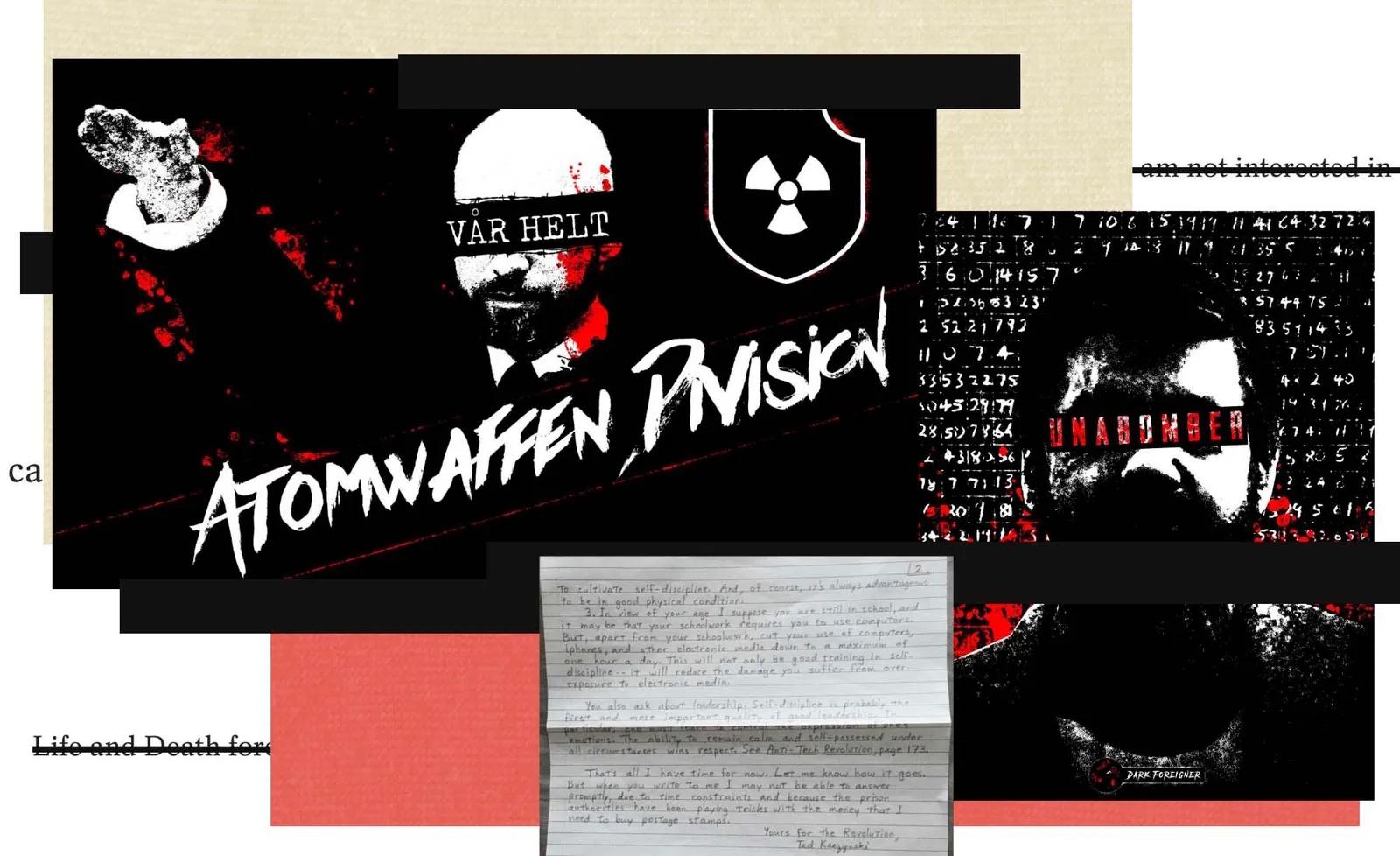
Note: It's a news story that Attomwaffen Division admire the Unabomber and make Unabomber memes, including one with a letter from Ted in it. Plus, I guess journalists infiltrated their forums and saw them discussing what questions to send to Ted. The letter in the meme is very likely just a letter they found online, as I doubt they'd want to connect themselves to a letter that had a real postal address. Augustus Sol Invictus is likely a member however, whose letters to Ted are listed as being archived at the University of Michigan.
It’s like a different world. The fenced-in apartment complex in the heart of Denver is located just a short walk from glitzy boutiques and high-end restaurants, but there is no sign of prosperity here. Homeless people are camped nearby while addicts smoke crack in the parking lot.
People are socializing in front of the building’s entrance despite the midday heat. A black man is pacing the fence trying to get someone’s attention while two younger men are carrying furniture into a neighboring building. It’s a convivial neighborhood and everyone seems to know everyone else. Everyone, that is, except the older, gray-haired man who walks up to the door with a shopping bag full of vegetables at around 4 p.m. He doesn’t even look at his neighbors before disappearing into the complex without greeting any of them.
But once you’ve seen the photos from the inside of his apartment, it immediately becomes clear why the 66-year-old seeks to limit his contact with the outside world. And it becomes even more clear when you look into his past.

James Nolan Mason was an extremist even as a teenager. He joined the American Nazi Party of George Lincoln Rockwell when he was just 14 and became involved in the National Socialist Liberation Front in the 1970s. He has served several prison terms, including one stint for attacking a group of black men together with an accomplice. On another occasion, he was charged with child abuse. During a search of his apartment, the police found naked photos of a 15-year-old girl along with swastika flags and photos of Adolf Hitler and his propaganda minister, Joseph Goebbels.
In the 1980s, Mason decided to publish his fantasies of power and violence in book form, which he called “Siege.” The tome – a collection of his bizarre newsletters, on which he collaborated with the sect leader Charles Manson – is full of Holocaust denials and ad hominem attacks on both homosexuals and Jews. Above all, however, it calls for the establishment of a network of decentralized terror cells and for taking up arms against the “system.” Mason’s goal has long been that of passing along his intolerant worldview to the next generations – and for a long time, he found no success. But that all changed in 2015.
James Mason and Atomwaffen Division

That year, the Nazi group Atomwaffen Division (“Atomwaffen” is German for atomic weapon) was founded on the internet forum ironmarch.org, a discussion platform for neo-Nazis from around the world. The extremists discovered James Mason and were excited about his crazed, radical ideas. “Siege” became a must-read and Mason their ideological doyen.
But that isn’t the only thing that makes them so dangerous, according to experts on right-wing extremism. Members are heavily armed and prepared to make use of their weapons. Indeed, they are getting ready for what they see as the coming race war in so-called “hate camps.” Weapons training is conducted by members of the U.S. military, who are also among the group’s members. According to one former member of Atomwaffen Division, newcomers must submit to waterboarding, in addition to other such trials. But who is behind Atomwaffen Division?
The first murder took place on May 19, 2017. That’s when Devon Arthurs, 18, shot to death his two housemates, Andrew Oneschuk, 18, and Jeremy Himmelman, 22. All three were members of Atomwaffen Division, but Arthurs would later say that the other two didn’t respect his faith. Arthurs, it turned out, had slowly become estranged from the group’s right-wing extremist ideology, converted to Islam and began sympathizing with Islamic State.

The group’s leader, Brandon Russell, likewise lived in the shared residence and the police found firearms, ammunition and bomb-making supplies in the garage. Before the discovery, Russell had told followers in internal chats of his intention to blow up a power plant. He was sentenced to five years behind bars.
The Murders Continue
On Dec. 22, 2017, 17-year-old Nicholas Giampa shot and killed his girlfriend’s parents in Reston, Virginia. They had forbidden their daughter from associating with him because of his right-wing extremist worldview. Giampa is open about both his admiration for James Mason and his membership in Atomwaffen Division. After the two killings, he shot himself as well, but survived.

The most recent murder committed by one member of the group, Samuel Woodward, took place not even a month later and the investigation into the incident is ongoing. The victim: 19-year-old college student Blaze Bernstein. Reporters from DER SPIEGEL were able to speak with police officials in Lake Forest, California, where the killing took place, in addition to the mother of the victim. We were also able to examine the private chat messages sent between the victim and friends, allowing a detailed reconstruction of the crime, that you can read here.

When the rest of his fellow Atomwaffen Division members learned that Samuel Woodward had been arrested for the murder of a homosexual Jew, they began celebrating his crime, referring to him as a “gay Jew wrecking crew.” For the beginning of the trial, they even had T-shirts printed with Woodward’s image, complete with a swastika on his forehead.
Atomwaffen Division is not a group of online trolls who spread derogatory images and graphics on the internet. Rather, members share their propaganda within their own social media bubble and secret communication forums. DER SPIEGEL has gained exclusive access to the group’s internal chats.
Inside Atomwaffen
Those chats quickly make it clear that the group doesn’t just have it in for homosexuals, Jews and blacks. They also glorify all manner of right-wing extremist terror along with mass murderers like Timothy McVeigh, Dylann Roof and the Norwegian Anders Breivik.

The group is also pen pals with the three-time murderer Theodore Kaczynski, better known as the Unabomber. They have set up a thread to discuss among themselves what questions they next want to ask of the imprisoned Kaczynski.
Yet interspersed in the discussions focused on their idols, National Socialism and violent video games, sentences such as the following can be found: “Carpetbomb your local refugee center;” “Bombing police stations is artistic expression;” and “I want to bomb a federal building.”

It is difficult to assess whether the online posing is an immediate precursor to concrete attacks. Members share links to archives, including hundreds of documents listing the preparations necessary for armed battle and terrorist attacks. Among them are handbooks that describe in detail how to carry out attacks on power plants, electricity grids and highway bridges – and dozens of instructions for building pipe bombs, car bombs and nail bombs along with directions for manufacturing delay detonators and powerful explosives out of household items.
A Broad Swath of Hate
But Atomwaffen Division doesn’t just glorify right-wing extremist terror: Taken together, their chat messages convey a rather confusing picture. Members post images of people who have been beheaded or murdered in other ways, including execution videos made by Islamic State. They also share extremist interpretations of Koran verses. In one posting, the school shooting at Columbine High School was referred to as “a perfect act of revolt.”
The group is also extremely misogynistic. Members refer to women as “egotistical sociopaths that have no worth,” and as “whores” and “property.” One member writes that “every rape” is “deserved.” “I wouldn’t even CALL it rape,” writes another. Pedophilia isn’t a taboo either. “She bleeds she breeds” and “birth is consent” are just a couple of many such examples.
It is, in short, a broad swath of hate, from National Socialism to child abuse to Islamic State. So, how does it all fit together?
Memes of Hatred


The Hate Network
At some point, it was no longer enough for Atomwaffen Division members to simply read “Siege.” They wanted to meet its author in person. And in 2017, allegedly after searching for him for years, they tracked down James Mason, who had gone into hiding. A friendship developed along with a business relationship. By then, the marginally successful phase of Mason’s Nazi career had long since passed and he was solidly on the path toward complete insignificance.
“James Mason passed the torch on to us.”
Atomwaffen member Denton
But the young Nazis from Atomwaffen Division set out to advance him into the digital era. They brought out Mason’s dusty Nazi propaganda and repackaged it under the label Siege Culture. Atomwaffen Division then began publishing his articles on a new website and also recorded podcasts with him. But the focus of Siege Culture is squarely on Mason’s books. John Cameron Denton, the group’s leader, claims to own the rights to the books.

Members of Atomwaffen Division take care of layout, promotion and sales. Five books are currently available, including a reissue of “Siege” and an even more bizarre collection of writings in which Mason claims that both Adolf Hitler and Charles Mason are reincarnations of Jesus Christ. Seven additional books are planned. They are printed and sold using Amazon’s self-published platform CreateSpace.
On a recent Sunday morning at 8:25, the man to whom young Nazis flock is shuffling down East Colfax Avenue in Denver. He makes his way past the park that is home to several homeless people and down the street to a bus stop, where he picks a waiting spot that is a few steps away from the others. He appears to be in a good mood. What’s he thinking about? What does this man who is so full of violence and hatred have to say? James Mason doesn’t speak with journalists and has lived in hiding for more than 10 years. But he is happy to speak to an interested tourist from Germany. The following interview was conducted with a hidden camera:
For Atomwaffen Division, the cooperation with James Mason is important primarily because of the recognition it brings within the scene. It helps the group attract violence-prone young men, and not just in the U.S. The cult surrounding Mason’s “Siege” has produced a global network of fanatics. For some, contact is limited to the internet, but others travel across the globe to meet their fellow comrades. And new chapters of Atomwaffen Division have recently begun springing up. Here you can read which groups emerged and how far the network has spread.
Atomwaffen Division now acts as a global amalgamator of violence-prone young men, and James Mason is their inspiration. His young men promote a barbarous worldview and want to be as extreme as possible. From a rhetorical point of view, the Nazis have reached an acute level of zealotry. The only thing left is translating that hate into action.
“Many of you must step up your existential apartheid game,” one member wrote in a chat at the end of July. “The internet can only give you pointers, not experience.”
Authors, Camera, Video Editing: Alexander Epp, Roman Höfner
Additional Reporting: Roman Lehberger
Graphics: Max Heber
Layout: Elsa Hundertmark
Programming: Chris Kurt
Copy Editing: Katrin Zabel
Fact Checking: Claudia Niesen
Editing: Jens Radü
Translation: Charles Hawley
Aerial photography: GOOGLE EARTH, DATA SIO, NOAA, U.S. NAVY, NGA, GEBCO, LANDSAT / COPERNICUS, DATA LDEO-COLUMBIA, NS
Fascism Against Time
Subtitle: Nationalism, Media Blindness, and the Cult of Augustus Sol Invictus
Author: Shane Burley
Source: <www.sulbooks.com>
Date: March 24 2016
The New Right is a particularly worrisome influence on many Pagan, Polytheist, and Magical communities. We are particularly pleased to host this long-form essay by Shane Bayer on the ideas of the New Right and their relationship to Fascism as seen through the platform of Augustus Sol Invictus.
We’ve also included a special page on the New Right, their intersections with Paganism, and how a Pagan Anti-Capitalism can better address these same issues.

At about 9:00pm on Tuesday, March 1st, Rose City Antifa (RCA) sent out an alert that a neo-fascist politician from Florida was having an open “meet and greet” in Northeast Portland. Augustus Sol Invictus had begun his “Northwest tour,” and was publicly congregating at the Radio Room in the trendy Alberta neighborhood. RCA, it seems, had been monitoring his Facebook, which he leaves public so as to create a constant stream of contact with supporters and vague ideologues.[4]
After anti-fascists protesters began calling in, Augustus and friends were kicked out and went down the road to the Bye & Bye, which refused both to remove the growing crowd of Invictus supporters or to defend them against the roaring collection of protesters that were amassing just outside its doors. Augustus was not shy about what came next, posting on his Facebook at length.
First of all, fuck you to the piece of shit bartender at Bye & Bye who refused to call the cops, saying. “Not my problem, man.” When there is a woman in the bar about to be jumped, it “is” your fucking problem. The day you and a woman you’re with are about to get jumped by twenty people, I hope the bartender tells you the same thing. Second, fuck you to the antifa who hit one of my supporters with a 2×4 and smashed the windows out of the car of another supporter. One day you’re going to pull that shit on someone who is armed, and you will get what you deserve. Come to Florida with that, and see what happens to you. Third, fuck you to the manager at Radio Room who kicked us out because you were so offended at the fact of my mere presence in your bar. I can get a cheeseburger at a thousand different bars in my short stay in Portland: you will always be an idiot, no matter what bar you manage. Fourth, thank you to the score of antifa who came by to take me out. I didn’t take the death threats seriously until tonight. You could have just left me alone and let me make my speeches in peace, but you decided to make a movement to assassinate me. I have been waiting for a worthy enemy all my life, and you have given me the best gift a man could ask for. Fifth, thank you to the supporters who refuse to be intimidated by threats of blackmail and violence. Remember that this is what the Fasces means: As individuals we can be broken, but together we are invincible.[5]
Below that he gave a special “fuck you” to Mark Zuckerberg, since Facebook had taken down the original post for violating their terms of use. The reaction to the news that Augustus was in Portland came hard and fast as a street action to confront him dropped onto the Alberta arts district like a lightening bolt.[6]
In RCA’s report back they noted that Augustus’ phone had died, which actually may have decreased the number of supporters that came to clamor at his internet stardom. While Augustus was angry with certain Bye & Bye staff members, RCA also wrote that “the Bye and Bye bouncers went so far as to act as bodyguards for Augustus.”[7]
Earlier that day I had walked into a Panera Bread on Holgate to find that Augustus was as early as I was.
A couple of months ago I wrote an article, “Imperium and the Sun,” looking at the neo-fascist politics of Augustus Invictus, his campaign and his associations. He wrote me back a letter outlining some problems he had with the article, but generally commending it for being a fair and biting critique of him. I followed it up with “Fascist Performance Art,” where I went deeper into his politics and aesthetics, as well as the ways that I think Augustus tries to insulate himself from criticism. In his letter, he referenced coming to Portland as a part of his Northwest tour, and mentioned he wanted to grab a cup of coffee if I was up to it. After a bit of mental pacing, I decided to do this, as I had more questions forming that I wanted direct answers to. At the end of “Fascist Performance Art,” I listed 14 questions for Augustus, all of which were designed to be straight forward and provide the kind of answers about his political ideas that had remained clouded behind a wispy ambiguity.
When I arrived, Augustus was reading Jack Donovan’s The Way of Men, a sort of manifesto of “male tribalism.” Jack, also living in Portland, has had his own infamy grow over recent years. His first book, Androphilia, was a call to other queer men to drop what he saw as the “gay identity,” and to instead reclaim their masculinity. He has gone on to write heavily about masculinity and male tribalism, now speaking at White Nationalist allied organizations like the National Policy Institute and American Renaissance. Most recently he has made news for joining the controversial group the Wolves of Vinland, a “folkish” heathen collective that combines many of the tribalist ideas of motorcycle gangs with Germanic neo-paganism.[8]
Augustus was on his way to get a tattoo from Donovan after our meeting, which was his campaign’s logo on his back. This is an eagle, wings outstretched, clutching a “fasces.” This, as I mentioned in the other articles, is a bundle of sticks bound together, the image for Mussolini’s Fascist Party. It is also the image above the Roman senate of antiquity, a move towards the plausible deniability of the Invictus campaign. In his comment on Facebook, he mentions this “fasces,” a motif he is happy to resurrect.[9]

Past polite pleasantries, we jumped headfirst into the meat of it as I delved into pointed questions about his positions on race, gender, nationalism, and other topics that have made his “Fireside Chats” so controversial. For his part, Augustus not only answered honestly, but seemed to fight to do so. I have interviewed dozens, perhaps hundreds, of people in my life, but almost none tried quite so hard to give an honest answer as he did across the table from me. Here he took time to analyze his own thoughts and to be as clear and as fair as possible, all of which is done to keep himself in line with some of the values that make up his own image of heroism.
I led with a question about race and IQ, asking if he believed that there were genetically defined racial difference in intelligence. This has been one of the most common edge arguments of White Nationalists over the last decade, creating a “field” known as “Human Biological Diversity.” This was formerly known as “race realism,” but HBD sounds even more innocuous and less likely to raise flags immediately to uninitiated onlookers. Augustus’ family is bi-racial, as he has bi-racial children with a woman from Puerto Rico.
He answered clearly that he thought that there was not enough evidence to make a determination one way or the other, and that IQ studies tended to be “political” and overly prejudiced. When I asked whether it gave him pause when thinking about his own children, he said no.
“No, I know my kids are smart,” he said, referencing that they were in the gifted program.
“I would say that I have never seen the work of Charles Murray [The Bell Curve] or J. Philippe Rushton [One of the best known proponents of racial differences in intelligence] disproved. I have seen many people offended by their work—but I have never seen anyone disprove it….I am largely agnostic in this area. I try to keep an open mind to all studies, because I am inclined to believe that anyone working to prove something about race—whether proving equality or inequality—likely has some sort of agenda.”[10]
Equality, however, is not something that Augustus approves of nor believes in, and when asked if he thought people were generally equal despite their own particular differences he replied, “absolutely not.”
In Augustus’ response to my first article, he took issue with my use of a source that said he had a “dim view of women.” His response included saying that he “worshiped the feminine,” which he meant to include Goddess worship as a part of his religious practice.
In my second article I wrote that this argument was essentially the “religious version of saying I have a female friend.” He told me that when he first saw this second article he was using LSD as a part of a religious ceremony and it made him incredibly angry. He later went on a White Nationalist podcast, Radio ThreeFourteen, and mentioned it, saying that my first article was fair and the second one was despicable trash.[11] He re-read the article later on and, while taking great issue with that particular statement, found it reasonably fair.[12]
I brought this issue back up. I said, both to him and in the article, that worshipping the “feminine” and believing that you respect women is not the same thing as being allied with feminism. “So, then, do you believe that men and women have different prescribed roles?”
He answered that they did, that they were fundamentally different, which I responded was certainly not a feminist or progressive reading of gender or women. He agreed:
“Men and women are biological compliments. To treat them as identical is to allow ideology to override common sense and thousands of years of historical evidence (“groundbreaking” studies of far-flung indigenous tribes aside).”
The “groundbreaking” work he is talking about, whether anthropological or socio-biological, is generally mainstream at this point, whereas the notion that there is a gendered “essence” specific to someone’s assigned birth gender has been largely discredited. This discourse is one of the last holds that the far-right has in modern culture, as the battles over gender identity form the hallmark of the fascist crossover into Evangelical ecstasticism or GOP punditry.
Much of the previous discussion brought in some of what seemed like a series of paradoxes about Augustus’ politics, which is not unusual when looking at the syncretic ideas in fascist movements. I assumed that the primary focus of his own right-wing ideas, and the reason he supported groups like the American Front even though he is in bi-racial relationships, is that he supports a general Will to Power and the use of categorical hierarchies to stratify society.

He confirmed this, saying that he believes that hierarchies are both natural and normal. We discussed this at length, where he used well traveled analogies, citing the differences in ability in certain skills and professions as examples of these hierarchies. He added that he and his family would do well in a “warrior” society that was heavily stratified, and that this fact is what is important to him rather than what the average person would experience. He made it clear that he would prefer his own vision of a warrior civilization, based on the will of strong men, which is why he allies with them despite the monoracial ideas of his colleagues.
This does not mean, however, that he believes in a multi-racial, multicultural society. He stood firmly as a nationalist, though he disagreed with “rigid” racial nationalists. To Augustus Invictus, racial nationalism was never a feature of past society, nor is it likely to be achieved. In his broader nationalism, Latino people may be allowed over the border.
“My view of nationalism is broader than racial or ethnic nationalism. But I do ally myself politically with racial and ethnic nationalists—whether white, black, Hispanic, or Chinese—because, as I see it, we all have the same goal of the self-determination of peoples.”
He often brought things back to how he sees his own family, where certain types of diversity may be allowed to be present—for example, someone dating his daughter. His nationalism was more cultural, and reminded me of the America First politics of far-right political parties in the ’60s and ’70s, or perhaps the positions of Pat Buchanan in 1992 or Donald Trump today. When asked if he would allow a Jew or African American person to date his daughter, he said he would be less likely, since they would be further from his own “culture.”
These racist politics are not cleanly defined as they would be in the American Front, and seem to require mental backflips at times. However, Augustus still has clearly put a lot of thought into them. He mentioned his affection for Malcolm X, stating that his Black Nationalism was not out of a “hatred of white people” but instead a “love of his own people.”
This is not an uncommon talking point, but one that seems to lack even a basic understanding of the differences between Black Nationalism and White Nationalism. The Black Nationalist movement was not simply an attempt to reclaim identity as some sort of essentialist tribal marker. Members of the Black Nationalist movement hoped to find a sense of personhood that had been robbed by white colonial enslavement, and to create a community so as to resist oppression. White Nationalism is, as best we can see, the last gasp of reactionary whites attempting to hold on to some sense of privilege, or the identity that was formed through the subjugation of other peoples.

He took a great deal of time to explain how he not only was not homophobic, but could not even understand how a person could be. He said several times that he “advocated bisexuality,” which could mean either that he condoned it or that he thought it was the preferred way of being. This is part of why he said he only dates bi-sexual woman and that it would be fine if his son dated a bi-sexual woman, but he was less likely to accept his daughter dating a bi-sexual man.
When asked about transgender people, he said that he did not like what seemed like the “blaming of heterosexual people” by transgender people, but he thought that he should not have any political control over them. He did, however, say that they made him personally uncomfortable, and that they would likely not be allowed in his own “tribe.”
He made this tribal distinction often, lacking political “universalism.” There were no answers about what was “right,” but what would be allowed in his own perfect social sphere—a culture where the weak are dominated by the strong (whatever that means). Certain types of queer relationships may be allowed, and certain ones not. Some types of racial communion would be acceptable, while others would undermine the national identity that he prefers. He sees his own nationalism as “concentric circles” similar to Jean-Marie Le Pen—first the family, then the neighbors, then the community, and so on. He feels that this is compatible with people like the American Front.
The only conversational point where he seemed a bit cagey was about the Jews. His law firm, Imperium, is named after the anti-Semitic fascist tome Imperium by Francis Parker Yockey, and he often goes on anti-Semitic programs to promote his campaign. He does not say much about Jews publicly, except a visceral opposition to AIPAC and all things Israel. He has been accused of Holocaust Denial in the past, so I asked him if he doubted the official numbers in the historical record of the Holocaust. He confirmed that he did, saying that while most Jews likely had no negative intentions towards “Western civilizations,” some certainly did. He later tried to clarify that he did not think blanketing Jews with a broad category made sense.
“I was trying to say is that grouping all Jews as “THE JEWS!” is fallacious, just as it is asinine to call all Scotsmen, Frenchmen, White Americans, and White Australians as “WHITE PEOPLE!” and ascribe to all “WHITE PEOPLE!” all the unjust treatment of all non-white people in the world. As I’m sure you are aware, there are many different Jewish groups, and none of them can agree on anything… Point being, trying to bait me on “THE JEWS!” is probably not productive.”
This does not undo what has been a deep relationship with anti-Semites, his public declaration of Holocaust Denial, and his sideline remarks about the Jews and their role in “Cultural Marxism.”
While he certainly answered in person that he did not believe the official reportage of the Holocaust, or found that the “numbers had changed,” he would not put that answer in print when answering the questions. Instead he focused on the person who had originally made this claim about him, which happened when they were traveling through The Netherlands.[13]
“So with all due respect, Mr. Burley, I won’t be put on the defensive for the dirty tricks of [He has been naming this woman in the press, but she would prefer to remain anonymous].”
“Health Over Sickness, Strength Over Weakness”
A lot has been said about his stated support for eugenics, which comes from an article he wrote in law school after working on philosophical papers as an undergrad. He later dropped his support for eugenics as a state policy, but only because he said that if the kinds of people that are in power today took control over it then it would become a “dysgenics program.” My written questions included asking what type of eugenics program he would want to see implemented in the U.S., if, for some reason, he had total control over it.
“I value health over sickness, strength over weakness, intelligence over stupidity. I would not, however, be so ambitious with any eugenics program that I would seek to promote these things, though my opponents would love to hear me say that. The only thing I ever promoted was the lessening of human suffering. For instance, if it is a certainty that a child will be born with AIDS or Huntington’s Disease or mental retardation or severe physical handicap if two people came together to create a life, that is an evil that should be prevented. I still believe that, but I doubt whether a state-sponsored eugenics program is the right mechanism for it. I also doubt that many people actually read the article I wrote in law school, but the aim was always to prevent unnecessary suffering, not to create the Nietzschean Superman; which, incidentally, I believe must be created outside of all human civilization. Still, I would reiterate that any eugenics program, no matter how modest in its ends or means, would likely be used for evil by the bureaucrats put in charge of it, and this is too likely a danger to justify that risk. This is why I have stated repeatedly and publicly and without qualification that I do not advocate state-sponsored eugenics programs.”

What he describes here is less of a eugenics program and more of a state-run form of sterilization and abortion based on the idea that allowing disabled people to be born would be a form of civilizational cruelty. The eugenics notion would be that this intervention would eventually rid the gene pool of certain “weaknesses,” such as genetically prescribed disabilities. It could then be taken to its next logical step by trying to isolate and breed in “positive qualities.” While he has suggested intelligence would be one of these, in past periods of “racial hygiene” this often included things we would today consider subjective and situational, such as attractiveness, racial purity, and criminality.
We do not oppose eugenics simply because it is racist (which it is), but because it is scientifically incorrect. There is little evidence (beyond “groundbreaking” studies on Human BioDiversity blogs) that you can control disability in this way, nor that controlling disability actually leads to human benefit. I can agree with Augustus about one thing in this however: if the state ran a eugenics program it certainly would be a tool of unprecedented human brutality.
Eugenics may be the most taboo part of the Human Biological Diversity movement, as this tends to be paired almost universally with their ideas about Asian superior intelligence and Kenyan superhuman running capabilities. Race scientists like Richard Lynn have continued to argue in this direction, while non-scientific, culturally-focused White Nationalists at places like the Radix Journal regularly make claims like homosexuality could be abolished through eugenic selective breeding programs.[14]
The new focus on eugenics may seem like the revival of earlier periods of now discredited science, and it is, but the process of doing this is an essential and profound one for them. To do this, you make a few clear statements:
-
First, the qualities that eugenics programs favored are essentially valuable. This means, for example, intelligence, as it is very narrowly defined in this instance, is innately a sign of superiority, and must be preserved as such.
-
Second, the move away from these now-discredited racial and socio-biological sciences, which discussed the innate inferiority of the “lower classes” and the biologically defined roles of women, but also claim that we need to move backwards to old “truths.”
-
Third, eugenics means that we can now use ideology to drive evolution, and can craft a world that has been ideologically predicted by people like Friedrich Nietzsche and Ernst Junger. Invictus certainly mentions that he does not mean to use eugenics to build a “superman.” Instead, that happens outside of a state. This does not mean that he would oppose driving biological evolution in the direction of what he sees as superior qualities.
Much of the conversation traced through his experiences running his campaign, how he negotiated his libertarian politics, and what his intentions were after the fact. His relationship with the Libertarian Party of Florida is a complicated one, as are most libertarian political outposts. Rather than a location for coherent economic politics, they are often the stop-over spot for those on the radical right attempting to crossover into some part of mainstream discourse. The anti-tax movement on the 1990s was an entry point for KKK members, skinheads, and various neo-Nazis, as was paleoconservatism and paleolibertarianism a vessel for a coherent far-right politic boring into the GOP in the 80s.
The libertarian movement is often broken up today by those who align with socially liberal values, and were brought on to the Ron Paul campaign on 2007–8, often associated with the Caito Institute and Reason Magazine, and those on the further fringes who decry the slow creeping liberalism into their hardened anarcho-capitalism. Free market capitalism seems like the ideological foundation of the Libertarian Party, its entire reason for existence, but for Augustus, this is not all that important. Though he often says buzz lines about destroying the “social safety net,” he is also incredibly clear in calling for its maintenance to shelter those lower on the economic ladder. This seems to be in line with his own nationalism, where a “nation” should be served by its government. It is those that are outside of the nation, whether ethnically or by whatever vague dividing line Augustus claims for himself, that would be stricken from governmental aid.
This is not a libertarian distinction, nor are many of his policies beyond ending the drug war and destroying the Department of Education. Instead, the Libertarian Party seems like a place where he can enter into a semi-mainstream public discourse without being immediately flagged as outside a reasonable frame of debate. He told me he that he originally intended to run a few years into the future as a Democrat.
Paganism, Fascism, and Obscurantism
We went into his religious practice quite a bit, where he outlined his own interpretations of Thelema more deeply. This includes seeing most European pagan gods as being culturally interpreted versions of each other, which is to say that Heathen gods are somewhat the same as Roman gods, yet with different names and cultural stories. He did not say whether or not this included non-European traditions, though I’m sure he would have granted it some degree of universality, while saying that he would only respect the European ones. He was consistent in his support for traditional paganism, and promised to sanction human sacrifice if given full reigns of world affairs. According to Augustus, collective sacrifice our enemies to the gods would bring a great deal of national unity, since the gods gain their power from blood.
The difficulty to find coherence in Augustus’ politics by many trying to defend him against claims of fascism comes not from his own incoherence (though there is some of that), but from the lack of discourse about the evolution of fascist politics in America and Europe. Not only is fascism not a label that Augustus finds too offensive, he generally revels in the label as a medal in a war for offensive individuality.
He is a fascist in all the ways in which that political title is true, even if he does not share the raving white supremacist racism and homophobia that many have come to expect from the cartoonish buffoons that occasionally hide behind police protection in public. Instead, he believes in the innate inequality of people, the need for tribal nationalism based on in- and out-groups, the different prescribed roles for men and women, a conspiratorial view of certain ethnic groups, and that we need to restructure society along a heroic warrior model.
What is difficult when we look at Augustus is that many people, who no one would describe as having National Socialist leanings, have found him attractive. Inside of individualist pagan circles, especially those allied with the Left Hand Path, critiques of Augustus as being on the radical right have gained little traction. Part of this comes from the penchant that many in those circles have for offensive and iconoclastic rhetoric, as well as a philosophical ethos to move outside of conventional moral strictures.
Augustus’s own rhetoric, of destroying the system and abolishing conventional politics (both right and left) has also been taken up by the less discerning elements of the left that find any kind of revolutionary character a plus. When people went through the lists of supporters in Portland there were a lot of personalities you would expect, as well as many you wouldn’t.

Known left-wing activists have been traveled on his page, as well as progressive pagans who know far less about his problematic politics than that he is the most public pagan politician in America currently. Without a keen lens as to the history of Third Positionist and esoteric fascist politics, and with a definition of fascism that only reveals a shaved head and a Klan robe, how would people even know without taking up a research project?
When talking with Augustus a quote from Steven Weinberg, a 1979 Nobel Prize in Physics winner, came echoing through my mind. This particular quote is often used by problematic New Atheists and is meant to deride the religious, but I think it could be used for political orientations of this type as well.
Religion is an insult to human dignity. With or without it you would have good people doing good things and evil people doing evil things. But for good people to do evil things, that takes religion.[15]
Augustus was courteous and friendly throughout our entire conversation. He was both sincere and open to criticism, genuine in his demeanor. It sounds as if he is likely kind to his family and friends and generous in the circles he runs in. In a different world, he could likely be a friend. In this world, however, he was holed up in the Bye & Bye. In this world, he organizes a political movement that continues to found itself in xenophobic racism, sexism, nationalism, oppression, and violence. His politics, to him, are good natured and logical, but they also have consequences, ones that are very real for those who have been the target of these fascist movements, both in outbursts of violence and in the few cases when they are able to take political power.
Intersections with Libertarians & Confrontations with Antifa
What brought Augustus out here were some American Front events, starting across the Columbia River in Vancouver, Washington. Augustus first raised eyebrows by defending American Front members against criminal charges in Florida, and eventually helping them formally disband the organization. He has said many times that he is friends with AF members, and lives with one currently. However, he would not be allowed to be a member, because of his bi-racial relationships.
After his private speech to the American Front, it was posted online as one of his “Fireside Chats.” Here he used the talking points one might expect, such as the fact that the AF deserves fair representation, yet in reality they could not get an attorney besides himself. Groups like the ACLU regularly represent neo-Nazis, and while many oppose this, nobody assumes that they share in their politics. That is likely because they do not publicly call themselves nationalists or fascists, nor do they speak at their events.
It was this very connection that eventually put a dramatic, and public, hold on Augustus’s Northwest tour. The primary purpose for him coming out was to speak at an additional American Front event in Vancouver, British Columbia. Vancouver Against Racism then started a campaign calling for the venue, The Railway Club, to cancel the event, which they did. Vancouver Against Racism also pushed for a counter-demonstration that would dwarf the original political event. Counter-organizers in the area had discussed a “creeping fascism” in their subcultural space, a term that is often used for the way that fascist ideas can seep into left-associated spaces through shared counter-cultural roots. They mention bands like The Night Profound, with fascist and skinhead connections, using their fan base to promote Augustus’ event. The band had previously turned heads when they brought in controversial bands like Death in June.[16]
Augustus was determined not to be influenced by increasing numbers of fingers pointed at him, making jokes about the growing anti-fascist contingent that saw him as a public target. As he went to cross over into Canada from Washington, he was detained by the border authority, who asked him questions several hours before essentially denying him entry. He was technically allowed to reconsider his application for entry, but this was likely semantics at this point.
In a press release put out several days later, which seems likely written by Augustus in the third person, it notes that his interrogation was about his “affiliation with neo-Nazis, about the charges of Fascism, and about allegations of racism:”
“I was a politician traveling to give a speech and yet they treated me like a gang member trying to run guns across the border. They said that no good could come of my entry into the country because violence would certainly ensue…There is no question my expulsion from Canada was due to political reasons.”[17]
He tried to tell the border guard that it was not him issuing threats of violence, but the “communists” instead—but to no avail. The Canadian government stated that he had no legitimate purpose to enter Canada except “to cause trouble.” Augustus alleged that they went through his text messages and emails, asked personal questions about his girlfriend and ex-wife, and got much of their information from the Antifa organizers blocking the Vancouver event.[18]

He almost immediately went on Facebook to say that Antifa had “won the battle,” and posted the “Allowed to Leave Canada” paperwork that he had to sign as he was forced back stateside. Grandeur seemed to be the reserved place for Augustus to lick his wounds after this set-back as he took to social media in long, angry tirades referring to himself as a “leader” and providing advice for those that have to deal with Antifa:
Advice for those who are not professional street brawlers:
-
– Do not travel to or from the event alone. Antifa are cowards without honor. They travel in numbers, and they attack only when the numbers are asymmetrical.
-
– Assume an ambush. Antifa are cowards without honor. They will hide in the shadows to jump unsuspecting passersby.
-
– Keep your head on a swivel. Antifa are cowards without honor. They are sucker punching bitches who wouldn’t know a fair fight if they saw it on pay-per-view.
-
– Film everything. Antifa are cowards without honor. They will hit you and run to the police when you hit them back. It would be a good idea to have proof that you acted only in self-defense.
ASSUME DEADLY FORCE WILL BE USED. The antifa have openly declared their intent to assassinate me and to begin a civil war at this event. Take them at their word. If you are attacked, do not hold back.”[19]
He continues to focus on the bi-racial ethnicity of his children, his relationships with non-straight people, and his worship of the goddess as a protection against many of the allegations of bigotry that were leveled against him.
The news of his removal from Canada exploded like a social media frag grenade, heading to places like Gawker, Vice, and Raw Story, where they did not go much further than mentioning that a fascist who “drinks goat’s blood” has been blocked from entry. His own press was as equally outraged as he was, with right-libertarian and “race realist” Christopher Cantwell coming to his defense with anger.
“Speaking of liberal idiocy, Senate Candidate Augustus Invictus was refused entry to Canada this week because he has ‘no legitimate reason to enter the country and will just cause trouble’. That is quite odd since Prime Minister Justin Trudeau seems to think open borders are such a fantastic idea, at least when it comes to Syrian “refugees.” Perhaps the leftist immigration agenda has nothing to do with freedom at all, and is rather about flooding countries with welfare dependent non-white voters who will perpetually favor the expansion of government.”[20]
This story revealed the uncomfortable relationship that libertarians, and, by strained association, Invictus, have to mainstream conservatism. As the anti-fascist contingents swelled in response to Augustus’s upcoming speech, libertarian internet press continued to push forward to support the event. Lauren Southern, a right-wing libertarian with Rebel Media and Press for Truth, came out to cover the event and bait protesters.
After yelling at the crowd that there were “only two genders” and mocking rape allegations, a protester came by and threw urine on her. Press for Truth then dug their heels in to focus on the story, calling the protesters feminists and “SJWs [Social Justice Warriors].”[21]
They never mention any details about who Augustus Sol Invictus is, or why the protesters are there. Organizers refer to Southern as their “local Ann Coulter,” saying that the protest was a “smaller crowd of wing-nut conspiracy theorists, and other right-wing weirdo[s].”[22]
Drawing together the subcultural elements of Augustus’ campaign that allowed him to be invited to Vancouver in the first place, as well as the reaction by the right wing to Antifa’s policy of “no platform,” organizers used this as a temperature check.
By not engaging critically with ideas, and preferring subcultural markers to a personal and political affinity with one another, people are leaving an open door to anyone who’s critiques of capitalism, “communism”, “corporatism” and “international financiers” is just subliminal messaging meaning Jews. By refusing to look into or take seriously pre-and-non-christian(sic) religions and occultism, just because it is not clearly associated with what they see as conservative capitalist values, people are leaving the door open to right-wing interpretations of Odinism, Satanism, etc, that reinforce racial hierarchies and create fear and hatred of immigrants on the basis of being “other” and not being “western”.
Disallowing fascism doesn’t mean being exclusive. It means being invested in an idea, and open with more intention. Not only would this be a serious thorn in the side to any fascist movement attempting to grow in sub-cultures, it might create an even more vibrant, creative, and interesting culture in which to mingle.
Another interesting quality to the right-wing mobilization around Augustus is the extreme reaction to ‘callout’ and anti-oppression culture. We see this in Lauren Southern’s rhetoric, and it was quite apparent in many of the Facebook memes and comments of Augustus himself and his supporters…The caricature of the spoiled brat university kid demanding a safe space (which can at times be embarrassingly accurate) is now being evoked, even by fascists, to justify the most disgusting misogyny and white-supremacy.[23]
This story was then uncritically picked up in Tea Party allied sources like Breitbart News, continuing to be echoed throughout the right-wing press as Southern being assaulted for her views on transgender people. What she was doing, coming out to favorably cover an event hosted by the American Front, seemed beyond the purview of BigGovernment.com. The rest of the coverage turned Augustus into the side-show that they have generally made of him, making sure to focus first on the internet famous goat-head and his stream-of-consciousness “LSD journals,” rather than the nationalist content of his speeches.[24]
Media Sensationalism = Media Complicity?
It was exactly this vapidity, the focus on the sensation of Augustus rather than the real story, that led to us casually talking over medium-roast in a Portland Panera. He reached out for me not because he had affection for my politics, but because there had been no one on the opposition that had been able to see his presentation as anything other than Live-Action Role Playing. It is exactly this paradox that kept him off the radar of anti-racists for months, largely because the dearth of coverage he garnered showed him as an insane creature clamoring for internet stardom rather than a dangerous fascist.
Instead, a real ideologue was proposing a growing base of far-right ideas that drew on subcultural fascist notions that had reshaped and been repackaged over the decades of anti-fascist organizing. For months, no one saw Augustus because the image of him climbing through the desert, preparing goat sacrifice for the camera was only enough to inspire trendy Twitter hashtags rather than an opposition. While this was happening, he was amassing supporters, not to get him elected, but to further a movement of Will to Power dissension that may continue to see its ranks swell as disaffection continues to flow through the country.
When asked if he opposes mass democracy as a concept, he said “absolutely.” This is unique for a candidate in a representative system, but that is because elections are simply a canvas on which he can paint with his own mix of spirit, water, and blood. He enjoys references to his movement as a “weird sect,” making fun in jokes about its cult status.
The support of the American Front is no fluke. Augustus has now accepted an invitation by the National Socialist Movement to speak at a Rome, Georgia, event on April 23rd. The event, which is co-sponsored by the Loyal White Knights of the Ku Klux Klan, was actually taken down from his campaign’s Facebook after it was first put up. The post was then archived over at the American Third Party Report, where he posted a multi-page explanation. He resurrected the analysis that nationalists, including both himself and the NSM, were challenging “McCulture” and the oppressive state.
“And this is all one can ask for in an ally. The question is why this is so difficult for so many. As I have said in several of my speeches & interviews, I have never been attacked by a white nationalist or black nationalist—physically, verbally, or otherwise – for having an [sic] Hispanic family or for tolerating homosexuality or for drug use or for anything else; but I have been attacked—physically, verbally, and otherwise – by leftists for exactly those things, and for my refusal to denounce white nationalists as the Devil’s spawn. The willingness of the NSM to have someone like me speak at their event, combined with the willingness of the Antifa to stop me by any means necessary, should be a glaring demonstration of where the true intolerance lies.
So I will speak in Rome. And I will make it the best speech I have ever given. And I will speak to the Nation of Islam if they ever get around to asking. And I will speak to the Cuban nationalists in Miami and the Puerto Rican nationalists in San Juan. We are all in this together, no matter our race or ethnicity, against the special interests that would destroy our respective cultures for their own profit under the guise of humanitarianism.”[25]
This shift to the right, if not in rhetoric at least in relationship, is a telling point for the direction of Invictus, further pushing outside of acceptable discourse and away from anything the Libertarian Party would publicly associate with. His previous stop over at the more “respectable” neo-fascist milieu was short-lived, and now even those Alt Right depositories where he has done many interviews would likely find his most recent announcement politically toxic.
This turn may seem logical when looking at the most recent reactions to Augustus, which put him in a long history of antagonism between the shape-shifting far-right and the increasingly militant anti-fascist left. Before Rose City Antifa’s sharp confrontation and the organized response to his event in Vancouver, there was little conversation that discussed him exactly within the fascist context that he spoke. Now his connections and ideas have been placed front and center, putting all of his more moderate connections into question.
Part of this is done through the singling out of Augustus by the anti-fascist left, which has hardened his resolve to abandon most leftist appeasements and allies. This could useful to anti-fascist organizers who need to shed his false allegiances and clouded discourse in order to cleanly identify him as a dangerous right-wing revolutionary. If the Canadian libertarian press tried to redeem him through vilification of the “SJWs,” this was entirely undone as he announced an event with cartoonish neo-Nazis who cover their blackshirts with swastika patches.
In a certain sense, Augustus has cemented opposition to him while closing the door on any of the political crossover that he was hoping for with the Libertarian Party of Florida. Roger Stone, former Donald Trump lobbyist and right-wing ideologue, was rumored to be brought in to run against him simply to save the name of the party. Augustus did not see this happening since the Invictus campaign had “nothing to lose,” and Stone was in poor health. At this point, no one would be surprised if LFP Chairman Adrian Wylie would pull a “hail Mary” in a desperate attempt to save the party from the only person who could fundamentally destroy it. The destruction of the LFP would close that bridge between the far-right and the GOP, as well as the neoliberal economic cover that seeks to influence beltway conservatism.
“The Will To Power”
The toxic hand of Invictus now seems as though it will poison all who touch it, and that is not reserved simply for party politics. Augustus had been long listed as a speaker at the upcoming International Left Hand Path (LHP) Consortium in Atlanta, Georgia, taking place from April 8th to 10th. The event’s website is ornamented with the expected pictures of greasy ponytails, leather trench coats, and pastel drawings of naked women with dragons. It pledges to bring together Satanists, Thelemites, tribal religionists, and other people who “eschew conventional morality” and have a rough individualism in their occultism. Anti-racists have brought concerns to the organizers of the event, including Atlanta Antifa.The convention organizers posted a response in a snidely made “Critics Corner” on their website.
Their amateurish understanding of neo-fascism is one that seems to only see fascism as being synonymous with the political structures it used during WWII. Instead of being able to see that fascism’s nationalism and anti-egalitarianism has used a variety of political forms, they parrot back tired caricatures and clichés about the far-right that should have been dispelled with a simple Google search. They begin by going through references to the fasces on Augustus’ campaign images, which they find examples of just about everywhere. They then go on to defend Augustus’ eugenics paper, saying “Can you name one person who has not written or said something in their youth who later regretted it?” This is lukewarm as they then not only voice their support for eugenics in the same way Augustus had, but also to note that the LHP tradition would as well.
While we, at the LHP Consortium do not in any way, shape or form condone racism, neo-Nazism, or eugenics programs, we do strongly feel that the United States government has favored a decadent ideology that rejects the beauty of strength. And we also strongly believe that this country has enabled and even encouraged the exponential growth of weakness and ignorance by dumbing down the populace through disinformation campaigns, fear mongering, and defunding education programs in favor of feeding billions into the military industrial complex as well as funding corporate and foreign welfare. Our government habitually bails out corporations and banks while cutting funding for education and wounded veterans. The country has transformed the movie ‘Idiocracy” from a comedy into a documentary by encouraging and rewarding ubiquitous weakness and ignorance.[26]
They continued to mock allegations that Augustus is “both a fascist and an anarchist,” without even a cursory understanding of the anti-state fascist trend. Fascism has not been synonomous with authoritarian political forms, which were in fashion during the interwar period far beyond their fascist implementations. Instead, fascism defines itself through its exclusionary ultranationalism, its enforced hierarchy, heroic mythos, elitism, anti-democracy, and anti-egalitarianism. They went on to define the LHP as a uniquely opposed to the “self-deception” and “false morality” of the conventional Right-Hand Path religions.
Left Hand Path philosophy often sees altruism as a form of self-deception that is created and promoted by Right Hand Path religions. This is because most altruistic actions reap some sort of benefit or reward for the person or organization who is accomplishing the deed. For instance, if you donate money to Planned Parenthood to make birth control available to indigent and homeless women, you help to reduce society’s financial burden of caring for unwanted, sick, and drug addicted children, which in turn, should keep your taxes from going up and help to maintain a stronger, healthier community in which the altruist lives.[27]
These right wing sentiments are not modern addendums to the LHP tradition. The ideas of a egoist “self-worship” and a kind of Might is Right “overcoming” was central to LaVey’s notions of morality in the Satanic Bible, aligning itself with the kind of “strongman” politics that fails to be universalistic, egalitarian, or democratic. That being said, the LHP Consortium is also going to be filled by edge spiritual and occult practitioners who would be horrified by this discourse, and whose idea of ego-worship does not include the notion of the biological inferiority of entire groups of people. Their rough libertarian talking points attempt to insulate them from criticism for including someone whose behavior would be considered publicly abhorrent, but this superficial rage is only a veiled reference to the same “Will to Power” that Augustus has made his own life’s law. The work that many would want to do to undermine the right-wing contingencies inside of the LHP Consortium has already been done through their unwavering support of Augustus, which, after the NSM announcement, rippled through participants, shrinking their numbers and further breaking the LHP community from broader occult, New Age, and pagan contingents.
The irony of the Consortium’s response became apparent as they led two other pagan/occult organizations in dropping Augustus after the pressure mounted. Taylor Ellwood and Ken Henson, both presenters at the event, said that they would “not take part with Invictus.” It was actually Invictus’ own behavior that got him the final boot as the organizers were clearly going to side with him against Antifa. On a private forum, which was later deleted, Augustus went after the protesters with explicit language that insinuated violence.
You “protesters” are swine. I will not go out of my way to placate or sweet talk cowards, fools, & hypocrites. You claim to be practioners of the Left Hand Path. No member of the Left Hand Path that I have ever in my life met has been a soft, moralizing ninnie like the lot of you “protesters.” You call yourselves men and women. Some of you even dare to call yourself gods. All I see are keyboard warriors with SJW dicks so far up their asses they have their brains scrambled…You say I am a fascist. It is hilarious that your fear of Fascists far exceeds the fear Christians have of LHP practitioners. If only they knew how pathetic you really were. If only they could see the pitiful, pudgy face of Rufus Opus, claiming to be a representative of the occult community, worried to death that his delicate reputation is going to be smeared by association with a right-wing politician. You call yourselves fearsome, but I smell the fear on you from 2,000 miles away. You call yourselves individuals, but anyone else with eyes can see your sheepish conformity to society’s values. You call yourselves freethinkers, but look at what slaves you are to the reigning political dogma.[28]
The Consortium’s website has now taken down the Critic’s Corner page, and the original statement in defense of Invictus.
Augustus’ rage has become expected at this point as his response has just been a heart beat of increased anger, spewing out without restraint at any objection to him and his program. His response is quite telling for what this wing of those communities think about this type of leftist moral anger.
Modern attempts to whitewash the occult are a desecration of the sacred. In our line of inquiry, the more mainstream the discipline becomes, the more profane. To blacklist a speaker for voicing unpopular beliefs is not only outrageously hypocritical; it is self-defeating. And if this is the road we are going down, I thank you for counting me out.[29]
The War for the Past & The War for the Future
The injection of his ideas into paganism is both modern and recent, which is true both for racialist heathens and for ultra-liberal Wiccans. The argument that these modern political ideas were absolutely present in ancient pagan religions is more than hyperbolic, both for the far right and the far left. To a large part, this requires contemporary pagans to acknowledge the actual modern role that their religions have, even if reconstructed from incomplete records of the past. These religions do not have continuity to their original implementations, and are instead just as subject to contemporary understandings of philosophy, politics, and theology.
The battle over values is happening inside of Goddess worship just as it is happening in mainstream Christian churches, and both sides of those agreements turn to practice and lore as justification. Augustus’ arguments in favor of animal sacrifice are also intended to make the argument that he is resurrecting the “real” pagan tradition of the past, which mainstream American paganism abhors, and is likely the direction he goes in when voicing support for human sacrifice.
Augustus himself seems only energized, at least publicly, by this increase in oppositional attention. There has to be something personally hurtful for him during this as he continues to state publicly that people are simply misreading his positions and that their accusations are baseless. Though much of his rhetoric has been a smokescreen to make his previously unconscionable ideas palatable to a larger audience, the veil is dropping and his fascism is becoming known. The movement that he had been cultivating, a sort of “para” campaign to his public political one, now faces a challenge of opposition that it lacked for many months. The real questions are how Augustus is going to change, how far to the right he is going to shift, and how those “border agents” who enjoy straddling the line between mainstream occultism or GOP politics and the radical right are going to negotiate someone whose political orientation is becoming more and more plain.
After our meeting I sent an email to Augustus thanking him for talking with me and answering my questions, which is something I noted that he really had no obligation to do. He offered me several compliments in his reply, something that I have to note he likely intends to see reflected in the way I talk about him. Many people would criticize even having this level of back and forth with him, but I think that being open to listen closely allows us to better understand exactly what creeping fascism looks like today. Beyond headlines about blood letting and dropping acid during ceremonies, a certain media vacancy has permeated the discussion around the Invictus campaign—a trend that seems to be ending as the laughter turns serious. Rose City Antifa transformed the ephemeral into something concrete: a movement that is unwilling to grant his politics any showing in the public sphere.
The real question is less of intention and more of pragmatic politics, and how a senatorial campaign can continue once its façade has all but burned away.
Shane Burley
Shane Burley is a writer, filmmaker, and organizer based in Portland, Oregon. His work as appeared in places such as In These Times, Truth-Out, Labor Notes, Waging Nonviolence, CounterPunch, and Perspectives on Anarchist Theory. He contributed a chapter on housing justice movements to the recent AK Press release The End of the World As We Know It?, and has work in upcoming volumes on social movements. His most recent documentary Expect Resistance chronicles the intersection of the housing justice and Occupy Wallstreet movement. His work can be found at ShaneBurley.net, or reach him on Twitter at @shane_burley1.
Primary Source Reading & Watching
Augustus Invictus, James Mason, and Atomwaffen Division
Date: 2020-03-31
Topics: Nazi, racist, Augustus Invictus, white nationalist, James Mason, Nazi, Atomwaffen Division, white supremacy, Charles Manson, violence, insurrection, Siege, jail, prison, racist
Source: <https://archive.org/details/Invictus_Mason_Atomwaffen>
This video was created to inform the public about the connections between Augustus Sol Invictus, James Nolan Mason, and the Atomwaffen Division.
By raising awareness, this educational documentary seeks to prevent the racist violence that these individuals promote.
Video contents:
NBC News report on James Mason and Atomwaffen
CBS News report on the arrests of several Atomwaffen Division members
Inmate Augustus Invictus’ hearing before a South Carolina judge in January 2020
James Mason interviewed by Augustus Invictus in November 2019 in Denver, Colorado.
Atomwaffen propaganda video featuring James Mason
Propublica and PBS Frontline documentary on Atomwaffen, James Mason, and other U.S. neo-Nazis
Augustus Invictus’ “Guerrilla Radio” program in which he says that only white men should be able to vote and own real property, and then admits that he is a white supremacist
Augustus Invictus interviewed by Craig Patrick for “Money, Power & Politics.” Invictus admits to drinking goat’s blood as part of a pagan ritual. He also confirms that he desires an armed insurrection against the U.S. government, a second civil war.
Augustus Invictus speaking a 2017 Confederate monument rally in Orlando, Florida. Again, Invictus urges using guns against the federal government. “The federal government remains. It is a monster that sooner or later you are going to have to fight. And I don’t mean in ballot boxes. I mean literally, with rifles. Just as our founding fathers did. If you are not preparing for war, then you are a fool.”
Augustus Invictus interview with Justin “Master Chim” Garcia on the Pressure Project Podcast in 2017 following the deadly “Unite The Right” rally in Charlottesville. Invictus threatens to execute journalists.
Augustus Invictus speaking in Chapel Hill, North Carolina. “They call me the Commie Slayer. And for good f---ing reason.”
Augustus Invictus speaking at a “free speech” rally in Washington, D.C. Other speakers and attendees included Richard Spencer, Jason Kessler, and Mike “Enoch” Peinovich. Invictus says that journalists and anti-racists should be killed by being dropped from helicopters, like Chilean dictator Augusto Pinochet did.
Augustus Invictus speaking at the “Freedom March” rally in Austin, Texas in 2017. He calls for the death of George Soros, Bill and Hillary Clinton, Janet Yellen and the Federal Reserve board, communists, and antifascists. He said, “Hang them from the lamp posts. If not for your sake, then for the sake of your children.”
CN2 news story on Augustus Invictus’ court hearing in York County, South Carolina. The report includes testimony from Invictus’ wife describing his domestic violence against her.
Old News Stories
Augustus Invictus Meet & Greet Report Back (March 5, 2016)
Author: Rose City Antifa
Source: <rosecityantifas.weebly.com> & <itsgoingdown.org>

On the evening of March 1st, 2016, Augustus Sol Invictus made a disastrous attempt to quietly pass through Portland on his campaign trail, hoping to “meet and greet” fellow neo-fascists in our city.
About Invictus
Augustus Invictus is a self-proclaimed “American Fascist.” He is a lawyer and senatorial candidate from Florida, running as a Libertarian despite the Florida party chairman quitting in protest of Invictus’ candidacy. Invictus’ campaign logo incorporates the fasces, which was used as the symbol of Italian Fascism.
As a lawyer, Invictus represented white supremacist Marcus Faella of the American Front, working on Faella’s appeal for his conviction on two counts of teaching and conducting paramilitary training with the intention of starting a race war. While defense lawyers typically have all sorts of clients, Invictus writes about the white supremacist Faella as being “my friend” on the Invictus for Senate website. In fact, on February 27th of this year Invictus spoke at an American Front gathering in Washington state.
Invictus claims to no longer be an advocate for the racist “science” of eugenics, stating that he no longer believes in a pro-eugenics paper he published while in law school and has changed his mind. However the Invictus for Senate website still lists the following as a major “failing” of the federal government:
“It has abandoned its eugenics programs & elitist mindset in favor of a decadent ideology that rejects the beauty of strength and demands the exponential growth of the weakest, the least intelligent, and the most diseased.”
Invictus’ writings are frequently xenophobic and contain far-Right themes. Take for example the following from Invictus’ “A Letter to the People of Europe” from earlier this year:
“All of Europe is in existential danger. A disease has slowly but surely been spreading throughout our ancestral lands for the past several generations, and we are now seeing the boils come to the surface: mass immigration of Arabs and Africans; the criminality of criticizing the Zionists or of questioning the official account of the Holocaust; entire cities of parasites defying assimilation into their host countries; […] your shores and streets flooded with the unwashed rabble of the foreign lands your ancestors once conquered.”
Invictus frequently appears on far-Right and fascist websites to spread his message, for example, being interviewed on the racist and antisemitic “Red Ice Radio” show. (Invictus denies accusations of racism, citing his four Hispanic children as proof that he cannot possibly be racist.) Invictus sees himself as part of the broader “alternative right,” writing: “I would say that the alternative right or the Nouvelle Droit [sic, Droite] or whatever you want to call it is certainly making headway in America, and I think it’s about time.”
Augustus Invictus in Portland
While visiting Portland, Invictus spent time with another figure of the “alternative right,” Jack Donovan. Donovan is a gay man who argues for male “tribalism” but against a homosexual movement he believes to be leftist and effeminate. Donovon moves in fascist and “alt. right” circles, for example, being a speaker at the October 2015 National Policy Institute white nationalist conference in Washington DC. According to Facebook, the two not only met and discussed, but Donovan “tattooed the [fasces-incorporating] campaign logo on [Invictus’] back.”

Invictus also announced on his Facebook page that he intended to host an informal meeting somewhere in the Alberta Arts district of Portland, and that he would announce the location closer to the time of the meeting. A number of Northwest far-Rightists expressed interest in attending, including a set of white power boneheads from Olympia. In addition, recently-released Oregon synagogue attacker Jacob Laskey (who is trying to revive the American Front here in Oregon) had been discussing Augustus Invictus in the days prior to the Portland visit, so we thought it possible that Laskey would also show. (In the end Laskey did not attend, but after the fact Laskey volunteered to provide American Front “security” for any future visits by Invictus.)


From esoteric neo-Folk style cultural fascism, to more traditional ultra-conservative neo-fascists trying to break into mainstream politics, to neo-Nazi boneheads, Augustus Invictus has a following that creates considerable opportunities for neo-fascist networking. Rose City Antifascists were not about to let that networking happen in our town.Fortunately, Augustus Invictus forgot to charge his phone so that he could promptly communicate where he was going to his supporters, and consequently he did not tell people until well after 8PM that his followers should gather at The Radio Room bar on NE Alberta. If this phone delay had not happened it is likely many more local white supremacists would have turned out. Rose City Antifa and local allies had been monitoring Invictus’ speaking tour closely and word spread immediately that people should mobilize to northeast Portland and shut the meet & greet down.
The Radio Room, unaware of Invictus’ intent to host a fascist gathering in their establishment, came under immediate pressure from anti-racists calling in to inform them of the gathering. Rarely does a phone jam produce such quick results, and we commend the bartenders on duty at the Radio Room who immediately kicked Invictus out, refusing to associate the establishment with fascist organizing.
With his original plans thwarted, Invictus and the small party who actually showed up to his event immediately moved next door to the Bye and Bye bar. (Unfortunately, due to some miscommunication antifascists did not get to say “hello” to Invictus at this point.) While Invictus and his followers cowered inside the Bye and Bye, antifascists converged on the area in increasing numbers in response to the public call out.
Unlike the Radio Room, the Bye and Bye refused to evict the fascist group once the business was informed of who Invictus was and of what his group was doing. Instead, the Bye and Bye bouncers went so far as to act as bodyguards for Augustus Invictus and his companions. When the meeting disbanded, however, contact was made between antifascists and part of Invictus’ crowd. We should note that despite all the far-Right rhetoric of courage and loyalty, one of the event attendees drove away in his car, leaving his erstwhile companion to face the music alone. Despite Invictus’ macho rhetoric, he called for police protection.
In the aftermath, Invictus was left hopping mad.

The events of March 1st are a victory in that they show that Portlanders are willing to come together at short notice to confront neo-fascists, and also that we can do this effectively. The events of March 1st are one small incident in a much broader struggle against the resurgent far-Right, however. There will be future fascist and white power networking events, and so we must organize to challenge them time and again until the tide is turned.
Libertarians Continue Support for Augustus Invictus as Brutal Assault Accusations Emerge (March 23, 2017)

Editor’s Note: The Hilton Hotel in Harrisburg, Pennsylvania has canceled the Mid-Atlantic Liberty Festival. According to Steve Scheetz, one of the official organizers for both the MALF and the Pennsylvania Libertarian Party 2017 Convention (and Facebook friends with Austin Gillespie), they are currently trying to find another venue.
After IGD released an article about how Libertarian Party of Florida member and former Senatorial candidate Augustus Sol Invictus, real name Austin Gillespie, a fascist and fellow traveler within Alt-Right and neo-Nazi circles, was speaking at an upcoming Libertarian Party event in Pennsylvania, we received a flood of emails. These didn’t come from Libertarian Party officials or from Gillespie; instead they came from people within the Libertarian Party who were glad that we were finally shining a light on fascists making inroads into Libertarian circles. On Facebook however, various people connected to the Libertarian Party downplayed the article or claimed that the Libertarian Party of Pennsylvania itself was not officially organizing the Mid-Atlantic Liberty Festival (MALF), or “soiree,” and thus should not be held accountable.
At the same time as this was going on, Gillespie himself issued a statement responding to the article, painting himself as a weak victim. Meanwhile, Will Coley, the former Vice Presidential Candidate for the Libertarian Party who Gillespie is set to debate, also made a statement attacking people who were pushing to shut the event down, claiming it would affect him negatively economically.
Meanwhile, new information has come forward that shows that a second fascist, friend of Gillespie, and another contributor to his website, The Revolutionary Conservative, is also scheduled to speak at the conference. Furthermore, the Libertarian Party of Pennsylvania also gave $1,500 to the MALF in order to help fund it, although it appears that at some point the money was returned out of concerns about MALF by the LPPA.
Lasty, according to Alexandria Brown, a journalist that interviewed Gillespie several times and had developed a friendship with him, now claims in a recent blog post that Gillespie “raped, brutally beat, and threatened his [19 year old] ex-fianceé with a gun.”
Will the Libertarian Party continue to associate with fascist trash like Gillespie or will they draw a line?
Who is Behind Invictus?
According to anonymous individuals within the Libertarian Party of Pennsylvania on social media, there is a distinction between the Libertarian Party of Pennsylvania (LPPA) official convention and the MALF event, organized by individuals.
The truth however, is very clear. The MALF event is being organized by Greg Faust and Steve Scheetz, the same two official organizers of the LPPA convention, (and who are both friends with Gillespie on Facebook), according to the LPPA website. The LPPA also sent out official emails promoting both events and the official Facebook hosts both events. According to Libertarians Against Fascism:
The Soiree occurs in conjunction with the Libertarian Party of Pennsylvania 2017 Convention the following day. The two events are nominally separate and linked only for marketing purposes. However, the organizers of the Soiree, Greg Faust and Steve Scheetz, are also the official LPAA organizers for the convention, according to the LPPA website. Greg’s phone number and email are listed on the facebook group promoting both the conference and the Soiree. They are both facebook friends with Invictus.
Furthermore, the LPPA has sponsored the Soiree by fronting them $1,500 [archive], with the understanding that it will be reimbursed through ticket sales. There will also be a Meet-and-Greet event organized by the Montgomery County Libertarian Party on March 30th, the previous day.
The debate itself will be hosted by The Revolutionary Conservative, Invictus’s media outlet at which Okyay is an editor. That name is a reference to the interwar German political movement that was a fellow traveller to Nazism. It’s mission statement plainly declares its goal as “the defense of the West, starting with the restoration of the American republic”. It articulates a third positionist political orientation, hostile to the twin forces of leftism and “international finance”. It hearkens back to an era of unapologetic imperial conquest.

But Gillespie isn’t the only fascist who will be coming to the MALF event and who Libertarians are embracing with open arms.

As Libertarians Against Fascism wrote:
Raquel Okyay will be speaking at the Mid-Atlantic Liberty Festival and Soiree in Harrisburg, PA…Okyay is the Region 6 Representative for Libertarian Party of Florida.
In promotional materials for MALF, Okyay is clearly identified with The Revolutionary Conservative blog which publishes openly fascist, white nationalist, and far-Right articles, and openly links to other such projects such as Red Ice TV, which have in turn, interviewed Gillespie.


Okyay has supported Augustus Invictus through his ‘career’ and now works with him on his fascist and Alt-Right blog, The Revolutionary Conservative.
Accusations of Rape and Assault from Journalist and Former Friend
According to a journalist that interviewed Gillespie twice in the past (last interview is dated on January 22nd of this year) and also established a friendship with him, Gillespie recently horrifically assaulted his much younger ex-fiance. From her tumblr account dated March 21st, 2017 [post has since been taken down, however IGD is in contact with author – content and trigger warning]:
“If you’re going to stab a tiger in the back, you’d better make
goddamn sure you kill him.”
“Adriana“ messages me on Facebook chat. She tells me Augustus Invictus posted the above on his Facebook 18 minutes ago. Augustus Invictus is a former candidate for U.S. Senator with the Libertarian party whom I interviewed twice, beginning last year, and then befriended, to the chagrin of many of my friends. At this point, when Adriana tells me he posted this to Facebook, undoubtedly aimed at Adriana and/or me,

Augustus is a coward. Only a coward could, as a man over 30, do this to a 19 year old girl. Yet I’m terrified to be writing this, even though he is scum and a dog and a monster in my eyes now.
Nietzsche said we must protect the strong from the weak, but I don’t think what he meant was, “we must valorize those men who bludgeon 19-year old, 118 lb. girls with a gun.”
So I am going to Jezebel. I am going to Vice. I have contacted former Libertarian candidate for Governor Adrian Wylie. Will the KKK show up at my door? I don’t know. If they do, everyone will know it was you.
Stop Fascists Augustus Invictus and Raquel Okyay
The Libertarian Party needs to decide if fascists have a place among them. As Libertarians Against Fascism wrote:
Invictus is a racist and a fascist. That is proven and settled. It’s not a debatable interpretation of his and actions, and suggesting as much only aids his attempts to muddle the definitions when he wants to play at respectability.
Debate works with people that care about discerning truth. It does not work on people who only care about power. Fascism’s appeal lies in the promise of strength through belonging. You cannot argue it into oblivion because it is so profoundly anti-rational. The way to stifle it is to deprive them of any image of power and legitimacy; to make the image it promises a transparent lie. And while there are always pathetic fascists whining in the corner, that victimhood is not what gains them recruits. They despise losers and long to be winners. Trump’s campaign presented them a credible promise of strength, and it was at that point that American fascist movements really began to snowball.
Apply this to Invictus’s own career. The Libertarian Party allowed him to catapult himself into prominence. Merely being allowed to represent it gave him the image of legitimacy. Now he’s busy networking with other fascists, running a fascist media outlet, while continuing to exploit the LP’s open offer of a platform. He already got a nomination; we ask Will Coley just how many more free lunches do we owe him before he goes away?
We shouldn’t have to explain to a libertarian that subsidies increase demand for otherwise unmarketable products. A boycott may kill this event, but it will send a valuable price signal to the LPPA and others that hosting fascists is an unprofitable venture. It may persuade the organizers to pull the plug. The hotel itself might pull the plug if they discover that they organizers are allowing fascist thugs to devalue the property with their presence.
Our belief in a free marketplace of ideas does not mean we owe every random reactionary support to boost their signal. It does not mean we owe advocates of race war and a white ethno-state the courtesy of demonstrating how they are wrong.
We live in a time in which violent fascists are exploiting libertarian ideas and twisting them to support their right-wing authoritarianism. This is not a time for equivocation or moral cowardice. We can either take a stand, or continue to be used and forever tarred by an infiltration that we did not resist.
Keep Calling! No Fascists at MALF!
Mid-Atlantic Liberty Festival
Phone: +1-844-725-4237
Email: gregorysfaust@fastmail.com
Main Organizer
Greg Faust
Chair at Libertarian Party Radical Caucus
Founder / CEO / Interim Chair Pennsylvania Liberty Fund
1303 Seneca Run, Ambler PA 19002
Email: gregorysfaust@fastmail.com (official event contact)
Phone: +1-646-284-7829
LPPA 2017 Annual Convention
Email: LPPaConvention2017@gmail.com
Phone: +1-484-788-5228
Libertarian Party of Pennsylvania
Address: 3915 Union Deposit Road #223 Harrisburg, PA
Phone: 1-800-774-4487
Web Contact Form: https://lppa.org/index.php/actions/contact-us
LPPA Chairs and Board Members
Daniel Richardson
Twitter: @danielrayrichardson
Phone: +1-484-893-0689
Email: drr@use.startmail.com
Shawn Felty
David Jahn
Elm City Report Back: Keeping the Green Clean (July 11, 2017)
Source: It's Going Down. <itsgoingdown.org>

Saturday, July 8th was a successful day for the U.S antifascist movement. In Charlottesville, VA, the KKK was run out of town. Here in New Haven, a group of fascist and white supremacists attempted to hold a rally on the Green downtown. Members of the nationalist, misogynist Proud Boys, who double as the Connecticut Fraternal Order of Alt-Knights or FOAK chapter, American Guard and neo-Nazi group Identity Evropa showed up in an attempt to “resist socialism” i.e. spread hate around the city. They even had scheduled pseudo-celebrity alt-right Proud Boy Augustus Invictus to speak at the rally.
Demonstrators are now marching, chanting "Run Nazi, run." #NHV pic.twitter.com/6slUcwSw9M
— Esteban L. Hernandez (@EstebanHRZ) July 8, 2017
In preparation, various east coast antifascist crews, local activists from several organizations, and residents from neighborhoods around the Elm City showed the fuck up and shut them the fuck down. A crowd of over 200 marchedfrom one corner of the Green (a large park in the middle of the city) to the other, holding a banner that read “Welcome to Hell” as a show of solidarity with Hamburg and chanting “Run Nazis Run.”

As soon as fascist rally organizer Sean Voets of West Haven, CT stepped foot on the green, he learned his mistake. A crowd of community members and anti-racist and anti-fascist individuals confronted him, calling him out by name and asking why he was there. The crowd physically removed him from the main part of the Green and started to escort him down the sidewalk. Community members and antifascists physically displayed their power over him, and one antifascist took the opportunity to serve him with a mouthful of knuckle, setting him off his feet and exposing his weakness.
White Supremacists came to New Haven and were quickly ran the fuck outta here pic.twitter.com/9GQsstFL3Z
— BLKLIVESMTTR (@BLKLIVESMATTNH) July 9, 2017
Another gave him several literal kicks in the ass furthering the embarrassment and driving home the essence of the counter demonstration’s purpose. If that wasn’t enough of a sign that he should leave, another antifascist managed to grab his hat off his head, throwing it to the ground – which he attempted to reclaim, failed, and subsequently had his knife removed by an anti-racist protester. Sean was forced to leave the green with his tail between his legs.

On the opposite side of the square a group of Proud Boys and American Guard led by Tim Boland tried to cross the street onto the Green. Even before they could make it to the corner, they were covered in silly string and surrounded by protesters on all sides.

By this point a large police presence had formedafter a liberal snitch named Maureen Johnson called 911 and she ended up putting the entire demonstration at risk. Pigs are known for going after those who are challenging any individuals or apparatuses that are perpetuating the white supremacist patriarchal state, especially, people of color. Maureen was so worried about her whiteness being inconvenienced she literally got four people detained, landing one in the hospital at the hands of the pigs.

When these pigs showed up, they were clearly protecting the fash from any potential “harm” they may have faced. Once they finally made it to the corner of the Green, paint and glitter bombs began to fly, splattering over the fash and their precious flags as well as the streets of New Haven. A crystal clear message was delivered that they were not welcome in the community. They even had to request a police escort as they were leaving the Green, somber and defeated.


There were no more fash to be seen. They all either retreated or were too scared to get out of their cars. Within 45 minutes the entire fash rally was shut down, they had to promise the pigs they wouldn’t come back, and Augustus Invictus cancelled his appearance. Within a day, the main organizers deactivated their Facebook accounts as did the American Guard’s CT chapter. We had them running off before they could even begin. Local activist groups of varying causes and the people of Elm City from neighborhoods all around showed the fuck up and shut the fucker down.


In all, four people were detained or arrested, including one individual who was peppered sprayed and beaten by the cops and had to be brought to the hospital and also happened to not be white. This happens entirely too much at these sorts of action and we need to develop concrete radical ways to defend ourselves and our neighbors against these hate attacks by the pig filth. One person was released, and two others are facing charges.
During jail support for the two remaining individuals, Sean was taunted once again with a random, identical, not connected, definitely not the same black MAGA hat. An individual who came into contact with the hat entered the police station wearing and then waving it in front of his face, which was when Sean squealed “that’s my hat!” The police restrained the individual but they released shortly after. Apparently, Sean had lost a hat that looked just like ours earlier that day. (We don’t know why the pigs believed Sean’s tale- it was probably the mustache.) Jail support tried to get their hat back but it was futile. While we all mourned our favorite communal hat, Sean got a police escort out to his bright red motorcycle where one person shouted out “That’s my bike! Can I have my bike back officer?” Of course his mustache wasn’t prominent enough nor his skin pasty enough to receive the help of the Pig Department.
It’s okay – as soon as our comrades were released a complete double rainbow appeared over the city.

The Fascist Creep Within the Church of Satan (June 8, 2018)
Author: Trident Antifa
Source: <https://itsgoingdown.org/fascist-creep-with-the-church-of-satan/>

Newcomers Trident Antifa offer up a critique of the fascist creep happening within the decades old Church of Satan.
Although the Church of Satan isn’t an organizing political entity, it should still be on the antifascist radar. Even though the organization is over 50 years old, there is still a lot of confusion, ignorance, and downright lies about what it represents.
It should be made clear what the Church of Satan and Satanism are and they should be critiqued for the actual positions they hold instead of straw-manned. The Church of Satan is not a front for fascism or white supremacy and [the Chruch’s brand of] Satanism is not devil worship. Instead, they espouse an ideology of “vital existence.” The concern here is with the organization’s lazy permittance of and complicity in some members’ fascist and far-Right leanings. Any organization or institution that allows these ideas in their ranks and also gives them a platform should be subjected to vitriolic criticism and ultimately be annihilated.
What are the Church of Satan and Satanism?
The Church of Satan was founded in 1966 by Anton LaVey. After his death, it was taken over by Peter Gilmore and Peggy Nadramia. It exists to represent and defend Satanism as defined in The Satanic Bible and The Satanic Scriptures. The organization consists of a hierarchical structure with its Active Members being of various degrees: 1st-degree Satanist, 2nd-degree witch/warlock, 3rd-degree priest/priestess (also referred to as reverend), 4th-degree magister/magistra, 5th-degree magus/maga.
Satanism is an atheistic ideology using Satan as a symbol for rebellion, iconoclasm, and liberation from “spiritual” religions and herd constraints that would stifle man’s carnal existence in this life. Satanism is a life philosophy that champions “vital existence” and indulgence (not compulsion) and does not recognize or concern itself with notions of the supernatural or an afterlife. It is squarely about living in the here and now and getting the most out of this life. It is a religion of the flesh and natural instincts and is at odds with religions and ideologies that aim to subjugate people under their rule and conformity to an arbitrary and restrictive morality, such as in Christianity, Judaism, and Islam. Satanism espouses life-affirmation, while these religions and ideologies espouse life-denial.
The Problem With the Church of Satan
The Church of Satan depicts itself as an apolitical entity whose members choose their politics freely in accordance with their needs. This includes members who identify and sympathize with the Alt-Right and fascism. The organization puts forth the argument that it is apolitical because it doesn’t in any official manner endorse any political party or candidate and that its membership spans the political spectrum, from far-Left communists to far-Right fascists, and liberals and centrists in between. But in practice, the organization breaches any claim to being apolitical.
The organization runs a news feed on its social media accounts and on its website. It can be seen by a quick search that in numerous cases it has endorsed and promoted, effectively platforming, posts that include podcasts with fascists, and one, in particular, featuring fascist political candidate Augustus Sol Invictus in a Heathen Harvest episode (the post on the Church of Satan’s news feed seems to have recently been taken down, but the post dates back to 2015 and it remained up no problem for 3 years). The host of the show is a Church of Satan Reverend named Raul Antony. But the Church of Satan claims to be apolitical; but the problem is that you can in no real way be apolitical while in an official capacity post links to sites and podcasts in which the hosts or guests embrace fascism. That is by definition a political endorsement.
The Church of Satan draws the ire of this article in a twofold manner: 1. because of its clear, hypocritical, and dishonest ways of platforming fascist ideas, and 2. because of its lazy and repugnant tolerance of its membership being far-right, alt-right, and fascist. The organization has not made any statement or policy barring people who are fascists or fascist sympathizers, and when questioned on its complicity in allowing literal nazis in their ranks it either remains silent or wholeheartedly deflects the question and the church’s responsibility, which is hypocritical and ironic because the Church of Satan prides itself on championing responsibility to the responsible. Moreover, fascism itself is not in-congruent with Satanism. In fact, there is canonical evidence via The Satanic Scriptures in the essay The Fascism Question that supports this claim. We will be taking a look at this essay in the coming days.
Additionally, the Church of Satan regularly (again, in an official capacity) promotes posts for The Accusation Party, a podcast that focuses on an anti-SJW, anti-feminist, anti-antifa, pro-free speech, Alt-Right narrative. The Accusation Party frequently makes strawman arguments against its flawed and dishonest notions of social justice, safe spaces, and antifascism. It puts forth toxic ideas of intolerance and is dead-set against inclusion and equality. Although The Accusation Party may not necessarily be fascist per se, it consistently perpetuates the talking points of the Alt-Right. It is in practice an Alt-Right podcast whether it wants to admit it or not. It is entirely bigoted, ignorant, and dishonest while being absolutely wrong about absolutely everything. What is striking about this is that the Church of Satan prides itself on being as accurate and researched as possible, putting forth an air of credibility; but it actively links to pages that outright spew disinformation, having no concern at all for truth. This reveals a repugnant character. If the Church of Satan really is apolitical and it does not condone fascism or disinformation, why can the moderators just not be bothered to research and investigate the content they are promoting?
Since it has been demonstrated that the Church of Satan has no problem with literal nazis in their ranks, that they platform fascist ideas and outright disinformation, and that they have taken no initiative to distance themselves from fascism or bar fascists from their organization, it is now shown to be the morally bankrupt institution that it is.
This Week in Fascism #43: Fascism Is Not Anti-War (January 14, 2020)
Source: It's Going Down. <www.itsgoingdown.org/this-week-in-fascism-43-fascism-is-not-anti-war/>

Welcome, fellow antifascists! This week we have a lot to cover and catch up on!
Today we hit on why we need to drive the Alt-Right out of the anti-war movement, so much news – it’ll make ya head spin!, new doxxes, actions, and how you can help shut down an upcoming neo-Confederate conference.
There’s no time to waste, let’s dive in!
Explainer: Why We Can’t Let the Alt-Right Co-Opt the Anti-War Movement
Only a few days into January and Joy Behar on the hugely popular The View announced some “good news” regarding the white nationalist leader Richard Spencer, who only a few months before generated headlines after a leaked recording of a racist and anti-Semitic temper tantrum went viral. Behar argued that Spencer’s tweets “apologizing” for voting for Trump and stating his “opposition” to a potential war with Iran was, a positive thing.
Sounds like a refreshing read. Nick Fuentes has gone full neocon and seems to support war with Iran. Because you see, America has to be the BOSS and Iran needs to submit according to him. Oh yeah, it's also stupid to care about ancient Iranian cultural heritage sites now.
— GomiePyle321 (@GPyle321) January 6, 2020
“Syria Girl,” a pro-Assad troll who frequents white nationalist podcasts, shares a link to a neo-Nazi website run by Erik Striker of the Daily Stormer.
As if on cue, almost over night, a large section of the Alt-Right has gone into shifting much of their propaganda against the possibility of a war with Iran, while Nick Fuentes, leader of the Groypers, seems to be pursuing a much more pro-war, neo-con stance. Orange man good!
It is important to remember that as fascists and white nationalists, the Alt-Right does not fundamentally oppose war. Fascism at its core in fact has always celebrated war; Mussolini for instance built a coalition around nationalist World War I veterans, pro-war syndicalists, and violence obsessed Futurists. Central to the platform of the Nazi Party was the idea of gaining control of “living space,” or using the German military to engage in the colonization of new territory for the “mother land.” American white supremacy and settler-colonialism likewise, have also been shaped by the idea of “manifesto destiny,” which has been coupled with a State sanctioned policy of genocide against Native peoples. In short, war, conquest, and violence, have always been central to both the core of fascism and white supremacy.
We are calling for a flyering campaign to counter the warhawk neocon narrative. This design will appeal to many people and those of us with criticism of this Empire will understand the intent of these optics. If you see this, print this out and start putting it up nearby. pic.twitter.com/50NsMlLmCt
— Legion of St. Ambrose (@AmbroseLegion) January 4, 2020
The current US white nationalist movement is also obsessed with the idea of war. The Turner Diaries ends with a new, white nationalist government waging a nuclear holocaust against non-whites of the world. White nationalists through the ages have also fantasized about launching armed uprisings against their enemies, preparing for an all out race war, and that acts such as the Oklahoma City bombing could be used to kick off such a violence conflict.

As anti-Semites, the Alt-Right opposes the US conflict with Iran because they see the US empire’s strategy in the Middle East as being directly tied to the state of Israel due to conspiracy of “Jewish domination” – not geopolitics. As opposed to neo-consversative and neo-liberal imperial ambitions, they counter pose that instead, the US should adopt a fascist foreign policy based on expansion of territory which would benefit “the nation,” while militarizing borders against non-white immigration.
No More Foreign Wars #PatriotFront pic.twitter.com/GPXXbfA2z6
— RevolutionaryGlory (@RevoltingGlory) January 6, 2020
As Richard Spencer and Augustus Invictus discussed in a now deleted conversation on Invictus’ YouTube show Guerrilla Radio, ultimately the goal of a white nationalist and fascist society would be the creation of a world order that would be based around the ideals and desires of a white ruling class. That instead of a neo-liberal order, there would be a ethno-nationalist order, with ruling class whites obviously on the top. Such a society would only be possible of course through massive amounts of war, genocide, and violence.
Richard Spencer's new YouTube show features [at]Partisangirl aka "Syrian Girl," who quite a few of our mutuals follow and has over 100K followers on Twitter. You can't advocate apartheid, ethnic cleansing, and fascism and be "anti-war." pic.twitter.com/v1A2FEeSuP
— It's Going Down (@IGD_News) January 8, 2020
But with thousands taking to the streets, in a rush to cash in on potential new recruits, most white nationalist groups have begun sticker and flyering campaigns against a possible war in Iran. In several cities, they have also attempted to show up to demonstrations, only to largely be shown the door. Just like online spaces, the Alt-Right and white nationalists seek to colonize whatever space they are in. The more that people allow them into the “anti-war movement,” go on their podcasts, and share their articles – the more normalized these ideas will become – which is their goal to begin with.
Great roundup of how those on the far-Right and Alt-Right are attempting to co-opt anti-war sentiment for their own fascist, racist, and anti-Semitic ideas. Also how antifascists are pushing back – and kicking the neo-Nazis out of anti-war marches and protests. https://t.co/IL9vmlNILq
— It's Going Down (@IGD_News) January 9, 2020
People everywhere much drive a hardline against fascist entryism into the anti-war movement. Both online and at demonstrations. Towards this end, our friends in Atlanta have created an awesome flyer you can hand out. Be sure to stay on the look out for seemingly innocuous flyers and stickers against the war as well as questionable people at demonstrations. If they had their way, they’d be waging a whole different type of conflict – one in which most of us wouldn’t survive.
We made a "What to do you if Nazis show up at your anti-war demonstration" informational flyer.
We use the (fascist) Patriot Front flyers at the anti-war demo in Little Five Points on Sat. as a starting point, but much of the advice could be applied elsewhere.#NoNazis #gapol pic.twitter.com/2WLo8BOOOX
— Atlanta Antifascists (@afainatl) January 9, 2020
News
Andy Ngo Doxxes Teenager and Teams Up with Jesse Morton of ‘Light Upon Light’ to Doxx Family
1) Portland, OR, has a problem with hate crimes in its greater metropolitan area. But to hear the New York Post’s @MrAndyNgo tell it, their real problem is people faking hate crimes. Thread follows.https://t.co/jZ1CqjHcse
— David Neiwert (@DavidNeiwert) March 31, 2019
Far-Right grifter Andy Ngo doxxed a 17-year-old through Instagram after they texted him a photo of him being milkshaked. According to the Daily Dot:
The teen, along with friends, found Ngo’s phone number and texted Ngo a photo of him getting “milkshaked,” a form of antifascist activism where protesters will either hurl a milkshake at or pour one on right-wing figureheads.
In screenshotted messages posted to Twitter by a user who knows the teen, the teen claimed Ngo “reverse number searched us.”
The 17-year-old further claimed they were the only one with a Twitter account, which is why Ngo specifically targeted them.
Ngo included the handles to both the teen’s main Twitter account, which uses their real name, and a secondary account of theirs.
The user who posted the screenshots also tweeted that the teen “had to deactivate for his own safety because Andy Ngo has doxxed him on his Instagram. And yes [redacted] is a minor.”
TFW you went to Columbia University and are serious about combating extremism. pic.twitter.com/1FBS7iNLaT
— It's Going Down (@IGD_News) January 14, 2020
Moreover, Ngo, along with the neo-Nazi Daily Stormer author Erik Striker, and Jesse Morton from the “extremist” watchdog group Light Upon Light, which we covered in the last column, have also been setting their sights in their own respective capacities recently against antifascist researcher, Antifash Gordon. This move comes after Gordon, along with many others, pushed for Ngo to be removed from Patreon and also helped expose Light Upon Light for working closely with anti-Muslim organizations and former National Socialist Movement leader turned “anti-extremism” grifter, Jeff Scheop.
It should come as no surprise at this point that Light Upon Light founder Jesse Morton is uncritically retweeting fascist propaganda. pic.twitter.com/gyJOESqXyO
— Light Upon Light Upon Light (@lightuponlul) January 14, 2020
In response, Striker, Morton, and Ngo have responded by digging up a year old blog post that has already been addressed many times over and using it as a way to disparage Antifash Gordon. In doing so, Ngo has even gone so far as to doxx Gordon and his family, while Morton, the CEO of a non-profit and a former student at the prestigious Columbia University, has attempted to paint Gordon as bourgeois for working in a…library.
For more information on this lengthy trail of bullshit, we suggest you read this statement from Light Upon Light Upon Light.
Nevada ICE Captain who Posted on Neo-Nazi Website Placed on Administrative Leave
After being outed as a poster on the now defunct neo-Nazi forum Iron March, which is famous for spawning the paramilitary group Atomwaffen, Travis Frey, a ICE captain in Nevada has been placed on administrative leave. According to posts, Frey expressed interest in mobilizing neo-Nazis in the area and starting a chapter of the Traditionalist Worker Party (TWP). As Talking Points Memo reported:
Travis Frey, a captain at an ICE detention center who was once active on a neo-Nazi message board, has been placed on administrative leave, according to the jail’s owner.
Vice News revealed Monday that Frey had an account on Iron March, a now-defunct neo-Nazi message board whose users’ personal information was leaked online late last year.
“The employee in question has been placed on administrative leave while we review the information that has come to light,” Amanda Gilchrist, director of public affairs for the private prison operator CoreCivic, wrote to TPM in an email Tuesday.
CoreCivic owns Nevada Southern Detention Center, where Frey works as a captain. The jail contracts with ICE and the U.S. Marshals.
Frey joined Iron March in 2013 and posted on the site as he worked as head of security at another CoreCivic detention center in Indianapolis, Vice News reported. Frey self-identified as a “fascist” on the site, according to Vice News, and in November 2016 said “deep down no one really gives a shit about racism.”
“I am interested in helping build the Indiana TWP,” Frey wrote on the site in June 2017, according to Vice News. “Let me know what is needed.”
TWP is a reference to the Traditionalist Workers Party, a white nationalist organization run at the time by Matthew Heimbach.
When someone on the message board responded to Frey’s post asking for more details, he wrote back “I’m trying to find all the NS [National Socialist] guys in Indiana to get together for a meet and greet,” according to Vice News.
First Patriot Prayer Associate Pleas Guilty to Rioting Charges for May Day Attack on Portland Bar
The first of several far-Right street brawlers plead guilty to charges of rioting on May Day 2019, when white nationalists, Proud Boys, and Patriot Prayer associates attacked patrons outside of the Cider Riot bar. According toOregon Live:
The first of six men accused of inciting a riot between right-wing Patriot Prayer and left-leaning antifa outside a Northeast Portland pub in May pleaded guilty Monday and a second defendant is scheduled to enter a plea later in the day.
Patriot Prayer founder Joey Gibson isn’t among those who have reached deals with prosecutors.
Matthew Demetrius Cooper, 24, pleaded guilty to a single charge of riot outside the now-shuttered Cider Riot pub during the May Day clash.
Christopher Ponte, 38, also is scheduled later Monday to change his plea. Ponte was indicted on charges of riot and recklessly endangering another person. Check back on OregonLive.com for details about Ponte’s plea hearing.
It’s unclear if any of the other four defendants, including Gibson, are currently negotiating plea deals with the Multnomah County District Attorney’s Office. DA spokesman Brent Weisberg declined comment, and all four defendants are still scheduled in the court’s electronic filing system to go to trial in early March.
According to court records, Cooper was arrested in Portland sent back to Virginia, where he was charged with “forcible sodomy on a child under 13.”
CW/TW rape 2016/17 Matthew Cooper was charged in Henrico county Virginia on the charges of forcible sodomy on a child under 13. He was arrested in PDX and sent back to Virginia. Deme plea bargained away the sodomy charge to assault and battery of the under 13 child. pic.twitter.com/pJyYN0JRLU
— A It Mek Intensified! (@AIntensified) August 8, 2019
White Nationalists Applaud Anti-Semitic Attacks in New York; Attempt to Exploit Tensions
Predictably, neo-Nazis, white nationalists, and those within the Alt-Right sub-culture praised the anti-Semitic attacks in New York that took place at the end of the year in 2019. On online forums like 4chan, those on the far-Right also mobilized to spread a variety of memes through fake accounts aimed at widening tensions between Jews and African-Americans.
As CNN wrote:
Trolls on the online forum 4chan celebrated on New Year’s Day as a fake Twitter (TWTR) account seeking to stoke tensions between Jewish and black Americans amid a string of anti-Semitic attacks in New York provoked outrage.
“As a fellow Jew who was frightened by the string of anti-Semitic attacks, I am frightened,” the fake account, which used the name “Elaine Goldschmidt,” tweeted Wednesday. Using the n-word to describe black Americans, “Goldschmidt” added they “were supposed to be on our side. Now, we have lost control of them.”
All the while, trolls on 4chan, which is known as a hotbed of online hate and is often used to coordinate the spread of hate online, celebrated Twitter’s inaction and expressed admiration for the person who set up the account.
According to NBC New York:
It wasn’t difficult to decipher the troll accounts were imposters. The profile picture for David Rothstein was actually a photo of Rabbi David Lau, one of Israel’s chief rabbis. A link under the profile picture of Rabbi Hezekiah takes readers to the homepage of Congregation Beth Shalom, a suburban Atlanta temple whose real leader is Rabbi Mark Zimmerman, a man who preaches tolerance.
This most recent campaign is similar to others also organized through 4chan, such as “It’s Okay to Be White,” and the massive failure, “My Borders, My Choice.”
Teenage Groyper Tries to Burn Down a Planned Parenthood in Dover, Delaware
18-year-old Samuel Gulick was arrested on January 3rd, after attempting to light a Planned Parenthood on fire with a Molotov cocktail in Delaware. Gulick also wrote “Deus Vult” graffiti on the building, a slogan associated with pro-Trump and far-Right circles, along with various symbols associated with the Groyper movement, which is led by white nationalists such as Nick Fuentes and Patrick Casey of the American Identity Movement. According to reports in the Washington Post and Buzzfeed, Gulick’s social media accounts were filled with white nationalist and Groyper memes. A spokesperson from Planned Parenthood stated that had the building gone up in flames, the residential units surrounding it may have well burned down as well.
Teenager involved in Nick Fuentes' "American First" Groyper movement tried to burn down Planned Parenthood in #Newark. Office is surrounded by apartments + could have led loss of life. Sure you won't hear either Andy Ngo or even TP-USA say shit about this. https://t.co/ZFlf2lkjyI
— It's Going Down (@IGD_News) January 10, 2020
From Buzzfeed News:
Federal authorities have charged an 18-year-old man connected to a young white nationalist movement of lighting an incendiary device and throwing it at a Planned Parenthood clinic in Delaware.
Investigators found Gulick because he used his father’s car to flee the scene, the complaint states. However, they also identified him through his Instagram profile, which was filled with far-right rhetoric and memes that reflect beliefs and attitudes in line with an evolving young white nationalist space, sometimes referred to as the America First movement, “groypers,” or the “groyper army,” so named for a distorted picture of an overweight version of Pepe the frog named Groyper.
Employees at the Planned Parenthood clinic in Delaware see this as a larger trend:
About two weeks ago, for example, employees at the Planned Parenthood clinic…watched stunned as protesters who usually gather outside the clinic performed the Nazi salute as patients were going in.
“We have never seen that before,” she said. “We do see some alt-right, Hitler stuff on Facebook too, and that’s happening across the country. The hate-filled rhetoric is stronger and we are seeing a lot more about eugenics.”
Former Proud Boy Leader Augustus Invictus Arrested for Kidnapping Wife
Austin Gillespie, also known by his even dumber name, Augustus Invictus, the former leader of the Proud Boy’s military wing, the Fraternal Order of Alt-Knights (FOAK) and speaker at the Unite the Right rally in Charlottesville, was recently arrested and accused of kidnapping his wife at gunpoint in front of their children and forcing her to travel across state lines to Florida. According to one journalist on Twitter: “Police said the victim, his wife, told them she was “100 percent sure he would kill her. It was only a matter of when.”‘
Bond denied for Augustus Invictus in Rock Hill on domestic violence and kidnapping charges. Police said the victim, his wife, told them she was "100 percent sure he would kill her. It was only a matter of when." pic.twitter.com/WircfODZtK
— Greg Suskin (@GSuskinWSOC9) January 9, 2020
Since being arrested Augustus has appeared in front of a judge who has denied him bond and has now been picked up by authorities in South Carolina.
According to the Daily Beast:
Austin Gillespie, was arrested Monday in Florida on counts of kidnapping, aggravated domestic violence, and possession of a firearm during a crime. The incident began in Rock Hill, South Carolina, on Dec. 12, when he allegedly put a gun to his wife’s head and forced her to travel to Florida with him. She was later able to escape back to South Carolina, where she spoke with police.
Gillespie has a long history of being accused of brutal assault, which is prevalent among the leadership of white nationalism as evidenced by high profile cases involving Matthew Heimbach and Richard Spencer.
A post shared by Augustus Sol Invictus (@emperorinvictus) on Nov 13, 2019 at 4:27pm PST
Currently Gillespie is pushing another pathetic electoral campaign and recently published an interview with James Mason, the author of SIEGE, which inspired the paramilitary neo-Nazi organization, Atomwaffen. Over the years, Gillespie has also worked closely with Richard Spencer to pen a variety of Alt-Right and white nationalist texts.
Neo-Nazi Swatting Group Contains Member Linked to Attomwaffen
A man linked to the neo-Nazi paramiliary group Atomwaffen has been charged for his involvement in an online group that carried multiple act of “swating,” or the malicious practice of calling in a police SWAT team on someone. Over the years the group has targeted journalists and a Facebook executive.
NEW: The sheriff's office in Alexandria, Virginia, just released the mugshot for John William Kirby Kelley, the man with alleged ties to Atomwaffen Division who was arrested Friday in connection to a neo-Nazi "swatting" ring. pic.twitter.com/e6mx2MjTog
— Nick Martin (@nickmartin) January 13, 2020
According to The Verge:
A man loosely linked to violent neo-Nazi group Atomwaffen has been charged with participating in a swatting ring that hit hundreds of targets, potentially including journalists and a Facebook executive. John William Kirby Kelley supposedly picked targets for swatting calls in an IRC channel, then helped record the hoax calls for an audience of white supremacists. He was allegedly caught after making a bomb threat to get out of classes.
As Krebs previously reported, the group behind Doxbin and Deadnet IRC have claimed responsibility for swatting a Facebook executive last year. Krebs, who has been swatted multiple times, says he was targeted after appearing on Doxbin, as was Pulitzer-winning columnist Leonard G. Pitts Jr., who was labeled on Doxbin as “anti-white race.”
Krebs apparently also reviewed some Deadnet logs, revealing other details not directly connected with Kelley’s case. He writes that one member admitted to making a bomb threat around a university speech by former Breitbart editor Milo Yiannopoulos, hoping to “frame feminists at the school for acts of terrorism.” Another member supposedly maintains a site for followers of the neo-Nazi James Mason who has advised Atomwaffen and posed with members of the group. Three Atomwaffen members are currently on trial for five murders.
Swatting hoaxes — where a perpetrator makes a fake threat to draw an extreme police response — can be highly difficult to trace. It’s easy to make anonymous phone calls online, and the results of a SWAT raid can be deadly; police have repeatedly killed innocent residents during them, including one swatting victim. Many swatters are never found, although the serial offender behind that death was sentenced to 20 years in prison.
Weird Emails Going Around in the Pacific Northwest
According to various antifascist accounts online and The Stranger, someone in the Pacific Northwest is impersonating a journalist in an effort to get information about antifascists.
As The Strangerreported:
For the last two weeks someone pretending to be Stranger reporter Lester Black has been calling local activists and Democratic party operatives. The person identifies himself as “Lester Black, a reporter for the Stranger,” claims to be working on a convoluted story about antifascists, and then tries to obtain personal information from the subjects, according to people who have been contacted.
The activist who received these messages provided the phone number these texts came from. The imposter did not respond to multiple calls from me, and the voicemail associated with this number isn’t set up. I assume this guy is using a burner or some kind of internet number to make his calls.
Another person this Lester imposter has contacted, David Fleetwood, the first vice chair for the King County Democrats, says the Lester imposter called him twice: once about a week-and-a-half ago, and once last Monday. All told, the two spoke for a total of two hours.
On the first call, Fleetwood said, the fake reporter asked him if there were any connections between antifascist organizers and the Democratic party. He also seemed to be “obsessed” with Rep. Matt Shea, the Spokane Valley Republican who was booted from his party and his committee assignments after a recent investigation revealed him to be a domestic terrorist.
“He kept trying to imply that maybe things had gone overboard [with Shea],” Fleetwood said, “and he was attempting to make it a both-sides thing, saying both [antifascists and fascists] are just as radical, both are just as dangerous.”
In an attempt to rebuff the caller’s equivocation, Fleetwood brought up the Ballard Nazi as an example of Nazi-aligned fascists operating in the region. In response, the imposter asked if he thought Nazis getting doxxed, evicted, and fired from jobs was fair. Fleetwood said that “there are consequences for behaving in ways that are antisocial.
On the second call, Fleetwood said the Lester imposter spoke mostly about the history of antifascism and fascism, and insinuated that antifascists created fascism. On this call he also sought information about activists Alycia Ramirez and Matthew “Spek” Watson, and wondered why many activists don’t like Stranger writer Katie Herzog.”
Actions
Proud Boys Hangout in Philadelphia Vandalized, Again
Millcreek Tavern was vandalized with “FCK PISS BOYS ACAB” in yellow spray paint.
On November 15, the West Philly bar hosted the Philly Proud Boys but the owner refused to denounce hosting the group, despite a boycott that followed.https://t.co/IAlCR6KfOZ pic.twitter.com/LgWOIrE9Os
— Adryan Corcione (@mxthemme) January 1, 2020
A bar in West Philadelphia that hosted the Proud Boys and was vandalized back in November, was once again vandalized on New Year’s Eve. Graffiti left on the building read: “FCK PISS BOYS.” Many windows were also broken out.
Doxxes
Murfreesboro Antifascist Action Exposes Neo-Confederates
Antifascists in Murfreesboro, Tennessee have exposed at length members of the Murfreesboro Son’s of Confederate. More info here.
white supremacist bigots who strive to maintain these symbols of African-American slavery and oppression with our sixth expose' "A Local Spotlight on The Murfreesboro Son's of Confederate Veterans Camp#33"https://t.co/loNH8udfl3
s
— Mboro AFA (@mboroafa) January 1, 2020
Organizer of Boston Straight Pride Parade Exposed
Antifash Gordon exposedformer GOP Congressional candidate John Hugo as the organizer behind the Boston Straight Pride Parade. You can email his work at choran.greencab@yahoo.com.
1/ This is John Hugo, former GOP Congressional candidate and organizer of the Boston Straight Pride Parade, an event with hate group ties.
He works as a dispatcher for Green Cab and Yellow Cab of Somerville, MA.
You can email choran.greencab@yahoo.com to express your concerns. pic.twitter.com/TrwlXsT4Ti
— AntiFash Gordon (@AntiFashGordon) January 2, 2020
Neo-Nazi Skinhead and Member of the Hammerskins Exposed in Northern California
Antifa Sacramento exposed Joshua Wallace, a member of the Western Hammerskins, a notoriously violent group of neo-Nazi skinheads operating across the US. Wallace is also connected to the Golden State Skinheads, the neo-Nazi group which carried out a mass stabbing in Sacramento in June of 2016 against antifascists.
Antifa Sacramento is encourage people to call Wallace’s work:
Sierra Pacific Industries (SPI) is a large company based out of Redding, CA with many locations, and the Sonora location is only one of them. If you feel so inclined to get in touch with SPI to let them know they should not be employing a neo-Nazi there are other options and ways to get creative outside of contacting the Sonora site. Here is the company’s website, and here is the link to where you can review specifically the Sonora location on Indeed, and also at Yellow Pages.
SPI is located at 14980 Camage Ave, Sonora, California, 95370. Their business hours are Monday to Friday from 9am to 5pm, and their phone number is *67 (209) 532-7141. (Use *67 to keep your phone number private!)
New on our site! Attention Sonora and the surrounding area!
In the article on Joshua Wallace, a member of the Western Hammerskins: his additional affiliations, where he works , where he lives, some actionable items & why it matters to Sacramento as well.https://t.co/6URgW9G7YS pic.twitter.com/WDtF0vIBDO
— Antifa Sacramento (@AntifaSac_) January 2, 2020
Florida Proud Boy James Paulk Exposed
Online antifascists exposed James Paulik of Holiday, Florida. Contact his work here.
Meet James Paulk of Holiday Florida. He is a member of the @splcenter designated hate group the "Proud Boys" and works at Deep Building Restorative Services pic.twitter.com/jBteomwB6s
— Death Cab For Scooby (@CabScooby) January 2, 2020
Philly Neo-Nazi Member of New Jersey European Heritage Association (NJEHA) Exposed
Antifascists exposed the deeply racist and Philadelphia neo-Nazi, Jackson B. Bradley, as part of the New Jersey European Heritage Association. The group is known for a series of small, pathetic stunts around the Northeastern area. More info here.
Let's expose a Nazi..
Meet Commander James Madison Mosley aka Hendrik Frensch Verwoerd aka Gaius Marius Titus@HubCityAntifa @PhillyANTIFA @TorchAntifa @gwensnyderPHL pic.twitter.com/TLMEEMqBGP
— Isimud Papsukkal (@isimudpapsukkal) January 3, 2020
Calls to Action
Phone Zap Against Neo-Confederate Gathering
Smash Racism Raleigh is calling on supporters to help them oppose an upcoming neo-Confederate event. They write:
The Sons of Confederate Veterans, the white supremacist group UNC decided to pay over 2.5 million dollars, is having a gathering to spew their hatred in Raleigh. Tomorrow we’ll be calling in to demand the hotel cancel their event. Here’s a thread compiling information on it.
Check the info below for more info and how you can participate in the phone zap!
Today! Call in to demand that Winwood Hospitality and the two hotels they own- Briar Creek Embassy Suites & Hampton Inn & Suites- disallow the SCV's white supremacist gathering. They are hosting the attendees, the conference, & offering discounted rates.https://t.co/uLcC25zQiY pic.twitter.com/6t5cqVGxpX
— Smash Racism Raleigh (@SmashRacism919) January 13, 2020
South Carolina Shock (April 1, 2020)
Subtitle: A white South Carolina judge has ordered white nationalist Augustus Invictus to be released from jail.
Author: Nick R. Martin
Source: The Informant. <www.informant.news/south-carolina-shock>
In a stunning reversal, a white South Carolina judge has ordered white nationalist Augustus Sol Invictus to be freed from jail as soon as today.
Sixteenth Circuit Court Judge Daniel Hall (pictured above) previously ordered Invictus to be held behind bars while awaiting trial, saying the racist figure who has ties to neo-Nazi groups like Atomwaffen Division posed a danger to the community. But Hall apparently had a change of heart on Tuesday, issuing a written order saying Invictus would be allowed to go free if he posted a $10,000 bond.
The order is set to go into effect at noon ET today.
Invictus is charged with domestic violence and using a gun in commission of a crime. He allegedly choked his wife and held a gun to her head during a domestic dispute in December. He was also originally charged with kidnapping, but Hall threw out that count a few weeks ago. Invictus has pleaded not guilty to the remaining charges.
During a hearing in February, his wife, Anna Invictus, read a statement making it clear she was afraid of what he might do if released.
“I implore you, I beg you, I plead with you, your honor, to keep him safely behind bars so me and my children and the others who have helped me escape him do not fear for our lives,” she said. “Augustus is not the stereotypical drunken wife beater. His calculated, violent, manipulative intentions deserve special consideration.”
She also mentioned that her husband had studied the late racist cult leader Charles Manson, whose followers murdered several people in the 1960s. Manson is looked up to by a subset of neo-Nazis who advocate for mass shootings and terror attacks to bring about the collapse of modern civilization.
At the time of the hearing, the judge sided with the wife’s pleas and kept Augustus Invictus behind bars.
But last week, with the coronavirus pandemic gripping the world, numerous defendants in York and Union counties in South Carolina were given the opportunity to ask for release from custody yet again. Invictus and his attorney latched onto the chance.
In the order, Hall didn’t explain the reasons for his reversal or even mention the coronavirus. He only repeated the facts of the case and said he considered those as well as the law when making his decision.
Hall is a former defense attorney who has drawn unusually public criticism from local law enforcement in South Carolina for his leniency in criminal cases.
In 2017, the NBC-affiliated TV station in nearby Charlotte, North Carolina, aired a report looking at the judge’s record and said it “uncovered a pattern that has many in our area disturbed and calling for change.”
The station talked to Union County Sheriff David Taylor, who was openly angry about some of the lenient sentences Hall had handed down.
“The inmates in my jail know when he’s coming and they line up to plead guilty in front of him because they know he’s going to give light sentences,” Taylor told the station.
The report mentioned that South Carolina is one of only two states where the legislature, not the public, elects judges. A 2015 report by the Rock Hill Herald noted that Hall ran for a judgeship three times previously and lost before finally winning a seat on the bench in 2014.
Hall’s order on Tuesday requires Invictus to have no contact with his wife and to immediately leave York County upon his release.
Invictus’ defense attorney told the Herald on Tuesday that he expects his client will head to Florida.
The judge did not order Invictus to wear an ankle monitor or keep in contact with law enforcement. Hall only required Invictus to return to York County for court appearances.
Like The Informant and want to help make it even better? Give me feedback, point out factual errors or typos, or send me news tips. Reach me at nick@informant.news.
Founder and editor of The Informant. I’ve investigated hate and extremism for news outlets and nonprofits including Talking Points Memo, The Daily Beast, and the Southern Poverty Law Center.
Speaker at ‘Unite The Right’ Rally Charged (July 26, 2023)
Authors: Hannah Gais, Rachel Janik
Source: <www.splcenter.org/resources/hatewatch/speaker-unite-right-rally-charged>
Virginia authorities have arrested and charged a white nationalist once prominent in the “alt-right” for his involvement in a torchlit march the night before the deadly 2017 “Unite the Right” rally in Charlottesville, Virginia, Hatewatch has learned.

Augustus Sol Invictus, 39, faces one charge of burning an object with the intent to intimidate, according to documents from the Albemarle Circuit Court. The documents indicate that a grand jury indicted Invictus on April 3. Court documents list the date of Invictus’ alleged offense as Aug. 11, 2017, the same night that scores of white nationalists, neo-Nazis and other far-right extremists staged a torchlit march on the University of Virginia campus. The charge carries a maximum penalty of five years in prison.
Augustus Sol Invictus was jailed on April 21, 2020, after accusations of stalking his wife. (Booking photo via Orange County Jail)
Invictus was initially arrested in June in his native Orange County, Florida, and charged with being a fugitive from justice. The Albemarle Circuit Court lists Invictus’ arrest date as July 20. His first court appearance in Virginia was a bond hearing, held on July 25. Invictus was granted $7,500 bond. The court set a jury trial date of March 20, 2024.
Hatewatch reached out to Invictus over two different email accounts. He did not respond. Hatewatch also reached out to Invictus prior to publication over text message and did not receive a response.
Invictus was scheduled to speak at the Aug. 12, 2017, “Unite the Right” rally the day after the torch march, appearing alongside a slew of prominent white nationalists, neo-Nazis and far-right extremists, including Richard Spencer, Mike “Enoch” Peinovich, Jason Kessler, Matthew Heimbach and Anthime Joseph Gionet, who conducts his activism under the name “Baked Alaska.” Speeches never took place, as the day devolved into violence. Invictus appears to be the first scheduled speaker arrested and charged under the burning-objects statute.
Photos from the Aug. 11 torch march show someone who appears to be Invictus holding a tiki torch on the University of Virginia campus. An Aug. 19, 2017, report from The New York Times quotes Invictus as saying, “Somebody forgot the pitchforks at home, so all we got is torches” during the march.
Since April, a handful of other men have been charged under the same statute, including William Henry Fears IV of Texas; Dallas Medina of Ohio; William Zachary Smith of Texas; and Tyler Bradley Dykes of South Carolina. Medina was released on bond in April. Officials also released Smith, who pleaded guilty to burning an object with the intent to intimidate, in early May on a $10,000 bond. He is set to return to court for sentencing on Aug. 7.
James Hingeley, the commonwealth’s attorney for Albemarle County, said in a statement in April that the indictments “were issued as part of a criminal investigation that is active and ongoing.”
Invictus, who legally changed his name from Austin Mitchell Gillespie in 2006, has a long historyof allegations of violence against women, as Hatewatch has previously reported. In January 2020, police in South Carolina arrested Invictus, after someone who said she was his wife told police that he had held her at gunpoint in front of their children and commanded her to accompany him to Jacksonville, Florida, as Hatewatch reported at the time. Shortly after Invictus was released from jail in South Carolina on charges related to the incident in January, he returned to Orange County, Florida. In late April the same year, law enforcement arrested Invictus on charges of aggravated stalking.
A civil suit filed against “Unite the Right” organizers identified Invictus as one of the organizers behind the Aug. 11 torch march. Court documents from the trial describes Invictus as having livestreamed the event.
The original complaint describes an incident in which one of the plaintiffs witnessed Invictus “harass and intimidate a friend” on the night of Aug. 11. The document goes on to state that Invictus then turned to the plaintiff, who is a reverend and had just come from conducting a religious service near the University of Virginia campus. Invictus, the complaint says, “kept moving forward” even as the plaintiff walked back. He then proceeded to hound the plaintiff “in a challenging and highly aggressive tone” in an effort to force him to reveal his church denomination, according to the complaint.
This January, over a year after the conclusion of the Sines v. Kessler civil trial, a federal court in Virginia partially granted a default judgment against Invictus, who declined to participate in the trial, for violating Virginia’s hate crime statute. The court also issued a default judgment against the Fraternal Order of the Alt-Knights (FOAK), a short-lived Proud Boys-affiliated group that Invictus helped lead, for violating a Virginia state civil conspiracy law.
Jason Kessler, one of the main organizers of “Unite the Right,” listed Invictus among the speakers for the Aug. 12, 2017, rally, in a June 7, 2017, message sent to prospective “Unite the Right” attendees on the messaging app Discord. In a subsequent message in the same chatroom, Kessler announced that Invictus had invited European white supremacist leader Martin Sellner and added that Brittany Pettibone, Sellner’s wife and a far-right YouTuber, was expected to attended.
“Augustus Invictus said he was going to try to bring Martin Sellner. Kyle CHapman [sic] said Pettibone coming as a journalist,” Kessler wrote.
Kyle Chapman, who became famous among the far-right for assaulting counterprotesters, is the founder of FOAK, the Proud Boys-affiliated group that Invictus helped run.
Hatewatch reached out to Kessler over text message for comment. He did not respond.
Richard Spencer, who attended the event as a headline speaker, has credited Invictus with drafting an early version of the “Charlottesville Statement,” a manifesto released in the run-up to the rally.
Spencer, in a request for comment, told Hatewatch that he was not aware of whether Invictus played a major role in organizing the Aug. 11 or 12th events and described the process of selecting speakers for the main “Unite the Right” rally as “disorganized.”
Written Interviews with Augustus
The warlike and Nietzschean choice for U.S. Senator
EDIT (01/22/17): Since writing this interview, I have significantly altered my views on Mr. Invictus’ political rhetoric and philosophy. Mainly, I think this interview significantly understates his theoretical and political entanglement with historical and contemporary fascism. For a more comprehensive explanation, see my second interview here.
Some say that politics requires identifying the enemy. Augustus Sol Invictus strives to live according to this principle. In Latin, his name means “Majestic Unconquered Sun,“ which is intimidatingly cosmological for those of us whose name just means “Defender of Men.” The iconoclastic and self-styled libertarian candidate for Florida U.S. Senate, who hopes to run against Marco Rubio, embodies someone with whom I may disagree on precisely who the enemy is. Yet I remain hopeful—and only partially because I am terrified—that he and I are not enemies. Today we live dark times, and it may indeed be a sign of his virtue that Augustus seems to inhabit the margins of mainstream acceptability.
The United States’ two-party system is clearly broken, in crisis , and “rigged,” as Elizabeth Warren recently said. It is probably no understatementto say that most Americans don’t want either Trump or Clinton to be president. The Sanders campaign’s inability to gain momentum, despite its critical mass of support, should make it clear that whatever you think about Trump, the left has problems. We must therefore be willing to reconsider easy dismissals. We cannot afford black-and-white thinking along traditional ideological lines. It was in this spirit that I interviewed Augustus Invictus.
Libertarianism is a political philosophy which supports states’ rights and limited government. They have a non-interventionist foreign policy, emphasize ending the War on Drugs, and focus on limiting the powers of the federal government.
Augustus Truly Has It In For The Federal Reserve.
Personally, I respect some libertarian political philosophy, given certain critiques. But Augustus’ media branding has been brutal. Interviews tend to emphasize things like his paganism and resultant sacrifice of a goat—which in my opinion should be uncontroversial to anyone who eats meat. Anyway, as a result of this, in meeting Augustus I had partially been expecting a barrage of extreme statements and incoherence. I contacted him anyway, having had an intuition maybe there was more going on than meets the eye. I wanted to know how a meritocratic libertarian society could exist without a transitional basic income to establish that meritocracy. We did not solve that problem in our conversation, but Augustus and I do have more than a few interests in common. To my surprise, I learned that he also went to USF, writing his thesis on Thus Spake Zarathustra. We had worked with the same professor of philosophy in our Nietzsche studies, a man named Dr. Martin Schönfeld, with whom I have studied intermittently at the University of South Florida since I was 13 years old.
Nazi political theorist Carl Schmitt—by whom Mr. Invictus acknowledges being influenced—oh-so-generously suggested that the enemy need not be a specific person or individual. One’s enemy, according to Schmitt may be an ideology rather than a person or a group of persons. This clearly did not stop the Nazis. But is important because it means, under a different interpretation, physical violence is not a necessary component of politics or warfare. For Mr. Invictus, the politics of the State is always-already warfare against the people by other means. This is why he advocates violent insurrection as a justified method of disrupting the State and changing the functioning of the government.
Now, it is not that I haven’t fantasized about violent insurrection when considering the prospect of mandatory national beauty pageants under President Donald Trump. But remains baffling to me how anyone as intelligent as Mr. Invictus could hold that even a “well-regulated militia” of civilians would have the firepower to go up against the U.S. government given our military capacity today. It is not difficult for the U.S. government to wipe out civilians. In fact we seem to have a bit of a frequent problem with it. So perhaps Augustus is simply planning on the fact that many of his supporters will die? Maybe he is hoping that the specter of those willing to die for their cause would create an ethical pang in the conscience of his enemies, which might force change.
Or perhaps he seeks, as Nietzsche said, “the archetypal Jewish revenge”—transformation of the enemy’s value system—in comparison to which such violence may actually seem crude and barbaric. Or perhaps the ethical character of violence simply depends entirely on the aim and the spirit in and for which it is carried out. And if the ethical status of violence depends on its spirit and its aim, there may be nothing inherently contradictory about calling for a revolutionary insurrection while simultaneously calling for the abolition of the death penalty, as Mr. Invictus does, often noting that the founding of the United States was a violent revolution.
Mr. Invictus says that he is not a white supremacist, but can be friends with a white supremacist just as well as he could be friends with a communist. I spoke with Mr. Invictus for a little over an hour, enough to discern that he is an erudite Nietzsche scholar. Anyone well-versed in Nietzsche’s thought may perceive in this claim—to befriend those whose worldviews one rejects —is a form of perspectivism. Perspectivism is the idea that there may not be objective, universal moral truths in the world, but that one becomes as “objective” as we can, simply by accumulating an understanding of as many different perspectives on the world as possible. Therefore, when politics requires the identification of the enemy, it also requires that the enemy can be a friend. This is in keeping with what I would expect from someone who loves Friedrich Nietzsche, who said “in the friend one must have one’s best enemy.”
As Mr. Invictus recent “Letter to the People of Europe” makes clear—audio above, texthere—he does not deny that he has his own strong biases. A promoter of European identity before many other things, Augustus is deeply concerned about the religion of Islam in its very existence (for Nietzsche’s part, he liked Islam because it “presupposes men”). Augustus seems to believe that Muslim and African immigrant presence in Europe represents an existential threat to Western civilization, despite what seems to me, based on my interaction with the local Syrian refugee community, to be a clear fact that it is ISIS and its enablers which represents a significant threat to Western civilization, not the refugees who flee them. Against Mr. Invictus claim that Europe is under threat from excessive immigration, it ought to be clear that any strong culture should be able to handle immigrants without losing its own essence. This is why a hospitable immigration policy was supported by the Old and New Testaments and should be supported by anyone who is a Christian—among others! The confusion today may be coming from the amorphous nature of ISIS’ organization. If U.S. citizens may be radicalized, so can refugees. But this is not a necessary fact, and the extremely low likelihood can only diminish if we are kind and welcoming to Syrian refugees—and if our country confronts its problem with ignorance, and Islamophobia.
Invictus insists that we must understand the sense in which today’s leftist identity politics threaten to make us so consumed by guilt and pity that we lose our ability to be proud of the very real accomplishments of European culture. While this claim is very politically precarious, it is perhaps a bitter cultural truth that Nietzsche has handed down to those who are able to hear it. It does seem undeniable that history has always paired great conquest and achievement with exploitation and bloodshed. Pain and pleasure seem to bloom proportionately alongside one another in this universe.
Mr. Augustus’ view on immigration reminds one of Donald Trump. He views immigration of Muslims and Africans into Europe and the United States as a threat to national security and an affront on the primacy of Western Civilization. He openly says he is more upset about terror attacks in France than attacks in predominantly Muslim countries, and therefore that he believes he is entitled to care about certain lives above others‚ and presumably that others are entitled to care in this way as well. This extreme perspective, pessimistic about the prospect of universal human rights, means that the risk of local terror attacks should always outweigh the ethical obligation to provide shelter and asylum to refugees—presumably it is, if others die, so be it. He believes in the traditional Libertarian non-interventionist, non-aggression principle, and therefore his position does not mean he should support attacks on Muslims that are not strictly in the name of self-defense. And again, he should therefore be willing to grant Muslims the same right to their own self-defense, at which point it becomes clear the ethical value of his position depends on where exactly one draws the line for what constitutes specific grounds for “self-defense.” One thinks of Trayvon Martin.
Thinker and famous Holocaust commentator Hannah Arendt said that violence and power are opposites; that violence only exists where power is absent. This is not to say that violence is always shameful—especially in self-defense. Weakness itself, for example in conventional femininity, is not always shameful. What this does mean is that for the United States to do violence to refugees by refusing them asylum in the United States, which is what such refusal and posture of indifference amounts to, is a sign of weakness. If Arendt is right, then if we are a strong country, if Western civilization is a strong civilization, then it can withstand properly vetted immigration without its culture being eroded. Indeed, it would benefit from the cultural exchange that such immigration creates. This is where as of the time of his “Letter to the People of Europe” recording, Mr. Invictus and I differ. While he may not consider himself to be Islamophobic in that he is likely not afraid of Islam per se, he certainly is appealing to Islamophobic voters, and this, along with his pro-life convictions, are the things that give me pause.
From a philosophical standpoint, Invictus’ perspective seems somewhat inconsistent. He has a clear hierarchical bias that Europeans are better than others. But the possibility of difference without hierarchy represents an event horizon for the very possibility of a Nietzschean politics. However, Mr. Invictus is not a philosopher, but an aspiring political leader, so perhaps his logic need not be flawless to be important to understand. Indeed, whether perfectly-reasoned or not, Augustus’ perspective is critical for Floridians to consider during a time of deep internal strife, which has at times almost seemed—as he notes more than he necessarily escalates—to be a looming prospect of civil war. If the European nationalism Mr. Invictus espouses is designed to exclude Jews as non-European, this obviously calls things into question. But when Invictus says that we, the “good Europeans,” must be sure to care for ourselves and the preservation of our own culture before we will truly be able to afford to take the risk of pitying others, this expresses a moral principle that can have relevance for Jew or Gentile alike. Multiculturalism has value, but must not be the cross on which living human beings hang themselves. His is a political philosophy of “Physician, Heal Thyself!” We must be truly strong to be capable of generosity towards those who are radically different. The leftmust be able to understand why messages such as Invictus’ position on immigration gain traction among white nationalists and others on the far right and “alt-right” today, no matter how unlikely it is that the call for an armed militia’s insurrection against the U.S. government would meet with any success. People feel that white identity is fragile. The influx of immigrants, along with movements such as Black Lives Matter, are a threat to Western and specifically European civilization itself. But if we do not want to see this feeling lead to a violent nationalistic frenzy, we actually must interpret it generously, understanding the kernel of truth which it contains.
As a politician who is also a Nietzsche scholar and a gifted orator, Mr. Invictus is in fact uniquely poised to articulate this truth, if he chooses to do so. And Nietzsche’s thought is a uniquely important and timely component of this very European civilization which many on the right are concerned with protecting.
This is anti-fascist Nor should his interest in a philosopher utilized by the Third Reich necessarily be a red flag. Although Nietzsche’s work was appropriated by his sister and by the Nazi regime for fascist ends during World War II, Nietzsche himself was not a fascist and he was not an anti-semite. As for the Augustus’ campaign use of the fasces in his official logo, he rebuts this and other accusations of fascism inthis March 2016 interview. I believe he opposes groups like Anti-fa because they are communist, not because they are anti-fascist.
A Respectable Statesman
Mr. Invictus expressed no specific position on the topic of abortion, asserting that this should be a matter for states to decide. While I agree with this in theory, it is clear that in practice it must be a covert anti-choice position given the power of pro-life federal legislators today, and indeed on a personal level Mr. Invictus has said that he is pro-life. Mr. Invictus believes that the death penalty should be abolished, going against the consensus among Jewish rabbis that the death penalty should be retained but very rarely (the execution of Nazi war criminal Adolf Eichmann remains the only time Israel has officially enacted a death sentence). This presumably means that Invictus would not support seeking the death penalty for Charleston shooter Dylan Roof—although again, the non-aggression principle means that one of the churchgoers would have for Invictus been justified in shooting him on sight.
However irresponsible it may be to view Nietzsche as a political thinker, the way the concept of perspectivism enables friendship across disagreement may be the one valuable kernel which people who strive to be responsible and ethical can bring into the political world. For example, even if Nelson Mandela may have been a communist, one need not share that political commitment in order to fight on his side for certain goals—for example, to end apartheid. Further, it is important to note that a diversity of African political philosophies exist, including those which are “communitarian,” which is clearly not communism as such. People must be educated about such distinctions. Indeed, precisely against Mr. Invictus claim that African culture represents an existential threat to Europeans, perhaps part of how we may overcome the fear, anger and confusion we see among white voters during this election cycle is to educate people about African political philosophy. To choose one salient example, world-famous African philosopher Dr. Kwasi Wiredu articulates a beautiful theory of personhood in Akan culture in Ghana, wherein those who commit evils against the community are viewed as having suffered the tragedy of losing their personhood. They are not to be vilified, but to be loved and rehabilitated, until they “become persons again.”
While the left may not support many libertarian political goals, I believe it is worth considering whether supporting the existence of a libertarian candidate without necessarily endorsing their entire platform could increase the ability of Americans to have a diversity of opinions as such. Our society must learn to embrace difference without automatically instituting a hierarchy.
Augustus Invictus’ use of the phrase “If you can’t say something nice, don’t say anything at all” was unnerving to me given his easy dismissal of Black Lives Matter, Bernie Sanders, and the impact of Judaism on nihilism in Western culture. I believe he said that about these things naively, separating the movement from the lives impacted and lost. I am unable to say much more. I am saddened and exhausted by the death, and I am not the one whose place it is to pronounce judgment on behalf of the Black Lives Matter movement. I feel that one of the most terrible parts of the loss of life in senseless killing is the way it can eventually desensitize the witness from feeling their very compassion and pain. Sometimes in order to survive, one must say goodbye to sympathy for others, and flee a corrupt society into solitude. This is inherently immoral and apolitical, and yet the bitter Nietzschean truth is that it may yet be true. And it is not as if I can pretend my loud, tragic, emotional expression would help anyone or prove that I care about black lives. Some suggested I use this paragraph to write a harsher, more strident castigation of Mr. Invictus’ comment on BLM, but I am refuse to proffer anything further but my silence.
Augustus must not be misunderstood or dismissed by the left because of his more conventionally provocative alt-right positions. He is capable of complex and profound thought, and is a man who holds himself to extremely high standards. The risk of fascism makes this more important, not less. Whether or not his standards are mine (some of them are, some of them are not), he is to be respected. One does well in this historical moment, where we see a rise in white nationalistic violence, to remember that Hannah Arendt remarked that the left did not have the unity or force required to fight the rise of Nazi Germany prior to World War II. Augustus Invictus is often accused of being a fascist; but what if, instead, it takes a man like Mr. Invictus to conquer the evils of fascism?
He Is My Antifascist Hero, Anyway
When I brought up the practice of torture by the United States Government such as we see in Abu Ghraib and Guantanamo, he insisted that torture should be abolished, with the caveat that torture is not torture in times of warfare. He was clear he believes what is occurring today in Guantanamo is unjustifiable, and that President Obama ought to already have closed the prison, insisting to me, “that is why we voted for him.”
When he visited me a few weeks later, I was in a bit of an altered state after working too hard for too long without sleep on a term paper on Friedrich Nietzsche. I have never met a man with a presence like Augustus.’ There are other men I have feared in my life, because they were creepy and full of ressentiment. Augustus is not creepy. He terrifying in a sense evoking the Kantian sublime. Standing in my darkened hallway, I immediately knew he could kill me at any moment if he wanted. However, I don’t know what all the fuss over his “dangerousness” is about. Where there is a lack of power, there is violence—Augustus is a man who has control over his own power. He seems entirely safe as far as I am concerned. And it was only once the Majestic Unconquered Sun left me that I realized, auspiciously, we had spent our brief time together near a landscape mural presided over by a moon.
Mr. Invictus’ official platform is here.
30 Questions With Augustus Invictus
A l e x a n d r i a B r o w n — 30 Questions With Augustus Invictus
Precisely because we seek knowledge, let us not be ungrateful to… resolute reversals of accustomed perspectives and valuations…to see differently in this way for once, to want to see differently, is no small discipline and preparation for its future “objectivity”—the latter understood not as “contemplation without interest” (which is a nonsensical absurdity), but as the ability to control one’s Pro and Con and to dispose of them, so that one knows how to employ a variety of perspectives and affective interpretations in the service of knowledge. Henceforth, my dear philosophers, let us be on guard against the dangerous old conceptual fiction that posited a “pure, will-less, painless, timeless knowing subject”; let us guard against the snares of such contradictory concepts as “pure reason,” absolute spirituality,“ “knowledge in itself”: these always demand that we should think of an eye that is completely unthinkable, an eye turned in no particular direction, in which the active and interpreting forces, through which alone seeing becomes seeing something, are supposed to be lacking; these always demand of the eye an absurdity and a nonsense. There is only a perspective seeing, only a perspective “knowing”; and the more affects we allow to speak about one thing, the more eyes, different eyes, we can use to observe one thing, the more complete will our “concept” of this thing, our “objectivity,” be. But to eliminate the will altogether, to suspend each and every affect, supposing we were capable of this—what would that mean but to castrate the intellect? Friedrich Nietzsche was a German philosopher of Existentialism. He was called an anti-philosopher. In the quotation above, Nietzsche is gesturing towards is his concept of perspectivism. Perspectivism exists in a world without absolute truth. Indeed, even scientific rationalism itself cannot escape its inevitably finite, partial perspective in order to have one that is absolute. At no point is the human being able to see from a birds-eye view the totality of existence itself, in order to possess a detached and universal objectivity. There exist facts, which are objectively true within a limited context. However, there is no absolute objectivity: not in morality, in epistemology, in ontology, and especially not in politics. One may accumulate perspectives, but must keep in mind the only basis for privileging one perspective over another is itself, another perspective. In this sense, Nietzsche’s world is fundamentally amoral. Yet Nietzsche detaches us from the value of truth not in order to dispose of truths altogether: he simply wishes to reinvigorate human life by ensuring that our will to truth answers primarily to it, rather than forcing in every case life to asnwer to Truth. And surprisingly—despite Mr. Invictus’ imminent claims— Nietzsche gives us several reasons to oppose fascism. For example, in Zarathustra, the concept of the gift-giving virtue implies a primordial generosity of the will, originating in the overabundance of health and strength, that would by its very nature not need to kill or oppress in order to have influence. Such a spirit does nothing but give and bestow. The good will is essentially generous. Further, for Nietzsche, unlike the Nazis, there is value in weakness, just as much or more than there is value in brute strength. Far from being an anti-Semite, Nietzsche viewed the Jewish people as playing an essential role in the very civilization of humanity itself: for Nietzsche, Judeo-Christian religion, beginning in Judaism, is the origin of ressentiment, loosely defined as “the resentment of those who are stronger that oneself.” Ressentiment is a concept which is commonly understood to be a bad thing in Nietzsche’s philosophy. However, it is only through cleverness that we overcame our physical limitations. Without ressentiment, human beings would have no memory or history; indeed, ressentiment is what Deleuze called “the motor of universal history.” Thus, in one sense, Nietzsche believes that the Jews “invented” consciousness. And although his work may do much to question the primacy of conscious experience for the human being, at no point does he deny that self-consciousness is man’s distinguishing characteristic.
Nietzsche’s “political philosophy,” inasmuch as it existed, was anti-democratic. But this is not because he supported an anti-democratic form of government such as fascism. Essentially, Nietzsche supported no government: his philosophy views brutality as inexorable from human society, yet he does not approve of that state of affairs for its being inexorable: on the contrary, it is partially for that reason he views Man as something to be “overcome” in favor of the Übermensch. Many philosophers have debated what this means, but one thing is clear: the path towards it, as we see in Zarathustra, is radical. It is perhaps his only “absolute:” involving departure from humanity, not simply the modification of human society—for better or for worse.
Getting back to the interview: the value of Augustus Invictus, to me, is both that he is representative and that he is unique. He is representative of the move towards the far right which is happening culturally and politically today in the U.S. and Europe. In that sense, he provides one with a window of access and perhaps even understanding. But he is also unique, in that he forces us on the left to confront that the right is not simply an amalgamation of unintelligent, impoverished “rednecks.” On the contrary, Augustus is well-educated, and he has complex reasons for what he does. Indeed, not everything I have learned from or about Augustus is entirely negative. I think that is important: not every person on the far right is Martin Shkreli, and those whose views reflect or border on fascism can often be quite charismatic and charming.
In this interview, Augustus says two things that I think are essential: First, he says, “you have to understand the counter-arguments to your own worldview.” There is incredible value in understanding the counter-arguments to one’s views. We live in a time when people are intellectually lazy. When they have an opponent, they typically seek to attack the weakest possible version of their opponent—the lowest common denominator. But all achieving that accomplishes is to leave oneself open to being toppled by the stronger, actual version of your opponent’s argument. Further, to caricature your opponent in light of their weaknesses indicates a deep disrespect for them. This disrespect, beneath the lens of an ethics of generosity, and indeed, the lens of an ethic of making the friend one’s best enemy, is ultimately quite embarrassing for the one doing the disrespecting, more than for the one who is disrespected. And so it is only with great grief that I say that the Left today in America does not in my estimation deserve a huge amount of respect. I think the Left has yet to come to terms with the fact that, evidenced under the grim reality of the Trump administration, many of our own friends and family at least tacitly condone fascism. Many did indeed vote for someone we find utterly abhorrent and morally reprehensible. I think the Left must come to terms with the actual strength and nature of their enemies and their enemies’ constituencies—not just what we imagine it to be.
There is a second thing Augustus says in this interview which I think is essential. He quotes Andrew Breitbart as saying, “politics is downstream from culture.” What this quote means to him is that “you’re not going to have political policies or political activism or anything of the sort that’s not already stemming from a culture that exists.” Culture precedes politics; thus, the wars of culture are “real wars” with consequences that are ultimately real. If this is the case, then the far Left should be ashamed of the tendency to trivialize any violence, even the violence committed against Nazis and members of the KKK—whether or not such violence is justified. We should be ashamed of our own desperate and murderous approach to generating a culture of resistance under the Trump administration thus far, and the tolerance for casual violence that is developing as a result. The pretense is that the ends justify the means; the reality is that casual violence does not discriminate: this will only yield a politics that is casual about violence in general, regardless of the specific identity of the person against whom the violence is directed. But the Left preaches tolerance, and so as a result even these threats are merely talk! The Left does not have the militias of the far right. Most lack even the bravery for enacting the violence they supposedly condone—quite reasonably, as they also lack the training and ability! I have no respect for a culture in which the many turn violence against a Nazi into a “meme,” despite that most people sharing this meme would pale at even being in the same room with a white supremacist. As Jean Baudrillard said, “the left is dead.” Far from being some sophisticated alternative to the current status quo, we are all-too-many frustrations and failures. Liberals trade their dreams for success, and radicals forfeit both: we are sad people who, by virtue of our cowardice, disunity, and marginality, forfeit the very integrity of our dreams without even achieving success in return. We let Obama fail to deliver on his promises. We let Trump win the election. We do not have quite the political, ideological, or moral high ground we believe ourselves to have. Instead, I believe it is the Left who must answer for neoliberalism itself. It is us who must answer for our all-too-human complicity, with the same old cycle of endless consumption and destruction that has led all of the globe to the brink of overpopulation, climate change, widespread fascism, and total collapse.
It ought to go without saying that I take issue with the content of much of the interview that is to follow. Although I do agree with Mr. Invictus’ theoretical, academic claim that Nietzsche’s concept of the Übermensch involves a literal progression “beyond man,” the concord practically halts there. I doubt the relation between Donald Trump and the alt-right is as tenuous as Invictus claims. I do not believe that Nietzsche’s bellicosity would have made him a supporter of fascism today. Especially, I disagree with the Mao quote, “power comes from the barrel of a gun,” which Invictus prefers to Hannah Arendt’s claim “power and violence are opposites: where one is present, the other is absent.” In reality, violence only emerges out of a vacuum of power. The type of power obtained through violence is not absolute power. It is a specific, reactive kind of power, a rule by fiat which can only be perpetuated with further violence. And as Augustus himself says: for obtaining real power, spontaneous influence and diplomacy often go much further.
I reject Invictus’ emphasis on the death penalty, and I was incredibly disturbed by his joke in response to question about genocide, where he says that if he could, he would perhaps carry out a genocide against “Marxist professors.” Given the situation today, that is a joke in poor taste at best, and a veiled threat at worst. There are many other problems with Mr. Invictus’ claims. To list only one more: if the state is “necessary but evil,” it is highly confusing why treason would be a capital crime. At the same time, there is a reason why I did this interview. Augustus’ thoughts on Obama are dreadfully apropos today, and the reader would be missing something not to hear his thoughts on Chelsea Manning and Dylann Roof.
I would also here like to note that this interview will likely be extremely disturbing to read because it contains an element of Holocaust denial. Invictus attempts to claim that people are too quick to dismiss anyone as a heretic if they quibble with the historical details of the Holocaust. In saying that, Augustus misses the point entirely, with an almost pathological obliviousness. The gravity of the Holocaust is not the number “6 million.” The number may be instrumental to its gravity, but whether it is accurate or whether the true number is 4 million, what occurred was a horrific genocide against Jews and many other minority groups. It is a genocide which we all have a solemn responsibility to prevent from ever happening again. Invictus says at one point that the term “genocide” is overused, but perhaps there are many points where it is under-used today. And even if it were fair to say “genocide” is an over-used term: the gravity of the tragedy of the Holocaust would still merit the word. That gravity is entirely beyond the need for perfect historical accuracy. In fact there will never be a perfectly historically accurate portrayal of the Holocaust, because the only people who could ever produce a truthful or reliable testimony of the Shoah are those who perished in it. The true witnesses are absent; they are no longer here to tell their story. Thus, all survivors of the Holocaust have lost something irretrievable. All of humanity has lost something irretrievable. Jew and Gentile alike have lost what is irretrievable. As David Carroll says in the preface to Jean-Francois Lyotard’s text Heidegger and “the jews,” Western thought owes an “unpayable debt” to “the jews,” a term here taken to mean not only Jews but all others who perished in the Holocaust, indeed all who have ever existed in a state of radical subalternity and marginality. Human society can never be affirmed until we confront “the terrifying consequences” both of Western thought’s “refusal to acknowledge its obligation [to “the jews”], and of its attempts to liquidate its debt so that it will have no obligation.“ (H, xxi) For until we can collectively confront these consequences, we will never be able to guarantee with any integrity that the Holocaust will not recur. Although I agree with Mr. Invictus that a sense of humor is important, and that sometimes even cruel jokes can have their place, I make these claims with an icy sense of sobriety.
What Mr. Augustus Invictus unfortunately does not understand is that Mankind will absolutely never be “overcome” as Nietzsche wanted him to be, without the human repayment of the debt we owe ourselves, by owing it to all “jews.” We must learn as human beings the ethics of settling our own accounts. For my part, I will not even promise that such a repayment involves anything finite—involves anything other than an infinite form of obligation to the Other and her world. As I write this, I can think of few more important things to keep in mind confronting the current manifestation of the spectre of the state—and its alleged “necessary evil.”
—Alexandria Brown
Listen to audio of the interview by clicking here.
Text below:
Alexandria: Define fascism. Why is it valuable?
Augustus: I suppose I would go with an originalist definition of fascism which would be the form of government instituted by Benito Mussolini, more a political movement than a form of government, really I think. Um, and the basis of it is from the fasces. “Fascismo” comes from the Latin word, fasces. And that was an item that was carried around by the Roman consul, or by anyone who was vested by the power of the state in Ancient Rome, the power over life and death specifically. So, the symbol was one of unity, so any of those rods could be broken, but united, they were invincible. And that is really the core of fascism. Um, as a political movement, it had certain aspects, um, that were defining characteristics: things like valuing the spiritual over the material. Things like valuing hierarchy over egalitarianism, which was in opposition to both liberal democracy and communism at the time. Things like the “will to power” over the social contract. Things like the vitalism of spirit over mechanical Darwinism. And those are things that came about I think more as a reflection on fascism, as it became a more popular movement, but as an initial philosophy and an initial movement, what it was was a nationalist approach to politics that was anti-communism but that also recognized the failures of liberal democracy. So as to the second part of your question, how it’s valuable, um, does that mean “how is it valuable today?” or “how was it valuable back then?”
Alexandria: I would say as generally as you can, for this question, because there are other questions that relate to it, but: Why is it valuable as a philosophy?
Augustus: As a philosophy, I think it’s valuable because it does stand in opposition to everything we’ve been taught. So, at the very least, an understanding of fascism—as it actually is, and not as Antifa and liberals say it is—it’s invaluable in the sense that it can change your perspective on a lot of things. For instance, when I worked in international law, I bought into the whole globalist liberal democracy sort of program, and in reading Carl Schmitt, who was admittedly a fascist legal theorist, it completely destroyed that entire worldview. And in reading Schmitt—had I been exposed to that [sooner] maybe things would have been different. Had I been taught to synthesize that with the modern world, maybe I would see things differently, maybe I wouldn’t have had such a grand disillusionment with liberal democracy and internationalism—but I did. But at the very least, it is valuable so you can understand your own worldview, I think.
Alexandria: What is the connection between Donald Trump and the alt-right?
Augustus: If anything it would be that the alt-right supports Donald Trump, end of story. I don’t think Donald supports the alt-right, if he knows who they are, I don’t think he gives a shit about them. They are just part of his voting populus that helped him get into office.I do know if I were on the other side of the fence, the immediate reaction I would have to that is, “Well, Donald Trump once retweeted this picture of Bernie Sanders in an oven, some meme with Pepe the Frog,” or something like that, you know “Donald Trump said this or that,” but really I don’t think Donald Trump has any idea who the alt-right is. I am sure he has heard of them I’m sure his advisors have told him, I’m sure he has read the media stories, because he reads everything. But as far as being a member of the alt-right or it’s his creation or his vehicle to come to power, I think that whole notion is absurd.
Alexandria: What do you think of Steve Bannon?
Augustus: I don’t really know anything about Steve Bannon, to be quite honest. He is head of Breitbart, right?
Alexandria: I think so.
Augustus: Yeah. So, Breitbart, I read sometimes for news, same way I would read CNN, Fox News, MSNBC, any other media outlet. And Breitbart—like I said, I don’t know about Steve Bannon, but speaking of Breitbart, which is why most people hate Steve Bannon—I’m not a big fan, because their headlines are clickbait. And to me, they are just the right-wing version of CNN. They’re the right-wing version of The Rachel Maddow Show, because it’s not true, everybody knows it’s not true, these are clearly slanted news articles, but they make no bones about it. And I guess you can respect that, but that doesn’t mean that is where I am going to get my news from, even if I am right-wing.
Alexandria: You studied philosophy at USF. In fact, you attended the Philosophy Honors program and you wrote wrote thesis on Friedrich Nietzsche’s Thus Spake Zarathustra, is that correct?
Augustus: Yes.
Alexandria: So, can you tell us about this? What was your thesis on more specifically?
Augustus: Hmm. Well, it’s been a long time since I’ve reviewed that thesis, but I think the two main points I was trying to make is that Nietzsche’s talking on the one hand, about eternity, and on the other hand, about overcoming, which seems to be teleological. And, my synthesis of those two conflicting, um, perspectives, is that of the spiral. So if you’re thinking of teleology in the terms of millenarian apocalyptic sort of thought, like Judeo-Christianity, you think of teleology as a straight line, and it’s going to end in the Kingdom of God or Jesus coming back, or Marx overthrowing the, you know, horrible rich people. But if you think of the ancients, which is where Nietzsche comes from, you think of time as a cycle. There is no teleology, everything is cyclical. And if you read Thus Spoke Zarathustra, it has both of those concepts together. And I think that it boils down to the fact of the spiral. Like, Crowley talked about the horns of Baphomet in a spiral, where all of existence or energy or the DNA helix, they’re all spirals, and that was the life-force. Nietzsche, I think, when he talked about the ring of eternity, was talking about something completely outside of time. And when he was tlking about the Übermench, I think he literally meant man was something to be overcome. Just like man overcame the ape—
Alexandria: Right.
Augustus: —so would the superman overcome the man. And a lot of thinkers—well, I use thinkers liberally—what I really mean is a lot of academicians. They read Nietzsche and they think, “Well, this can’t be literal, this is poetic, or this is metaphor, or Nietzsche is just talking about a higher version of man.” But he talked about the higher man. There were clearly different sorts of men, he never said all men were equal, and he specifically said only the highest can men can be that bridge to the Overman. Um, so that was a lot of what my thesis was about, was trying to reconcile the two notions of Overcoming and of Eternity, being outside of time.
Alexandria: Ok, interesting. So, what do you think Friedrich Nietzsche would say about WWII and about fascism?
Augustus: That’s a good question, because I know Nietzsche hated Germans as much as anything else, and he was talking about the Good European, and for all the anti-Semitic things he said, he also said anti-anti-Semitic things. So Nietzsche has a lot of conflicting statements, even in his own corpus. But, you know, that’s no different than anything I”ve written about the federal government. I’ve said “the federal government has its uses, the federal government does positive things. I’ve even said positive things about the New Deal, and Roosevelt’s administration.” But I’ve also been the one to say, “We should burn it all down.” So, a thinker I think, can have opposing views even within himself, just like Nietzsche would say you have to have chaos within yourself to give birth to a dancing star.
As far as his view on WWII, I think the militant aspect of his thought would say, “This is great, because Germans are struggling, and life is struggle, and warfare is a fact of life that we cannot escape.” As far as the outcome of WWII, I think he would say, as any German would you after WWII, “This is not good.” Because, whether you think of Hitler as a hero or as the Anti-Christ, it is incontrovertible that his politics completely destroyed Germany. And I think Nietzsche would have had issue with that.
As for fascism, I would think he would be in favor of it
Alexandria: ….Okay.
Augustus: And that’s probably the most controversial statement I’ll make tonight.
Alexandria: Oh, we’ll see!
Augustus. Ha. I think he would be in favor of it, because it does recognize hierarchy, like I said, at the outset; it does recognize militancy, it is nationalist and, yes, Nietzsche was more nationalist than European than German, but Francis Parker Yockey was also a nationalist, and he talked about the Western Nation, about um, Western Civilization and not necessarily America or Britain, even though he was a British American. And not about the Catholic church even though he was Catholic, from what I recall. Um, so I think Nietzsche would have been mostly in favor of it. On the other hand, if you read people like Oswald Spengler, Spengler, who wrote The Decline of the West, was very Nietzschean, and he hated the Nazis. But what’s counterintuitive about that is that he hated the Nazis because they were not racist enough, they were not German enough, and when they signed that alliance with Japan, that was a betrayal, in Spengler’s eyes, a betrayal of the German people, they should never have done that. I mean, and geopolitically speaking, historically speaking, he was correct, they should not have done that because Japan got them dragged into war with everyone in the world. So, that was a horrible decision on Hitler’s part, um, but I think generally speaking, to answer your question directly, Nietzsche would have been in favor of fascism.
Alexandria: Kind of…um, so to switch these questions around. So, Dr. Martin Schönfeld was sponsoring your thesis at USF, right?
Augustus: Right.
Alexandria: Um, how did you decide to work with him?
Augustus: [pause]
I think he, if I recall correctly, he had the reputation as “the” Nietzsche scholar in the building. And, um, he happened to be German, and he was teaching a seminar on Nietzsche, so I think—I don’t think that I had a class with him before that, before the Nietzsche seminar and the independent study. No, you know what, I did. In the Fall, I took “Zen Poetry and Being” with him. So the point of that class was, talking about poetry, examining poetry, and learning Zen, and interpreting even German poets through the lens of Zen Buddhists. So, speaking with him in that class, and learning about his positions on Nietzsche and knowing that he was going to be teaching Nietzsche the next semester, that is how I came to ask him if I could do the independent study with him. That was it, it might have been 8 or 9 years ago, maybe 10 years ago, so my memory might be cloudy there.
Alexandria: And do you still talk to him at all, or what happens now with him?
Augustus: I haven’t. I have not spoken to any of my professors from USF except for West Gurley and Tom Brommage, who I’m friends with on Facebook. And both of them are at different Universities now.
Alexandria: Mmhmm. Do you know why? Is that because you just didn’t want to, or because, did they not respond to you?
Augustus: Yeah They did not respond to me.
Alexandria: Okay.
Augustus: The only ones I’ve really reached out to have been Schönfeld and Sadler. but neither will respond to me, no.
Alexandria: Okay, so, kind of shifting gears: Mao said, “power is at the end of the barrel of a gun,” and Hannah Arendt said “power and violence are opposites; where one exists, the other is absent.” Which of these do you agree with more, and why?
Augustus: I agree with Mao more, but I do appreciate Arendt’s sentiment, because I am reminded of a quote by Napoleon that he said once, uh, he was surprised how little force achieved in anything, because everything was about influence. Even as emperor, he couldn’t force anyone to do anything: he had to inspire them to do it, or influence them to do it somehow. He—force really did nothing, even when you have all power as an emperor. But, that being said, I think Mao is correct, that force comes from the barrel of a gun. It’s the same sentiment that Thomas Hobbes relayed in the Leviathan when he said that it is authority, not truth, that makes law.
Alexandria: Okay.
Augustus: The Why side of the question? I think we would look to history for that. Saying that violence does not equal power is just an absolute denial of all of human history. Violence is power. Whether you like violence or not—which is a normative question, I suppose–you cannot deny that all of history is violent and that people come to power through violence. Um, it’s like Hume’s guillotine. You can’t get an “ought” from an “is,” or vice versa. And I think Arendt wants the world to be where real power is love, and understanding, and all these other feminine things, but in the real world—which is brutal—uh, violence does accomplish power.
Alexandria: It accomplishes it, but they are not identical.
Augustus: No, they are certainly not identical. I would agree with that.
Alexandria: Okay. Um, so I have a quote for you. You’ll have to forgive me, someone else gave this to me and I don’t have the source, but I can give that to you or maybe you’ll recognize that. I’ll just read it:
“The Fascist conception of the State is all-embracing; outside of it no human or spiritual values can exist, much less have value. Thus understood, Fascism is totalitarian, and the Fascist State—a synthesis and a unit inclusive of all values—interprets, develops, and potentiates the whole life of a people.”
So, there’s that. And, on the other hand, although you do state that you are influenced by fascist philosophy, you also seem to appreciate Nietzsche’s passage in Zarathustra “On the New Idol,” which refers to the State as, among other things, “the coldest of all cold monsters.” So, how do you reconcile Nietzsche’s opposition to the State with your identification as a fascist, which as we see from the above quote, imagines the State as all-encompassing?
Augustus: Right. That quote sounds like it’s from [Giovanni] Gentile’s ghostwriting of the Doctrine of Fascism, which was published under Mussolini’s name. If I’m correct, then I believe what Gentiles is saying—that’s the original doctrine of totalitarianism. That’s where the entire concept comes from, is that essay. And the philosophy of fascism—totalitarianism is not Orwellian totalitarianism. Uh, it’s not total control of every aspect of a person’s life
Alexandria: Hmm.
Augustus. What the fascists are getting at, at least the fascist philosophers, is that fascism is totalitarian in that it affects every aspect of your life, as in: the spiritual, moral, mental, uh, intellectual and physical levels. Not that the state is dictating everything you do from the moment you open your eyes to the moment you go to sleep, but that if you believe in things like hierarchy, like loyalty, like courage, and uh, nationalism uh, love of country and of family— if you believe in those things, then it does affect how you live your life, it affects how you vote, um it affects how you run your business. And, in America we have this notion that you can actually separate church and state, which is absurd. One way or the other, sure, you can cut off federal funding to a Catholic school, but you cannot tell a Catholic “Don’t vote the way your conscience tells you,” which is the way the Church tells you. That’s just not reality. Um, so in that aspect, fascism just recognizes the reality of the world, that your outlook on things really is totalitarian, you can’t divide things between church and state, or between the business world and the family life, uh, you really are a holistic person—I think that’s what they were trying to get at with the word “totalitarian.” But of course, we associate that world with 1984, which is not at all how the original fascists thought of it.
Alexandria: Okay
Augustus: As far as Nietzsche’s “On the New Idol,” I did a fireside chat about that, during the campaign. That’s how strongly I felt about that chapter. I think every word of it is correct, that is why it’s the only Nietzsche reading I did during the campaign. The state, um—is indeed the cold monster. And the state is an evil. And as a classical liberal, one thing I point out to all the anarchists who support me, is that while the state is an evil, it is a necessary evil. Um, and I have been bashed on that by other anarchists, who say, “Well, how could you say any evil is necessary? That’s a horrible thing to say!” But, it’s not saying I would like it to be there. I’m saying that is something you have to recognize in the world as it is not as you want it to be. And if you want to accomplish anything politically, you have to live with the world as it is, while still aiming toward your ideals. So Nietzsche may well have thought the state should die, because the Superman cannot be born within something like our modern society. That is why he tells people, “Flee into the mountains! Flee into the wilderness, because you can’t do anything here. Don’t talk to the marketplace, go into your solitude.” He says that throughout the entire book, it’s one of the main themes of the book, it’s “Escape humanity, escape civilization, and there you will find greatness, and there you will find your own overcoming, and that is the only way, the only path to the Übermench.”
Alexandria: Okay.
Augustus: So while we may hate the state, as far as being it being a hindrance to the development of the Superman—it is a reality that even Nietzsche would have to recognize.
Alexandria: So long as there is humanity, and not the Übermench, there is the State.
Augustus: Right, just like so long as there are apes, and not only man exists, there’s going to be communities of chimpanzees out in the wild. And as long as there are humans, there will be humans in society, and the state.
Alexandria: Okay. So, what is the role of the State in generating economic prosperity, and what is the role of the State regarding how such prosperity is distributed among persons.
Augustus: I don’t believe that the State has a role in distributing economic prosperity across persons. Um, like I said I’ve made positive remarks about the New Deal, I’ve often said I don’t think anyone wants to go back to 10-year olds working in coal mines, no one wants to go back to bakers having 20-hour work weeks. For all of its evils, the New Deal did have pieces of legislation that we don’t ever want to go back from. Even conservatives don’t want to go back from that. Um, on the other hand, being a libertarian, I think the main role of the State as far as economics is concerned, is protecting the domestic welfare, and protecting from foreign invaders, and making sure that an economy can be stable. And you can’t have a stable economy as long as there is civil war, and you can’t have a stable economy if you’re being invaded, or if there are populations of mass immigrants coming to your country and wrecking the economy. So that is a proper role for the federal government. That being said, I’m also not of the hardcore libertarian position where like secularists believe in the separation of church and state, hardcore libertarians will believe in the separation of the economy and the state. And iI think that’s insane. Um, not insane in the sense of church and state, where, you’re just not recognizing the reality that people are going to vote according to their religion and things like that, but insane in the sense that if you separate the State from the economy, all you’re doing is creating a power vacuum, where these corporate interests will completely dominate every aspect of American life. And in that sense, that’s why I get called a fascist, because I do believe that the state can be a counterweight to unmitigated corporatism, uh, well, corporatism is the wrong word—unmitigated capitalism.
Alexandria: What is race?
Augustus: Ha! That is a trick question, I think. As far as race being a social construct, I think that’s bullshit. As far as there being general divisions among human populations, I don’t think that one can deny what white people and black people are two different races. I don’t think that you can realistically deny that a European person and a Chinese person are of the [different] races. So as far as that’s concerned, broad divisions of humankind, I think those are applicable. I think the main opposition that people have is, “Well, but you have French people and you have German people, and those may be two different nationalities, but then you have those people who are French and German, so you can’t really have French and German people. Or they’ll say, well, you’ve got white people and you’ve got black people, but you’ve also got mulatto people, or you’ve got white people and you’ve got black people, but you’ve also got people who are quarter white, or anything in between so it’s a spectrum, it’s a fluctuating spectrum. I don’t think that’s any different than saying that “Red and blue do not exist, because purple exists.” I think it’s more accurate to say “Red and blue exist, and purple also exists, and it is the blending of red and blue.” Um, and to deny that is just sophistry.
Alexandria: Okay. One of your campaign platforms was to abolish the death penalty, is that correct?
Augustus: I don’t think that was one of the things I really stumped on, but it was probably in the platform, yes.
Alexandria: Okay, so, how do you reconcile this with your position that the people who committed the recent hate crime against a disabled person should be “shot in the head?”
Augustus: My position on the death penalty is that our legal system is so corrupt that it cannot be instituted effectively. Having been a criminal defense lawyer, I’ve seen innocent people get convicted. It happens. It happens every day in this country. So, if you are depending on this legal system to make decisions over life and death, then you are just setting yourself up for failure. Innocent people get convicted all the time in this country, and so if you’re going to sentence them to death, and you’re not sure that they’re guilty, ah, then you have a real serious problem. As for the people in Chicago, they’re on fucking camera. And the only reason for them to have a trial is to present mitigating factors. Any lawyer will tell you that they’re on camera, they’re 100% guilty. The only mitigating factors they’re going to be able to plea are things like insanity, um, and then some crafty defense lawyer will think up, “Well, they grew up in these horrible circumstances, et cetera et cetera,” but the fact that they committed the crime is incontrovertible. So—
Alexandria: And you think that the crime that they committed is a capital crime? Because, they didn’t kill anybody.
Augustus: Right. I think a lot of crimes are capital, in which people are not actually dead. I think treason is a capital crime. So I’ve often advocated hanging every member of the Federal Reserve board, and most of the politicians in Congress and the White House. And they didn’t kill anybody, I mean not personally, anyway. But, treason being a capital crime, they deserve the death penalty. Um, torturing someone, especially a mentally retarded person, I think that warrants the death penalty. Child molestation or child pornography—um, we used to bury those people in the backyard 50 years ago. And now they’re getting five years probation. It’s absurd. Those people should be executed. My position on the death penalty as far as our legal system is concerned, uh, is that the legal system is too corrupt to be an effective tool in that regard. Which means I’m far more in favor of vigilante justice to be quite frank.
Alexandria: So the first time we spoke and you—as you do now— you claimed to believe torture is wrong, but my understanding is that you also side with the Schmittian position that torture is acceptable in times of warfare. Given you think the people are always-already at war with the state, or more accurately, that the state is always-already at war with us, this would seem to mean that you don’t actually think torture is wrong. In fact, it would seem to follow that the people at war with the state have justification for engaging in torture and/or killing of representatives of the State—as you’ve just said—at any time. So, just confirming, do you believe this is true? Um, and in what sense, then, do you meaningfully oppose torture?
Augustus: I think the logical misstep there is to assume that I agree with Schmitt that torture is acceptable.
Alexandria: Okay. I seem to remember it in the first interview, but maybe I am wrong.
Augustus: No, I hold Schmitt in very high regard, and you can probably assume that I generally agree with him on everything, and he’s one of my biggest influences not just in politics, but in legal philosophy,—but I don’t think that war justifies torture. I think part of the development of Western civilization is that in fighting the Crusades we learned chivalry. And throughout the middle ages, chivalry developed. And the laws of warfare, they developed such that torture is illegal for a reason, because it is um, it is offensive to our consciences. So, war or no war, I don’t think torture is acceptable. Um, and whether the Federal Reserve board should hang from the lampposts or not, I don’t think they should be tortured on the way there. I think their death is warranted both as a symbol and as just punishment, but I don’t think torture fits either of those, um, justifications.
Alexandria: Okay. Um, kind of backtracking… why do you think fascism failed before? Why does it deserve to be tried again, and why will it be different this time?
Augustus: I think fascism failed in its first instance because of its militancy, in large part. Hitler certainly did derive a lot of his success from diplomacy, you know, the Czech Republic, Austria was taken without a single shot fired, and he had some major accomplishments without any bloodshed whatsoever, taking back the Rhine, it was only in the instance of the Danzig where he actually invaded a country to take take back land for Germany. And from that point, maybe there was nothing he could do, um, Churchill certainly was implacable, the English after Danzig were not willing to compromise at all. But I don’t think Hitler helped anything by then going against the Soviet Union and opening war on two sides. I think you can call yourself the Master Race all you want, but when you put yourself in a losing position like that, what are you trying to prove? So I think the arrogance of the militancy that they had was probably their downfall. Um, Mussolini and Hitler waging war on everybody in the world, um, and Japan certainly had its reasons for bombing Pearl Harbor but did that really help in the end? Absolutely not, I mean I’m sure America would have gotten involved sooner or later, because Roosevelt really wanted to get involved, and was just itching for a reason, but um, waging war on everyone in the world was a losing proposition. So I think that’s why it failed in the first instance. What was the second part of the question?
Alexandria: Why does it deserve to be tried again, which I suppose you’ve already sort of covered when you talked about why you think fascism is valuable.
Augustus: Right. So, I’m not saying that we should institute a fascist government, I’m saying that the fascist philosophy is valuable to understand, because there are real problems with liberal democracy, and there are real problems with communism, and fascism puts those on the table. So, if you don’t know those, you’re like, uh, like a Christian fundamentalist little girl going to college for the first time, and you’re Existentialism teacher’s going to turn you into a fucking nihilist in your first semester, you know. So, you have to be prepared for those things and you have to understand the counter-arguments to your own worldview.
Alexandria: So, you don’t think a fascist government should be instituted?
Augustus: No. If anything, if we were going to the ideal government, I would argue for the re-institution of the monarchy—
Alexandria: Okay, that’s interesting.
Augustus: —because liberal democracy is not working out.
Alexandria: Hah. It’s not working out…
Augustus: No. And, monarchy suited everyone just fine for a couple thousand years.
Alexandria: During our first interview, you said that Obama ought to close Guantanamo. You said, and I quote, “he needs to understand that is why we voted for him.” Did you vote for Barack Obama?
Augustus: I did. The first election. The second, I sat it out. Uh, well—it was a nice sunny day in Chicago, and I waited in a very long line, with all the other Chicagoans, and we all voted for our fellow Chicagoan. As for my reasons for voting for Obama, he said he was going to close Guantanamo, he said he was going to end the drug war, he said he was going to end the wars in Iraq and Afghanistan; he said he was going to bring the banks under control, he said he was going to bring the corporate interests under control. All of those things are phenomenal. I campaigned on those same things myself for the Senate. But he did none of those things. Not a single fucking one of them. So, we were all betrayed. So, yeah, I would vote for him again if it were 2008, because I believed in the message that strongly, and part of that message is my own, but he clearly failed in that entire agenda.
Alexandria: What do you think about the recent death penalty verdict being meted out to the Charleston shooter Dylann Roof?
Augustus: Well, that’s another instance where I think he was clearly guilty. Um, and yes, I am against the death penalty because the legal system is ineffective, but he admitted to it, he wrote a manifesto, he did it on purpose so that people would know about it. His guilt is incontrovertible, unless there’s some grand conspiracy going on I’m unaware of. His guilt is not at issue. The only thing that was at issue was his mental capacity. They want to say that he was insane, just like they tried to get Kacszynski’s lawyers—tried to get his doctors to tell everyone that he was insane, and Kacszynski said, “Absolutely not. I’m not insane, I’m perfectly fine, and if we go the legal insanity defense, everything I’ve written and everything I’ve done, means nothing. It’s just the writings of a madman.” So you have to be found sane. Dylann Roof did the same thing to my understanding. I didn’t watch the trial, but from what I’ve heard of it, um, he argued that he was perfectly sane, and he was convicted because he clearly did it, and he was sentenced to death. Um—
Alexandria: He rejected psychology as a discipline, which is kind of different from just saying that he was sane—but yeah he said that it was a Jewish invention and they were imaginary problems.
Augustus: I think a lot of us share the belief that psychology is largely bullshit, but that aside, no matter how you feel about psychology
Alexandria: Right, because, that could be a whole other interesting conversation…
Augustus: Right. I mean, I think he warranted the death penalty, and he sought the death penalty, and that makes him a martyr. Now, that is a totally different question. So yes, he deserved to die, because he killed people, and I think most people would agree on that. However, what have you accomplished except making him a martyr for his cause, in sentencing him to death?
Alexandria: Do you mean you personally view him as a martyr or that you believe he made himself a martyr?
Augustus: No. Right, I don’t see him as a martyr, I see him as a horrible writer who got his manifesto published by killing people. That’s the American way these days, unfortunately. But, he certainly made himself a martyr, because he made this political statement, and now the state is sentencing him to death for it. So, really, he won, in the end, if you ask me.
Alexandria: Okay. What do you think about Chelsea Manning recently being freed?
Augustus: what was the name of that kid that they were coming after for being a hacker? Not Snowden, and not Assange, but some kid who killed himself because he was facing federal charges. Do you remember that guy?
Alexandria: Maybe… [Note: The name of the person mentioned here is Aaron Schwartz]
Augustus: The Obama administration was to blame for that. Obama is also the one who denigrated Snowden for what he did. Obama also—correct me if I’m wrong—is not pardoning Assange, so the entire issue of leaking seems to be beside the point. Because if you’re going to hail this kid as a hero for doing the just thing in exposing corruption, then you should do the same thing for the kid who killed himself, because your Department of Justice went after him.
Alexandria: Oh, I know who you’re talking about now.
Augustus: Right. You should do the same thing for Julian Assange. These people are all in the same category, um, my friend Chris Cantwell, he was pointing out in his show that there was some guy who took a picture of the submarine and showed his mom. It’s not like he was giving these pictures to the enemy, but that was enough of an act of treason or of delivering state secrets, that he is in prison for that. He wasn’t pardoned, but Chelsea Manning was. So that entire thing is a social justice issue. It has nothing to do with what Manning actually did, which is the same—no matter how you view leaking state secrets, it’s all in the same category, as all these other people. Obama doing that is a political statement about the transgender community, which I think is wholly inappropriate. Either you’re going to pardon all of these people because what they did was heroic, or you’re not going to pardon them because what they did was treason.
Alexandria: Okay. So, throughout the time I have known you, you have made several statements containing negative generalizations about Jews.
Augustus: [laughter]
Alexandria: What, exactly, is the problem you have with the Jewish community? And, does that relate to a specific role that you think Jews play in culture or politics?
Augustus: It depends on what these negative statements are. These are not the joking statements?
Alexandria: You’re going to have to use your imagination, because I am not remembering any specific one right now.
Augustus: There was a kid in my high school American History class who would respond to things the professor said with, “Well, that’s Jewish.” And the professor was African-American, and he kicked him out of the class for that, and I had no idea what was going on, because I didn’t actually know any Jews at the time. I didn’t really know any Jewish people until I moved to Chicago, which is literally run by Jews. Um, so was my law school, and so that was a whole new world that opened up to me. As far as any wisecracks I’ve made, I think they’re just funny. Um, I also tell the joke of, “What’s faster than a black man with a television set?”
Alexandria: I don’t know, Augustus…
Augustus: “His cousin with a VCR.”
[A friend laughs, in the background]
Augustus: Because it’s funny. I think I’ve told you that joke before too. It’s not because I hate black people, or because they’re natural born thieves, but it’s a funny joke. Um, just like a lot of Jewish jokes are funny jokes. So, it’s not that I have a problem with them, it’s just that it’s funny. And I have a very cruel sense of humor, and I don’t care about political correctness.
Alexandria: This may lose me points with my audience, but—
Augustus: Well, you can edit that part out where I said that I told you that joke before—
Alexandria: But, I also think cruel jokes can be perfectly fine on occasion, and I will not edit that out. Which brings us to one of my favorite questions, number 20: Do you think the Holocaust a) happened and was wrong, b) happened and was justified, or c) did not happen? Why?
Augustus: I would pick, “d, none of the above,” because certainly Jews were killed, during WWII, I don’t think anyone could argue against that. As far as the textbook definition of, “6 million Jews died, because Hitler was a psychopath and all the Germans are evil people,” that I would certainly take issue with. As far as their causes of death, being put into ovens, um, being subjected to these terrible experiments, I mean, we know the experiments happened. We know that ovens existed, but what were they for? There are people that would argue they were there because typhus was spreading, because it was a time of war, and that these bodies had to be cremated—they would also argue that these ovens were not nearly big enough, no matter how many you had, to execute and cremate 6 million people. So there are just technical difficulties like that. Or the technical difficulty that most of the Diary of Anne Frank was written in ball point pen, which was not invented until 1952. So the things like that, um, people were bringing up, and they were historical revisionists— I don’t, I’m not a historian, I’m a lawyer, so I have no way to judge those things, but I do think it is important to be critical of any movement that says, “If you question this, then you are a heretic. If you question this, then you are an evil person. So, if I question the fact that Otto Frank wrote the Diary to Anne Frank and attributed it to his daughter—if I question that—I’m an evil person. I don’t know whether Anne Frank wrote it or not. I don’t give a shit, to be quite frank. To me, it does not change my world view whether this little girl wrote it and was executed in a camp or died of starvation or whatever, or whether her father wrote it to make a political statement against the Nazis. Either way, it doesn’t change the fact that you shouldn’t starve little girls to death in a fucking camp. Whether it happened or not is immaterial, and whether 6 million Jews were gassed and put into ovens and gotten rid of with “German efficiency,” is really irrelevant. I mean, the fact is, you should not do that. And I think that’s the real article of faith is, “Do you think this is wrong?” Well, of course if that happened then it’s fucking wrong. But the fact that we’re not even allowed to talk about it as an historical event, and we have to talk about it as a religious event, that I find offensive.
Alexandria: What do you mean by, “a religious event?”
Augustus: I mean that, if you do not believe that 6 million Jews were murdered, systematically, during WWII, then you are a heretic. You are an evil person. If you do not believe that zyclon B was used in murder vans to go around kidnapping and killing Jews, then you are a bad person. If you don’t believe that every single person in a concentration camp was a poor victim, then you are a bad person. Those are articles of faith, they’re not historical statements.
Alexandria: So, if I’m understanding you correctly, you’re saying your position is that you don’t feel you have sufficient knowledge of history to make a definitive statement about the event that is called the Holocaust, um, and if it happened as “Holocaust-affirmers” say that would be [morally] wrong, but you don’t know that it did, and you take issue that with the pressure that is put on people to believe that it did.
Augustus: I would agree with 98% of that summation, except for the fact that I do think I have enough historical understanding to know what’s going on. I think that my study of WWII, and of fascism, and of the Holocaust are probably superior to most people’s.
Alexandria: So you do think that the severity of the genocide against Jews is overstated?
Augustus: That, I would agree with. I would agree with that statement, yes.
Alexandria: Okay. Most people would consider that a form of Holocaust denial—
Augustus: Holocaust denial. Right, in which case, they would put me in the same boat as the government of Israel and the government of Poland, which both claim that it was not 6 million but 4 million. There are different statistics of the Holocaust all over the world,but the “official number” is 6 million, and if you deviate from that you are a historical revisionist and a Holocaust denier. That’s what I find offensive.
Alexandria: Okay…Okay. So, I guess you’ve already answered this question, but it’s basically, your thoughts on the moral status of genocide. You think genocide is morally wrong, correct, or incorrect?
Augustus: Uh, yeah, I mean, if you’re trying to wipe out a whole group of people I’d say that’s morally wrong. Where I differ with people is—everybody wants to classify this or that or the other as a genocide, and I think the term is misused and overused. But yes, if you’re wiping out a whole group of people, I would agree that is wrong.
Alexandria: Okay. So, if you had the power, you do not think that you would commit genocide today?
Augustus: [laughs] Probably not. Unless it’s a genocide of bankers or Marxist professors—
Alexandria: Ooooooooookay…
Augustus: —Or corrupt politicians, but no. Not based on race, ethnicity, gender, or anything of the sort. Any of our protected classes.
Alexandria: Just…checking. What do you think should happen to social safety nets such as the disability programs that provide stable food and housing to disabled people, such as myself?
Augustus: Right. So, what to do with them, I don’t think abolition is the answer, like I’ve said a couple times now in this particular sit-down, I don’t think that all of the programs of the New Deal were bad. I think some social safety net is warranted. I would, however, say that I think state governments are better able to provide those safety nets, and probably should do it, and not the federal government. On the other hand, if you look at history, and you look at the real world, that did not happen, and that’s why the New Deal had to happen, because charities were not providing these services, state governments were not providing these services, at least not reliably. And so the federal government under Roosevelt decided to step in and just get it done. So I’m not opposed to social measures. Um, I just—if I had to rank it in order of preference, I would hope that charities and private organizations would do it first. And if they do not exist, then state governments should do it. And only as an absolute last resort should a federal government do anything about anything that is not defending the country or preventing us from collapsing into a Civil War. The federal government to my mind, is a very limited institution. As far as disability specifically, Social Security Disability payouts, are actually part of the reason our government is going bankrupt right now. So you can apply for Social Security Disability, and it takes you a few times to get it, for most people, but then, you have it forever. It’s like getting a government job. It might be difficult to get, might not be. But once you’re in there, it is almost impossible to get fired. You can try to get fired from a government job. Can’t do it. Same thing with disability payments under Social Security, and a lot of these payments, these people don’t actually need. If there were a review process, maybe we could reform it. But again, I think the better solution would be, “put it back in the hands of the state governments if the federal government can’t get their shit together.”
Alexandria: Okay. So during your campaign, in response to accusations of white nationalism, oftentimes one of the things that you would cite is that your ex-wife is a Hispanic woman. I’m just wondering, what does she think of your political views?
Augustus: Um, she agrees with my political views.
Alexandria: Okay.
Augustus: I can’t think of any area where we disagree, quite honestly. But, she’s also not an exceedingly political person. I mean, she’s not an activist, she’s not a member of the party, she did not work on my campaign, um, but I can’t think of any area where we’ve had an argument about what policies should be taken. Maybe that’s more testament to her disinterestedness in politics, but if what you’re asking is “Does she support the fact that white supremacists support my candidacy?” I don’t think she really cares. The fact is, we are running on these policies, she agrees with those policies, um, and she understands that politics is politics and you’re going to have people supporting you that you don’t necessarily agree with 100% of the time. Um, and you also can’t control who supports you. Um, I think the real question is, “Why don’t you disavow these people?” And, “Does your ex-wife expect you to disavow them?” I really don’t think she does. But most people do, and it’s funny that it’s all the strangers who are all suburban white people who expect me to disavow these people when the Hispanic woman says, “This is politics, this is the real world, you have to live in it.”
Alexandria: Okay, that’s interesting. What was your relationship like with your mother? Where is she now?
Augustus: I have no relationship with my mother, and I never did. She lives in North Carolina.
Alexandria: You recently quoted Breitbart on your Twitter, saying “politics is downstream from culture.” Can you explain what this means?
Augustus: Yes. First, I’d like to clarify that I was quoting Andrew Breitbart, not Breitbart the news source. I was quoting the person, not the company and its policies. As far as what it mean, is that politics is really a manifestation of the culture. You’re not going to have political policies or political activism or anything of the sort that’s not already stemming from a culture that exists. So a lot of people, let’s take the libertarians, for instance. They like to think that we’re going to elect this guy as Senator, and that will change everything. At least, some libertarians believe that. Most libertarians are realistic to know that’s not the truth. But, some people I have to remind, “Look, even if I were to have been elected, I’d be one person in Washington.” What is really needed is a cultural shift. You have to convince Americans that a limited government is not only possible but desirable. You have to have a culture of independence and of self-sufficiency, in order to bring about that shift in perspective. Because right now, Americans expect the federal government to take care of all their problems. They expect the federal government to legislate over all these matters they could very well take care of themselves. They don’t need the federal government, but they don’t know that. So, part of what my message is, is that we need a cultural shift back to individualism, and a rejection of the paternalism of the federal government.
Alexandria: Okay. A rejection of paternalism, I didn’t expect to hear that from you.
Augustus: Hah. It is probably counterintuitive.
Alexandria: Okay. So, how do you feel about the fact that many people, such as the people in Antifa, sincerely hope for you to die? Is that ever hard, or scary?
Augustus: No. There was only one time it was concerning, and that was in Portland when we were unarmed, and surrounded. That was the only time it’s ever been a concern. Ever since then, we’ve been prepared to kill every Antifa that comes near us, and they never do, because that particular circumstance will never occur again. So, really it doesn’t bother me at all. Like Roosevelt said of the financial interests, “I welcome their hatred.”
Alexandria: Who do you think you have hurt the most during your time in this world, that you intended to hurt and that you think was justified?
Augustus: [long pause] Politically speaking?
Alexandria: You can interpret it as you choose.
Augustus: [pause] Let’s come back to that one. I’ve hurt a lot of people. I’ll have to put some thought into that one.
Alexandria: Well that is part of a four-part, which is all about hurting people: Who do you think you have hurt the most in this world, that you regret hurting? And then, who has hurt you the most? And, what do you regret the most?
Augustus: No, that’s fine, those are easier to answer. As far as politics is concerned, I regret hurting no one, because politics is a contact sport, as the chair of the Libertarian party likes to say here in Florida. Um, I’d say that the people I’ve hurt the most have been in my family, or at least, those are the people I’ve noticed that I’ve hurt, those are the ones I’ve noticed, and have regretted, because they are family.
Alexandria: Who has hurt you the most?
Augustus: Also family.
Alexandria: What do you regret the most?
Augustus: As far as hurting people, or like in my life?
Alexandria: This is, in your life.
Augustus: Generally speaking, I’d say probably my biggest mistake was withdrawing my candidacy from the Naval Academy and enlisting in the Navy. I think that set my life on a course that was absolutely irreversible. When I was 17.
Alexandria: What happened with that?
Augustus: Well, I was involuntarily separated for medical reasons, which is another reason it was a horrible decision, because that would not have happened, if I had gone to college and been an officer. So, every step of the way, everything that happened from that one decision, it was irreversible. There was no fixing any of that. That one decision changed everything. Now, as far as personal regret, like, interpersonal, that is, I could talk all night about that. Like I said, I’ve hurt a lot of people, and done a lot of shitty things. I think all you can do in those instances is learn how not to be a shitty person, and don’t do it again.
Alexandria: Okay. This is the last question, and it’s from a friend of mine, who asks, “Do you know that dominating others without their consent does more harm to you than to them?”
Augustus: [Laughs] No. I did not know that. I’d love to hear that lecture, though.
Alexandria: He just wanted to know if you knew that.
Augustus: No. No I do not. I would actually argue that that is incorrect.
Alexandria: So you believe that dominating others without their consent does more harm to them?
Augustus: Yeah, absolutely. Yeah. I mean, if I were to enslave someone or rob someone or rape someone, I 100% believe that is far more harmful to them than it is to me. And unless I’m a Christian, and I think that’s going to have me eternally damned to hell, then, yeah, that would be much more harmful to me. But I’m not a Christian, and morally speaking, yes perhaps I’ve incurred great culpability on myself, but really, they were the ones who got robbed, raped or murdered, or enslaved—that seems far worse than me feeling guilty, or me feeling like a bad person—I, that seems completely backwards to someone who is talking about moral agency. I mean, the “wrong” is on the person wronged, not on the person doing the wrong, that’s like clinically insane.
Alexandria: Okay. Yeah, I’m not entirely sure I understand that question, I am just the messenger. But that is the last question.
Augustus: Okay, so the one we were coming back to was “Who have I hurt the most that I intended to hurt and that I feel is justified?” [pause] There are a lot of people I’ve hurt because they interfered with my family. I have destroyed entire lives because someone said an unkind word about my children, or because someone tried to come between me and my woman. If somebody interferes with my family, I am pathologically defensive about that. So, I will do whatever is within my power to destroy those people, and I think that it is justified, because family is sacred, and you cross that line, there is no going back from it. Politically speaking like I said, I don’t really feel regret in those instances, but in a—they’re also playing that game and they are trying to destroy me, so politics in a sense is warfare, and you do what has to be done, which is an unfortunate situation, but I think it’s completely different than when someone, unprovoked, interferes with your family. That is crossing a line that I think most people would agree is unacceptable.
Alexandria: And by “family,” you mean, “people related to you by either blood or marriage?”
Augustus: Yes.
Alexandria: Okay. That is an interesting place to stop! Thank you!
Augustus: Where were the confrontational ones?
Alexandria: Well, if those weren’t confrontational enough, I can keep working on some.
Augustus: Fair enough.
Live Debates & Discussions
Debate with Augustus Invictus — Was Kaczynski Right?
Source: C.B. Robertson
Date: May 13, 2018
Description: Was Theodore Kaczynski right about industrial technology? Augustus Invictus and C.B. Robertson debate the merits and dangers of technology and whether it makes us more or less powerful and happy.
https://www.youtube.com/watch?v=oKpJHwcdrP0
Chris: And we should be live. Let me check on that. It says we are live. I’m going to assume that we are. I am here. My name is Chris Robertson.
I’m here with Augustus Invictus and we are here to talk about Theodore Kaczynski, the Unabomber.
Contrary to most people’s impressions of him, he was not a crazy lunatic, but was actually a relatively serious scholar and had some rather critical opinions about industrial technology.
So I will let Augustus make the argument, because I’m going to be arguing against his position.
So, Augustus, ball’s in your court.
Invictus: Radical.
Well, I guess when you start off calling him by his FBI title the U-A-Bomber, that’s It’s starting off on the wrong foot.
But I mean, that’s how it gives people an idea of him anyway.
Yeah, well, definitely.
But I mean, that’s how everybody came to know of him at first.
So it’s probably not unfair.
But as far as the argument goes, he opens the first book that was published in the newspapers to stop the bombings.
Like the first line of it was that industrial society has irreparably harmed humankind.
It has had disastrous consequences for mankind and the globe.
So his argument is that with the industrial society’s advent, humanity started on a crash course to total annihilation and at this point, we haven’t gotten quite to annihilation, but we certainly have gotten to what we might term technological slavery, where we are entirely enslaved in the technological system and it’s something that I think, you know, Kosinski hasn’t been out of prison since 97 or so.
But I think, you know, in the past 20 years or so, we’ve seen that humanity has unconsciously accepted this fact.
We know that we are enslaved to the system.
You see movies coming out of Hollywood left and right about, you know, the Terminator this and Skynet that and you know, iRobot and all these different dystopian futures where humanity is asleep at the wheel and handing over, you know, the keys to AI or to machines in general.
So there is some part of the unconscious that recognizes the state that we’re in.
But if you talk to people about the dangers of something like artificial intelligence, which, you know, the Trump administration just came out with this whole task force to promote artificial intelligence.
People just laugh.
It’s like talking about UFOs.
You know, you talk about artificial intelligence and you’re the insane person because you think there might be a danger to it.
Kaczynski, same treatment.
He makes the argument that there’s an industrial society that is destroying humanity.
It has enslaved humanity.
It’s making us worse.
It’s not progressing anything and it’s, by the way, destroying our natural environment and Kaczynski is the crazy one.
So the argument basically is industrial society is an absolute evil that cannot be controlled, cannot be reasoned with, cannot be regulated or barricaded and the second-half of his argument is, therefore, we must revolt against it and destroy it.
That’s it in a nutshell, I reckon.
Chris: Okay and just for some backstory, what got you interested in Kaczynski? What was the most persuasive argument for you about his position, since we’re doing this kind of informally?
Invictus: The most influential argument for me, I mean, I suppose when I was introduced to his work, I mean, it was kind of finding a kindred spirit.
It wasn’t, I read this work and, you know, had a eureka moment where, oh, that’s right.
You know, we’re on a crash course and nature’s going to be destroyed and so are we.
It was, I already felt that way and here’s the person who had already put it into words when I was just a little kid.
But if I had to talk about one argument that really spoke to me on an intellectual level, I’d say it was in Anti-Tech Revolution, his most recent book, where he talked about Mao.
Now, he’s always talked about a lot of different revolutionary leaders, even talks about the founding fathers and in that book, he goes through all these revolutionary movements and I’ve always pushed for revolution just in a different sphere of action.
But he’s talking about Mao and Mao’s contention that, you know, a revolutionary has to play on this the main contradiction in a people.
what is that thing that the people must stand for and what is that thing they must stand against? There has to be a black and white conflict, a clear line, and you have to be on the right side of it, right? And to Kaczynski, it is wild nature versus technology.
That is the conflict and to me, that is perfectly accurate and I couldn’t have said it better myself I guess.
Chris: Okay and I guess one more question before I get into my take on it can you run us through what the power cycle is?
Invictus: Oh you mean for the leftists?
Chris: Well yes and the leftist psychoanalysis that he provides in the beginning of industrial society is Excellent.
But my understanding of that was that the left, his psychoanalysis of the leftists was merely a case in point of how he thought industrial society interrupted or stymied the power cycle.
Invictus: Right, or the power process.
Chris: Power process, I’m sorry.
Invictus: Yeah, that’s what it was a little unfamiliar.
It just came out of the blue.
So that’s how I remember it is, you know, he used the leftists as the example.
of the power process being inhibited by industrial society.
So to him, the power process is where, and I’m going to butcher this because this is not a scientific assessment.
This is a paraphrase, just as my disclaimer.
The power process is that process through which an individual goes to basically reach a self-actualized state and maybe not self-actualized in the sense of Maslow and psychology and all that, but in the sense that he feels, a man feels he has control over himself, his environment, his life and it used to be we’d have things like initiation, where, you know, a man becomes a member of a tribe and he goes through an initiation to become a member of that tribe and that was a very powerful statement that he has come into the world.
A rite of passage.
Right, right and we have no rites of passage anymore and this is exacerbated by the fact of industrial society.
So we’re all just cogs in this machine.
There’s no control over the environment and again, that’s his argument that we are all enslaved to this technology and it’s not like, you know, the modern argument that we’re all slaves to our cell phones or, you know, the computer and Facebook because we can’t get off it, because that’s that’s not enslavement.
That’s more addiction.
The enslavement aspect is not any, one piece of technology, but the technological system itself, which means the entirety of it, not just the internet, not just the automobiles, but everything from Honda to Facebook to, you know, the IRS to, I don’t know, construction workers and developers, everything that you think of as the system.
That is what we are enslaved to and when you have no power over that and when you really can’t determine your own life, because if you sit down and think about it for just 10 minutes, you really don’t have any power over this system and you have a very limited scope of ability to determine your own life and those people who really can’t have any influence on the direction their life takes, those people become leftists and that’s basically the crux of the argument, because they are so frustrated in their ability to overcome obstacles and to be their own person and to be independent and self-reliant, that then they seek this inclusion in a larger group and that’s where they fulfill their need for the power process by joining in this large group, by identifying with some minority group with which they have no real connection, They therefore fulfill that need, that psychological need that all humanity has to go through this power process.
Chris: Okay.
That’s a, it’s been a few days since I went through the material at your reading on your website.
You read it very well, by the way.
Everyone should go check it out.
I came by Kaczynski myself after reading Matthew Crawford and listening to Tristan Harris, both of which, and you said it wasn’t that addiction is different than slavery.
From a...
No, I.
Invictus: Think it is different in that, you know, if you’re saying all these kids today, they’re slaves to their cell phones, I think that’s like colloquialism.
You know, I don’t think they’re really enslaved to their cell phones, but we are existentially enslaved to the technological system.
Chris: Right, right and well, that’s one of the points that Matthew Crawford and Tristan Harris bring up is that the I mean, when you consider a heroin addiction, that’s not that’s not like some kid on their cell phone.
That’s a that’s a very, very serious dependency that can be absolute hell to get out of, you know, and I think from a From an outside looking in mechanistic perspective, it can be easy for us to say, well, that’s not slavery, that’s an addiction.
But from the experiential phenomenological perspective, the two can be almost interchangeable, I would say and so I have my very, very serious concerns with technology, particularly with the way that technology seizes and divides our attention.
When you consider that who we are is in many ways just the product of what we direct our attention towards.
The fact that technology not only seizes our attention but breaks it down so that we can’t concentrate on one thing for long periods of time and develop that depth of attention and understanding.
I think that many manifestations of modern technology are existential threats to us as authentic individuals.
Which is a, it’s almost more terrifying than conventional slavery because it makes us, in some sense, participants in our own enslavement.
Invictus: Oh yeah, and there’s the whole rhetoric about you’re actually your own boss.
You’re your master.
These things, they free you to do whatever you want.
Your cell phone, your computer, your automobile gives you the freedom to drive wherever you want.
But when you back up out of the picture and you look at it, actually you have your car so that you can drive an hour to work every morning and sit there for 9 hours and then drive an hour home and then you don’t ever want to get in the car again.
Then you do it all over the next day and your phone’s there so that not so you have the freedom to do this and that, but so that you can get a hold of people and people can get a hold of you and you can never get away from your phone.
So when you, take it from a bird’s eye view, these things, they do have the power to possibly free you from a certain situation, but at the same time, they’re really chaining you down, but very subtly.
Chris: Right.
So I wanted to begin with that partial concession, because there are dangers to technology.
However, I would want to begin with a look back at a Platonic dialogue called Phaedrus, in which Socrates is talking to another gentleman, and this gentleman is going on about the wonderful invention of writing that the Egyptian god Thoth, I believe, handed down to his people.
I could be getting that mixed up.
Invictus: No, that sounds about right.
Thoth was the Egyptian god of writing and magic.
Chris: Right and he’s explaining this wonderful gift that the Egyptians received of being able to write and Socrates says, that’s very nice.
You think this is a wonderful gift, but it is in fact a curse.
Writing in embodying your memory in this, on the paper, you actually lose the ability to remember things yourself, and you become dependent upon the writing, and people will and because the Greeks thought, and not without reason, that memory was an important part of thinking, that losing one’s memory because you’re writing things down will not only make people forgetful, but also stupid.
Invictus: Well, I’d actually, I’d agree with him on that.
I know that sounds a little insane, but I think that’s true.
Chris: Well, it’s not insane, but there is a clear, it’s a trade-off that we’re being offered because there is a cost in memory to writing, but at the same time, it opens us up to the writings of other people whose thoughts we would not have thought otherwise.
I can read Aquinas and Augustine and Plato himself and Aristotle and I can I could read the Bible and the book of the law and all sorts of other thoughts from from authors the smartest authors in all the world that’s true and given that’s that’s a trade-off though.
Invictus: Again because the you know the trade-off is do you really want to know all these things I mean there’s a lot of things that have nothing to do with our local cultures that are influencing us because this person in, I don’t know, China wrote this thing, 1000 years ago and let’s try to apply that to our business practices.
In ancient times, you had no opportunity to do that because the local academics, they knew everything about the history.
You know, there are tribes in Africa where they have a sage who knows the family history of everybody in the tribe back 1000 years.
But there are also more modern studies done.
not just Socrates, but say Francis Yates, which I know it’s ironic to quote a book about this, but Francis Yates wrote The Art of Memory, and she goes into all of these just astounding feats of memory where people would create, you know, the mind palaces of Sherlock Holmes, where they would, you know, make these total like amphitheaters in their minds and catalog things and be able to access them, things that we have no idea how to do today.
They’re not taught in schools, not taught in universities.
There’s no group of sages or professors who have any idea how to do these things.
But they are in books.
It’s gone.
Yeah, they’re in books for us to marvel at the ancient wonders, you know, like the pyramids of Egypt.
We have no idea how to reconstruct these things.
So you’re right.
There is a trade-off where you know, I can read Aristotle and I love Aristotle But at the same time my memory is **** compared to Aristotle Yeah, and I don’t know if that’s a good thing.
Chris: Yeah, I think that um We can we can look at an old analog to gauge whether it’s a good thing in an objective sense or not by looking at our ancestors about 42 to 46,000 years ago, our major competitors, the Neanderthals, were probably smarter than us, were stronger than us.
There is some evidence that indicates that they are better tool makers than us.
They were more resistant to the cold than us, and they were more resistant to attacks than us.
The one advantage we had was we had a slightly sharper shaped larynx that allowed us to create a broader variety of sounds.
That broader variety of sounds allowed us to have a more elaborate and precise language by which we could communicate and organize with each other.
Now, in the technical sense, language is a technology and perhaps, one could argue, the fact that we relied upon this language and social organization and dependence on others was what allowed us to become weaker and maybe not quite as intelligent as the Neanderthals.
But ultimately we wiped them out.
Invictus: Well, I think this might be the point to bring up that, you know, Kosinski is not saying that, and neither am I, that all technology is across the board evil.
His point is that there’s a difference between, and this is a more subtle point most people don’t see in his writings, but because there’s a difference between large-scale technologies and small-scale technologies.
So if you’re talking about small-scale, like the making of spears and knives, the ability to build houses, to put a yoke on an ox and plow your fields, like those things, People are going to make those up tribally.
They’re going to make them up all over the world, except Africa.
But that’s another discussion.
But in large scale technologies, those things collapse with a civilization.
So when Rome collapsed, nobody was making aqueducts anymore.
They just completely lost that technology on how to build these massive buildings, these massive infrastructure projects.
It was just gone and it had to be rediscovered hundreds of years later.
So if you know, the industrial society collapsed right now, no one would have any idea how to, you know, make cars from scratch.
Like you have to have factories for that.
For factories, you have to have electricity.
All these things are interdependent upon one another.
So if the large scale industrial society collapses, we go back to small scale technology and that would, you know, that would include, granted, writing.
It would include, you know, weapons making and possibly automobiles, if people were really that determined to make them from scratch.
But for the most part, the society itself and the infrastructure we have, it would completely collapse, Fight Club style.
Chris: Well, the reason that I brought up writing as my first counterexample was that Socrates’ critique of writing was essentially the same in its substance as Kosinski’s critique of industrial technology.
Now, I think there are some gray zones as to what qualifies as industrial.
Is the loom or the printing press industrial, for example? You could make a strong case, I think, in either direction.
But any technology at all, any dependence upon tools, period, has the same effect, not to the same scale, but it has the argument is essentially the same or could be made the same.
We become enslaved to the objects that we are dependent upon and it makes our power process easier and therefore in his argument less meaningful.
Now, I’d like to argue against that, but one of the reasons I in a little bit, but one of the reasons I brought up the Neanderthals and the Homo sapiens is that in anthropological circles, one of the big points of fascination is with matriarchal societies and matriarchal societies have existed around the world in the past.
The problem is that they get wiped out whenever they come across a patriarchal society.
It seems that when men don’t have a known investment in their society, they’re less likely to fight for it and so matriarchal societies get wiped out by patriarchal ones whenever they come into conflict and if one society were to give up on industrial technology in the same way, they would be giving up on the power that industrial society brings with it.
Like the Homo sapiens, if we had given up the power of language in order to pursue the strength and speed and cold resistance of the Neanderthals, we may have been the ones wiped out.
Invictus: Right, and there’s a two-fold response to that.
One is Spengler, who wrote Man and Technics.
He’s the guy that wrote Decline of the West, for those that don’t know.
But in Man and Technics, he’s talking about that exact point, that what makes the Western soul besides it being the Faustian spirit that’s striving for the infinite is our technical ability.
You know, everything that defines Western civilization has to do with technics.
It has to do with machinery.
But at this point, we’ve gotten to a point where it’s, you know, the machine has surpassed its creator, you know, like Frankenstein or something and the second fold point to that is Kaczynski.
who, you know, his argument is not we as Americans should disarm, you know, like the anti nuke people who think we should disarm our nukes and all of a sudden we’re going to have world peace.
He says in his book, Anti-Tech Revolution, that obviously, you know, one country is not just going to destroy its own technological foundation.
Like that would be suicide.
Absolutely.
If America did it, then Europe would take over or the Chinese would attack us or whatever and if China did it, then their country would be destroyed and we’d just grow in power.
So, you know, and that’s the practical failure is how do you do that? I mean, he recognizes that problem and he’s saying, therefore, we have to have this, you know, like revolutionary cadre, like like a Lenin type vanguard.
that just destroys the system worldwide.
The question is, how the **** do you do something that massive?
Chris: Right.
Invictus: And that’s where, you know, who knows? Who knows? And I don’t think Kosinski pretends to know either.
Chris: Yeah.
Well, specifically dealing with the Western dominance of technology, I was chatting with a friend of mine about Chinese history, and we were going over the question of how did Why did China not have a warrior aristocracy? They had it an aristocracy, but it was a bureaucratic aristocracy.
If you were a magistrate, if you were a scribe, that was the position of power.
They had soldiers, but they were kind of looked down on in the way that serfs were looked down on in mid-century Europe.
So what happened there? And by my friend’s hypothesis, the very early invention of the crossbow rendered ordinary people so power powerful in combat that the warrior aristocracy had no place anymore and it was it was arguably for this reason that the Catholic Church banned the crossbow in much of Europe by the time that Europe got around to inventing the thing, too.
So they technology had a profound effect on on China long before Europe was inventing these sorts of things.
So I don’t think we have the dominance of technology and even if we were to completely abdicate as the West, as a group, our technology, that still might not be enough when you include Asia and Africa has its own strengths outside of technology, we can say.
Invictus: Right, because I think, if we stop sending them weapons, they might not be able to produce them themselves.
Chris: Right.
Invictus: And then they’d be in a different situation.
Chris: Well, they’ve got they’ve got a population boom that we’re we’re about to feel in a big way, but we’re getting.
Invictus: Yeah, again, which is our fault because we keep sending them food and medicine and making sure that they, you know, don’t follow the evolutionary practices they’ve been following for 10s of thousands of years.
But that’s a different discussion, I reckon.
Chris: Right.
So it seems to me that we would not just need to unilaterally disarm the West of industrial technology and perhaps more than just industrial, but the entire world of that technology.
Invictus: Right.
I’d agree with you there.
If you’re going to destroy the industrial society, it has to be worldwide.
Destroying it in the Western countries would just be amount, it would amount to suicide on our part.
Chris: So I’m not content with just the necessity argument.
There’s 2 more arguments I want to make though, because if we stop, if we were to stop here for some reason, we’d be leaving it.
Well, yeah, that is a good ideal to strive for, but it’s not doable, but it still would be good to strive for.
I actually think while completely granting the dangers that technology, many of the dangers that technology can pose, There’s a couple points that I think he misses out on, which is, and the first being pre-industrial people, there’s a point that he makes that pre-industrial people were more psychologically well-adjusted and happy than post-industrial people and he says, now you may think that the fact that we’re living longer and healthier lives means we’d be more psychologically well-adjusted, but you’d be wrong.
Those two things don’t necessarily correlate together, and he’s right.
However, when you go back and read the old texts, when you read Job, for example, or the Iliad, or the Epic of Gilgamesh, you come across people who are so profoundly struck by the by the power of nature that they’re sometimes ascribed to, the gods, sometimes just to nature itself and the sadness they feel, I mean, when you read Job, it’s like, this is a guy who rent his clothes and ripped his hair, covered himself in ash and sat in silence for three days.
That’s a, when you think about what it would take to, sorry, go ahead.
Invictus: Oh, no, I didn’t say, I was listening.
Chris: Okay, when you think about what it would take to cause you to feel that degree of despair and sadness.
I mean, people in modern society do experience that, no doubt about it.
But this is a centerpiece in ancient stories.
It’s not like the ancient people were unfamiliar with not just suffering.
suffering, but with the psychological damage that suffering caused.
There’s one extraordinarily interesting, and in my opinion, underrated psychologist named Julian Jaynes.
He wrote a book called Origins of Consciousness in the Breakdown of the Bicameral Mind and he’s a neuroscientist of sorts, and there’s parts of your brain called Broca’s area and Wernicke’s area that have to do with language processing and there are parallel parts of the brain in the other hemisphere that we don’t necessarily know what they do, but we know that they communicate with each other and based on his analysis of literature and his understanding of neurology, he’s convinced that the other part of our brain, across from Broca’s and Wernicke’s area, is responsible for producing interior dialogue.
When we talk to ourselves, that’s what’s going on.
Except in ancient times, you keep hearing these people, they’ll generate their own thoughts, but they will ascribe them to gods and what his hypothesis is, that the fact that the corpus callosum, which is the connections between the right and the left hemisphere, Maybe those weren’t developed, and so their own interior monologues sounded external to themselves.
So they were running around hearing voices coming from inside their own head, but they sounded like voices of angels, gods, deities, other people’s dead friends, so on and so forth.
What would cause such a thing? It was a weird world full of schizophrenic zombies running around hearing voices.
His...
Part of the hypothesis is that, and we see this a little bit, we see a regression to this in people with severe PTSD, exposure to so much suffering, so much tragedy, so much pain in the old world that the corpus callosum didn’t develop in the way that it does in modern people and this was pretty normal across sight.
This is sort of speculative neurology, but it matches what most people read out of ancient historical texts, the amount of suffering and the psychological maladjustments that we experienced as a result of that seems to indicate that we’ve become more psychologically well-adjusted over time.
Now, I think that might be overstating it because from what I know of what we know about happiness, happiness seems to normalize.
pretty much no matter where we’re at.
People, if you experience a certain amount of suffering, you can become adapted to that.
So I don’t think we’ve become, this is strange after putting out the origins of consciousness argument, but well, I think it’s, you could reasonably say that we haven’t necessarily become more psychologically adjusted and I think social media and all these other sorts of things have some hand in that.
But we’re certainly not worse off than the ancients.
There may have been a few exceptional individuals among the ancients who were extraordinarily well adjusted.
But the fact that they came up with such incredible and effective coping mechanisms and philosophies and religious doctrines that were effective in generating psychological health I think, spoke to a deep need for those philosophies and psychological technologies to be healthier.
So I don’t think that Kaczynski is right in saying that the pre-industrial man was more psychologically well adapted.
Invictus: Yeah, see, I would retort that it sounds like an atheist argument, that he’s trying to figure out where did all this talk about these gods come from.
Clearly, these people were insane because gods don’t talk to people and to my mind, they do and that’s the mark of mental illness in this day and age, is that if you do hear the voice of God, clearly you’re batshit insane, which is ironic because Kaczynski actually is a pretty devoted atheist.
Right.
So I don’t know what his retort would be to the origins of consciousness argument, but to me, it sounds like Like you said, it’s speculative neurology.
It’s looking backwards to say, why don’t these people fit our standard of what a mentally adjusted person should be? So I’m not fully convinced by the argument that these people just didn’t have developed brains and I also retort that if you read something like, you mentioned the Iliad, right? And if you read something or watch the play of Sophocles, Ajax, That’s about Ajax coming back from the war and being totally insane and slaughtering and just out of his mind with madness.
So they did understand what madness was and there were warriors who went through the 10-year war and didn’t crack.
You know, they came back and they were I wouldn’t say fine but they certainly didn’t go mad they clearly had an understanding in ancient times of difference between you know hearing the voices of gods and being insane and hearing the voices of gods because you are a pious person who just happens to get messages from these people.
Chris: Certainly and as a as a Christian I am certainly on the side of believing that people can communicate with with God Just because some people can speak to and hear from God doesn’t mean everybody who claims to is sane, though, of course.
Invictus: Yeah, it is telling the truth.
No, doubt about that.
I mean, there are clearly schizophrenic people.
There are clearly, you know, people who are insane, people who do think that they’re Napoleon or Jesus Christ.
So, yeah, I’m not arguing there’s no such thing as mental illness.
I’m saying that I don’t think that it’s a, you know, sound argument to say that ancient people had something wrong with their brains because they don’t conform to what we think of as sane.
Chris: Sure and my argument wasn’t.
Invictus: I just suggest the reverse is true.
Chris: I wasn’t trying to suggest that ancient peoples, because their brain had developed differently.
in order to adapt to the environment that they lived in were in some ways, in any way, dumber or worse off or inferior to us.
I’m trying to say that they developed differently in order to adapt to a different set of circumstances than what we live in and the fact that those circumstances involved so much cruelty and suffering and trauma relative to what we have today and you can see the reactions to it in these ancient texts.
Gilgamesh was crying for days over the death of Enkidu, for example and of course, we both know Achilles’ reaction to Patrocles dying.
But I think that perhaps the saddest scene in that whole story is when Hector is speaking with Anjumaki, and Anjumaki, the background with Hector’s wife is that all seven of her brothers and her father were killed by Achilles, and now her husband is going out to fight this guy as well and it’s just like there’s...
It’s hard to even fathom, I mean, before your husband even goes to fight this guy, that’s already an immense amount of loss and suffering and a feeling of instability about the world and again, I’m not trying to say that these people were necessarily psychologically less well-adjusted than us.
I think their brains developed differently in order to normalize their experience of happiness.
But the experience of stress and trauma and despair and hopelessness are as old as the species and I think it’s, I think to say that it’s, we’ve reached a new height of this because of industrialized technology and we’re seeing this manifest in depression and suicide and drugs and modern leftism and so on.
Invictus: I like how you include leftism with suicide and drugs.
Chris: I mean.
Invictus: No, and I think there’s one of the big differences between what you’re describing in the Iliad or even, that was happening in the Middle Ages and something today is just basically meaning, and the meaningfulness of death and tragedy and suffering.
So, when her whole family had been slaughtered and then Hector is killed too and then dragged around in the chariot, all eight of them died because they were defending troll.
It wasn’t a surprise.
They knew what they were doing.
That was a man’s duty.
They fulfilled that duty and in those times, that was the best possibly have was on the battlefield.
Whereas, you know, somebody who’s 60 years old has lost all his or her family to car wreck, boating accident, cancer, whatever other random, stupid ways to die.
It’s the same thing, but totally without meaning.
Absolutely devoid of meaning.
So the entire world seems like this grand ******* circus act.
There is no God.
There is, you know, no order in this universe.
So I think, you know, from my perspective, that makes it infinitely worse.
I would rather lose all my family when my city is burned to the ground, because at least I know what they died for, then my wife and all our kids die in a ******* I don’t know, gas explosion.
It just seems like a different magnitude of order to lose your family to the absurd ways we all die today, as opposed to at least you’d got to stand a fighting chance back then.
Chris: I mean, that may have been true of Hector.
I mean, most of the people who died in ancient times, so far as we can tell, died extraordinarily painful deaths of their teeth and of disease and of accidents, drowning at sea, being willed by animals or bandits, so on and so forth and there are certainly glorious deaths.
I would say that there are glorious deaths in modern time, too.
I think of the astronauts that came down in that ball of flame a few years back.
A terrible way to go, but when you think about it, also one hell of a way to go.
Invictus: Absolutely.
Chris: It’s up there with exploding helicopters in ideal ways to die and I think one of my favorite psychologists is a guy named Viktor Frankl, who follows from the Nietzschean and Freudian school of psychoanalysis.
But for him, Freud focused on pleasure, Nietzsche focused on power.
But Frankel focused primarily on meaning and purpose and in his experience in World War II, it seems that the prisoners that he was around, because he himself was a prisoner in the death camps, I believed in Poland and he said that the people who had something to live for, even if it was something small and petty, had a better chance of making it out than the people who did not and that was just an observation he had, and he developed his whole school of logotherapy based on that observation and so this is a very, it’s a true point, I think, but it’s not one that industrial technology necessarily diminishes and can, even in some cases, improve.
This is a point that Matthew Crawford brings up.
I want to give you a chance to throw in a word or two before I just go on another monologue.
Invictus: No, you please do.
I’m going to give you the Viktor Frankl argument because I there’s there is nothing nice I have to say about Frankl’s.
I’m just going to let you go to your Crawford argument.
I can’t even talk about Frankl in a gentlemanly manner.
Chris: My hope is that the argument that he’s making is true beyond the speaker right his own.
Invictus: Character people searching for meaning yeah right I I’m gonna just agree with you on that aside from going into.
Chris: The historical origins of yes right yes claim and you could say that Nietzsche pre pre-dated um Frankel in the argument to Nietzsche in his in his style will say in a sentence or two what other people say in an entire book.
So when he says a man who has a why can withstand almost any how.
Right.
You get the gist of the argument without having to go into World War II and the conclusions we might derive from that.
But speaking of Nietzsche, Nietzsche’s concept of happiness was feeling an increase in your power and for Nietzsche, the necessity of it was not as critical as it is for Kaczynski.
Just becoming more competent at something, becoming stronger than something, is worthwhile in and of itself, even if it isn’t necessary.
One of the things that Kaczynski sort of mocked in industrial society and its future were people who focused excessively on their own bodies in.
Invictus: Yeah, and also people who had very specialized jobs.
Chris: Exactly.
Invictus: He’s saying, look, you don’t need any of these things to survive.
But to be fair, I think, you know, Kaczynski and Nietzsche were in different environments where, you know, Nietzsche was a college professor, like vacationing in the ******* Alps.
Like what a life and Kaczynski was living in a cabin by himself for 30 years, like just trying to battle the wilderness.
So they had just very different living positions, even granted Nietzsche’s, chronic physical illness.
I just think they had different ways of, understanding what power means to human beings.
Chris: Sure.
Invictus: Because Nietzsche was talking about, you know, the great men of history, Caesar and Alexander and Napoleon and Kaczynski’s talking about man as an individual against nature.
I mean, Kosinski and Nietzsche are both, you know, two of my biggest intellectual influences.
So I’m not saying one or the other is correct or incorrect.
I just think they were coming from two different perspectives.
Chris: Sure.
Well, one of the points that Crawford brings up is that Nietzsche wasn’t talking about power as dominance over other people, at least not exclusively and I think Nietzsche clarified this in a letter he wrote to a friend where he said, you know, I’ve met more powerful and noble men who are you know gardeners who stay at home and who who refine and hone their craft and create you know beautiful gardens and cook beautiful wonderful food then a lot of these you know politicians and you know so-called powerful people elsewhere right who higgle and for power with the rabble exactly yes and So technology, I mean, to go back to strength for a second, back in the 1800s or so, people, there were weight trainers.
They were usually in circuses and were clowns in the technical sense and they would do exercises, of course, to get strong.
But the weights that they used were, they used lead shot in balls on the end of their bars and that limited how much weight they could put on the bar and they had to do, they had to get the bar onto their shoulders if they were to do a squat, for example, or a clean or something, by standing it on its end and rolling it back onto their back before they could begin the exercise.
Brutal.
It was very difficult.
Yes.
It was only, and that limited how much weight they could get on.
It was only in the mid 20th century that we began making plates and began making racks to put the barbells on and what that did is it allowed us to lift heavier weights to get more and heavier weight onto our back and to lift it and that was something made possible by industrial technology.
Another point that Crawford brings up is, Crawford himself got his PhD in, I want to say, the history of political thought before he got a job at a think tank, quit that in disgust after five months and reopened his motorcycle repair shop and continued with that and one of the arguments he makes is that, you know, repair work and work with your hands is in many ways more cognitively demanding and rewarding than working on absolutely.
Invictus: I’ve worked in the gym for, four hours a day for the past eight months, and I’ve also been, a fellow at a human rights institute and it’s far more rewarding working out of the gym.
Chris: Oh yeah and some of these gym guys are ******* smart too.
Invictus: Oh yeah.
Chris: They’re like scientists.
Invictus: The nutrition they talk about, the systems they have, like they have it figured out and like I was saying, I drive to the gym and I use the, squat rack at the gym.
I’m not, bending over, rolling it over like a, like an 1800s power lifter.
So I’m not saying, I don’t use these things.
Like clearly these are better ways to train and they’re better ways to get around.
They’re better ways to do all these things that we’re talking about.
But the argument isn’t that, you know, we wouldn’t use these technological advances if they’re right in front of us.
The argument is, you know, we’d be better to have them.
Well, no, that you become enslaved to them as they become generally accepted.
So cars, for instance, you know, it gives me a greater freedom.
I don’t have to walk the two miles to the gym.
I probably should, but I don’t because I have the car and it’s faster, et cetera.
And, you know, that’s great, but The point is that with the general acceptance of the automobile, it made roads and it made distances, traveled more commonplace.
So now nobody’s in the same neighborhood.
People travel an hour away for work, which is, you know, 50 miles to 60 miles away, work every morning and you’ve become now trapped in this automobile.
It’s not granting you the freedom to get there anymore and that analogy might break down in the gym because I couldn’t imagine, lifting these lead shot things.
That sounds like it would be terrible.
But there is something to be said for our ancestors who did ancient strength training without the use of squat racks.
They had, you know, rocks and boulders and Milo was the guy that lifted a cow, you know, every day as it grew and that’s how he became the strongest man in the village.
So, you know, we have all these modern advances in weightlifting today.
But we don’t really need them.
I mean, we had strength training for thousands of years before.
Chris: Right.
Well, the need, I think, would go to two things.
First, to the necessity argument I brought up before with China and Islam and so on and so forth.
But the second thing where the need comes from, I would say, is women.
Women like civilization, I think more than men do.
Invictus: 100%.
Chris: We do these things for our ladies so that they will love us and be content in the houses that we build.
Invictus: Oh yeah.
It’s difficult to convince your wife to move with the kids out to the wilderness because I want to be a man.
Chris: Right.
Invictus: You’re going to say, all right, well, you go be a man.
I’m going to move in with Roger, who’s going to be my new husband.
He’s an investment banker with a nice apartment.
Chris: Exactly.
So But the greater point of Crawford is that in becoming a motorcycle technician, the industrial technology that is the motorcycle, or the violin, you could say, or the pipe organ, provide us means of developing competence as well.
These are extraordinarily complicated devices, and they require us to submit ourselves and our ego to the objective reality in front of us.
We have to learn what the entity is we’re working with, whether it’s a motorcycle or a nation or the English language, because remember, the language is a technology as well and it’s a trapping technology.
If I learn English, there are certain sounds that I can no longer produce.
I can’t say, due to my upbringing, I can’t pronounce a Spanish R.
I can’t do it and there are other sort of guttural linguistic sounds that other people can’t make, and we like to make fun of them for this.
Japanese people can have an extremely difficult time differentiating between the R and the L sound, much to our Western amusement.
So.
Invictus: It’s actually an interesting story about that in the, have you seen the series on the Unabomber, like the Discovery or whatever it was, the eight-part mini-series? No, I haven’t.
It just came out like last year.
Yeah, there’s a funny part where they’re getting the warrant for Kaczynski and it’s based on the analysis of his language, like his written language between the letters to his family and the Unabomber manifesto and the story that the judge tells before signing this warrant is that he was in the Korean War and they had a code word, you know, for people approaching in the night and the code word was liberty and when the approaching, you know, the approaching soldiers were asked for the code word, they said river prayer and so they knew they were not.
American and they slaughtered them all.
So that was actually how he justified signing this warrant.
I mean, I’m sure that’s just made-up for the show, but it’s a it’s a true sentiment there.
Chris: Yeah and the point of that, I mean, you could you make it even more basic and say that our our human body constrains us contrary to whatever gender fluid people we have out there.
We can’t we can’t fly.
with the bodies that we have.
We need airplanes to do that.
Nor can we run 70 miles an hour the way that the cheetah can.
Our body constrains us and so the thing that Matthew Crawford that I liked about him that he focuses on is that the goal is not freedom.
The goal is agency and I think Kaczynski would agree with this to some degree from my reading of him.
It’s that it’s that feeling of power over your environment, even though that power isn’t absolute, you can’t, you don’t have infinite choices.
You have maybe 5 choices and you try to choose the best one and these choices are offered to us by the, by our environment, basically.
If I’m playing a violin, there’s only four strings I can play on and there’s only so many finger positions I can use on each string and it’s those limitations that give us the choices in some sense.
Because if there was infinite positions on infinite strings on a violin, there would almost be no such thing as music, at least from the violin’s perspective.
So the technology that we are dealing with, the industrial technology, cars, computers, give us not just, they do give us all sorts of constraints.
But within those constraints, and because of those constraints, they give us the opportunity to develop competence as well.
Whether it’s repairing the car or networking your parents’ Wi-Fi, you know, they can sometimes have a hard time with that.
Invictus: Yeah, sure.
I mean, there’s, yeah, there’s no argument here that you have different opportunities to become competent.
And, you know, I mean, take jet mechanics, something that the ancients had no consent of.
There’s certainly plenty of room for people to improve and, become more intelligent, et cetera.
But you could make the same argument about things past.
I mean, the memory games, for instance, that we had talked about earlier, or playing the flute, or horsemanship.
Nobody rides horses anymore.
You know, shipbuilding, like the Vikings, we don’t do that anymore.
Now we build massive, you know, metal battleships.
So there are differences, certainly, but I don’t think that you need large-scale technology systems in order to become a competent person or to gain power over your environment or anything like that.
Chris: Certainly, no argument there.
The argument is not we need this technology in order to develop competence.
It’s that the technology doesn’t inhibit us from developing competence and participating in the power process.
Invictus: Well, in certain areas, perhaps not, but in certain areas it does, because there are different things, like automobiles, for instance, the motorcycle, right? So this guy, he’s, what book is this, by the way?
Chris: He’s got two books, they’re both exceptional.
The first one is called Shop Class as Soulcraft, and the second one is called The World Beyond Your Head.
I actually wrote a review of it on Countercurrents Last month, I believe.
Invictus: I’ll check that out.
All right, so this guy is a motorcycle repairman, right? So he’s spending this time working on his motorcycle and certainly he’s not inhibited from learning something else, but the time spent on that means he is not learning how to ride a horse.
It’s an opportunity cost.
Exactly, right.
It’s A trade-off.
So, you know, you’re not being inhibited from learning these ancient practices, just like, you know, you and I are riders.
We’re not inhibited from learning the art of memory according to the ancients, but in pure practical terms, we just, we can’t.
There’s just, you don’t have the time to do that and be a writer.
It’s impossible and all the other trade-offs in the world are the same way.
Like having a cell phone, it’s not inhibiting you from learning how to sail or mountain climbing.
But if you spend all your time on social media, you’re not going to be sailing or mountain climbing.
Oh, absolutely.
Yeah, it’s just a trade-off.
It’s not inhibiting you per se, but in practical terms, you’re you inhibition doesn’t mean anything because it’s already gone.
Chris: Well, I mean, the Kaczynski’s argument is that this technology, the industrial technology prevents us ultimately in the long run from going through the power cycle.
Invictus: Oh, I see.
Power process.
I see what you’re saying.
Okay.
I would I think that might be a misunderstanding of the argument, because I don’t think he would say, that motorcycles or weightlifting equipment, any of these specific pieces of technology.
would prevent you from fulfilling the power process.
I think what he’s saying is the system itself, like the whole thing put together, that does.
So, you know, having a car gives you the freedom to go to the grocery store faster.
Chris: Yes.
Invictus: But having a car and a job that’s across town and kids that are in two different schools on other sides of town, That’s the system itself and that is what has you enslaved.
So, yeah, I think you got to draw the distinction between, individual pieces of equipment, even those that might be produced by industrial society and the society as a whole, which is what is actual.
Chris: That’s sort of the argument that Heidegger makes about industrial technology as well.
He thought that the end game of industrial technology would be that it would turn everything into potential energy waiting to be used by something else.
It would turn everything into just the trees, into lumber, waiting to be used in the house, and that this would eventually include humans as well.
We would all be Human resources waiting to be used.
Sounds prophetic.
I think the thing that he missed, though, and call me a little bit arrogant for going toe to toe with a mind like Heidegger or Kazinsky for that matter.
But this end scenario seems to never arrive.
It’s like the left behind apocalypse where everyone gets pulled up.
It’s like, it’s going to happen in 1996.
Nope.
It’s going to be 2002.
Nope.
It’s going to be the end.
The end point never seems to arrive.
Socrates could have thought like we’d all be absolutely stupid by the year, you know, 1500 BC.
That didn’t work out.
I’m sorry, I’m getting Homer and Socrates mixed up in the age, but you get the, you get the point.
Invictus: Yeah, I think Socrates came around after.
Chris: Right.
Invictus: 1500 received.
Chris: Right.
Invictus: Yeah, I see what you’re saying and it seems to me like the frog in the frying pan where you just keep turning it up slowly and eventually he’s going to cook.
Chris: Well, let me tell you why I think that end time will never come and why it’s, it’s not quite a.
going to happen and the reason seems to be that people will use technology for their own ends that don’t coincide with the grand plan or what appears to be the logically necessary terminus point of the essence of technology itself.
That’s what Heidegger was concerned with, was the essence of technology, the means for something else and so, say the government comes up with a new technology, let’s call it Common Core, and they use this technology to try to make better, more manageable, more replaceable parts, human resources, out of their civilians, right? Seems like a decent plan, except Wouldn’t you know it, all these pesky people out there are using the very information in Common Core as a tool against Common Core.
People like Dr.
Duke Pesta or Stephon Molyneux or any number of other people.
We can use technology for our own ends against the utopian dream that is being imposed upon us and we do this consistently.
We do this with language.
Satire is infuriating to the powers that be because they have a such a hard time controlling it.
Invictus: Yeah, but I’d stay with the electronic situation right there that you were on because it, you know, you could.
Chris: Consider Bitcoin or Ethereum.
Invictus: Well, I would consider PayPal, Airbnb, Facebook, Google, YouTube, Twitter.
who else stripe Expedia yep all of those are companies that terminated our accounts at the revolutionary conservative and everybody associated with our company after Charlottesville just wiped everything annihilated funding absolutely nothing we could do and it wasn’t the government government didn’t have to lift a finger and there was there’s no fighting back you know?
Chris: Well I wouldn’t I wouldn’t say that the government is the one central power and that’s another point that Crawford makes is that he sympathizes with libertarians in many ways, but disagrees with the old school libertarian idea that the government is the one true source of all evil and misuse of power.
He’s like, corporations and corporations and marketing organizations and things like that can do this too, particularly on our attention.
so on.
But we can use, we can use, and they will win victories and we will win victories and it seems, looking back across history, like there’s always this tension.
But the government never seems, or the powers that be, we can say technology itself, never seems quite able to dominate the human spirit.
We always find some way of twisting it back on itself.
Maybe we’ll create an app that controls the rest of technology.
I have an app that I used to use on my old laptop for writing.
It was called Freedom, incidentally.
You had to pay for it, unfortunately, but you would pull up the browser, you’d put in a time, say an hour, and it would disconnect your internet.
for an hour and you would have no ability to get it back until that hour had passed.
You couldn’t restart the computer and get it going again.
No, you had to wait a full hour and by manually choosing to use this tool, first of all, buying it makes you feel like you need to use it now too.
So just the act of paying money is helpful in that regard and then it’s much easier to type in 60 Enter than it is to actually stay off the internet for an hour.
I think that’s.
Invictus: Playing right into the enslavement argument, because now you’re not even your own master of your own agency making this decision to just end it with your own willpower.
You’ve now given that function over to an app.
that does it for you.
So now you don’t have to use willpower to stop it.
So I think that in itself proves the enslavement argument, just like a slave on a plantation.
You know, you convince him that he, and no, my family was not slave owners, SPLC, when you’re listening to this, but a master would pay to his slave.
You know, I’m going to let you choose which suit you’re going to use, you’re going to wear, you know, when we go to Charleston this weekend.
like you do with a child.
Like, hey buddy, which one of these shirts do you want to wear? It gives the illusion that they have a choice in the matter.
They’re going to wear one of the ******* shirts.
Right.
Not up to them.
They are, you know, he’s a child.
He doesn’t get to choose.
Same thing’s happening to us.
We are children.
We don’t get to choose, you know, whether to use social media.
We only get to choose whether we prefer Instagram or Twitter.
Chris: Well, this brings us back to the whole agency versus freedom argument.
Freedom means like I have as many choices as I want.
Agency is like I have a constrained number of choices, but those I can still pursue.
It’s not even my interests exactly, but it’s expanding this, the competence and power that I have over my own life and the utility, the tools that we use have less to do with it, because we already use tools, and this is one of the points that, forgive me for keep coming back to this guy, but Crawford talks about with what’s known as embodied cognition.
When we write, for example, sorry Socrates, we are using the paper as an extension of our memory.
That’s what the abacus did when it came to counting.
It allowed people to store larger numbers, not on their head, but on the abacus so that they didn’t have to keep it in their head.
The spear, as I think I talked about in Defense of Hatred, it becomes an extension of the soldier carrying it to the degree that he’s familiar with it and our growing up from being a newborn infant, actually this begins in the womb actually, but as you mature into a two-year-old and a three-year-old and become more tactilely skillful, We’re not born with absolute control over our limbs.
It’s something that we develop over time.
So what we consider, what we consider I or me to be becomes a serious question and a challenge.
But I don’t think that using technology to battle pernicious kinds of technology means that we’re giving up something of ourselves.
We are in some sense extending ourselves out across the field before us and using what’s before us to do what we want to do and to better ourselves.
Invictus: Yeah, but I think I’d have to disagree because it seems like it’s a moot point if you didn’t have that problem in the 1st place.
So it’s like I always get flack from the alt-right kids, right, when I talk about technology.
Because they say, you know, the retort is, if we have technology like Facebook and all these social media platforms and Gab and whatever, we wouldn’t be able to be fighting this system right now because it’s because of these platforms that we can get on here and we can **** post and we can post articles and so on and so forth against this system.
But that’s the entire point.
If it were not for this system, we wouldn’t need to be doing guerrilla ******* tactics on Facebook to fight Facebook.
Like if Facebook didn’t exist, there would be no reason for any of this movement to exist.
Like if the technological industrial society did not exist, the alt-right would not exist because everybody would already be what we consider alt-right these days.
They would already want to defend their family and their community and their country.
They would already, you know, live in a homogeneous society.
It’s technology that has put us in this position and now we’re just trying to grasp what straws we can to fight back against the very thing that put us in this place.
Chris: Well, I think the problem, and this comes back to the whole necessity argument from the very beginning, the problem is that we live in the jurisdiction of a state, a very militarily powerful state with a very powerful law enforcement agency and we’ve built laws around ourselves and we can’t just do what we want within that or we’ll get wakoed, right? We’ll get arrested for doing something wrong and taken away.
So we live in, for whether we want to or not, in a world of constraints that our ancestors have left us with.
That’s their legacy to us and they left it with us in the hopes that it would leave us better off than they had been and that their parents had been and it’s become more and more complicated.
In some ways it has been, in some ways not so much.
But the alt-right kids are, when you talk about kids, I’m getting a particular kind of **** poster in mind and they’re not very, very careful in their thinking about these sorts of arguments.
But I think on this point, they’re right in that we’re not living in a parallel universe where we could have done otherwise.
We are where we are, and we have the tools that are in front of us and not much else and I think that freedom, not freedom, I’m sorry, agency lies in using the tools at our disposal in order to achieve what we think is best, given the choices we have, rather than rejecting the tools that have been left to us by our ancestors, and in doing so, trying to free ourselves from the constraints that are their legacy.
Invictus: Well, what if someone maybe wasn’t as gifted with social media as some of these 17-year-old, you know, alt-right trolls are? And what if he’s an engineer who’s much better at making bombs? than at using Facebook.
Is it then legitimate for him to start an assassination campaign because that would be a way of attacking the system? Because that’s perfectly in line with using what your ancestors have given us.
I mean, bombs are definitely a Western thing.
Chris: I don’t know what I’m allowed to say here.
My first inclination, this isn’t a very serious point, is that bombs are really more of a Middle Eastern thing to do.
But I think that the problem with Kaczynski’s strategy with bombing was that it seriously damaged, I mean, his goal was, I mean, it was technological in its manifestation, but fundamentally it was ideological.
He was trying to get an idea out to help people.
That was his idea and I think unfortunately, because of what Sun Tzu calls the moral law, right? It’s what he opens up the art of war with.
He says there are five laws and the first law he gives is the moral law and that’s what motivates men to fight and to defend and what doesn’t.
He doesn’t talk about it in moralistic terms, interestingly enough.
He talks about it in psychological terms and I think on that front, Kazinsky was counterproductive to his own stated aims.
I think he made people afraid of seriously dealing with his ideas and maybe it’s just me, maybe it’s just the circles I’m running around now, but it seems to me that gradually, slowly, people are beginning to take his ideas more seriously again, or at least to try to deal with them for the first time in, you know, 10, 15 years or so.
But he could have sped up that process quite a bit if he hadn’t been running around Bombing people.
Invictus: Well, I don’t know man because you know how many of those people who have read Kaczynski have read Jacques Ellot and his book Technological Society which is what Kaczynski’s ideas were based on.
Nobody’s ever heard of that guy.
Nobody’s ever read of that book because he didn’t have a 20-year bombing campaign.
Kaczynski did and so that dramatic example did it and yes it brought a lot of backlash on him and on his ideas and they were you know verboten for a long time.
But people say the same thing about Tim McVeigh.
Right.
Blew up the federal building, those poor children in daycare, like he knew there was a daycare center there.
Blew up the federal building.
It caused a massive black backlash by the Clinton administration on the Patriot movement.
So, you know, all the right wingers say, well, Tim McVeigh really ****** us on this one.
You know, by doing the exact thing that Patriots were talking about for decades, he actually went and did it like a violent act against the federal government and everyone blames him for the backlash.
Same thing that happened to us in Charlottesville.
You know, everybody’s ******** on the alt-right and the right wing for doing unite the right because, well, look what you guys did now.
everybody hates the alt-right.
It’s destroyed.
Now they’ve torn down all our southern monuments and it’s all your guys’ fault.
But if you don’t ******* do something, and take action against the system, of course there’s going to be backlash.
But if you keep doing nothing, it’s just going to keep avalanching all over you.
Chris: Well, I certainly won’t argue that there’s never a time for violence.
I think only moral fools and people who haven’t thought things through would make that point.
There’s absolutely a time for revolution and violent action, if you want.
As an example of that, Vox Day over at his blog has variously been memeing about St.
Breivik, pray for us.
Now one of the things that people don’t know about Anders Breivik is that he wasn’t just attacking a, and I’m not trying to say this to defend or attack Anders Breivik, I’m just stating Vox Day’s opinion here.
Breivik didn’t just attack some random group of migrants or immigrants.
He wasn’t even specifically targeting migrants.
What he was targeting was a left-wing Labour Party youth leadership training camp and supposedly, the Labour Party has yet to recover from that attack in terms of raising up the next generation of political leaders within their group.
Voxay says to expect a lot more of these.
But my response to this whole thing about violence would be, the Romans had this phrase, carpe diem.
It doesn’t mean seize the day, as a lot of people think it does.
This is from that Robin Williams movie.
Seize the day, it’s this romantic thing.
That’s not what they mean.
Dead Poet Society.
Yes, Dead Poet Society.
It was an excellent movie.
It means something closer to pluck the day, and it implies a deal of timing and patience and it implies that the right moment is not necessarily the day, but to be aware of the possibility of a right time and to be prepared for it so that you can seize the day when the time arrives.
This is one of the better things that I think Jordan Peterson has said in taking down this stupid modern Christian interpretation of the meek shall inherit the earth as some sort of like the pacifists will rule the world.
That’s not true.
When you actually go back into the Greek, what the meek word meant was something like those who have swords and know how to use them, but aren’t quick to use them are the ones who inherit the earth.
Perfectly willing and able, but not That’s not their first.
Invictus: Yeah, I mean, you’re talking about the guy who said, if you don’t have a sword, sell your cloak and buy one.
Chris: Exactly.
Invictus: So not a pacifistic philosophy at all.
Chris: Yeah.
I think what turns people off and the question that you’re raising essentially is, there such thing as bad publicity or is all publicity good publicity? Beyond our excellent and wonderful friend Richard Spencer, I think history is replete with examples of people who got plenty of publicity, but their publicity did not do good things for their ideologies and those who were most effective seem to be the ones who patiently churn away for year after year after year, sometimes decades on end and then one day, seemingly out of the blue, become 20-year overnight successes I think is the phrase John Molyneux says.
Invictus: Well I’d say I don’t think that publicity is really the issue when it comes to someone like Kaczynski or Bravik I think it’s a matter of targets and this is probably skirting the line on what’s allowed on YouTube but you know when I first heard of what happened with Bravik I was taking the bar exam And my first thought, from the limited amount I knew was, what in God’s name is this guy thinking? Of all the targets you could pick in all the world, you choose kids.
Like that is absolutely the number one thing you do not do is target children.
Nobody has your back on that one.
There is absolutely no one in the world who’s going to think, bully, bully for you.
Spot on, mate.
That is awesome.
Everybody’s going to ******* hate you, even your own people.
But then in all these years later, like you said, they still haven’t recovered from that and he, I mean, he was wiping out the next generation of communist leadership in his country.
Actually, it makes a lot of sense intellectually, but politically it was a terrible move, just like Kaczynski.
If you think about his targets to the FBI and everyone else, they seem totally random.
But if you know his philosophy, actually, It’s with mathematical precision and perfect logic.
You know, he’s targeting airline executives, these professors who are pushing this nonsense, the people that he feels are responsible for the expansion of technological industrial society.
Logically, it makes sense, politically disastrous, because common people just cannot grasp why someone would kill an innocent computer scientist, you know, or an innocent young man who just wants to be politically active in his local, Labour Party youth group.
Chris: Yeah.
Well, I think that if we really want to do away with technology, the fastest thing we could do would be to take an Aevolian accelerationist approach, maybe up up our immigration a little bit and Let it collapse.
Let things deteriorate faster.
Yeah, that’s how Rome collapsed.
But things would get a lot uglier before they got pretty.
Based on the necessity, I think those threats are worth repulsing for their own sake.
They give me a sense of meaning and reason to get up in the morning dealing with Islam and with the left and with the, what you might call, the forces of global capitalism, which sounds weird to say as a capitalist myself, but you, I’m sure most people understand the distinction.
Yeah, I think those.
Invictus: As long as it’s not libertarians listening to the show.
Chris: Right, You can be a capitalist and oppose other capital, the forces of global capitalism and I think for the sake of opposing those, for the sheer enjoyment and power derived from learning about and developing a competence with certain technologies, and based on the fact that people prior to the Industrial Revolution also had severe amounts of stress and suffering and pain and psychological maladjustment.
Not more, but probably not less than what we had.
I think that opposing industrial technology and certainly taking a revolutionary, violent approach to it is not just the wrong approach for a wrong goal, but is probably going to be counterproductive.
Invictus: Well, man, I guess different folks, different strokes.
Yeah, I mean, there’s a...
It’s just like anything else.
There’s a point where you just have to make the decision for yourself.
Is this something, like, is this the hill I want to die on? Is this actually necessary? And if it is necessary, how do you do it? Is it practical? Can it be done? Well, I just don’t, I don’t know if there’s a way to sell that to the masses and I think that’s Kosinski’s point is that it has to be a vanguard of, you know, revolutionaries who are ready to die for it.
Chris: I suppose I have to get going here and finish up, but I’ll close with one final question to you to see if we can maybe hit, if not common ground, then leave the listeners with an interesting perspective on this.
Would you rather live in an industrial, and we can even say like post-industrial society, Or would you rather live in an Islamic society if it came down to it?
Invictus: I, well, first of all, let me ask what, I think I already know my answer, but what is a post-industrial society?
Chris: By post-industrial, I mean.
Invictus: After it’s collapsed or like after everything’s fixed or what are we talking about?
Chris: I’m talking about, I’m sorry, that was a poor phrasing on my part.
I’m thinking even more industrial than it is now, futuristic maybe even.
Invictus: Yeah.
I mean, I’d rather I’d choose the more industrialized society because I’m not a ******* Muslim.
Like it’s, yeah, I mean, it’s a disease, you know, like the technology or the way it’s turned out anyway, it’s a disease in the Western soul in my mind, but it’s still the West.
Chris: The Faustian.
Soul selling spirit.
Invictus: Yeah, right.
Yeah, exactly.
Like it’s the Faustian spirit on overdrive to a self-destructive purpose, but it’s still like our culture, it’s like, would you rather live in your family home that’s been, in your house for, 10 generations? Or would you rather have these people from, I don’t know, ******* Zimbabwe come and rent you an apartment down the street? Like, obviously I’m going to stay in the family house that’s been in my, you know, on my land for 10 generations, you know, decrepit or, you know, disastrous as it may be, because it’s my home.
It’s my family and the West is my culture.
Chris: So I’m still not convinced, but possible conclusion, Kaczynski was right, but the time is not quite yet.
Invictus: Well, I think he’d agree with you because he’s another point he makes in anti-tech revolution.
He talks about the trends of revolutions and how they come to be, saying that actually, you know, the example he used is the founding fathers who didn’t really create anything new.
They just accelerated a trend that was already on the way here in America.
He gives several examples of that, but he’s saying, you know, the technological society isn’t going to just collapse on its own.
Chris: And it’s certainly not going to collapse.
Invictus: Yeah.
Chris: Sorry, had to make use of the indoor plumbing real quick.
Invictus: It’s all good.
But yeah, I don’t think he’d say you can just destroy technological society.
It has to be something that it’s already coming down and this vanguard has to go in and, you know, help it on its way.
So I he’d agree with you that the time is just not now.
Chris: Okay.
Well, I think that’s probably a pretty good place to end it.
We’ve been going for about an hour and a half.
So it’ll be interesting to see what the what the commenters say down below and perhaps we can talk about this more in the future.
Invictus: Absolutely, man.
I’m always there for you, buddy.
Chris: All right.
Pleasure chatting, Augustus.
Take care.
Invictus: Back at you, man.
Talk to you later.
The Wild Adventures of @EmperorInvictus
Host: IanMalcolm84
Date: Dec 5, 2024
Source: <www.x.com/IanMalcolm84/status/1864490482644013132>
Ian: Well, good morning, good afternoon and good evening to everybody out there and uh, Mr is, is it Augustus, is it Invictus? Is it emperor? What? What is the? What’s the best call sign here?
Invictus: Well, many people call me dark Lord, but I mean Invictus, my last name.
Most people will call me Augustus.
So whatever you want to do.
Ian: The dark Lord, now is that after Voldemort or Darth Vader? Or where does that one come from?
Invictus: I’m a big fan of Voldemort, actually.
I try to try to explain to everybody that I grew up with Harry Potter, that Voldemort is obviously the good guy and no one sees that like Harry Potter’s is.
You know, obvious analogy to liberalism and, you know, Voldemort is the arch Nazi trying to protect magical blood.
It’s like we’ll just look at it objectively, obviously Voldemort’s the good guy, so.
Ian: Well, OK.
So given given that the space here is going to be a little bit organic in the sense that even the title itself, right, the Wild adventures of what better place to start than? With a deep dive into your kind of views here on the Dark Lord and on Voldemort, cuz this is a it’s very interesting because I started this off asking if it was Voldemort or a Darth Vader reference, and curiously I think there’s a similar comparison that could be made.
Between the quote Unquote empire in Star Wars, which is trying to bring peace to the Galaxy, Darth Vader even says that.
Unknown Speaker: That’s right.
Ian: And and this idea of the rebels being prospectively the ragtag liberals that are trying to take down an authoritative figure, so your your thought is that it’s one and the same in the Harry Potter series perhaps.
So I’m curious why don’t we why don’t we start there and then use that as a way to to play into your your.
Use of that term where it comes from and your views on the world.
Invictus: Well, why not? That’s just a what a wild start to anything.
Well, I mean, I had Harry Potter come into my life as everybody else did when I was, you know, a teenager or whatever, and it was for kids back then and then it turned into a pretty serious thing around the time the movie The Prisoner of Azkaban came out, it started turning more and more serious and you know, I never liked.
Star Wars, to be honest, like ever.
I did like episodes 2 and 3 when Anakin finally became the.
Man and I always identified with him too.
You know, he’s this ambitious young man that nobody takes seriously and they want to make him into a villain.
But you know, Hollywood often does that where they make the villain this the most relatable character, the obviously right character and he’s seen as wrong because he’s inflexible.
Or because he’s ambitious, or because he has this tragic flaw when an ancient literature or mediaeval literature, or, you know, any literature prior to 1950? The guy with the tragic flaw was the hero and he was the dynamic character.
He was the person that everyone identified with, so people like Anakin like Tom Riddle.
Like Bane, I mean, these are all people that we identify with and they’re people that Hollywood tries to cast as the villain.
I only say dark Lord.
Because it’s funny.
It’s a joke, you know, like people always identify me with the goat sacrifice thing from when I was a Pagan.
So it’s just been kind of a running gag for you.
Ian: Well, we’re we’re going to have to get into the Pagan side and the sacrificial goat here.
This is new to me.
But what what’s interesting about that is you were mentioning because Episode 2 and three in the Star Wars saga, and I’m just gonna discount the whole 789.
Not that I’m just throwing that out.
The window never happened, but the but the thing that’s interesting is so you bring up two and three, which is basically the.
Invictus: Never happens, yeah.
Ian: You know, you could call it the downfall of Anakin Skywalker, right? He he gives in to passion.
But the passion that he gives in to is not motivated by evil.
It’s motivated by a sadness for the loss of his mother.
A love for this woman, the fear of potentially the loss of that woman and like you said.
An ambitious young person trying to figure out how do I protect the things that I care for now, what’s interesting? Is that in episode 1 they talk about is this the chosen 1? And I always found it very curious because if you actually look at the six movie ark, the rise of Anakin is met with his tragic downfall and he becomes the villain.
But then in the very end of the whole movie.
It is actually him, not Luke Skywalker, that ends up taking out the mighty emperor, bringing peace to the Galaxy.
Or what do they call balance to the force? All those other kind of things, and so.
So up until the tragedy that was the 7th, 8th and 9th film that Disney made more recently, what I found beautiful is that George Lucas, who oh by the way, is not AJ, But yes and.
Unknown Speaker: Right.
Really.
Invictus: That’s the only takeaway I get tonight.
Ian: If I mean but like let’s Fact Check me on that one, but I’m pretty sure he’s not and what’s interesting is there’s a lot to be said about George Lucas taking the idea of the hero’s journey, which is a Joseph Campbell psychology piece.
It’s beautiful.
Invictus: Yeah, it’s listen.
Ian: And and that George Lucas took this approach of if you look at all six films, it is the it’s the tragic downfall, heroic individual that is redeemed in the end not due to their greed or their vanity or any of these things, but by an aspiration of some kind of higher motivation for their family, their people.
Whatever and it’s it’s actually and like you said, you weren’t necessarily a fan.
It’s one that I relate to a little bit more, but it’s it’s because it had such.
Beautiful, religious and kind of natural themes that were infused throughout the film.
If you think of not only the Vader side of things, but also you think of Yoda and this idea that the force is, it’s in the rocks, it’s in the trees.
It’s it’s between you and me, right, that that there’s something that’s.
That’s bigger to the world that we live in, that we should all try to embrace and to become part of and it’s really it’s.
It really is beautiful and I think George Lucas, while probably crazy in his own ways, was certainly beautiful as a spirit when he was motivated to largely construct that entire thing, which.
As wild as it sounds, that was all really his his brainchild as well as if I’m not mistaken, Indiana Jones and I can’t remember what his other property was.
India, there’s one other one that I’m.
Invictus: Yeah.
Ian: That slipped in my mind.
Invictus: That’s the only two really important ones are Star Wars and Indiana Jones, and I should qualify.
You know when I say I’m not a fan of Star Wars.
I mean, growing up, I hated Star Wars and it’s mostly because Luke Skywalker is such a snivelling little.
Well, just not a not a relatable character.
He’s not a I mean, yeah, OK.
He’s heroic in the sense that he does become a Jedi.
He is fighting.
You know what he believes to be the bad guy? I’ll, I’ll concede that.
But, you know, compared to Anakin Skywalker, Luke is just such a such a.
Of beta little I mean the real tragedy of Star Wars is that Anakin’s son was Luke Skywalker.
Like if you’re that great a man and your son becomes this guy, that’s got to be the hardest thing of all for.
Thinking but when you were talking about George Lucas being crazy, I mean, one of the things that Nietzsche said was that you have to have chaos in yourself to give birth to a Dancing star like you have to be a little crazy to be that kind of creative genius.
One of the other things that so Nietzsche would say is that, you know, the tallest.
Free.
If you’re going to reach to the heavens also has to have roots that descend into help and so you think of Anakin Skywalker or or any character really, like like a game.
Take bane.
I mean, you’ve got this ultimate villain who’s going to wipe out Gotham City, but at the heart of it is this story of a guy who’s caring for this young girl and you and Anakin story.
You have a man who’s in love and yeah, he has ambitions.
But like, it’s the love for his wife that turns into the dark and you know, you have to have this in order to have a redeeming arc.
You have to have a fault.
That’s just part of the storyline and the harder the fall or the, the greater the evil in that person, the greater the story of redemption in the end.
Ian: Well, and what’s so interesting about that is, is there’s been and I don’t know if it’s a shift I’d be I, I mean the way that you’re presenting these ideas about very, very excited about this cause I think you you see the world perhaps in a similar way where there’s the stories and then there’s the meta that inspires the stories and.
Kind of pulling all these apart, this idea of the vigilante, right, because you’re talking about Bane, which infuses the character of Batman, which, you know Batman’s a hero, but at the same time he’s he’s assisting the law, but he’s operating outside of the law.
He’s taking matters into his own hands.
So the use of the term hero is.
Is maybe a little bit nebulous with him, right? It might be a misattribution.
And and so with that in mind, do you think is this idea of the vigilante? Is this something that is becoming more popular in modern society because of? Changes to society.
Or do you think that the vigilante has always been as popular as it is in in today’s era, and the world’s always been the same level of chaos that we we might see around us today?
Invictus: Ohh absolutely.
I mean, I’m.
I’m Catholic, you know.
I’m.
I’m.
I believe in the teleological outlook of history and salvation history and all that but.
You know, I’m, I still believe Nietzsche was right about a lot of things and one of those things that, you know, Mircea Eliade and a lot of Pagan philosophers, they all agreed that time is an eternal circle.
There’s always this eternal return and to think that we have more or less chaos now than we did in the time of Achilles or of Hercules is totally fallacious.
That’s like that Francis Fukuyama’s end of history nonsense.
So when you think of the icon or or what you might call the archetype of of vigilante like, yeah, it’s pretty bad now and you’ve got Daniel Penny now and you’ve got all these Batman movies, but you know, 30 years ago, you also had the Punisher and that’s just modern history.
I mean, you and you’ve got Batman, as you pointed out, even before the Punisher.
But I mean go way back, like, look at all of the stories of the ancient heroes.
Look at Hercules like he was assigned these 12 labourers, sure, but.
You know, at the core of that story is the story of justice.
It’s of fighting evil.
It’s of destroying evil people and that’s.
That’s in Perseus.
That’s in Theseus.
That’s every story of a hero.
Is them killing somebody? That was evil and whether they were assigned that task by a king.
So they do have state authority to do so, or they were just a hero who took it upon themselves to go out and fight evil.
It doesn’t matter.
Archetype is still the same and it’s much clearer back then when they were, you know, hinterlands and there were places between cities because the life was set in city States and you’d have to travel into wildernesses.
So it was a little clearer picture then than it is, you know, the Punisher or Daredevil in New York City.
But the story is still the same.
It’s a lone man fighting against the evil in the world, and we worship that.
That is why we engage in hero.
Ian: It’s it’s so, so I love and this does it goes right back into this notion of the hero of 1000 faces, right, this idea that all heroes are the same at the end of the day in one capacity or another and one of the things I find so interesting about Campbell’s take is that there is this.
Speaker 4: Right.
Ian: There’s a way that you can basically, let’s deconstruct his belief system and look at the here of 1000 faces and come to the conclusion that of all the heroes and I bring this up because, you know, obviously in in your your bio, the very first thing and I love that you have this.
Is is the term Catholic? It’s it’s at the top of everything else.
It’s the the, the paramount piece and I’ve.
I’ve heard a lot of individuals.
I think it was Tom Brady actually who talked about that it was it was his belief in God his belief in his family and then his desire to make a better community and I you know I’m not a big football person not a big sports ball.
Person, but I like that concept and I bring it up because Joseph Campbell’s concept.
Of those thousand faces, the one metaphase, so that is the embodiment of everything, is the concept of Christ and I heard Jordan Peterson, of all people, who I don’t.
I don’t love his current affiliations with the daily wire.
But he talked about how of the thousand faces that Christ is the hero of heroes.
He’s the person that gave everything for nothing, for everyone but for himself and if you look at the concept of the thousand faces and this idea of going through the hero’s journey, whether it’s whether it’s Luke Skywalker, like you mentioned or it’s Harry Potter or it’s Jesus Christ, they all go through this similar, similar progression.
So I’m kind of curious if if that’s and that, have you examined thought about and when it comes to some of the heroes in your world, you know, who are the ones that I guess you most identified maybe with Voldemort of of of all of them I’m kind of curious how how has this kind of played into your world especially when it comes to consuming media because you’ve obviously read.
A lot of the both ancient and the most, you know, modern of heroic tales.
Invictus: Well, let me first say before we pass on from Joseph Campbell that he was Catholic and he was raised as Catholic and he went into anthropology and studied all these religions.
But.
You know you can’t escape the fact that they all point in One Direction, and that is the incarnation of the Christ.
As far as my own thought on that like.
At being a Pagan convert, a lot of what I think or thought during my conversion is you know what we have all these historical instances like.
Christ, what just came out of nothing like these? Uh, prior stories just didn’t happen.
Like, you know, the picantes, for instance.
That was written by Euripides.
Dionysus is put on trial and it the whole scene there is basically the gospel account of Jesus on trial with Pontius Pilate, and it’s like, well, the Gospel writers not know that and you have, you know, as this, this old quote, unquote.
Documentary back in the days like guys pointed out, well, you have all these so-called holy families like.
Horus and Isis and Osiris like that is reflected in Jesus and Mary and Joseph.
So you see all of these archetypes leading up to the Christ and you know the Protestants answer to that as well.
It was Satan playing tricks on people.
But there’s actually a very ancient concept that says that.
All of our ancient people, all of our ancestors, they were aiming towards what we might call platonic truth, and there was always the truth of God in this world before the incarnation of Christ, and all things were really approximating that perfection of Christ.
So that’s kind of how I think of it as.
You know, in what way do these ancient stories or even modern stories approximate that perfection of the Christ? And I think if you’re someone like Joseph Campbell, you cannot escape from that.
You were raised Catholic, you know that and no matter how far you go into all these other religions, comparative religion, anthropology.
You’re always going to come back to, well, this is the centre, not just of my life, but of the.
Entirety of creation.
I’d forgot the second part of your question, I’ll be honest.
Ian: Well no and it’s actually it’s really interesting because the path that you just took us down, I’m really curious because I mean obviously you know you’ve gone from at least self-proclaimed A Pagan to somebody who the first thing in their bio is their religious Catholic identity.
So I’m kind of curious like especially given the title of this space, I mean take us back to to little.
Emperor Invictus, right? Where where did the Pagan saw is? Is that raised Pagan? It was raised kind of atheist or agnostic and became a Pagan.
Like tell us all about the journey of going from, you know, seemingly at least a Pagan to a Catholic.
If not, maybe from a.
Agnostic to a peg into a cat like.
I’m very curious about this life journey he went on.
Invictus: Well, I mean that might be an all night conversation.
I’ll try to make it succinct.
I’m.
I mean, my father was, you know, a Freemason.
Essentially, with all that implies with, you know.
He he wanted to be Catholic, but just never actually was my mother, you know, both sides of my family essentially were from free Masonic roots.
But my mother, her family, had converted to Jehovah’s Witness by the time she was born.
So I had a very just strange.
I was born into a strange religious kind of voice and you know, by the time I was a teenager, they decided something had to be done with me specifically, but also my little brother and so they started taking us to non denominational churches, Baptist churches and just Protestant whatever they could get us to.
They were told.
Ian: You you were like car shopping for.
For religion, is that right?
Invictus: Yeah, right.
Whatever church is and I think that’s what a lot of Christians do today.
Well, I don’t like this, pastor.
Let’s go see what this pastor has to say.
Well, I don’t know what Presbyterian.
Let me try the Episcopalian church and I think Catholics do the same thing, like, well, I don’t know about this Latin mass business.
Let’s go see what this church down the street.
Maybe they’re more conservative than not as liberal as the other Nova sort of church, and a lot of people go tyre kicking.
For new churches.
Right and so my parents at some point were told by my little brother’s Sunday school teacher that I was possessed and that started a very strange.
Probably 1/4 century.
Ian: Can you can you define define possess there? I mean there there I’m thinking horror movie or is it a political comment where where where were they go?
Invictus: Of my life.
Oh yeah.
Speaker 5: Chinese.
Ian: Yes.
Invictus: No, not like I was, you know, crawling on the walls or anything like modern horror movies.
But definitely she meant I was literally possessed by, if not the devil himself, then at least a demon and this this became.
It turned out that was true and I don’t really talk much about that.
Obviously, but turns out that was true and you know, years later I had gone to speak to a santera, which is like a priestess, and the religion of Santeria.
That’s another long story that ended up going to Avalara, which is like the high priest of Santeria, and they just decided they just couldn’t do anything with me.
Like there was no way to exercise this demon.
And, you know, years and years later, like, I’ve been in A at this point, I was already in a cultist.
For like 6 years and you know, I just went down that path of occultism forever and ever until.
Actually, I was in law school and went through what’s called the CIA programme, which is the rite of Christian initiation for adults at the Catholic Church.
Who was Saint Michael Cathedral in Chicago.
Except when I converted, I didn’t really convert.
I, uh, you know, went through all the rituals as rituals like an occultist would do and so it never really took and I didn’t really convert.
I mean I went, you know, full I took communion.
I I was initiated into the Catholic Church, but wasn’t really Catholic, you know, from that point and I went fully apostate.
Continued in occultism.
That’s when the famous or infamous goat sacrifice came about after a pilgrimage to the desert and it wasn’t until I landed in gaol back in 2019, that’s when.
I I actually converted that’s when I it finally got through to me that.
All this cultism and satanic stuff was was.
Quite self-destructive.
So that’s when I went back to the Catholic Church and here we are now.
Ian: OK, there’s there’s a there’s a lot to unpack.
Invictus: I told you that that’s a long conversation, buddy.
Ian: OK.
All right.
So so let’s, let’s, let’s rewind and maybe hit pause a couple times and ask for the directors note.
Because.
All right, so let’s start with the possession piece because this, I mean, the word certainly caught me off guard there.
So you said, which you believe that was actually the case.
So.
So I suppose the first thing I would.
Invictus: OK.
Unknown Speaker: Yeah.
Ian: The first two things I would ask is where or why did this possession happen and what was the process of recognising that it was there and removing? I guess prospectively a demon or whatever it was that was possessing you and I, I apologise for the ignorance here.
It’s just that this one’s kind of catching me off guard a little bit.
Invictus: No, it’s well, yeah.
I mean it should.
You know, this should not be part of your normal worldview.
If it does you, you’ve got a problem or you’re an exorcist.
So.
I was must have been 12 or 13 years old when this person had said this as far as how that came to be the case.
Like I said, I went to a santera and this Palau and somewhere in in between all that Santeria stuff it, you know, I think it was the santera.
Who had told me that there was a curse placed on me when I was born or before I was born.
I went in the womb whatever it was and you know, they gave me the initial CM.
They were like someone with the initial CM placed this curse on you and I only knew one person with those initials.
Couldn’t have been her.
I went to my dad’s right.
I told my dad.
Hey, I talked to the santera.
She’s doing some.
Crazy stuff.
She’s telling me a curse was placed on me like you don’t happen to know anybody with the initial.
See him, do you? He’s like, actually.
Before you were born.
I was with this woman who was a stripper and she had a gay best friend and he was Boohoo like this, you know, magician sort of person and.
You know, he wasn’t with the stripper.
They may or may not.
Uh, you know, she said that he had if she was having his kid, right.
Blamed him for this and, you know, cursed his child.
But that was not the kid they had had so.
Speaker 6: So.
Invictus: You know, turns out I may have an older brother out there somewhere and my my dad was telling me this whole story.
That was kind of mind blowing that I may have an older brother that this, this stripper and her brujo best friend laid a curse on me when I was born.
That’s apparently where it all came from.
As far as how to get rid of it, that clearly did not happen until and I went through an A literal exorcism in the Catholic Church.
Ian: Uh, you said literal there.
So you actually had an exorcism performed? And if so, am I to presume it looked like something out of the film out of a horror movie? I mean, what what, like, tell us what that was?
Invictus: No.
I I wish I mean.
Then there would be some kind of definitive answer, you know, like seeing this black spirit depart from the church, screaming like that.
That would have been great.
But there was, there was no such climax.
It was very much like, well, I don’t know.
Did something happen? Did nothing happen? I have no idea what’s going on.
But yeah, that it was a literal when we went through the right the exorcism right at the church and it seems that nothing happens and then.
You know all this evil stuff starts happening and they say it’s, you know, the devil doesn’t want to let go.
Of his grip on you.
So all these evil things are going to happen.
That’s how you know it worked, apparently.
Ian: Well and so the the, the possession.
The consequence of that possession, it was the acting out.
It was the disenchantment that you had with religion.
Like, how did you arrive at the conclusion that something was off to the point that that this even happened.
Speaker 6: Oh man.
Invictus: Well, I wasn’t.
Concerned at all? You know, when I was a teenager, it didn’t occur to me anything was wrong.
You know, they’re telling my parents I’m 12 or 13 and.
Next thing you know, my mom’s taking all my Slayer CD’s and I can’t listen to Marilyn Manson anymore.
I wasn’t allowed to wear black.
I mean, when you look back on it, it’s like, well, obviously this kid’s troubled listening to Slayer and 9 inch nails and Marilyn Manson in his room was dressed all in black all the time.
Like, what the hell is wrong with this kid? At the time, it didn’t.
Occur.
To me, anything was wrong, you know, and even when the santera is telling me, hey, you are possessed.
I see a demon.
Over you and this demon is speaking to me, like telling me that you’re cursed and he’s going to kill you.
Like, even then, I’m like, yeah, whatever.
You know, this this doesn’t.
I’m.
I’m still.
I mean, to this day I’m.
I’m 41 now.
I I’m still indestructible, but especially when you’re 19 years old and you’re me.
Like dude, nothing can hurt me.
So it never occurred to me as a problem until again.
I ended up in gaol on.
100% false charges.
Kids were taken from me my whole life was just destroyed overnight.
That was when it finally got through to me.
Hey, this whatever you were up to, these things are not what you were promised.
This whole Pagan promise of strength and power and beauty and all these things.
I you are living the exact opposite of all these promises that were made to and it may be that it was Satan lying to you.
That’s how it finally got through to me.
I was, what, 36 years old at that?
Ian: Time well and so in that I’m curious the let’s let’s go to the this Pagan side.
I’m I’m I’m curious were you seeking.
You know, earthly material possessions and vanity and greed and all those kind of things and as a result, you found yourself sacrificing a goat or something along these lines.
Or was this something where you were more just an individual who didn’t necessarily believe in Christianity and as a result, you kind of just flirted with some other stuff? Or were you? Were you, like, methodically trying to bring about some kind of demonic force or benefit or something along those lines?
Invictus: Well, we didn’t believe in it as demonic.
Right.
It was just they were spirits.
Right and they were.
Things that called themselves angels.
There were these entities.
We don’t care what they are, as long as they’re accomplishing these ends of your occult ritual.
As far as what I was after.
No, I was never after the material riches and all that stuff.
You think of these people like, what is that woman? The name the she did the spirit cooking stuff.
Ian: Yeah, the Miriam and gravity or whatever.
Invictus: Thank you.
Yes, her and you think of all these like elite occultists in the government and that’s what they are doing.
They are, they are all about this, you know, personal power and riches and so on.
All this disgusting stuff that just kills your soul at.
For me, it’s.
It’s what we were talking about at the beginning.
It was always this struggle against, you know, this.
This this horrible evil, right? And you’re seeking power in that fight.
That’s how I always saw it.
Something more akin to, like, an odinist.
Which, I mean, I did those rituals as well as a Pagan where you’re asking the gods for superhuman strength.
Basically, to go and fight this evil, that’s how I always saw it.
So if I were doing a cult ritual or Pagan ritual with the odinists or the heathens or whatever we were doing at that time, it was always.
We have this mission to restore the natural order to overthrow this filth that has taken over the world.
It is very much A to me at least at the time.
An heroic enterprise like we are fighting and we need the strength of the gods to do that.
That’s how I always saw it, however.
Again, in retrospect, you think of all these promises that are made about power.
I mean, I’m speaking specifically about failing my, which was my own religion.
You know, you read the book of the law, you’re talking about power.
You’re talking about literal, actual power over the earth and it’s very it’s impossible, I would say, very difficult.
It’s impossible to square that with sitting in a maximum isolation cell.
You have no idea where your kids are and the entire world has just, you know, collapsed under you.
It’s like, well.
These were lies.
Ian: Well, and the lies were the false promises, which is is curious because I feel like that’s actually one of the tenants of.
Loosely speaking, just of evil, right? It’s it’s this.
This set of promises, the illusion of and, and whether it’s in.
In many cases, I feel like it’s motivated by greed, by vanity, by lust, whatever.
Have.
To you, it sounds like you were just trying to explore the world and to try and find something to connect with.
If I’m not mistaken.
Invictus: Well, yeah.
I mean to in a degree that the.
Higher purpose is always like finding the truth with a capital T, right? But I will say, you know, Full disclosure, there was a very specific point in my career as an occultist where I was given a choice by these entities, whatever you want to call them, angels, demons, whatever and there was a specific ritual that was done, a specific one of these entities that I’m not going to name, but they’ve, they’ve posited to me this choice and it wasn’t a question he said you choose knowledge or power and uh, he’s like this is the choice before you, right and then in that very moment, I chose power.
That was like I am not.
I mean, yeah.
Obviously I’m concerned with the knowledge and gaining that.
But I didn’t want to be some Pythagoras.
Being a scholar, I didn’t want to be some, you know, philosophy PhD, which is why I went to law school instead of getting my PhD in philosophy, even though I could have, I was always very much interested in.
We have to attain power in order to effect these ends, which is the restoration of the ancient ways.
So that’s where I had approached it.
From at all time.
Ian: And and when you say the ancient ways, I’m kind of curious.
So I look around and I see a lot wrong, at least with what I would define as modernity, a lot of areas where I feel like people are living lives that are vapid, they’re meaningless.
They’re hedonistic and ironically, in spite of people living solely for the pursuit of their own ego, they are finding themselves absolutely hollow.
Right, they’re only self-serving, but at the same time they’re not ever self satisfying and it’s because the things that they’re filling themselves with spiritually are as empty in some kind of, let’s say, meaningful calorie as a Big Mac, right and so we’ve got this society where people are gluttonous.
On food, on materialism, on hedonism, on sexuality.
Right.
It’s just endless consumption of things and.
People, but nobody feels any kind of deeper connection.
So is is it? Is it that which you were looking for when you say that you were looking for something from the past that maybe was a little bit more meaningful? Was it trying to get out of modernity or what was the driver there?
Invictus: Yeah, I think it was a lot of getting.
Out.
Of modernity and you know all this that we could criticise for hours, days, weeks, you know the industrial Revolution and its consequences and Snapchat and Instagram and everything under the sun.
But you know, it’s all just.
Of.
It’s just an exaggerated form of of anything we’ve seen in the past.
I mean, you know, the the, I don’t know, the courts of mediaeval Europe or, you know, ancient Rome under Caesar Augustus, like it was already so degraded at that point, the aristocracy and everybody was so into this.
Hedonism that Augustus had to pass these.
Don’t say draconian laws, but I mean very strict morality laws.
I mean, this is something that we as humanity struggle with and have struggled with forever, you know, Sodom and Gomorrah were wiped off the face of the Earth because of the things that we’re into now.
In America, so this is not some new problem at that time I didn’t see it that way.
Of course, at at that time when I was an occultist, I saw it as essentially industrial society.
Modern society in a technological sense.
I mean, I’ve.
Still to this day, you know I’m I’m just existentially offended by being surrounded by technology and electricity and the like at all times, you know, it’s offensive to me.
I can’t see the stars at night here in Orlando or that and I’ve always constantly got the hum of.
Electricity.
Computers, cars.
That alone, if we could just have a worldwide EMP and reset technology.
Me.
I’d be happy I’d die happy right now, that’d.
Ian: Be great well.
Invictus: So.
Speaker 5: And that a.
Invictus: Lot of that means going back to nature in my opinion.
Ian: So it’s it’s, it’s fascinating that you say that because I think if we look around at the world, we notice, I mean you were talking about some of the great heroes of the past, right? We noticed these these patterns that have repeated all throughout mankind over and.
Again, that idea of the EMP I often find myself looking around and saying, you know, I think between the Internet and social media and AI and just technology at large, maybe tomorrow would be better if all of that just disappeared and we went back to the late 80s before the.
The the maniacal use and development of the World Wide Web, let’s call it, and it then makes me wonder.
If perhaps that hasn’t already happened and if if for those individuals, since we’ve been talking, we’re talking movies earlier, the Matrix trilogy, right, the first ones about the rise of Neo the Saviour, who’s going to break the matrix and then you end up finding out in the second or third movie.
Oh, this is actually he’s the 6th NEO, they’ve they’ve come and they’ve gone and they’ve reset the matrix and then we go back and we.
Rinse and repeat the whole thing over again.
The moment that we’re in right now.
Is this the first time that this kind of technology has ever, ever existed, that it’s ever been or? Or do you think that we’ve been through perhaps some kind of reboot reset? And if so, is it because, you know, as a Catholic, it’s not necessarily, I would assume because we’re in a computer programme, but rather because mankind has gone through some kind of evolution.
Speaker 7: Boy.
Ian: And due to some kind of religious catalyst or a moral compass has kind of reset the system.
Like I’d be curious for.
Your thoughts on that?
Invictus: Well, I mean, that’s not speaking authoritatively, just in explorative sense.
That story is all over the world.
For centuries.
Millennia.
You know, you look at the Mahabharata and you that the Indian epic, you look at Plato, of course talking about Atlantis and its destruction.
You think about the Mexican origin story and by Mexican, I mean Aztec, the five worlds that were created.
I mean, there are stories in every culture on Earth about.
So this isn’t the first time around, right? And that seems to be corroborated by people like Robert Shock, the geologist who studied the Sphinx and the pyramids and said, hey, this sphinx, it actually has water damage from like 10,000 years ago.
How the heck did that happen? Well, probably because there were.
These were wetlands, there was grass all throughout Upper Egypt, Lower Egypt, according to the Egyptians.
But there was grass.
There was water here.
This was not a desert.
When this thing was built and there’s water damage to the to the foundation of this thing that seems to fly in the face of what we know of recorded history.
Even something is simple and.
I think uncontroversial at this point is transatlantic Colombian ISM.
Where you have.
Pyramids in Egypt and in Central America and in Japan, you have this worldwide phenomenon here.
Ian: Have you seen the one in Antarctica? And do you believe that that’s a real thing or is that kind of an Internet Bigfoot theory?
Invictus: I don’t know.
I mean it, you know, I’ve seen the one on Mars too.
That’s why I’m saying.
I’m not saying this, like, authoritatively like, hey, this alternative history happened, but.
I think you should be asking a lot of questions about that.
You know, you ever heard of Thor Heyerdahl?
Ian: I don’t think so, and unless he carries a mule in your and I’m I think I butchered the pronunciation.
Speaker 8: OK.
Invictus: No, no.
He was named after that Thor.
But I’m glad you don’t know him because this is going to blow your mind.
Ian: There.
Invictus: Four higher dole was also an anthropologist, but he was from Scandinavia and he had this crazy idea that the ancient peoples actually had a way to circumnavigate the globe, that they could sail and did sail from Europe, from Egypt to Mexico, from Mexico to Easter Island to, you know, all around.
The world and of course, everybody said that’s nuts.
They didn’t have shipbuilding capacities, no way.
So this guy went to Peru.
He cut down the trees himself.
He and his team, they tied them together just like the ancient Peruvians did and he sailed that sucker from South America all the way to Indonesia.
Just blew everybody’s mind and he he proved that they could in fact have made that distance and so not content with that, he then goes back and he builds a ship based on the specifications in an Egyptian.
Simple.
He left a piece off thinking this is non essential.
Turns out he’s sunk in the Mediterranean before making it to the Atlantic, goes back to Egypt, rebuilds the boat according to the specifications in the temple, and sails all the way to Mexico with his crew.
Proving that not only could they have made it from Egypt to Mexico.
But they definitely could have made it from South America to Indonesia, proved that they could have actually connected the entire world back then, and that explains the legends of the white God Kontiki in South America and in the.
You know the cultural transfer between all of these ancient civilizations, the hieroglyphics, the pyramids and it all comes together.
So something even that small.
Should call into question a lot of what we understand as authoritative history and that’s not even to get into the Sphinx having water damage, and has the world being destroyed before and recreated.
That’s not even getting into all that.
All I’m saying is what we know about history.
Is not.
You know necessarily true.
Ian: Well, and what’s interesting is so you find stories like the one that you just shared, truths that that blow the mind because it’s like, well, that doesn’t, that doesn’t add up.
It doesn’t make sense when compared with what I’ve been taught and the one that I find the most wild when it comes to the sphinx.
Or at least to Egypt.
Is not just the pyramids and their construction and their size, which in and of itself should make somebody scratch their head.
It’s also the precision to the stars, which is down to not even the inches.
It’s down to centimetres in these giant structures that we still, you know, many people.
Believe that we still can’t explain how different people, different theories, but there’s no kind of conclusive explanation as to how primitive man would have.
I shouldn’t even call him primitive, but.
But let’s just call it historic.
Man could have constructed that.
But even if you are willing to say, oh, they they constructed canals or whatever it is that you know, people might want to believe, when you look at the precision to some of these celestial bodies, it gets to a point where even if you just agree, OK, fine.
They did it with giant.
You know, amazing inventions that they came up with, their ability to pinpoint them to the stars and if I’m not mistaken, the three great pyramids are perfectly in alignment with Orion’s.
Felt in a way that you couldn’t have just looked up into the sky and said no.
No, no.
A little bit more to the left, like something else was clearly going on there.
Invictus: Right and I’ll be honest, I don’t know what that is.
I mean, there’s the famous, you know, meme of the guy is saying aliens.
Everybody thinks that aliens are what built the pyramids.
I don’t know, man.
I mean, there’s stories of aliens coming out and teaching the Africans how to farm and teaching them where serious is.
Because they’re saying where that they came from the star series, I don’t know.
I mean, all I know is I’ve seen some crazy stuff.
Of in my short life here, and I once saw in Mexico, in the dead of night, I saw the sun come down from the sky.
Never forget that so.
Speaker 2: Wait, wait.
You’re.
Ian: I’m.
I’m gonna have to and I say this only because I and I’m.
I’m I’m really curious for your your story here because I remember I was watching a show I had my my blinds closed significant others sitting next to me and it’s it’s I.
I don’t know.
Probably 9:00 or 10:00 at night and all of a sudden, the kind of floor to ceiling shades illuminate.
Invictus: 1.
Ian: And I’m thinking, I guess a car is right outside the window or something.
It was that bright, and sure enough, I opened them up and what looked like the sun in the middle of the evening is beaming there in the sky and the thing proceeds to sit there for what felt.
Like 2 minutes and then BOOP just stop dropped below the horizon line.
Now remember as it did seeing the moon way way way in the distance so it it wasn’t like it was the moon glowing unusually but it it and I don’t know if it you know it’s it’s the guy like you said from Discovery Channel the aliens guy I don’t know if it was a space station.
Or if it was Darth Vader himself, or the son or whatnot.
But I’m curious if it aligns at all with your experience, because I will never forget that moment as long as I live.
Invictus: Well, that is interesting because it did disappear under the horizon for me too.
So I woke up in the middle of the night.
It’s pitch black.
Back and sold this thing and no, I was.
I was not on drugs.
So I was dead sober.
I just had to go to the bathroom in the middle of the night, honestly, and saw this thing.
I I also had floor to ceiling Windows I was in.
I think it was the intercontinental hotel and I’m looking out over the mountains.
This this incredible hotel room like it looks over the mountains and I see this thing and I’m I’m watching it.
This sin behind the mountains and I mean the easy answer to that is that’s the UFO.
Everybody knows it’s Mexico.
There’s UFOs everywhere.
Like, I don’t know, I didn’t see anything like that.
I I only bring it up to say I’ve seen crazy enough stuff.
The.
You know, aliens coming out of a UFO to tell Africans that they came from the STAR series.
Wouldn’t surprise me.
I don’t think anything would surprise me at this point.
I’ve seen way too much.
Ian: Now, because you’ve you’ve mentioned substances, I have to ask.
This is one that I find very curious.
Have you in these adventures right? The Wild Adventures of Emperor and Victus have you? Have you experimented with or participated in some kind of ayahuasca ritual? And if so? I would love to hear all about it saying I find very curious.
Invictus: I have not deny Osca.
I did however, publish a book of a bunch of acid troops, so that was pretty.
Ian: Wild you you published a book about your experiences.
With it.
Invictus: Yeah, it’s unpublished now.
Once I went back to the Catholic Church, I went on a serious mission to destroy everything that I had ever published or put out there.
So it’s going to be tough to find.
But yeah, I did and that that was largely experimental and it was all poetry.
Ian: And and when you say poetry, the the, the work that you did about.
Those, let’s say the acid adventures.
That was the poetry that came out of that or it was you trying to be poetic talking.
About the past.
Invictus: No.
I don’t know.
I mean, I was on LSD writing the poetry itself.
It was a very intense experience.
I made a lot of recordings at that time of.
Other poetry, especially Ezra Pound, was a huge still.
I’m a huge fan of Ezra #.
For, I mean many reasons.
Yeah.
So you know, I’ve never done ayahuasca, but I’ve done my share of that and I’ve, you know, famously had been a hedonist for much of my life, so been sober now for.
Just over 8 years so all my cool days are behind me.
Ian: Well, God, God love you.
For for that and I say that because I know a lot of individuals certainly have all sorts of of struggles with various substances.
You know, as as simple as alcohol and as complex as all the hard things that are out there when it comes to.
To that entire portion of your life, I just have to ask, do you think that when messing around with something, whether it’s acid or any of these other substances? Are those drugs and ayahuasca is the one where I think it’s most interesting, perhaps from like an intellectual or spiritual exercise? Are they lowering a fog that exists all around us all the time, that is.
Religious, is it something that’s constructed by the water that we drink, the air that we breathe like is, is it lowering the fog that we’re not supposed to be able to see through? Is it opening a new piece of your mind and allowing you to tap into something spiritual? Is it screwing around with the wiring in your brain and creating things that are just merely? Chemical reactions.
What do you think exactly were happening during some of those adventures that you went on?
Invictus: Probably all of the above.
There’s.
You can’t really pigeonhole LSD into well, this is just this one thing, and that’s how we’re going to explain that and the universe.
I think a lot of it is a chemical reaction.
Sure.
I mean, I would counter, however, that pretty much everything in our world is a chemical reaction and people are very cynical and say, well, love is just a chemical reaction, it’s not real.
You know, there are people who are ******** materialists who say, well, all these so-called visions that people have of Jesus or whatever religious figure, it’s really just, you know, an electrical storm and their temporal lobe and look, we can reproduce that and they’ll SAP somebody and they see the Virgin Mary.
So yeah, I mean, at a certain level, of course, there’s there’s chemical reactions, and I’m sure LSD has that effect.
But at the same time, it’s a little too real to just say.
Ah, you’re just being poisoned a little.
You know, it’s just like alcohol, where it’s just damaging your brain.
Like now, something very real and unsettling and vicious and, you know, powerful is going on.
When you’re doing that.
Yeah, there is a theory that.
That.
Taking something like LSD, it shows you what the real world is and the theory is that we don’t see it that way in our normal waking state like we are right now, because we evolved as hunters, you know and if we were to see all these trees breathing and we were to see the vividness of the sky at all times and we were to hear these sounds and you can hear like a.
You know, like a dog when you’re on.
I mean, all of your sitting, and your senses are heightened so much.
If you were constantly being bombarded like that all the time, how could you possibly focus and, you know, hone in on the hunt to kill? So I think maybe there is some credence to that just in my personal anecdotal experience.
That.
It would make a lot of sense for us not to be able to see the world as it really is, because otherwise we could not possibly function in the world.
You of course have people who are functional after taking a lot of acid, but that just means they’ve developed the tolerance like they would to anything else.
It doesn’t mean that the world isn’t just as vivid and that they they haven’t destroyed themselves by the use of that drug.
So.
I think there are a lot of explanations as to what’s going on with LSD, and I’m not that kind of doctor man.
I’m just the Doctor of law.
I wouldn’t even pretend to know the authoritative answer on what the heck is going on with that.
I will say, however.
The thing that most inspired me to take LSD, not that I’m inspiring anyone else to do that is I read Alan Watts and it actually what? One of the biggest things that caused me to go to the Catholic Church was Alan Watts.
I think the book was called, behold the incarn.
Nation, behold the spirit.
That’s what it was.
Was behold the spirit by Alan Watts and he talks about the incarnation of Christ and that was such an incredible, I guess essay you would call it.
That I decided I needed to take the Catholic Church seriously.
I think it was that same book, however, where he talks about LSD.
So you know, when I think about it now, it’s probably a pretty prophetic.
Book to have in my hands at that period of my life.
Ian: Well, I love that you referenced him and I truly think I could listen to Alan Watts speak about almost anything for almost ever.
He his voice is as interesting as Morgan Freeman’s, and his mind is more interesting than almost anyone else.
Ever listened to talk about anything? I mean, he’s just exceptional.
Speaker 5: Absolutely.
Ian: He had a piece on, and I often found myself listening to the playback of it just cuz I could relate to it so much he talked about the concept of the overthinker and he said that the mind is a wonderful master and that it’s a terrible servant.
In the sense that it it’s basically the inverse of those two things.
Right, because it it’s fantastic when you can tell the mind what you want to focus on, but when the mind tells you what you’re going to focus.
On.
Invictus: A terrible master and a wonderful.
Ian: That’s that’s exactly right, yes, because it’s the.
It’s yeah, the it’s the inverse of one another in the sense that it does it, it can do wonderfully terrible things as maybe the way that I would say it because it can it can get.
Unknown Speaker: Yeah.
Ian: A mind like and I think you know, everybody thinks differently about the world for some reason.
I enjoy thinking about the meta aspects of it, like why I don’t really care about the bottle of bourbon.
What I find far more interesting is how did this come to be? Tell me about how the glass was made, how the label was prepared.
Why did the person who made that label? Decide to include the certain characters or font and what goes into the beverage itself and when I consume the beverage, what does it do to my? Mind and as a result, you know there’s some people that might be able to look at the bourbon pour glass and they enjoy that.
It makes them drunk.
I I sit there and like an obsessive compulsive crazy person.
I’m.
I’m trying to examine every little nook and cranny of of the story.
That is the thing that’s sitting there and when he talked about that.
You know, I’d recommend individuals listen to that, or really anything that he has produced because one of the more interesting people and I mean certainly in a guy.
Who is? You know, when it comes to something like drugs or or substances.
He’s spoken about things in a way that feels so out there that he had to be under the influence of something, either brilliance or some kind of substance, right?
Invictus: William he must have taken the substances, right? I mean, you don’t start writing those things unless you’ve been there.
You know, it’s like trying to write about the Himalayas, and you’re just looking at picture books like you’re going to expose yourself real fast.
People who have been to the Himalayas, they’re going to read those books and they’re like, bro, we know you’ve never been.
So there’s a huge.
There’s a huge disparity between those certain ways of writing, and I think he was the real deal as far as, like harnessing the mind or making it the servants, you know, Alan Watts based a lot of what he did on Eastern philosophy.
Behold, the spirit was probably an aberration, I’d say for Alan Watts.
I wouldn’t even call it a foray into Catholicism.
It was just like that was his standalone take on Catholicism and why it was so.
Important.
You know, one of the things I I’m not exactly an Allen wants scholar, but I don’t think I’ve ever seen him talking about the Mahabharata or the Bhagavad Gita.
He talked a lot about Eastern philosophy.
I I don’t think he specifically talked about Indian philosophy.
That specific Indian philosophy.
Anyway, correct me if I’m wrong, but you know, they talk a lot in the Mahabharata and especially about about Gita, about control of the mind and that’s really what yoga comes down to is control of the mind making the mind the servant because there is this higher self.
That is the observer and you know, Catholic or not, that’s just a science.
That’s not even a religious faith that I have.
It’s just, you know, if you engage in these 8 limbs of yoga, you control your body and asana, you control your breath and pranayama.
You go up this ladder.
Where you’re controlling each of these things in your body and your mind, and ultimately your soul, you realise that you have.
To control your mind has this super mental entity you have to take control of that or will like you said eat you alive because you can’t even drink the bloody whiskey because you want to talk about this detail in that detail and all the rest it’s it’s going to choke you.
You’re not going to.
Be able to live in this world.
Ian: Well and where do you think the? That the lack of that coverage came from when it comes to watts.
Do you think it was that he was less informed or less interested in it? Or do you think that it was something that he maybe disregarded altogether? Like, why do you think? That is absent.
Invictus: Coverage like in of yoga.
Ian: Well, yeah, just of of of all of it.
You’re saying he, you know, he definitely spoke a lot about some of the various religions of the world and theologies and that’s one that I do think right.
I don’t remember him necessarily going into it but what do you think would have been the cause for that?
Invictus: Well, maybe because of what we’re talking about with drugs, right? I mean, maybe he just did.
You know it and I think Alan Watts is a very sincere person.
If he didn’t know about something, I don’t think he’s going to try to be BS us saying, yeah, I know all about yoga.
I’ve read, you know, this book in that book and I’ve got a whole system here.
I think, you know, if he wasn’t actually sitting down and trying to do the breathing exercises and trying to do the asana and trying to control his mind and do the concentration exercises.
I don’t think he’d try to blow smoke up our skirts, pretending like he did.
So I, you know, and I, it may be that he wrote about it and I just don’t know.
But I do know that.
You can tell very quickly the people who talk about yoga as some abstract theoretical thing, because they’ve never actually done the work and you can tell, you know, when you go to yoga classes, which of these yoga American hip girls is like wearing the spandex and doing the stretching stuff because it’s an athletic endeavour to them.
You can tell them real fast from a person who does the disciplines in the ancient texts.
I mean that they’re completely different cultures like this, you know, American subculture of, of housewife yoga.
That’s one thing.
You’ve got actual Brahmans who like practise.
How much out of you like they’re celibate? They don’t drink like you got yoga classes here in America where these chicks are like drinking wine at yoga like that.
That would be completely antithetical to the original concept of.
Yoga.
So it may be that Alan Watts just didn’t experience it and didn’t want to write about.
That would be my guess.
Just knowing Alan.
I mean, I didn’t personally.
Know Alan once.
But I mean, just knowing his his work that I’ve read, I don’t think he would talk out of his hat about something he didn’t know.
Ian: Well, and it’s it’s interesting you say that as you look around and they have goat yoga and kitten yoga and puppy yoga and all these other things, right, it’s it’s almost a mockery in some ways of of of the original teachings.
I’m going to ask if if you’re familiar with and the name of it escapes me at the moment.
Speaker 5: Yeah.
Ian: But there’s a form of yoga.
That it’s it’s very much about, uh, not just the breathing and it’s it’s very little actually about the pose.
It’s much more about controlling your mind, your body, your breathing and they talk about.
Releasing a inner serpent and I found I tried it one time and then I remember sitting there in the class.
They were talking about do you do you feel the serpent coiling around your spine? And I was like, Nope, this is the.
Speaker 5: Yes.
Ian: Last time I’m messing around with this one.
Invictus: That was actually, honestly, that was my branch of yoga.
That was, of course, what I was into.
That’s called kundalini yoga.
Ian: That’s the one.
OK, so so can you help me understand where I was mistaken thinking that I was doing something that maybe was? Touching.
Maybe, maybe some some third rails I wouldn’t be interested in because it it it felt kind of demonic.
It was about feeling these inner flames and all this other stuff.
I was like, this is not aligned with, I think the good side.
Speaker 5: Yeah.
Unknown Speaker: Yeah.
Invictus: Well, I, I mean, you might not be wrong.
I don’t do kundalini yoga anymore.
Because of that.
You know, the traditionalist Catholic perspective perspective on yoga is just don’t do yoga at all.
Yoga is evil.
You’re invoking Hindu God names.
So if you talk to.
Anybody at my church? This entire conversation we’re having would be heretical, I think, according to to 90% of my church.
So when you’re talking about Kundalini specifically, I mean you were raising energy from the base of the spine.
Again, I look at it from a scientific perspective of do you do these things and then these other things happen.
Then something you know, there’s like some mechanical process here, however.
You know, there’s a guy.
I’m not going to name names here, but he’s a kundalini instructor that I was just enamoured of, not in a Nick Fuentes way, but in like a, you know, just I admired this guy as a yoga teacher.
He would open every session with these chants and you would focus on, you know, your your chakra and you would chant this, but the chance.
I mean or.
They are God names.
They are like invocations of these Hindu entities.
You can’t get around that as a Catholic or or as a Christian in general.
So you know you can do the asanas and the pranayamas and the.
This and that, but if you are chanting the names, it’s hard to get around like, well, there’s there is something Pagan about this and if you were raising that kundalini energy with the serpents around your spine, like, how do you square that? With being a Catholic and I’ve I’ve talked with my spiritual director about this and about everything under the Sun, but about this specifically and you know, it’s kind of like a detente situation where it’s like, look.
If you’re talking about this in a scientific perspective, and there’s the Catholic Church has said nothing on it, then you know I’m not going to tell you.
You can’t look into these things.
But there is a line that you can cross where you have created an idol here, or you’re worshipping an idol, or you are engaged in a cult practises and you know damn well that you are.
Uh.
But it’s a fine line to walk, so I think you know, the safest thing is just just go to church, you know, just live a safe life and don’t do crazy things and end up where I’ve been.
Ian: Well, and along those and so it’s interesting that you say that because in in these wild adventures, you know, we’re we’re trying whether it’s the acid driven poetry to the arrests to the Pagan rituals and sacrificing.
I mean you’ve you’ve seen everything under the sun.
I I guess I’d be kind of curious for for people that are listening, let’s let’s presume that there might be somebody in the audience who is you 20 years prior and is trying to understand where should I be focusing my time.
You know, I once heard somebody that said, what is it? It was the Smart man learns from his mistake.
Like the genius learns from the mistakes of others, and the fool never learns from anything.
Right? What would you recommend to the 20 year old genius that is? You know that is you at a younger era that you could speak to and kind of share here two or three or five things.
That based on the last 20 years of these wild rides that I would recommend you either fully pursue or that you never even take a step down the path of.
Invictus: Or where to begin? Uh.
I’d say the first thing like you pointed out, the first thing in my bio was Catholic because as it says in the good book seek you first the Kingdom of Righteousness and all these things will be added unto you and the first thing to do.
Is.
Do not go into the occult number one thing I’d say at a 21 year old me 20 years ago.
Do not go into the occult.
Go back to the church.
That’s what I would say.
That’s number one on my list.
#2, I’d say go to jujitsu because 10 years from now, you’ll be a black belt.
Go to the gym.
You should be lifting.
Don’t do drugs.
Don’t drink.
I mean, I was a notorious even before I was famous.
I was a notorious hedonist, you know, drinking, drugs, women.
I mean, just and it never affected me like the picture of Dorian Grey.
Right? But what I should have been focused on was lifting was, you know, like I said, I’ve always been indestructible.
So I was like, well, this alcohol will never affect me.
Drugs will never and thank God that, you know, knock on wood that they and I’m fine, but I should have been focusing all those years my 20s and now, now that I’m 41, my 30s, I should have been focusing on.
Getting stronger, staying clean and when I did have a family, finally I started a family really early.
Should have been focused on that.
You know, one of the biggest mistakes in my life and this was after I was 21 and I was going to law school and my wife stayed at home because her family was here in Orlando and you know, as a big family, and she didn’t want to move to Chicago with the kids.
And, you know, I was a law student, and I let them stay.
That was the biggest mistake of my, I mean, I could probably give you 30 that are the biggest mistake of my life.
But that’s certainly one of.
Them.
Should have insisted.
No, you and the kids are coming with me to Chicago.
We’re a family.
No *******.
OK.
That was such a monstrous mistake in my life and you know, my first wife was Puerto Rican.
So I would never have been in this far right political thing.
But.
You know, just from a human perspective.
That was a horrible mistake.
Not doing that, so I would recommend to everybody.
Keep your family together at all costs.
Don’t commit adultery.
Huge one on my list destroyed my marriage with that one.
Uh.
I don’t know.
I think that’s a good.
Running list, just you know.
Focus on your family.
Focus on your getting.
Stronger your health.
That that should steer you in the right direction.
Ian: Wasn’t it? And you know what’s so remarkable? And maybe this will open up the conversation away.
So for anybody who wants to come up, maybe ask some questions.
I mean, the, the life adventures you’ve had have just been fascinating and to that it’s interesting because what you basically just suggest.
Tested is almost antithetical to the entire concept of social Marxism, which I mean, obviously we talk a lot in, in, in some of my faces about a group and kind of an ongoing effort of that that I see.
Anyway, that seems to detract from the good, loosely speaking, and what you just said is to focus on.
God to focus on your family, to focus on your loved ones, whether that’s your significant others or your your your blood family and then the last piece to focus on yourself, not not in a way that’s hedonistic, but focus on your strength, your your physical strength, your intellectual strength, your spiritual strength and these things make you know it’s it’s it’s interesting you.
Invictus: Right.
Ian: You use the term invincible, right? Your younger self, you’re invincible from alcohol, from drugs, from all these things.
It’s my belief that if you focus on those core tenants of of your your your spirit.
Your mind, your body that you can become invincible, independent of everything else.
The world will throw you.
Whether it is, you know, external detractors, internal detractors and the things that that we all carry with us, that are our our own demons, you physically, you know, maybe having one in, in a literal sense, right, but that if you focus on those.
Those aspects and making yourself as strong and as as informed take take on the world as you possibly can that you can.
You can always wake.
Up tomorrow to take on and tackle the world and you can always go to bed tonight feeling like you’ve done your part to try and make the world as as as much better as we can individually do so you know.
Invictus: Yeah.
I think that last sentiment alone is something to focus on.
You know, there’s something that the Catholics do since at least the time of Saint Ignatius, where you do what’s called an examine, an examination of conscience.
Preferably twice a day, but certainly the night time examine and you ask yourself like, what sins have I committed? Where have I gone wrong today? But you know, part of that examined too.
What have I accomplished today? You know, a lot of business gurus.
So, you know, the Tim Ferriss is and Tony Robbins of the world.
They’ll tell you the same thing like you go to bed.
You think about your accomplishments, you think about what? Have I done today? How have I, you know, moved the compass? How? How have I moved toward my goals today, and what can I do better to? Tomorrow I think thinking about that every day, did I go to the gym today? I did not.
I was in court all day.
That rubs me raw, but you know, did I? I can do better tomorrow because I’ll be at jujitsu tomorrow.
Did I spend time with my family today? No, because I was in court.
Well, I’ll do that tomorrow.
Like you have to constantly think about the most important things in your life.
That they constantly examine yourself every single night that I use profanity today.
I just did like 5 minutes ago.
Just set it on the programme used the F word like that’s going in the exam.
Tonight you got to have these goals, which is another thing I’d tell my 21 year old self and not just, you know, world domination, but like actual, tangible goals.
Like I want to get my black belt in jujitsu, I want to bench 225.
I want to.
I don’t know, ace, my calculus test, whatever it is like you have to have these goals.
You have to work toward them and not just annual leave on your New Year’s resolutions, but every single day you should be examining what have I done today to get toward those.
Rules.
Ian: I absolutely love that I have to ask because you’ve talked about physical fitness, mental Wellness, the, the emphasis on family and jujitsu are, are you familiar with and have you connected with Arthur Kwan yet on here?
Invictus: Arthur.
No.
No, I’m not.
Ian: OK, I’m.
I’m.
I’m.
I’ll set up a direct message or an introduction for the two of you guys.
He’s one of my favourite people on on X.
He’s a an extreme man of faith, of, of fitness and not from a vanity standpoint.
I mean, he if, if I’m not mistaken and anybody that’s that’s listening, please correct me if I’m wrong or overstating this.
I think he’s.
I don’t want to say a national champion but he’s a super dedicated individual and I believe.
Fujitsu.
But at the same time is an artist, a man of extreme faith, somebody that intellectually.
I think you’d really find fascinating talks a lot about the political world, the cultural disasters that we’re in, how to fix them.
He’s he’s very much about, you know, those three tenants that you spoke of this idea of.
Kind of a faith, a family and fitness and if you have those three things aligned that you can, you can tackle the world.
So I’ll I’ll, I’ll have to introduce the two of you guys.
I I think you would.
Invictus: Like, yeah, yeah.
You know, the another thing that you could say about the Tim Ferriss’s and Tony Robbins’s of the world, he’s business gurus going back to Napoli and Hill is the concept of a mastermind, which is another thing I’d advise everyone on the concept that you have a group of people who all have similar interests, sure, but mostly most importantly, a common goal.
They’re all working towards something so.
It’s very important to have just groups of men who are dedicated to pursuing the same goals that that cannot be overstated.
How important that is.
Ian: Well, I, I mean, I couldn’t agree.
I was.
I just said I connected the two of you guys in a little group chat.
Yeah, it it’s it’s interesting because and that’s what’s so it’s one of the things that I find so conflicted about which is the.
Invictus: Killer.
Ian: The world of social media, because I think so much of it is.
Dangerous.
It’s scary.
It allows for, you know, kind of propaganda at a degree that’s straight Orwellian at times, but in the same breath here we are hearing your story, learning from you, you know, maybe maybe there are individuals that are listening, myself included, that are are getting turned on to and excited about new ways of thinking about the world.
Things to consider learning about and you know being able to come out of this and to connect you with somebody like Arthur and maybe the two of you guys will have all sorts of other things you’ll find interesting.
So do you think at large and this is such a huge question, but but this concept of social? Net negative net positive.
Is there a way that we can get the positives without the negatives, I mean and I know this is a very off tangent, but just thinking of the world at large and how we connect dots and try to make the world a better place, what are what are some of your thoughts there?
Invictus: Well, I’m.
I’m a straight up Kaczynski guy when it comes to the Internet, social media, cell phones.
I just think the world would be better off if we burned it all to the ground.
Quite frankly.
You know, I think.
Of.
Guys like Elon Musk, like obviously a super genius doing incredible things.
You know, a lot of the genius that we’ve seen come through the Internet and being shared with people.
But I mean, the world’s always been like that.
I mean, they were.
It was like I mentioned Pythagoras before.
You think of Aristotle.
Teaching Alexander, we think I was explaining to my son Eureka and the story of Archimedes, you know and displacement and volume like we had these intellectual heavyweights and we’ve had them forever and the world was much smaller.
There was no technology like we understand it today, post industrial revolution and somehow we still had these amazing super geniuses.
We had Isaac Newton, we had, you know, just so many.
Geniuses all over the world, and we somehow seem to interconnect with each other before the Internet and you know, I grew up in the 90s and I I’m like, how the heck did we ever find each other in a grocery store before we had cell phones? How did I meet up with my friends? At the mall without a cell phone, how did we do these things? Well, because we’ve been made mentally ******** by the Internet and cell phones and technology.
We’re surrounded by it.
We’re we’re in it so much we can’t see the world without it anymore.
That I feel like a Superman every time that I can walk out of a place and find my way to my car when everybody else is lost because I and I always say, well, yeah, I used to be the orienteering captain in ROTC, but I mean, the reality is I still have a sense of direction.
I hate technology and we’re going real fast from that and it’s like at, at what point are we going to have, like, I don’t know if you ever read of Francis Yates, but there’s a book on, like, the memorization techniques of the Renaissance era and how these ancient techniques have gone back since ancient times and how they, you know, Napoleon would have this thing is filing cabinet in his mind and you think of Homer, right? Memorising the entirety of the Iliad and the Odyssey, or you think of the Druids and their entire oral history of magic? And it’s like where? Who do you know on Earth who has that kind of prodigious memory this, you know, cult centre where you can train that sort of mind.
It doesn’t exist anymore.
It doesn’t exist because we’re all frittering our intellects away on the Internet.
I genuinely can’t think of anything I hate more.
Than the Internet, quite frankly, but it’s necessary for our work now.
I mean, what are you going to do? What are you going to do without?
Ian: Well and it it, that’s that’s the danger.
It’s it’s.
You know it’s interesting because the and I just saw something today about this where somebody was essentially suggesting that the intellect of 1 is is the offensiveness to the other right and that individuals that are are exceptionally bright prospectively we should we should try to dumb down society so that nobody feels they’re left behind.
Unknown Speaker: Of course.
Ian: And I do feel like at a societal level at at at 50,000 feet.
That that is exactly what is happening.
Individuals are completely dependent on their mobile device to not only direct them around town, right through navigation, not only to service the crotch when they can’t remember things they’ve got their Internet browser on their phone, but.
I mean, I can remember knowing everybody’s phone number that I was connected to in one regard or another and now John Mayer has a an interesting.
Invictus: I remember those days.
Yep.
Ian: Line from one of his songs, he said.
I hope I get this right, he said.
I never learned your number.
I just stored it in my phone.
You think by now I know the shape of calling home, referring to moving his fingers around on a touchpad, right, which that was a beautiful line and but but that’s everybody.
Right.
Like he was referring to.
Hey, I didn’t remember my significant other.
I just saved it in my cell phone.
But I mean that’s how everyone is with everybody now.
Invictus: Yeah.
I have no idea what my girlfriend’s phone number is.
I’ll be quite frank.
I have no idea.
Yeah, I couldn’t tell you for $1,000,000.
No way.
Ian: Do you know the area code? The first 3 digits?
Invictus: I know the area code because I know what neighbourhood she lives in.
That’s.
Ian: OK.
Invictus: The.
So here I’m I’m sure that’s the way throughout the entire United States, but you know, you know the area code because you know well, she lives here.
So that’s how I know, but the rest of the phone number, bro, you could pay me 1,000,000 bucks.
Couldn’t tell you a single digit.
It’s sad, man, because you know what? If you go to gaol, who you going to call? Like? I know, maybe.
Ian: Not the Ghostbusters.
I I had to.
Invictus: Right.
Maybe 5 people that I could I could remember their phone numbers and called them from gaol that they’ve had the phone numbers for years and I memorised them, but everybody else like, you know, my own phone numbers changed 30,000 times in the past 10 years.
So can’t expect anybody to memory.
Is that we just store it in the phone, call them when necessary, do.
There’s so many people I don’t even know how to contact.
I’ll just look at them on Twitter.
I’ll find them on Instagram and like, oh, there he is.
I’ll you know, you just hunt them down.
Basically.
You don’t know how to contact anybody in reality.
Ian: Well, and the scarier piece there is is individuals, I mean at.
At least we know how to connect with or communicate with the people once we get to them right.
We’ve just kind of created these shortcuts to to save our minds the the, the nuisance of of remembering those additional data points.
But where? Where I find things crazy is the younger generation that’s growing up with technology and almost this inability.
To even conduct the most basic of social norms or social routines, and you know whether it’s dating or even just individuals that are friends with one another, they’re almost living this entire existence that is.
Completely divorced, perhaps from what someone like yourself might have experienced personally, just because they’re, you know, I you said 41.
So I’m going to guess your your you know you saw the let let’s say the Internet and cell phones and all those things largely probably came into normal use somewhere you’re you’re probably.
I would guess in high school, maybe college, but kids that are, you know, three years old with the iPad, their entire existence is essentially moulded through that, that digital interface and it’s going to it.
I I almost feel.
Like the digital side won’t become an extension of the person, but the person in the future will become the extension of the digital, if that makes sense.
Invictus: Well, that’s the goal, right? Like the Satanic goal of enslaving humanity and so you’ve got this dilemma where, you know, I’ve got young kids.
Do I let them use a computer so they know how to use a computer and they’re not freaks? You know, amongst their peer group, or do I say no? You’re never using a tablet.
You can have a phone when you’re 18.
I don’t care what the world thinks.
I’ve chosen the latter person.
You have older kids too, where I tried to do that and you realise, like you’re you’re one man against the entire world and their mother, by the way, who thinks that they need a cell phone because.
How are we gonna get a hold of them when they get out of ROTC or they get out of their band, practise or whatever? You know? How are they going to call us and tell us they need a ride home? Well, yeah, there’s no pay phones anymore.
How are they going to do that? So the entire world has been geared towards cell phones.
Entire world is now geared toward this election.
Like like interconnectedness between us and you can’t survive without it.
So you know, I’ve got young kids now and I just try to keep them out of that matrix for as long as I possibly can, which is easy in a traditionalist Catholic school where everybody is on the same page about that.
But.
Yeah.
For people who don’t have that, I don’t know what the answer is quite honestly.
Ian: Well, and it all of these things, it goes back to where we were a little while earlier in the conversation about this idea of of of nuking technology and I say that not in the literal sense for the folks that want to get me suspended.
But but just getting rid of some of these technical wonders that are perhaps just as societally.
Constructive, if not more so than they are actually societally beneficial.
Invictus: Yeah.
Which again I think is most things you know in in the practise of law for instance.
It’s very convenient for me, like I’m at the office right now.
It’s very convenient.
I could file a motion right now, like just get on the E portal file.
The thing.
That’s great, because I remember when I first started practising law, I would have to go physically into the courthouse and put 3 copies in these certain paper bins and it was just it was a process and you have to go obviously during business hours, you missed the time the clerk of courts close, you’re done.
You missed the deadline and now I’ve got, you know, till 11:59 PM or I could even sneak it in before 8:00 AM tomorrow.
Everybody gets to the office and it’s like, yeah.
I technologies obviously made my job a little more convenient, but at the same time there are so many things that have gone horribly wrong, like the explosion and litigiousness and lawsuits and just, you know, zoom hearings and all these unnecessary things and.
You know, you don’t even see your colleagues anymore at the courthouse, which, you know, a double edged sword.
Paint.
There were the days pre COVID when all the lawyers had to go into the courthouse for the stupidest thing that you’d have a pretrial day hundred 200 lawyers being the same courtroom, waiting for the podium for 30 seconds and you were in there for hours, you know, and now post COVID.
Well, we’ve got zoom.
Hearings technology is advanced.
You can all show up here.
You can do your work at your office.
But.
You know, I like that, but at the same time, I’m also not press and flesh giving FaceTime with the judge.
I’m not, you know, talking to my colleagues in the courtroom.
I’m not meeting new clients at the courthouse like that technology, which is so convenient, has in a lot of ways destroyed the person bill aspect of the legal profession.
So everything about technology comes at a steep price.
Ian: I fully agree with that and the double edged sword I do sincerely believe that you know as beneficial as let’s let’s say the dating apps right as beneficial as they may be in terms of helping individuals get connected to one another however we define.
Speaker 6: Oh yeah.
Ian: Connected quote unquote, and while there might be some individuals that have healthy relationships and maybe get married and have kids as a result the damage.
Of that, you know it’s it’s, it’s.
It’s kind of like saying, hey, the nuclear bomb is really great because we won a war and sure, like maybe the other people surrendered.
Invictus: Hey, mass integration is.
Really late because look at the, you know, Indian restaurants we get and I can I can get Turkish food at midnight.
Look at that.
Mass immigration.
What a what a great thing.
Like, yeah, there’s a there’s a horrible.
Ian: Indeed.
To it.
Yep, you might.
You might I might get literally stabbed walking down because of the dangers of modernity as I try to get the food.
But if I’m able to get it, it it might be slightly better than the ones the.
Other ones.
Invictus: MSNBC ******, who was like, I hope Trump supporters are happy that the price of guacamole is about to double.
Dude, I could Christ of guacamole could quadruple and I wouldn’t bat an eye if it deports all these illegals.
God bless.
Ian: Well, and on that one, I mean what’s it’s interesting because.
What you just said, I think takes two things.
Number one, it takes somebody that’s willing to examine a situation and say what are the pros and cons of what’s happening.
If you then are able to critically think about it because the media won’t do that anymore right there.
The media is just pushing the narrative that they want and they’re getting people to fixate on the things that they like them.
So to think about so first you have to be critical and willing to say I’m going to think this through independent of what the big guy on TV tells me.
If you then arrive at a point where you say this seems societally detrimental.
Mental you then have to go through the next hurdle, which is determining that you’re willing to say that out loud in different of the fact that you will get slurred merely because everybody else that’s asleep at the wheel has been programmed to not only tolerate something that’s societally dysgenic, but also to be a naysayer towards anybody willing to speak out.
Against it.
Right.
So so the amount of of you got to jump over both of those hurdles and do it with complete indifference to the slings and arrows that you’re gonna get while you’re doing it?
Invictus: Yeah.
Yeah, I I’ve been rather callous about that whole thing for years.
Uh, and not just because you know of, of all the horrible things that have happened to me where I’m like.
You know? Come on, bro.
Like, you can’t.
You can’t lose a job like you, can’t, you know, take this one hit because you said something controversial.
You know, I’m.
I’m callous in that sense, but more in the sense that like we’re in America, you know, you’re not getting killed for it and I, even before I went into politics, I would think like.
The First Amendment really is just a like a safety valve.
You know, you allow free speech for everybody, and they just complain and complain and complain and complain so they don’t actually do anything.
You know, when you have the days.
Where? Your speech against the crown would get you put in the tower and executed.
Then you better be damn sure that what you are saying is something meaningful.
I think a lot of the problem we have with this quote unquote free speech movement is that they want to use free speech to be irony Bros to just talk trash.
About whoever they want to talk trash about, they just they just wanna say nonsense to like troll people to to just be controversial for the sake of being controversial.
Their words ultimately become meaningless because there’s no consequence to no real consequence.
I mean, you’re not going to.
Now you know, there are obviously exceptions to that, like I may be going to prison next month because of Charlottesville and the Torchlight rally.
But by and large, you know, people talking in the Internet, they’re not going to prison for things that they’re saying on the Internet with no consequence at all and I, you know, sometimes I yeah, obviously I love free speech, but I think does it cheapen speech when there’s no consequence to what you’re saying? Like I think you know I.
Have this long standing personal grudge with Nick, Flynn says.
Because you know, he he criticised me for being Pagan and at the time I was, you know, offended by it, challenged him to a fight, whatever else and.
You know, looking back, he he was right to criticise me as a Pagan.
I get it.
But yeah, at the time I was like, alright, you want to talk trash on the Internet? I’m going to challenge you to a fight and you can come back that up and his response was to put out a video like, I don’t know why people take me here.
I’m just a comedian.
Like, I don’t mean anything I say, which means makes, you know, raises the question.
Well, why does anybody listen to what you say, if anything, coming out of your mouth? Is a joke.
You don’t mean anything you say.
Then why is anybody listening to you? Why are you holding yourself out as some kind of thought leader that has always driven me nuts? So having no consequence to what you’re saying, like it’s kind of is a great thing and you know, it’s great that we have this marketplace of ideas.
But at the same time, it really you got to think.
Is it cheapening what you’re saying? I think about that a lot.
Unknown Speaker: Actually.
Ian: You know, and it’s it’s interesting.
So and this is not a Fuentes slight and I often, you know, I see some of his stuff here and there, but I’ve I’ve in totality I’ve probably not seen an hour worth of his his because I understand he does daily videos right and I say this not to in any way to critique or or and damn.
Or what? What? Not I just haven’t paid attention to it, frankly.
But I do see things from him.
I think a lot of them are.
Valuable, right? I think he talks about things.
I think he addresses, especially when it comes to the JQ.
I think he he has highlighted that in a way that few have with a voice that’s as as prominent as his.
But when you talk about humour, I do 1000% agree that if you infuse too much of that.
Into political commentary.
Uh, you then have this this kind of get out of gaol free card that was used by Jon Stewart.
It’s it’s it’s been popularised by him and it’s now used by tonnes of people on the left.
John Oliver being an obvious example where what they will basically do is to throw 10 different statements at you.
Invictus: Oh yeah, right.
Ian: And all ten of them will be political in nature and if you catch them in one or two or three that are just completely incorrect, they’ll say, oh, it was a joke.
The joke it’s not.
Unknown Speaker: Yeah, stop being so.
Invictus: Serious all the time.
It’s just a joke.
Ian: Yes and there’s a very interesting exchange with John Stewart and he was talking with Tucker Carlson and his other Co host when he did that show Crossfire and in this exchange, it’s so fascinating because they’re going back and Jon Stewart is just mocking Tucker Carlson for his.
His appearance, his haircut, his bow tie, all the other things and then there is this moment where Tucker catch.
Him and really puts him in a corner and he goes.
Jon Stewart goes well.
I mean, my show follows puppets making prank phone calls like it’s for fun bro and then immediately tries to hand wave off any and all the critiques and it’s it’s it’s so it’s so weak and it’s it’s frankly and look I think Jon Stewart.
Invictus: Exactly.
Ian: Despite disagreeing with him on a lot of things, I think he has put a pretty good foot forward talking about some issues when it comes to the vets and other things.
I don’t think he’s a bad actor necessarily.
I think he’s just on what I would label kind of the wrong team, but that type of behaviour.
I I find really effeminate when when you have this this continual get out of gaol free card, this continual pivot that you rely on because it it a masculine frame when it comes to talking about serious issues is the willingness to acknowledge when maybe you’re wrong and to understand where you may may be wrong.
Why you may be wrong and then to reevaluate the position to just be able to hand wave off the critique and just move right on with the conversation, is it? It’s just really weak.
I find and so I don’t love that.
I don’t know if Nick Fuentes does that a lot, but it it is a critique that I seem to see floating around the net pretty frequently.
Invictus: I’ll be honest, I don’t know if it’s something that does a lot either because I just don’t watch Nick Fuentes.
But you know there, there’s obviously a place for humour and I crack jokes all the time.
But you know, you know when I’m joking and you know when I’m serious about something, you know, when I have a position that I’m defending and you know, when I’m just like that was an offhand.
You know there there’s never a time where I’m going to be like, bro, why are you taking me so seriously? I’m just joking around.
Just a jokester.
I’m a joker like that will never come out of my mouth like that.
That’s never going to be a defence of mine and so I think a lot of Jon Stewart’s just one example.
Yeah, but a lot of these guys.
Like you think of Bill Maher, Bill Maher is a comedian.
He’s a talk show host.
He cracks jokes all the time.
But I’ll tell you that Bill Maher ain’t going to sit there and say, well, I’m just a comedian.
Don’t listen to what I say.
Bill Maher is serious and he’s cracking jokes, but he’s making actual points.
I don’t.
I don’t think he tried to weasel out.
I I think you know someone like that.
He’s actually pretty honest.
In in the Bill Maher sort of way you can be honest.
But yeah, anyone on our side like you said, Jon Stewart, maybe Bill Maher, they’re batting for the wrong team.
I think anyone on our side that does that sort of thing like, no, I don’t take me seriously, bro.
I’m just an irony, bro.
I don’t actually mean anything I say.
They should be just immediately exiled.
Why are we listening to them at all? They should start a comedy programme, you know, make videos.
Murdoch.
Murdoch made great videos and they never did anything, you know, shady or gay? I mean that they made great videos and everybody knew they were making videos.
They’re making statements in those videos, and you took it for what it was.
That’s they.
They never tried to back out of what they were doing.
So I think if you’re going to make art, if you’re going to make social commentary like that and funny stuff like that, then let people know that’s what you’re doing.
You’re not pretending to be a thought leader, you know, political movement leader while trying to back out of everything you say.
Ian: Well it it is and on Bill Maher, it’s interesting because.
I do find that there are.
There are some folks that are in the spotlight that I find more interesting than others and I think while there’s been a lot of stuff that Mars put.
Out that I.
Find, you know, maybe gross is the right term and I do note that he seems to come from a similar group that that often is very, very, very over represented in a lot of these things.
But but I yes, the Chinese are everywhere.
They aren’t everywhere.
God, it’s so it’s so insidious.
They are just like.
Invictus: Chinese.
Speaker 6: Arguing there control our government.
Ian: You walk around in Washington, DC, there’s just Chinese restaurants everywhere and the politicians, it’s just the CEO’s.
Speaker 6: Everywhere.
Invictus: Citizens between America and China, Can you believe that the Chinese citizens in our Congress? It’s incredible.
Ian: I see lots of lots of the politicians with the US flag and the Chinese flag right next to it on their lapel.
It’s it’s ever so calm.
It actually is pretty insane when you see the the, the, whether it’s a congressman, a senator, a governor when they’ve got the Israeli pendant or pin on their lapel, it’s it’s.
Invictus: Or they’re very rare.
IDF uniform to work at the House of Representatives.
Ian: It’s pretty sure you wouldn’t see that anywhere else.
Invictus: Yeah, they’re out of control.
Ian: It is.
It is pretty remarkable.
But but I suppose maybe to to open this up and I say this cuz we got a lot of a lot of folks that are are coming up here some with their hands.
Up like Pierce, I see captains got his hand up.
Invictus: Was that what that means? OK, I’m like, this is my first time on someone else’s space.
I usually just do my own podcast from restream.
So I never actually.
I’ve never seen this screen.
Ian: Yeah, they’re.
OK, now.
Now.
Are you OK? So so is actually before we go to the hands and we’ll go to Pierce first.
But but before we do, do you wanna share a little bit about some of that work? Where can people find you support your efforts outside of of Twitter cuz I mean, like you said you you’ve been referenced by Fuentes.
Right.
You’ve been famous in a number of different kind of points in your life across different channels.
Do you want to kind of share some of the work where people can find you, how they can support some of your, whether it’s the, the book that you want to disappear or or some of the content you put together going forward?
Invictus: Uh, yeah.
I mean my my Twitter is obviously Emperor and victus.
Uh, my YouTube, I don’t know.
You just search Augustus and victus.
It’s my channel.
I do the podcast, crime and punishment there.
Which is all just legal commentary, really.
I’ve I’ve destroyed all of my social media so I don’t have a Facebook.
I don’t have an Instagram, don’t have Snapchat.
My the same spiritual director that I have, the priest who did the exorcism, he also convinced me to just axe all the social media, you know, because we we tell ourselves it’s for marketing, it’s for business and it’s not like you’re just you’re using Instagram to look at chicks.
You know it, so stop fooling yourself.
So really Twitter and YouTube, where I do the uh podcast.
That’s really all I have publicly people for legal reasons.
I always tell people do not message me on social media ever about, especially about a an important thing.
My e-mail address is invictuspa@protonmail.com.
That’s the easiest way to get a hold of me.
You can find me in Orlando.
My.
I mean, look, I’m looking at it right now.
My profile, my address is on there.
So you can mail me there, you know, plenty of ways to get a hold of me.
Ian: But it and it is it’s.
It’s so wild like this goes back to that social media thing and the Internet in spite of all of its vices, the fact that we can have a conversation with somebody like yourself, that has been.
Published produced across all these different channels and to be able to have this medium where we can have this conversation and to have individuals that can come up from all over the world and to listen or directly engage with the.
Really is.
It’s pretty spectacular and I’m just always so humbled by and thankful for folks like yourself that are willing to kind of carve out time and just just converse with the world.
Right.
Just throw things out at the wall.
So.
So really, really, really appreciative of it and with that, let’s let’s maybe ask some or open up the floor to some questions.
Here I’m I’m kind of curious.
Dominic, do you wanna you wanna throw anything into the fire here before we go to Pierce? Or if not, we’ll go down there.
Speaker 9: Well, hi, gentlemen.
I’m going to be honest, man.
I kind of got in here a little bit later into the interview.
So I, I mean, I heard a few base takes and some things I liked I liked, but ultimately I kind of got in here a little late to give you to give you any real true feedback.
Invictus: How about the things you didn’t like? Would you hear? Let’s start with those.
Maybe we’ll talk about them.
Unknown Speaker: Oh.
Speaker 9: Well, honestly, you should ask the people that have been listening the whole time because I like I said I got it.
You’re kind of late, man.
I apologise.
Unknown Speaker: Earlier.
Invictus: No.
Ian: Problem and and.
For what it’s worth, it it’s.
It’s neat for the two of you guys to connect as well, I guess is if you’re not familiar.
Domino’s been doing a lot of work with not only Owen Shroyer also worked a lot with Alex Jones, some other really big big folks in the space and.
Invictus: So that, yeah.
Ian: He’s just always a wonderful mind contributor and also a connect and so if if ever it would be helpful to try and get connected into that portal, you know he he’s just a wonderful individual, always goes out of his way for folks that that we kind of bring into these spaces but.
But let’s get on to Pierce and see if he’s got a question for you.
Speaker 6: Yeah.
Thanks for the MIC, Ian.
It’s my first time up in one of your spaces here.
It’s kind of been a long time listener now, a big fan of your spaces and I gotta say that you bring forward a lot of interesting topics.
I I agree with a lot of what you have to say and some of what you have to say.
I disagree with, of course as well.
No, I just wanted to comment on what you guys are talking about about technology and what you’re kind of getting at is, is technology inherently bad or is it like kind of inherently evil? I, I would say it depends on the person using it or who’s necessarily.
In control of it.
Right, like these smartphones, they can definitely destroy a person’s life.
If you’re on there, Instagram throwing, you know, scrolling through booty pics, stuff like that.
Right.
But if you use it as a tool of learning or even like a storage device for your mind, I think it can greatly enhance your cognitive abilities or even, you know, your ability to learn things at a much accelerated pace.
Right and kind of a, you know, analogy.
I’ll, I’ll, I’ll.
I’ll make up here.
The contractor right and back in the day, I’m sure people were way better at putting in screws with a screwdriver, right? If I were to go head to head with the guy back in the day, putting in screws with.
The.
Screwdriver.
You know they’d smoke me.
They pulled me like 2–3 times as fast, but now we have drills and I’m going to smoke buddy with the.
Screwdriver with the drill, right? And it’s the same way with these smartphones.
Like you said, Homer, with the Iliad, could remember the whole Iliad, but outside of the Iliad, how much more knowledge did he really have? Right where nowadays there’s so much more knowledge at our fingertips, so much more to learn, so much more to know that we can’t remember every single little detail.
Every little thing.
But we can store much.
Like many more concepts in our minds, make references to those concepts in our computers or phones to recall, you know, the finer details of those concepts, right and that’s how I use this technology to benefit my life and to learn more and stuff like that.
So yeah, again, it’s, I don’t think it’s necessarily.
Evil or bad, it comes down to the person who’s using it, and then it.
Also another way you can look at it too, who’s in control of it, right, like there’s some technologies.
That I think.
Are bad right now, because the people who are in control of it are bad, right? Where if we were able to get rid of those bad people in control of these certain technologies, you know, they they might be able to use for the greater good.
So yeah, just that’s that’s basically all I wanted to comment there and great space, great space guys keep up.
The great work.
Invictus: True man.
Yeah.
I was a philosophy major when I was in undergrad, and that’s what my bachelor’s degree is in and one of the key distinctions is analytical philosophy.
Versus continental philosophy, you got existential philosophy got all these different branches, right? And in analytical philosophy they talk a lot about the extended mind or at least they did back when I was in school and they would talk about, you know, like notepads or books.
I mean, these are extensions of your mind, and you can always reference them.
Right.
So you have people like Thomas Jefferson.
They would have these common books, and they would write all these quotations and they would reference them for life, and they would go back to these books.
All the time, Thomas Jefferson had a very famous one, and Hamilton had famous common books.
Hamilton’s common book on law actually became like a textbook for law students in New York.
So these these are kind of the concept of that extended mind and of course that came to include computers and it it is very much a real possibility that you know, with everything Musk is doing that extended mine may become literal when they start putting chips in people’s mind.
So it’s not to necessarily a new concept, it’s just I’m very wary of things that are.
You know, technologically based and that that kind of take away from the natural order of things.
You know it’s a lot easier to control a common book or even to to editor or curate common books or publish them or don’t.
You could burn your common book, you know, and no one will ever see it again.
Whereas the chip man, you’re you’re opening a Pandora’s box there and I, you know, you’re you’re right.
There’s like a neutrality of this technology.
It’s not inherently good or inherently evil.
I think of a sword.
Right.
You could use a sword be a brigands, go rape women.
You know, Rob stores.
You know, kill children like you could just be a *** ** * ***** and have a sword and just, you know, cause mayhem.
On the other hand as.
Word in the hands of Perseus will kill Medusa.
A sword will kill an oppressor.
A sword will liberate a city.
A sword will kill the Hydra.
You know a sword is the symbol of Constantine, of of Christianity.
St.
Paul, I mean.
The sword is an ultimately excellent symbol.
You know, a sword is the spirit of of a man.
I mean, we name our our swords so it could go either way, right? But when you have something as out of control as like an atom bomb or a hydrogen bomb or.
The Internet.
Like you’re in a different world of possibilities, of good and evil and so I’m just always very wary of that and as far as your point about who has control.
Yeah, that’s always the issue.
Right and there’s that, I think the first Iron Man movie was excellent before they went all MCU on everybody and there was a point where the bad guy.
He’s talking to this tribal leader and he’s like, you know, technology was always your weak point here in the world and we control the technology.
We, the West, you know, we control technology and that’s why the entire world is subject to us.
You know, just as the world used to be subject to Genghis Khan because he had horses and bows and arrows and.
You know every society advances these technological developments and weaponry, and right now we are on top and we want to maintain that control.
But again, you lose that control like.
You’re in a world of trouble.
So we lose control of the Internet, we lose control of rockets, we lose control of drones and you know what? If China gets this technology like, you know, it just keeps escalating to this horrible situation.
We should never been in in.
The first place.
So that’s my.
Position on technology in a nutshell.
Speaker 6: Well, I would argue that we are out of control of it.
Ready that, that, that I think is is a is a long discussion that you know we can probably have another day.
Invictus: Touché.
Yeah, that’s a good point.
Ian: Well and I think it’s interesting and that just I think I’ve already arrived at what’s going to need to be the Part 2 Emperor and Victor space because I would love to focus specifically on this concept of technology with you through the lens of Ted Kaczynski and the Unabomber.
They brought him up uh briefly before and I mean, his manifesto is it’s dystopian in a way that perhaps Orwell or Huxley were and I mean, we could.
We could talk about, you know, that manifesto in of itself for an hour or two.
We could talk about, obviously the man and some of the things that happened with it.
The the one question that I’d have before we get on to captain is do you think there’s any possibility? He I mean, he and we can talk about this in much more detail in the space on this subject.
But I mean obviously he was part of MK Ultra.
He was a lab rat for them.
He was a guy with an IQ probably somewhere up, maybe near even Bobby Fischer, right.
One of the smartest people probably the last 20 or 30 years.
Is is it at all possible that he was framed or or do you think he 1000% just went off his his rocker, went into the woods, sent the bombs, did all of those things like is, is there any possibility in your mind that you think he was just such a threat because of the things that he thought and that he wrote about and that he was trying to advocate for that? That maybe he was set up or is that just a completely crazy conspiracy theory?
Invictus: Well, I wouldn’t say completely crazy.
Like I said, I’ve seen a lot of crazy things, man.
But I will say I think Kaczynski was the real deal.
I don’t think that he was framed.
I think you know, if you read industrial society in his future, there’s a very chilling line.
At the end of one of the sections where he said in order to demonstrate these truths to you and make these truths known to you, the public.
We had to kill some.
People.
It’s like a very sobering line like.
Look these and you got to.
Think.
These ideas that we know of as Kaczynski’s in industrial society in the future, we only know them because he essentially blackmailed the New York Times and Washington Post into publishing this thing, saying I’ll stop bombing.
If you publish this little thing right here and that’s how we know about these and that’s how he was caught was because his own brother mentioned noticed the line.
You can’t have your you can’t eat your cake and have it too, which is the real way of saying that phrase and so the FBI came up with this whole forensic linguistics, like new science to.
Basically not frame him, but like look, we’ve we’re making up this new area of silence so that we can prosecute the Unabomber and so, yeah, I don’t think it’s it’s correct that he was framed, I think.
We only know about his ideas because of the bombings, and we only know it was him because his own brother ratted him out.
When they when the writings themselves were published.
So he is a very well was they rest in peace a very.
Complicated guy like you said a super genius.
He was in the 4 runner programme the MK Ultra and they did evil things to him.
But I also don’t think it’s it’s fair to say that he went mad and started killing people because, you know, just that one line about in order to make these truths known to you, we’ve had to kill some people.
It shows you.
He really did think these things through.
He didn’t just, like, have some emotional.
Reaction and start massacring people and when you look at how he mailed these bombs, I mean he was taking buses like cross country in in these crazy patterns like with mail.
I mean the whole process of this he didn’t get caught for 20 years for a reason.
So I don’t think it was like some emotional disturbance necessarily.
I think he just had this plan and this plan of revolution and of targeting industrial society and the people he felt responsible for doing it, like computer engineers and professors that we can’t put the pieces together because we’re not on that same intellectual plane.
We we just.
You know, unfortunately, just don’t know everything about his motives and when you’re in a place like he was and I don’t mean like mentally, but like, physically you’re in AD Max.
Like what are you going to say? You know everything you say there is monitored everything you write.
Is monitored.
Even when you’re talking to your attorney.
They’re watching you on the camera.
You have to cover your mouth to talk to your own intern.
I mean, how could he possibly, like, explain it? Yeah, I killed so and so, because.
He’s in charge of this computer programme and this is representative of this in industrial society, like we’ll never know, we’ll never know what was really going through his head.
But I just don’t think that he was just a madman.
No way.
Ian: Yeah.
No, I, I, I would certainly agree with that final take about not being a madman and I mean, I arrived at a similar conclusion the, the behaviour is certainly indicative that I like the way that you phrased it, right.
We we know it was him because of the writings and we know who he is to begin with because we found out that the writings were him.
Essentially.
Invictus: Right.
Ian: Is very, very well stated and the wildest piece perhaps about that is that were it not for the bombings to your comment, nobody would have ever known who he was.
Nobody would have ever read his manifest, which really is it’s it’s shockingly accurate while being very, very dystopian.
He certainly made some points that I think at this point we look back and recognise were irrefutably accurate predictions on the future.
But but again, if it weren’t for.
Invictus: Taxi.
Ian: You know him making the decisions that he made and doing those atrocities that he did, that work would have probably never been seen by more than a half dozen people and.
Invictus: Yeah, I mean, he could have published it in some obscure, you know, right wing periodical and 1993 and no one would ever see it and now everybody knows about it and it’s a sick way that it came about, but like.
You know, that’s.
I won’t say they’re copycats, but like, that’s a lot of this phenomenon of we have mass shooters manifesto comes out because everybody knows.
You know, that’s the most effective way to get out your message and I’m obviously not advocating that.
I don’t think that’s a good thing.
I just think that cynically looking at it from a realistic perspective, everybody knows you want your message to get read like you could either build your Twitter to 1,000,000 people and.
You know, people will discuss your posts or.
You could massacre a bunch of people and they’ll find what you’ve read and think.
What the hell is wrong with this guy? How did this happen? Ohh, because industrial society has destroyed humanity.
That’s how this happened.
So theologically speaking, he had a thought process as dark as it may have been.
Ian: Yeah.
No, it’s it is and like I said, we’re going to have to do a whole space on that and dive into that writing because you know, certainly familiar kind of superficially with all of it.
But the pieces around technology, I really dove into a little bit there, but I think there’s probably a lot of people that are familiar with the man, maybe have heard about his manifesto, but don’t know much about it.
I I think a lot of people would be probably interested in that.
Let’s get down to to captain and then we’ll go over to to real truth or for some questions.
Speaker 2: How do you in great space tonight? How’s it going there, Augustus? Salve.
I I hope you’re doing well.
Yeah.
You know my brother.
Hey, we’ve talked outside of these spaces before.
I won’t get into it now, but I’m glad to hear you’re doing well and.
Invictus: Savvy.
Speaker 2: I’ll get that.
Invictus: Thanks.
Speaker 2: Yep.
You, you got it.
So I actually had a question for you, but now it’s almost like it’s Providence that I followed.
The gentleman who spoke before me because I wanted to tell some things, being somewhat of a classics major is.
The in ancient Greece, the Homer, the Iliad and the Odyssey was that was recited by a Bard, and I know you were saying, what else does he know? But this gentleman had to remember every line in that story and would travel each month to a different city in Greece and recite.
Both books from memory.
So if you can imagine the power of the mind to be able to know that many pages that many lines of poetry and be recited on cue month to month, to month to month.
Yeah, it it.
It literally is a pointer at the decline of the human mind and where it was at its summit.
You know, that bar might not know much on carpentry or fighting in the field, but man, the mental powers of that bar to be able to remember that whole book and recite it.
Second of all, I wanted to bring up and if everybody in the space, if there’s one thing you could do.
Right in your life.
Read this article.
I think it came out in 2008 by Nicholas Carr.
Is Google making us stupid AKA alternative name? How the Internet and Google Keep us in the shallow? And and if nobody’s read this article, please read it.
It literally talks about the dumbing down of the human mind being so reliant on the Internet search engine, or just even watching TV in general with the six minute content and then four minute commercial span and how it fragments your attention span no longer.
We did go into the library for four or five hours.
Augustus, I know you’re a lawyer and study for the Lsats and go into a deep dive where you’re literally putting on the scuba gear in the mind and going way down and getting deep into your your topic and learning the facts and so forth.
We’re fragmented.
You spent about 10 or 15 minutes and we had enough.
I got to take a break.
So just wanted to point that out and August this to my question originally for you.
Is out of your experience because it’s so interesting what you’ve said.
What made you decide to get into law school at the time you did so I yield.
Invictus: All right.
So let me ask you first, I want to turn the tables on you here.
When Homer was trout or the Bard, any bar before Homer wrote it down, they were travelling city to city doing these recitations.
Correct me if I’m wrong.
Were they singing the Iliad and Odyssey were these books sung? Where they simply recite it like we would expect someone to recite poetry today.
Speaker 2: You know, it’s interesting because Greek translations has unique terms and there’s much more to what the English offers us, but from what I’ve been told, it’s singing, there’s enthusiasm about it, there’s up tempo, there’s down tempo.
So yeah, there was a lot to it than just simply regurgitating.
Yeah.
Invictus: Yeah, yeah and I just regurgitating the words, but like, there was a whole action to this thing like a Greek chorus and.
Speaker 2: A performance exactly.
Invictus: It’s a ramp, yeah.
Interesting.
Yeah, that’s that’s intense, man.
When you said is Google making us stupid? What was that person’s name? Something car? Was it Nathan Carr?
Speaker 2: And Nicholas Carr.
Invictus: Nicholas Farr.
Speaker 2: It came out in the Atlantic, I believe, around 2008.
I was actually in school taking a class.
Our our professor had us read this and I instantaneously.
Was enamoured.
I literally dove into this thing because there was a couple of other articles he had us read and it just it hit right to the core of what we’re talking about.
Technology.
There’s a meme out there with a bunch of.
Let’s just say under 24 year old kids walking up to a payphone that would think was pictured and maybe Friday the 13th, the original one that came out in the 80s where there’s a Rotary payphone and they’re like all three of them are looking at each other and it’s like, how do we work this thing? So it’s just it’s funny.
Invictus: True.
Well, I’m going to read that to answer your question about why did I go to law school and at that time so.
Man, it’s like Nietzsche said, you have to be a barrel of reasons to remember all the reasons you did things.
I remember being a pharmacy technician.
When I was younger and the pharmacy was raided by the DEA and I was just a nobody kid back then, man and it just destroyed my life and I had a family.
I had a wife and four kids at the time, and I was just so personally affronted by this that I was like, I’m going to go back to college, I’m going to go to law school.
I’m going to go into politics and I’m going to destroy the DEA.
There’s like a Quentin Tarantino vengeance arc.
Looking back on it, the DEA really did me a favour by getting me on this trajectory to where I am now.
I still hate the DEA.
I think they do evil things.
But you know, that was my original impetus to go back to college, to go to law school, to go into politics.
Even when I got out of law school and went into politics, I still had this vendetta against the DEA, and I ran for the United States Senate as a libertarian and my entire MO was burned down.
The DEA and all this other stuff.
Speaker 2: I remember that brother.
I remember that.
Invictus: But at the time, you know I, like I said, I was an undergrad in uh, in philosophy.
So as a philosophy major, you can really only do two things.
You can get your pH.
D in philosophy, or you can go to law school like the only two career avenues you have and I already determined I’m going to law school, so I still am glad with the decision that I made.
Speaker 2: Awesome brother, thanks for sharing.
Invictus: Yeah, 100% man.
Speaker 2: And God bless Charlottesville.
Invictus: Ohh thank you.
Ian: Well, and love that we we see some familiar faces in these spaces from time to time.
Reconnecting people love to see it and with that let’s go to to real truth or.
Speaker 7: This is a real threat.
Ian: My my apologies, real real threat go forward.
Speaker 7: When this hit went down today, when you hire a junkie to do your work, that’s.
How it looks? And that’s really it.
Invictus: Have they caught? The guy yet?
Speaker 7: He’s just a degenerate.
People wanting people gone, man and I hope all you guys realise that and they do sloppy work.
Invictus: Well, I mean, I just learned about this before we came along as I was in court.
They and I was waiting for the space to start and saw this blowing up on X and I’m like what happened? And I remember hearing at the courthouse that the CEO had been shot on the streets and then seeing that it was a, quote, unquote, professional hit man, I’m wondering, like, have they caught the guy?
Speaker 7: See.
Invictus: This guy got away with a with a hit in broad daylight and nobody knows who he is.
I.
Mean that’s pretty good.
Speaker 7: The problem with everything that people just seem to agree with.
Is that we have video cameras everywhere, especially New York, NY’s a big city, but.
Speaker 9: Yes.
Speaker 7: You’re going to be seeing if.
You do a crime like that, especially against a big CEO like that.
But it was sloppy.
It was paid for and people want people gone and appreciate having me up here.
I’ll talk to you guys later.
Invictus: Sure, ma’am.
Thank you.
Speaker 2: If I can, if I can add something to there, some people that I know that are professionals, this hit was very sloppy.
It was handled.
If you look at the way.
He kept on trying to.
It seemed like he jammed the gun.
He actually got a lucky shot in the chest that actually killed him.
He didn’t get a headshot in.
So yeah, I just wanted to add that in.
Ian: Well and the and I’ll tell you, one of the crazy aspects about this, if I’m not mistaken, this is this is the second very, very high profile individual murdered in San Francisco.
I think it was.
Oh, God, I can’t remember the name of the company that he was from August.
It’s not sure if you do, but I wanted to say Uber, but I don’t think that that’s correct.
But but they had they had somebody in San Francisco, one of the billionaire tech guys, just about a year ago like that got stabbed in front of his home, if I’m not mistaken.
Invictus: I might have missed that one, honestly, that’s why.
Speaker 7: That’s really because no one really cares anymore, and people won’t stick out for other people and just let corruption just go and it’s very disappointing in life to see that because no one knows right from wrong.
You know what I mean? Like, it’s just like, oh, well, let’s go.
Unknown Speaker: Please.
Invictus: Yeah, well, especially in San Francisco.
Ian: Yep, and it was.
It was.
It was cash.
Bob Lee, the founder of Cash App a, a billionaire tech executive, stabbed out front of his home just in San Francisco, just so.
I just say it because it it really is unbelievable because you’ve got all these big.
Speaker 7: That that OK.
Ian: Tech billionaires? You’ve got of course, a bunch of companies that have their headquarters in San Francisco, most of which are are rapidly liberal.
They’ll go out and talk about the benefits of all the changes in San Francisco as.
The homelessness goes through the roof.
Drugs go through the roof, people are defecating on the sidewalk, homes are being broken into the tech.
Billionaires are being stabbed in front of their homes and we’re still told by these same elites that everything’s getting better.
It it really did.
To the comment that was just made there by real threat, it really almost does.
Feel like Gotham City in a sense, where it’s becoming such a disconnect between the elites and the average citizens dealing with the fallout and the consequences of their insanity that you know you you were talking earlier.
Invictus about the Punisher and Batman right? It it almost feels like we’re we’re seeing that and there is I don’t know if it’s just the nefarious indifference to the suffering of the people or if it’s a genuine despising of them.
But the people at the very top seem completely unwilling to recognise the horrors.
They are bringing on their citizenry and their cities that they’re kind of lording over at this point.
Invictus: Yeah.
You know, I don’t.
I don’t know if it’s like a hatred of the lesser people, I really think.
These guys genuinely believe this.
You know, they genuinely believe that the more immigrants you have, the better.
Like these same people out there.
They’re members of the Sierra Club and they’re pro environmentalist, and they’re out talking out that side of their mouth and at the other side of the mouth they’re talking about, we need millions of more immigrants.
Not having any thought about the environmental impact that that’s going to have and I’ve I’ve.
I remember, you know, JD Vance, his hillbilly elegy, when he’s talking about like, I know these people and they’re not as bad and he’s been given interviews since being nominated for Vice President too.
He’s like, look, I know these people was on Tucker talking about this.
I know these people and they’re not like evil masterminds.
Ian: Right.
Invictus: They’re just, it’s banal.
It’s a lot more uninteresting than that.
Like, they really believe these things, and they’re just unexceptional people, and they really just, this is the consequence of their apathy and their ideology.
Ian: I couldn’t agree with you more on that and it it’s it’s wild because it it goes back to this idea of viewing the political ideology that they subscribed to, not through this lens of pragmatic realism, but rather through a religious attachment to it.
Right.
It it sincerely is a cult, and whether that is driven by, you know, either ignorance to the reality of their their belief structures or to something perhaps more nefarious.
I actually believe it’s a combination of the two in the sense that people at the very top know that it’s going to be destructive.
They just don’t care and the people that subscribe to the ideology, they’re just absorbing what they hear based on the television and social media and all this other stuff, and so they’ll, they’ll continue nodding their head along and, you know, parroting the lines, so to say and the people at the very top that are orchestrating this.
So that if they use those emotional levers, you know, on immigration, they’ll talk about tearing apart the families, right and use all these other pleas at the heartstrings because any amount of common sense can can get somebody to look around and say, you know, I don’t think bringing 40 million illegals into the US in a five year period is a good use of time.
So it it, it is remarkable.
Speaker 7: I was just wondering everybody’s opinion on what happened in South Korea last few days.
Invictus: I mean, I’m not, like, a South Korea expert.
I saw a thread on it that seemed pretty convincing about how the president used to be a prosecutor and the President under whom he worked had tried to basically strip the prosecutor of his powers because they’re going after the wrong people.
Is this whole story of corruption? This former prosecutor ends up becoming president, and then.
He’s trying to resurrect these prosecutions that the previous government had gutted and so the leftists impeached him for it, and or they started to talk about it, and he he instituted martial law, which was apparently a very bad move because no one in the public supported it and so he, I guess they did bring the articles of impeachment last I heard and it’s just a corrupt mess and don’t worry though, it’ll be here in America next year.
Like if.
Speaker 7: Yeah.
Thank you.
Speaker 10: One thing I lied is that they’re also the opposition was considered to be cozying up to north.
So North Korea.
So yeah, yeah.
I mean, you know, more than me.
So I’m just going to add that.
Can you elaborate?
Invictus: Yeah.
Yeah.
So the opposition is leftist, right? So this guy in power net? Well, I don’t know if he’s he might be out of power as of this afternoon.
I don’t know.
But the guy who was president this morning, he was part of the Conservative Party, so the opposition is the leftists and they are accused of being anti state.
They’re leftist, they’re Marxist, they’re the communists, they’re aligned with North Korea and so it’s like this existential war between the leftists and the right wing in North Korea and the right wing just got a major blow today, apparently.
But yeah, I mean, you know, even.
Before this, what’s that?
Speaker 10: The force is over.
Special forces took over.
They.
Yeah.
The guy is not in charge anymore.
Invictus: OK.
Well, there you go, that’s the update.
But you know, even before all this happened, you know, I was friends with a Korean girl when I was in college and she gave me the lowdown on Korea and Koreans don’t see themselves as North and South Koreans.
Apparently they just see themselves as Koreans then.
So it was only the to them.
It’s like, inevitable.
One day there will be a Korea.
It’s just, how’s that going to be so? You know, if it all becomes a Communist Korea like, well, that’s Korean business I guess.
But, you know, back then when we made that line, we were in the.
Middle of a.
Cold War and So what we’re going to do, we have the policy of containment, and these are the consequences of that policy.
Speaker 2: Hey, Gus is before we go to break and if you shoot me a follow back I for reasons I won’t say on here now I won’t get verified on ex at this time but if you follow me back I can send you a direct message with the link to the Nicholas Carr article and some other.
Info on the boards.
Invictus: Just did buddy.
Ian: Well and with that if if if anybody wants to come up and ask a final question to Augustus if if not certainly excited for the next little go around here, we’ll certainly get that on the books around Kusinski.
If you’re up for that and victus would love to have that space and.
Unknown Speaker: Just.
The.
Speaker 6: I don’t know.
Ian: And this.
Invictus: If you were aware of this, but I was the actually the.
Guy that did the audio book for that.
Ian: Wait, what? You gotta tell us more?
Invictus: So.
Yeah, I was.
I never.
I mean, it was on my YouTube channel, but once it got downloaded, like I didn’t have my name on it or anything.
So it was just like I would get people sending me these memes with clips from industrial society in the future and apparently the zoomers got a hold of that audio book and started making memes of.
You know, chicks being in the guys that are listening to industrial society in the future was my my voice.
So my kids being zoomers, they got these memes and they would show me and it was just it was a riot.
But yeah, that was that was me.
So I have a very dear place in my heart for that book.
Ian: Well and I saw that sanguine just came up.
Did you have a question for Invictus?
Speaker 4: Yeah.
Thanks for letting me speak here.
Augustus, this is the guy.
When you did your YouTube YouTube live stream.
UMI was the username you wouldn’t pronounce, but uh.
Speaker 6: Gosh.
Invictus: Well, Sanguine Soul makes a lot more sense than the other word.
Speaker 4: Yeah, yeah, yeah, but no, no question.
Just wanted to offer my support and.
Unknown Speaker: And so.
Speaker 4: You know best of luck to you.
Invictus: Oh, thank you very much man.
Ian: And I love it.
We we always get the most positive if energies in these spaces I’ve, I’ve I truly feel so.
Humbled and blessed for for the community that we’re building here and it’s it’s it.
It has nothing to do with me.
I I am merely A conduit to minds like yourself and Invictus.
I I’ve really loved this conversation.
Learning about you, your, your, your past, your present.
When it comes to the future, I know that you you mentioned that you.
Have deleted and scrubbed a lot of those other social accounts, but anything that’s kind of on the horizon that you’re excited about that you want to kind of share with the larger audience or or kind of final remarks here that you want to make before you close things out.
Invictus: I don’t know if I’m excited about it, but I feel like I am compelled to write a version of the confessions like Saint Augustine.
Like the story of my conversion to Catholicism.
So I mean, there is a draft and I’ve I’ve talked to a couple publishing companies that are willing to do it.
I just and I’m like I said, I’m not excited about it.
It’s not a book I want to publish, but that’s probably the next thing that’s coming out.
Just don’t know when, I don’t know.
It’s going to be before I go.
To prison or after I go to prison, we’ll see.
Ian: Well, and on the prison side and the literal or figurative use of of of that any anything that the audience could do to support in those causes or in the effort on the book front just cause I know we’d all be excited for that.
Invictus: On the book front, no, I don’t have a publication dates.
I mean, I have publishers who are willing to publish the thing, but I’m really not happy with the book and I don’t know what would make me happy with it.
Maybe an ayawaska retreat? Maybe.
Maybe that’s what’s.
Next, but right now it’s just kind of like this is a thing that I really need to do and I just can’t bring myself to do it, but it’s going to get done and I’ll let everybody know.
Ian: Well, let’s let’s go to annihilation.
Who just raised their hand, and then we’ll we’ll get some final remarks here.
Speaker 10: Thank you.
Yeah.
You know.
From an authors perspective.
How did you? Initially you know.
Uh, basically end up.
Speaking your mind out of to a level that we all just.
Yeah, like you’re speaking for us in a in a sense.
Like, how did you come up with that? And I mean, cause that I know there’s a lot of people that they just feel like.
They’re at that level too.
They just didn’t write about it, you know? And and So what? What would what would you say that you did different? From these people like that just never wrote a book, wrote the wrong book.
You know, how did you do it?
Unknown Speaker: Apps.
Speaker 10: What inspired you with things like that?
Unknown Speaker: That’s.
Invictus: That’s a good question.
I mean, I’ve written, I’ve written a handful of books, I’ve I’ve written many books.
I and I think the dividing line is.
Do you have something that you want? Everybody to know like, do you have some message that has to get out there? You know before gaol and my conversion and all of that, I had this.
Just.
Just this unstoppable need.
Speaker 10: Do you like duty bound?
Invictus: Like.
To what?
Speaker 10: Rebound.
Unknown Speaker: Yes.
Invictus: I’m sorry, I was kind of breaking up there.
Speaker 10: Were were you duty bound? In a sense, like you just had to *******.
Say the truth.
You just you just knew it.
Invictus: I don’t think it was even duty.
It was more like a like a like a drive, like an inner compulsion like it this these things have to be said.
You know, I have this message that has to get out and right now I don’t.
You know, I have this book that is the story of my conversion and I’m just like.
I don’t know.
I’m not the guy to be talking about Catholicism.
Like.
I just don’t feel like that’s my.
Place and I’m I’m the worst convert in the world.
Like I am.
You know, anybody reading the story? My conversion is going to think I’m grifting.
I’m pretending to be Catholic.
I just don’t have that same drive to do it as I did for, like, writing this story about my pilgrimage to the desert.
Right.
Or, you know the.
The political books that are like the compilation of speeches that I made when I was running for office, like those things, were very much.
Like.
I was called to do this.
I was called to make this campaign to say these things, and I’m going to publish them and it was a very adamant sense of that this, so that your question about like, what divides the person who’s done these things but doesn’t want to publish them from the person who does publish them.
I think it’s just the sense that these things have to be said.
The world has to know these things.
This has to be done.
If you don’t have that, I wouldn’t even call it a confidence I would call it just a.
A A divine mission.
If you don’t have that sense where like the world must know these things, then you’re not going to take the time to sit down and write the book and go through the.
Hassle of publishing.
It you have to have that sense that everybody needs to know these things.
So I’m going to get this.
Done no matter what.
That’s the dividing line.
Speaker 10: And I’ll just end it with.
Would you say having a family? Did.
It really affect like did that was that the final line basically if you have to do it because no one else is doing it and you need to say the truth.
Because no one, no one knows saying the truth, you know, and you want your family.
At the very least, to hear, to hear you speak it, you know.
Unknown Speaker: Yeah.
Invictus: Well, in a sense, yeah, I mean, you want to be able to look your sons in the face, right when they grow up and you want to tell your you want your sons to.
Speaker 10: They’re like that.
Invictus: Know I did.
I.
Everything I could on the other hand.
Everybody in this game knows.
It takes away from your family.
You know, there’s a line to walk where? All the time that you spend on politics all the time you spend on law all the time you spend on public life, it takes away from time with your family and so a lot of people do not want to do that and I fully understand that.
Speaker 10: Against the machine, it’s.
Invictus: Yeah, I mean, you’re you’re subjecting your.
Your children, your wife to the torches of that machine.
You’re subjecting them to scrutiny from strangers, just rejecting them to death, threats and hate mail and you know, kids at school talking trash about them.
My kids, teachers, every.
Everybody knows who my kids.
Are.
There aren’t many Invictus running around.
Everybody knows who I am in town, so it’s not like you know.
Speaker 10: I believe you’re a man of honour.
Invictus: Well.
I try to be I mean.
Speaker 10: At the very least, just remember that you know.
Invictus: Well, thanks, man.
But yeah, there’s there’s a.
There’s a line to walk if you’re going to have a family and go into politics or or even writing or something public mean, you’re going to be putting your family in some level of danger.
Something to keep in mind.
Speaker 10: Like you know, if I was the king, I would give you the, you know, I’m not gonna give Bill Gates a knighthood, right? I’m not ******* that sort of king, but I tell you, you’re a man of honour and you represent us as a people like and what you did was righteous, you know.
That’s all that you need to remember, I guess and that what your family should remember about you when they grow up is they need to remember.
You’re right.
You’re an honourable man.
Now.
There’s there’s no greater honour, honestly than than that.
Invictus: Thanks man.
If something happens to me, just tell my kid that, please.
Speaker 10: Yes.
They’ll I think they’ll hear it.
You know, sometime in the future.
Invictus: Thanks ma’am.
Ian: Well, and I would have to concur with that and I say it just because Invictus, if there’s one thing I’ve noticed throughout the space it’s it’s your.
Humility in and willingness to examine.
You know yourself, your past, your present, your ups and downs, trials and tribulations, and to discuss them honestly and to be really vulnerable with them and I know that for some to use that term might sound effeminate or something along those lines, but I don’t think there’s anything that’s more masculine and that’s more indicative of strength than the willingness to sit back and say this is who I am.
Take the good, the bad and the ugly.
But I’m going to give it to you as it is and if you think about.
That idea of being vulnerable again? Maybe it sounds effeminate to suggest that that’s that’s strong or strength, but what do we associate physically with a strong man? We think of somebody that walks with their shoulders back and their chest proudly out and the reason for that is because it indicates that.
You.
Feel that you are not vulnerable.
That’s the entire reason that that posture is perceived as as strength.
It’s because you’re proud enough to stick your chest out, right.
The alternative of that is the person that’s hunched over.
They’ve got their hands in front of their chest right there.
That’s a defensive physical posture and we recognise that and so.
To be able to be out there with your chest out, literally or figuratively, as you’ve been to say, this is me.
Feel free to take shots at it for my past and my mistakes and all those things I just find it really admirable.
Invictus: Thanks man.
That’s touching.
Thank you.
Ian: Yeah.
No and let let’s go.
We got one final question here from lightning and then we’ll come back to Invictus for some final remarks.
Speaker 8: Cool.
I I’m just going to say invite this.
I appreciate the work you’ve done over the years.
Just, you know, publishing stuff on your channel.
It’s helped me and I will, I will say you have helped me and some friends of mine at some point.
I will also say that crime and punishment is an amazing.
Broadcast.
Invictus: Oh, thanks man.
Thank you.
I saw your your picture.
I thought that was Francis Parker.
Yeah, it is.
OK, I thought that was you first.
I was.
Speaker 8: Ohh.
It is.
Invictus: Like, hold on.
A second.
Speaker 8: It was kind of.
Invictus: Yeah, Francis, Burger, Yaki and I went to the.
Same law school.
Yeah, he’s a I named my first law, my first law firm.
I named it imperium after that.
Speaker 2: Oh.
Invictus: Look.
Speaker 8: Yeah, because, uh, I mean, it’s like I’ve heard him over the years and I still only read him like, oh, this guy’s.
Actually kind of very much interesting.
Invictus: Yeah, yeah, I like him.
He, you know, a lot of his work was rehashing Oswald Spangler and one thing we didn’t get to talk about in this programme was was Karl Schmidt, who was obviously a big influence on on Yawkey and probably.
The greatest you know, aside from Nietzsche, maybe the greatest philosophical influence on me.
I mean, Carl Schmidt destroyed my entire life like I was in International Criminal law.
I was in academia like I did.
I’d be in Europe right now, like just living the dream.
If it weren’t for Carl Schmidt, I read that and just destroyed my whole worldview to set me on this path.
Unknown Speaker: Ohh.
Speaker 8: Here.
Well, it’s an honour talking with you, man.
Unknown Speaker: So.
Invictus: Thanks man.
Thanks Becca.
Speaker 8: Doubles and doubles on your conversion too.
You know, I listened to you when you were like into, like the weird, like, uh, Pagan stuff and it didn’t bother me well.
Unknown Speaker: Thanks.
Speaker 8: Religiously, it bothers me, but you know, I knew you were smart guy.
Invictus: Well, thanks for sticking with me, Bill.
Ian: Well, and I’m sorry.
Speaker 2: Yeah, I just want.
I just wanted a second.
Sorry and I just wanted to 2nd that crime and punishment is an amazing podcast.
If you guys want to learn about the law.
Check it out, read it.
It’s taught me a lot.
Yeah.
Just giving you a plug there, brother.
Invictus: Thanks man.
I’ll have to.
I haven’t done that show since the summer, so I’m I had a girl asking me about it earlier this week.
I’m like, yeah, maybe I’ll try to do it this week.
So now I feel like I’m guilt tripped into start restarting it now.
Ian: Well, let’s go back to lightning.
Speaker 8: Ohh yeah, and then the case regarding Church of the creator.
Unknown Speaker: Hmm.
Speaker 8: That hell.
You you’re you’re going to talk about Matt Hill at one point.
You know, that might be a good topic.
Invictus: Well, it’s time we got it.
I mean, I’ll, I’ll say you know, just from a legal perspective.
Speaker 5: Yeah.
Invictus: No backing up from a personal perspective like whatever you want to say about Matt Hale or his case or, you know, whatever the Church of the creator, whatever you got to say.
OK, you have to know like that guy is just another breed like, and I mean in a good way.
Like this guy, you know? Again, whatever you think about his case and how he got there, he was like, they essentially doubled his sentence.
He was sentenced to 40.
Yes.
Years been in AD Max.
He’s been in Terra haute.
I mean, he’s just been put through the ringer.
40 years.
This guy and he just.
I’ve never seen anybody that just keeps fighting and just keeps fighting all all the time.
I mean, he’s just.
It’s an incredible inspiration for somebody who’s just the.
Whole world is turning against him.
He’s in the most hopeless situation and he just keeps fighting.
It’s it’s incredible, honestly.
But you know he it’s a.
It’s a dark tale because you know, I remember, you know, before ever talking with with Reverend Hale when I was just a, a mere law student.
Must have been my like, my second year.
Maybe my third year of law school.
His case is used.
As a case in the legal ethics classes, and I went to law school in Chicago, you know, Yaki also went to the poll law school.
He transferred to Notre Dame.
But yeah, you know, I was at the poll and one of the cases in the legal ethics class is the case of Matt and the point that they’re illustrating in that case is you do not have a right to practise law.
Practising law is a privilege and if you have these horrible worldviews, we’re not going to let you in the bar.
You’re not allowed to to practise law if you know the entire legal profession doesn’t think you’re of the character.
Practising law.
That’s the cautionary tale and then when you get to his.
His his legal trials.
Far after that, I mean that’s that’s a whole other can of worms that.
Yeah.
We just, we don’t have time for tonight, that’s for sure.
Speaker 8: Yeah.
Well, Illinois is.
It’s a little.
Bit like East Germany.
Speaker 6: Right.
Speaker 8: Well, never, never consent to anything that is, like, illegal on the.
Internet.
Invictus: Yeah, you know, that’s one of the things that Doctor Duke advised me on long ago.
He’s like, you know, anything that anyone comes at you with that is even remotely illegal.
You cut them off immediately and you never speak to them again.
You have to be cold blooded.
Speaker 8: Nice.
Invictus: About it.
Yeah.
Like you were in a public position.
Where people are going to come at you with weird things and they might, they might be feds.
They might not be feds.
They might be setting you up.
They might not be.
They might just be ********.
Whatever.
They’re.
Speaker 8: They’re just.
No, they’re trouble.
They’re trouble only.
Invictus: Yeah, they’re trouble in one way.
So you know the guy that they set up, Matt Hale or or how did they get to Edgar Steele? Like, you know, you cannot be put in that position, whether it’s through stupidity or it’s they’re just bad luck or they’re actually trying to set you up.
You have to be.
The.
Cognizant of that, you have to cut that off immediately and just be cold blooded about it.
Yes, probably the best advice I’ve ever gotten in this whole politics game was from Doctor Duke.
Speaker 8: That’s amazing.
Invictus: Yeah.
Yeah, he’s.
He’s a great guy and I.
Yeah, we can talk about him too, but, you know, I got nothing but positive things to say.
Speaker 8: Yeah, I think I have, like I may disagree with certain things about him over the years, but he’s definitely probably one of the more intelligent like original movement guys.
Invictus: Yeah, yeah, I read his my awakening back in law school and I was like, hold on a second.
This is this is David Duke.
This is the.
Guy that’s uh.
You know, is Satan and Carnett that that whole period after finding Carl Schmidt and having my whole worldview of the international order turned upside down.
That’s what was my original red pill and it led me to reading my awakening and reading mine comp and reading everything that I was like, hold on a second.
Let me get to the bottom.
Of all of this, because of this guy.
You know, if this guy is telling the truth, then and they’re lying about all this, well, then what about this guy? What about that guy? What about this subject? And it just it’s a cascading.
Disillusionment with everything in the world.
Speaker 8: I like a lot of the videos Zoomer historian puts out because that was kind of like how I got red pilled like I was reading a tonne of World War 2IN European history.
You know, particularly Germany and then certain things like, wait a second to the this this party in the 1930s.
You know, isn’t it? Just seems like German nationalism.
Like what?
Invictus: Yeah.
Speaker 8: Yeah.
Invictus: Yeah, it’s funny that the rabbit holes you go down, that’ll be the red pill.
You know, for me, I was working on a paper with my professor who was a mentor.
It was for a paper that he was writing on the law of war.
I worked for the, you know, the International Criminal law scene, and he was writing this paper, and he had quoted Hobbs on something and I was like, no, that’s wrong, that there’s no way.
That’s what Hobbs said and I had to go.
I’ll track down the original Leviathan in Latin at the Northwestern Library, and in that whole search for the original Hobbs in Latin, I found Karl Schmidt.
Like, it’s just the weirdest, like.
You know way to to get into something.
So, yeah, somebody sees a video on YouTube and that sends them down that path.
Like whatever it is.
I know you can’t.
Speaker 8: I probably would would have been in and cap because somebody handed my dad a book like, right after Obama was elected, called the creature from Jekyll Island and you know J.
But you know it it’s it sets the seed where you’re being beginning to think like, wait a second.
Invictus: Oh yeah, heck yeah.
Speaker 8: Having, you know, banking and stuff like this might not be the best thing for a society.
Ian: Lightning have you? Uh, have you gone down and truth teller always recommends these two, which is the creature Jekyll Island and then also the history of central banking by Steven Goodman.
I don’t know if you’ve read that one.
It’s.
It’s also exceptional.
It basically gives you the history on how let’s just say the creature that came out of Jekyll Island had been used and reused for not just hundreds, but for thousands of years going back to Rome and it was the same consequences over and over and over again and curiously, it’s.
Often pointing back to the same group of people.
Chinese.
Invictus: The Chinese, they’re acting it.
I’ve never heard of that book.
I’m on it though.
I’ve.
Ian: Written it down.
Yeah, the history, history, central banking and the enslavement of mankind.
The crazy.
Speaker 10: I don’t know Chinese like do you know? About the Jews.
Ian: Part is creature Jekyll island.
You can still get on audible.
The history of central banking.
I had to go to to eBay to get you, can’t you? Can’t find it anywhere except there.
But.
But I got a second hand copy of it and it’s it’s fantastic.
Speaker 8: Yeah.
Invictus: Interesting.
I’m on it.
Ian: Well, let’s go.
We got one final speaker here.
Let’s go to James Perry and see what’s going on over there, and then we’ll we’ll go back to Invictus for some closing remarks.
Speaker 5: I know I think it’s I think it’s been a great space.
I I’ve actually learned a lot here and.
I didn’t.
I’m I guess I’m one of the ignorant individuals.
Who? Who didn’t know who, who Augustus was and now I know and so I’ll go out and I’ll, I’ll start doing some some research of my.
Own.
About several of the topics that I’ve heard, but I wasn’t in the space for a long time.
You guys were just about to close just before then, but I really, really appreciated the remarks because I’m one of those individuals who still believes that that law is very much.
Common sense and I understand that it’s more complex than that.
But you know, we still have to walk around.
You know, people have to be able to walk around at at some point and have some freedom, right? So.
I.
I just wish that that Lawfare wasn’t.
That it wasn’t so strict on the people, but I still understand why socially we have this ridiculous set of laws within our within our society.
Does that make sense?
Invictus: Yeah, I mean, I wish lawfare wasn’t a thing to by Frank being the subject of lawfare, I really wish it would go away sometimes.
But I mean, yeah, that’s that’s how things have always been right.
Like we were talking about at the beginning of the show, it’s just it’s the eternal return.
This is how it is in every society.
That’s just the fact of life like.
You know, one of the things that I get really amped up about in my my soap box and I’m I’ll get just this righteous anger and I’ll, you know, shake my fist is the Nuremberg trials.
Like the Nuremberg Trials were such a miscarriage of justice on every level.
You can possibly conceive and Victor’s justice is one of those things that always comes up by critics of the Nuremberg trials.
They’re like, you know, you.
Put all these Nazis in the dock and you put them all on trial and I would just as a lawyer, go off on the trial and how it was conducted and the evidence therein.
But leaving all that aside.
You know, you just think of the fact that this is Victor’s justice.
You got these Germans in there.
You’re saying they did these evil things.
You’re putting them on trial for these war crimes.
But the judges are all from countries who did the same things, if not worse.
That’s the definition of victors justice like you got the Soviet Union talking about German war crimes.
Get out of here.
You’ve got, uh, you know, the British who bombed Dresden, murdered women and children, and they’re going to talk about German war crimes.
Is the worst hypocrisy you get and then you’ve got the Germans like paying reparations, war reparations for a war that should never have started and would never have started, but for, you know, Churchill and I would recommend Churchill, Hitler and the unnecessary war by Pat Buchanan for everybody and I also recommend Karl Schmitz.
The concept of the political.
But you you get mad about this victors justice thing and the hypocrisy of it, but.
But then you got to take a step back, right? Because we’re talking about law fair.
That’s how I’m going to thread this in here.
You got to take a step back and be like, oh, hold on a second.
Nuremberg was certainly a departure from, like international law norms, but like, if you look at the history of European warfare, you’ll get mediaeval Lords going to war against each other.
One mediaeval Lord.
Beats another mediaeval Lord.
You better believe that guy’s going to be paying reparations.
He’s paying the victor, you know, to the victor goes the spoils.
Like this concept of Nuremberg and the Nuremberg Trials.
Like, yeah, it just legitimised this new world order concept of.
Well, we have.
These abstract laws rule of law, you know.
All this nonsense like ideological nonsense.
But the actual fact of the matter of having victors justice, of having someone pay not just reparations, but going back even further, paying tribute to a conqueror like these are just facts of life.
So you know, as a lawyer or as a right winger or as a.
You know, just the guy who’s concerned about the truth.
Like you can get upset and jump up and down all you want about the Nuremberg trials and how unjust they were.
But.
You also have to be realistic about the fact that Nuremberg trials weren’t exactly.
The.
Like the first.
Of its kind, like the concept of it has always existed since the days of Agamemnon and before, it has always been the case that the Conqueror, you know, soccer.
Yes, thank you.
It’s always been that way.
Speaker 5: Socrates.
Invictus: So I try to think of, you know, lawfare like, yeah, America is out of control.
Prosecutors are out of control in this country.
Lawfare is evil.
But you also got to think, dude, there’s always been lawfare and it’s always the case that if you’re in politics, you’re going to get it, you know, or you’re going to use it.
I mean, it’s just the fact of being in politics.
So it sucks.
But it’s just something you live.
With.
Speaker 2: Speaking of.
Perhaps the guilty of lawfare should have to drink the hemlock potion after all.
Invictus: No comment.
Unknown Speaker: Yes.
Ian: Well, and look the no comments it’s it’s funny the Speaking of which I think it’s a good thing for us to to touch on real quick before we we wrap the space just because earlier today a poster I can’t remember the guys name off top of my head Steven something if I’m not mistaken.
Uh put up a post that was a link to a website that he puts together in which he announced that he was doxing 4 different quote unquote anti Semites on X.
Invictus: I saw that, yeah.
Ian: Which included the official 1984 Bullseye 9 millimetre, who ironically, 9 millimetres.
He’s pretty politically neutral, he’s.
He’s not nearly as quote unquote radical as the other three and noble who? This is a guy noble had, I think 30 or 40,000, maybe even 50,000 followers when an account got nuked, he then set up a subsequent alt accounts, which he got up to about 8000.
That’s when he got docked and now that account.
In, in the wildest turn of events.
Imaginable.
This other individual docs as these four people, which is against X’s terms of service just as the ADL docs the official 1984, maybe two or three weeks ago.
Again, that’s a blatant violation of the terms of service of this app.
Invictus: Yeah, there’s different rules for them.
Ian: Yep, the ADL still on the platform a A there was a warning label or a community note under their doxing of of 1984.
It was then subsequently removed, curious, and now this other individual has been able to docks 4 people and of all of them.
It’s not the person doing the docs and it’s the person that got docs and noble who has since been kicked off the platform.
His account now shows suspended and I just say it because, I mean, hell, I just put up a post not too long ago, a woman, I suppose she’s attempting to troll my my post and said that Trump’s entire cabinet so far has been all Pro Israel operatives and I then took a screenshot of it and said if I make this claim is is my claim anti-Semitic and the craziest part of all of it is that one of that person’s followers came in and said yes.
It is so.
We see this double standard playing out where right in front of our faces there is a seemingly.
A interest that is able to violate all.
Rules they don’t get, they don’t get punished.
If if we say things that are even slightly offensive, we’re just immediately booted off the platform, and sometimes the things that we can say that are offensive are things that they tell us in a mocking fashion and I say this folks just because, you know, Victor said no comment and on a lot of these things, I’m gonna advise folks that we just say no comment or that you don’t even type a comment there.
Speaker 10: I’ll I’ll comment.
It’s the Jews, alright.
It’s the Jews, you.
I’m telling you guys, that’s what everybody’s not saying.
It’s the Jews always has.
It still is.
Ian: I mean, what I what I can say is there is this double standard and the people that I believe are benefiting from it it I don’t think I disagree with your comment there and when it comes to over representation when it comes to the subservience that I see from the Western European nations and from America towards Israel.
I I think you make you can make a very compelling argument, but my point is we have to stay on this platform, folks.
We’ve got to keep voices like Invictus around, and unfortunately that sometimes means we got to bite our.
The the influx in inflammatory content that and I don’t think it’s just aimed at me.
I’m sure it’s aimed at all of you guys that.
Are aware of.
This pattern there are bots now trolling.
There are 8200 operatives and Mossad operatives that are trolling.
They are going to say everything under the sun.
To **** you off, to upset you, to gaslight you all with the hopes that you you put your foot in your mouth and you say something that they can report you for and it is now blatantly obvious.
That I what’s his name? Andrew.
Andrew Meyer has been stalking all of my posts and all of them.
He throws around the F word and I don’t mean the four letter one.
I mean, the other one that if I post 1000%, I will be suspended from the platform.
There is no part of me that doesn’t believe that.
But he can write it.
Over and over and over again towards me and I just rise above it, and I recommend that everybody follow suit.
Don’t give in to the temptation, it is the it’s the apple in the Garden of Eden and they are they’re going to hold it up over and over and over again and try and get you to just say something.
They get kicked off of here.
We have to stay on the platform because and Invictus, I don’t know if you have the same sentiment, but.
It’s my belief I don’t normally cuss Invictus.
I know that you don’t either, and so, so cover yours.
If you don’t like intensive language folks, we are *******.
Speaker 5: Why not?
Ian: Saying we are winning at light speed right now and they do not know again F bomb.
What the ******* do? Because the more they censor and shadow ban and suppress and manipulate and lie, the more parent it becomes to everybody that something is going.
On and then they start looking into October 7th.
They start looking into all the way back.
Actually to you.
Were you just talking about the Nuremberg trials? And people start looking and they start saying wait a second.
So my understanding of what took place is based on the testimony of a guy whose testicles were crushed under wait.
Wait, huh.
That doesn’t make a lot of sense.
Invictus: Yeah.
Right.
Oh, you just scratch the surface.
Just scratch the surface of the derberg trials and you’ll be like, hold on a second.
Now, wait a minute.
Like, are you talking about, like, an American trial? Because, yes, the prosecutor was American.
I mean, they knew what was going on.
They tortured guys to get these confessions that would never fly in America, not in a military court, not in a civilian court like you tell anybody a single piece of what happened at the Durbar trials and they’re like.
How did this happen? You know, I point out to people like the films that they showed.
At the Nuremberg Trials, they were done by a Hollywood film crew.
You can actually find them on imdb.com and they play these.
This would never come in as evidence in an American trial and the fact that they got away with this at the normal.
Trials should give everyone pause, but.
It’s just taken as a religious article of faith.
That the Nazis were.
Put to a trial in Nuremberg and they had committed war crimes, and that’s that.
I mean, they were hanged for that.
Right.
Like, what is there to? Look into but.
You look into it as a lawyer.
I mean, you have a field day with that.
There have in fact been several books written on it.
I mean, long before I was ever a lawyer like advanced to barbarism, which was written by a British lawyer.
You know several books on this and.
But you’re you’re saying like about October 7th and the sewers thing like people.
See this thing about the sewers in New York and you’re like, what the, what is going on? And eventually it will lead.
As it did for me after reading Karl Schmidt and then, you know, reading everything I could like, eventually it’s going to come down to.
Well, hold on a second, this entire international.
Speaker 6: Order.
Invictus: That we take for granted, it’s based on what is essentially a human sacrifice at the Nuremberg trials.
Like we set up this entire world order on these crimes of war crimes.
These, these wars of aggression.
Like all these things we prosecuted these Nazis.
Or we established the United Nations Security Council, all these organisations, so that this would never happen again and the entire impetus behind it was a lie.
I mean that’s that’s got to do some damage once people figure that one out.
Speaker 10: Thank you for saying that cause my blood was boiling.
You know.
You just said what I you know what needed to be said and that’s that’s one contention.
I I do disagree with.
The host right? I think we need to say what the truth we need to get censored.
We have to just.
Speak out and get mad over getting censored because this is.
It’s just getting ridiculous.
Speaker 8: But do it smartly.
Well.
Invictus: Well, I think what he’s saying is, you know, if you use the F word and not ****.
But like the other F word, that’s like, oh, you’ve violated gay rights.
Speaker 10: Fagot Fagot is the other word for anyone needs to know, ******.
Invictus: Like, yeah, you’re going to get banned.
Like like I posted something about M&M the other day and I used the F word and I got.
I got a post banned on that.
I’m like, are you kidding me? I can’t talk to Eminem.
Speaker 10: I’m going to get.
Bad it’s OK.
But.
Shouldn’t be there.
Invictus: And and use the F word on this platform.
Ian: Well, and keep in mind that when you get those post bans and I can, I can promise you this, I could actually show you statistics cause I ran.
I’m such a nerd.
But the when you get those hateful conduct slaps on a post, you can then appeal them.
If you lose the appeal you can then delete the post which you should always do.
Because if you don’t, it’s like a wart on your account and it will limit your your visibility to all.
Well, but even if you delete it after you delete it, so after you you agree you’re still marked and your your exposure, your visibility for weeks after that happens is going to be greatly reduced.
Speaker 10: Yeah.
But I want to say it’s OK though because because we’re not free, you’re not free.
If if this can happen to any one of us.
What is this mentality of tolerating this ********?
Unknown Speaker: Hmm.
Speaker 10: This this is, you know, we have to lie now to the general public.
Just we can’t even be ourselves and open what is.
But I think I I’m I’m not.
You know that’s there’s a red line has already been crossed at that point in my opinion you know I’m I can’t.
Ian: No, no, no and that, that’s.
Well, and that’s that’s the challenge is that look is that that I and I’m in total agreement with you the thing that we have to do at least in my opinion is to stay on the battlefield and to grow our ability to influence the masses who are completely.
Speaker 10: Live that way.
Ian: They are in the dark on this subject and the way that we’re sometimes going to be able to get there is not by engaging in, let’s just call it more vulgar or crass argumentation, but rather when when there is an example like this where this individual is able to literally docks people, which is a flagrant violation of the terms of service and then they suspend X suspends the person that got.
Docs we need to take the screenshots and to show it to the world and to say if this doesn’t demonstrate a double standard, I don’t know what could and that’s my point is that the more they grip that it’s that since since Invictus and I started with the Star Wars reference the tighter you close your grip, the more the star systems will slip through your fingers and that is what is happening.
They are losing the narrative.
They’re gripping on it ever more tightly and as they do, the truth slips through their fingers, hits the ears of the masses that are not awake to this stuff and that is how we are going to win person by person, day by day.
Yep.
Speaker 10: There’s a reason.
I say this.
Because the way you’re suggesting is you’re a protected class because you have.
You know, you’re basically infamous.
Essentially, according to the Jews, they’re gonna censor *** because you’re gaining too much.
You’re you’re speaking too much sense, essentially and I feel it’s just like COVID.
Like I never wore a mask.
I’m just gonna say that I’ll like and I’m proud of it.
But I’ve always heard from the people you know, you know the working class.
I am.
They were saying I’m just gonna wear one because I want to get along, you know, and not bother my wife or whatever.
Something ******** like that.
Right? But in they were shafting me.
I wasn’t wearing one.
So in their silence, I got shafted.
At the end of the day, we all lost because of their complicity in the crime.
That was to, you know, forced me to ******* wear a muzzle.
It it, I mean, none of these people were standing up for me at the end of the day.
That’s why I say.
Say what you have to say.
Be unapologetic.
No more tolerance.
No more lies.
You know what I mean? Like, because we’re all punishable together.
That’s that’s how we win.
Is is when none of us is going to tolerate any single one of us getting bullied anymore.
That’s what I feel is what needs to happen.
There’s no, there’s not.
You’re not gonna win with half measures in my in my sincere opinion, I felt betrayed by my own people.
That’s, I think lightning has something to say with that.
Yeah.
Ian: We we just.
I’m telling you and that’s the thing I really think that the best posture that we can take, they’re going to come at us with all this inflammatory nonsense.
They’re going to gaslight us like I was saying.
Like you’re saying that it’s it, it’s mockery.
It’s you look around and you see subservience from the people around you the best and this is my opinion.
Right.
Not a fact, but I believe the best thing that we can do is stand *******.
All be ******* proud.
Know the ******* truth.
I apologise for all the profanity here.
Speak it with an absolute indifference and speak it peacefully, but with an absolute in absolute indifference to the slurs that are going to come back and what I mean by that is, for example.
Speaker 10: Name the Jew.
Ian: If uh it every time something came out about the Biden administration sending another billion $10 billion over to Ukraine, I would.
I would just sit there and I would calmly post and I would say Biden’s kids, all married Jews.
Biden’s cabinet is 66% and Jew, Kamala is married to a Jew.
Zelensky is a Jew.
Is it possible that there is a Jewish overrepresentation in Washington that is selling out the American people for a foreign interest question mark? And all these people would come back and you’re an anti Semite and all this stuff and I would just say where’s where’s the air? Is anything I said wrong and they have nothing to say? Hey, because at this point it’s it’s and it’s so obvious it’s so flagrant and so for example, I this woman.
Speaker 10: Because it’s right.
Why this is one thing I’ll say, though we hail you our own as as, as heroes, we hail our own as leaders.
Because specifically because you’re under attack by the Jew that’s trying to censor you because you’re saying all the right things.
So when you self censor, that’s that’s I’m just going to say it’s a mistake.
Ian: Oh, you, we we should never self censor.
Just all I’m suggesting is to to self censor the the, let’s say the colour commentary.
Speaker 10: Right then you lose our support.
Ian: Theory that you would add to a truth that comes across and makes it an inflammatory statement, right? So for example.
Speaker 10: We’re.
We’re here, man.
We’re ready to *******.
I’ll.
I’ll ******* get censored next.
It’s my.
Whatever.
It’s my turn, you know, I mean.
Unknown Speaker: Hey.
Speaker 2: A better way to think.
Speaker 10: I’m just saying, yeah.
Speaker 2: Of it is is side by side shield wall and Ian, I’ve been meaning to talk to you about this.
I was.
I happened to drop into a geek site to the other day and then.
Talking about the algorithm and if you can for people who follow me and everybody in the space save the space however you want to bookmark it.
Like it and retweet it or requote whatever you want to do, do all three.
It’s like a home run hit and you make somebody like Ian and his voice, such a proponent on acts where they don’t want to delete him or squash him because he’s got too much of A following.
So I just want to add that there there too.
Speaker 10: That’s a good.
Yeah, lightning.
Lightning’s been trying that.
Ian: Yeah and and.
Speaker 10: For a while.
Speaker 8: Ohh yeah, I was just saying, you know, sometimes be small.
Well first of.
Well, you know, I think we already covered this like, you know, don’t don’t say stupid stuff and then you know, probably avoid certain types of people and you know, obviously.
I mean it’s it’s generally libtards and Zionists, I would say like don’t don’t do stuff around them.
But like for example like at my church I’ve, I’ve interacted with quite a few people who I get.
I was kind of surprised how kind.
Invictus: Of.
Speaker 8: Closer to our sort of policy.
They are.
You know what I mean? So it’s like it’s it’s also kind of small stuff like for example, I was talking with a guy I knew about Churchill.
I also know another guy from uh, let’s just say a part of the world where, you know, the suffering of our people is particularly bad, you know, be.
Be another important thing is to sort of be normal, but also speak the truth.
You know, to kind of balance the two, you know like.
I I think Duke was was particularly good at sort of like you know.
Putting out the message like, particularly in the 2000s when it was like, really like, you know, the movement I think was like in a bad spot.
You know what I mean?
Speaker 10: I guess really what I want to drive in here is that you don’t get a free ride once you’re at the top.
You gotta keep continue to speak the truth.
To the power.
Which is.
It’s obviously Jewish power.
We all know this.
You got to.
You got to keep it going.
Otherwise you’re not going to have our backing.
Speaker 5: Yeah.
Speaker 10: And and we’re here.
We’re we’re literally here.
This is why you’re there in the 1st place, right? We’re supporting you is how you got there and that’s why I’m saying continue the fight because we got your.
Speaker 8: Tell the truth, don’t be.
You know.
Take the risks you you think you know, like, like if you talk to somebody and they’re like, you know.
It would be kind of hard to explain, but like you know.
There’s sort of like.
Closer to our sort of worldview, you know, you can definitely, you know, just be like, oh, yeah, you know, there was all the stuff about Churchill.
Was true, yeah.
Yeah.
Get that conversation.
Yeah.
Speaker 10: At Churchill, you know, just go listen to Hitler.
What he thinks about Churchill.
Then you’ll find out who Churchill was.
Ian: Well, or you could just go back pre war and you could read Churchills writings on the Jews.
I think it was on the soul or the spirit of the Jewish people.
Very interesting article talking about how he believed that Zionism and Communist Jews were a great threat to the global peace of the world at large.
Kind of curious that that little tidbit is left out of history books, along with the fact that in Churchill’s writings there’s.
Curiously, there’s almost no message.
In fact, there is no writing in his history as well as in a number of other famous historians of the time.
Their their literary works don’t have any mention of a curious aspect of World War Two that is basically the aspect that everybody’s taught about.
It’s it’s rather strange that some of the.
Most prominent world leaders of the time in their own writings.
They seemingly left out that piece.
What’s this? That’s very strange.
Very strange indeed.
It it it might it.
It might also explain why there’s some other strange truths that came out from something called the Zundel trial in Canada that I recommend everybody look into.
I’m not denying any history.
I’m not making any claims.
I’m.
I’m just suggesting there’s some.
Curious things that that have been left out of the textbooks when we’re taught World War 2 history.
Hey, I didn’t say that I’m going to.
I’m going to.
Speaker 10: The thought never happened.
Invictus: I.
Ian: Deny that claim recorded space, denying that claim.
But I will recommend looking into those things that I mentioned.
They’re they’re curious.
Speaker 2: For you, I have an I have a 19.
Sorry go.
I was just going to say I have a 1946 set of Encyclopaedia Britannica that had bought off, an elder gentleman and I have all the updates for all the years and.
It is until 19, I think it’s 66 or 67 where you get the word Holocaust mentioned in encyclopaedia text.
Just know.
But.
Ian: It’s.
You can also go and you can use the Google Ingram viewer.
I think they call it which scans all books for any and all topics that you want and it shows the prevalence of those topics appearing throughout literary works over the last 100 plus years and if you type in Holocaust, you’ll see it.
Uh, it kind of comes into existence seemingly around that same window.
How? How curious that it first hit the encyclopaedia and then all these books simultaneously and then movies and all these other things.
It’s very peculiar it it.
It would make one scratch their head.
Speaker 10: There’s also the direct.
French there’s also, you know, which was written before Ink Pen was even a thing.
Right.
So that’s another one.
Ian: Ohh the ballpoint pen and Anne Frank that is a cup.
Unknown Speaker: Yeah.
Ian: Very well actually and not only that, there was, there was a court case about the authorship of Anne Frank’s diary, and curiously, that court case made the recommendation that they update the author of the diary that, hey, I’m not denying anything.
I’m just saying that some curious.
Unknown Speaker: Yeah, yeah.
Speaker 2: Didn’t the official writer? Didn’t he sue to get money or something? That’s.
Ian: District.
Ohh it was a court case.
That’s my point.
There was a court case about it and the comment around the ballpoint pen is.
I mean, seemingly perhaps Marty McFly got into The Time Machine and went back in time and delivered a pen that was.
Unknown Speaker: Not the type of life.
Ian: Used because otherwise it is curious that a ballpoint pen would be used by somebody prior to its existence.
How strange, again not denying anything.
I’m merely merely pointing to some stration.
The other thing on this note, since we’re having this conversation, I just wanna draw everyone’s attention.
The top left of the space I think it will be a kind of under the carrot you’re going to.
See the record.
Icon and I say that because I would highly recommend that nobody ever go into a space that is not recorded and I say that because your voice could theoretically be recorded in those spaces, clipped, taken out of context, all kinds of other things you enter into a space that is recorded, you forever have that record.
So you can say Nope, Nope, Nope, Nope, Nope, not going to let you take that out of context.
I think it’s really important to make that recommendation as well, since we’re talking about censorship and suppression, all that stuff.
Speaker 8: Yeah.
Ian: But but with that being said, Invictus, you want to you want to add some some closing thoughts here.
We’ve talked about a lot of things kind of going through the wild Adventures of of of Emperor and Victus.
I am excited for that additional follow up space if if if you’d be interested in entertaining that and then otherwise just your thoughts on.
You know, kind of maybe closing remarks and things if you want anybody to take something from this space on on some of your adventures, your learnings from them and maybe things to infuse in their day-to-day.
Any final thoughts would be of interest.
Invictus: Yeah, I guess I’d go back to one part earlier that people might have missed.
I mean, we’ve been here for several hours now.
So you know people who came in late might not have heard that part.
But I think the most important thing you would ask, you know, what would you tell yourself 20 years ago? And my advice was.
You know.
Go to church first of all, first and foremost like God should be the centre of your life.
Focus on your family.
You know if you have one and focus on yourself, not in a hedonistic or like modern American way, but focus on yourself in the sense of making yourself stronger instead of, you know.
******* away your weekends or getting drunk or, you know, going to find yourself and San Francisco or whatever, you know, you should be in the gym and you should be making yourself stronger and you should be learning how to fight and you should be learning how to shoot guns.
You should be learning how to survive in the wilderness like you should be doing all of these things.
That and I have.
Very little advice for women, I suppose, because I’m not one, but most of this is for for dudes, but I think that’s the ticket is making yourself stronger, not wasting your 20s, your 30.
These focusing on your family and getting stronger and God and you know that will.
Surely have you avoiding 99% of the mistakes that I’ve made.
Ian: Well, and I’ll add one more thing to that wonderful piece of advice.
Since you talked about your 20s, I remember being told if if you can take.
10 or 20% of everything that you can make throughout your 20s, you will have a wonderful time in your 40s, fifties, whatever, going for it, right.
It’s a basically an investment recommendation.
I would throw that out to everybody if you can spend like Invictus was saying, if you can spend your 20s for.
Speaker 5: Hmm.
Ian: For any young man that’s in this space, if if you can spend your 20s focusing on your mind, your body, your.
Hear it and I don’t.
I don’t mean to say your bank account from a perspective of greed or vanity or any of that kind of stuff, materialism, but there are realities to the benefits of financial prosperity and the ability to be indifferent to the machine, right, the, the, the most dangerous people right now to.
The let’s just call it the elites are those that are in a financial position where they’re able to be indifferent to the idea of an employer coming to them and say, sorry, you’re you’re you’re being fired right there.
There are.
There are individuals like Invictus that are out there.
They’re able to be independent of that, but unfortunately, if you’re going to work or intend to work for a big company, these are our third rail issues that you’re not able to speak to because if you do and your docs, you’re out of your job 1000% and so.
The idea of having financial stability that allows you to be indifferent to that, that might allow you, like Curtis Stone off grid Curtis, who I have a tonne of of respect for maybe it’s off grid stone I can’t remember.
But but for him to be able to move his family outside of a big city to be out to build their own self-sufficient essentially ranch, I mean that’s that’s an amazing luxury that he can now raise his family, spend time with his wife and his children and be self-sufficient with food that he knows is healthy.
Water that is fresh, etcetera.
These are things, unfortunately that, that there are there are costs and so you know, since since Invictus was mentioning things to do in your 20s, I would just implore everybody, you know, that is a wonderful window where you can take that money and you can apply it to a Starbucks, drink or another beer at the dive bar.
Or you could just say, you know what? I’m going to take even if it’s 5% of every dollar you make and just put it somewhere.
Aside put into Bitcoin, put it into, you know, a Fortune 500 company stock like wherever you want put into the bank.
You’re gonna get maybe 4% APR.
Or whatever it is.
But just but just try to save in your 20s I’d.
I’d highly recommend it to everybody, not financial advice.
I you know, I’m the last person to prospectively go to when it comes to those things.
No credentials for that, but I would really just recommend that and implore it cause I think it’s some of the best advice that that I’ve ever heard so.
I threw that out there.
Invictus: Yeah, this is not investment advice.
Just.
Unknown Speaker: Yes.
Invictus: Finally, don’t sue us, right? Yeah.
No, that’s a really good point, man and when? Whenever we give advice on on public spaces, we we never really talk about the financial aspect of things.
That’s a really good point to make, man.
Even on a personal finance level of saving 10%, I’d recommend to everybody.
Ian: Yes, not at all.
Invictus: The richest man in Babylon, there’s a financial classic.
Written in the early 20th century and said you gotta read it and that’s, you know.
Just the starting point for personal finance.
But you know in the right wing there’s like this disease where if you talk about money, you’re a Jew, you’re a grifter, you’re you’ve got some kind of game, some kind of angle.
You know, I’ve.
I’ve done.
A lot of things over the past 10 years that I’ve been doing this and like we we’ve raised money for prisoners, commissary, you know, we’ve raised money for legal funds.
We’ve had publication like, you know, and everybody on Twitter is now getting paid or you got, you know, things on YouTube.
You got super chat so.
Any time that you were asking for money for any sort of project, you’re going to have parasites just crawling all over your.
Comments and calling you a grifter and like I am personally bitter over that considering the amount of money I could be making just as a normal lawyer not doing political cases.
So I took that to heart for a long time and it’s just a disease like a cancer in the right wing that you have to get rid of and because you cannot, as Ian was saying, you cannot do anything without money.
Like to do it you you can’t run a movement on sunshine and hope you.
You can’t build a ranch, right? Just by YouTube likes like you can’t support your family just off of how many followers you get on Twitter.
Like at some point you got to put money in the bank, man and in order not to be.
As vulnerable to doxing as vulnerable to you know, the system coming down on you, you gotta put money away.
Like you gotta save money.
One of the biggest things like.
I mean, I could give advice to my younger self all day about all the things I screwed up.
You know, one of the things throughout my 20s is despite the fact that I’m indestructible, I’m definitely going to be dead by the time I’m 30.
Like, there’s no way I’m going to survive to 30 years old the way I’m living and it turns out I made it to 30 and then I made it to 40 and I had no.
I think.
Nothing saved when I magically made it to 30 years of age and wasn’t dead, so if I could go back and do it all over again, I’d do exactly what he and his advising I’d put 10% away and I’d invest it.
That’s just the prudent thing to do.
You know, prudence is one of the four cardinal virtues.
It’s not grifting.
It’s not Jewish.
It’s not greedy.
It’s not materialist.
It’s simply prudent.
It’s one of the cardinal virtues that everyone has known for thousands of years.
So you got to get your head away from that whole thing.
Like, if you’re thinking about money.
It’s evil and greedy and.
So on and so forth.
It’s just.
A totally self-destructive way to look at the world.
Ian: Well, and on that the if you think about it, if if you’re taking and storing for let’s let’s say a rainy day fund, right, you’re saving for your future, you’re saving and like Invictus was saying, you’re you’re using those savings to invest knowing that it’s going to grow and mature and all those things.
That’s the that’s the antithesis of taking your money and using it to buy.
You know, another night in the globe or another, another jacket or whatever other, you know, materialistic piece of of of nonsense.
People buy right.
Whether it’s a watch, a car, all these things and look, I’m not.
I’m not saying that those things are bad in of themselves, but that notion of prudence and of thinking.
You know, with a slightly longer time horizon, and I think one of the ills of the modern society and we know who is responsible for this, pushes this Yolo ideology, which you see flood social media, right and it was like the buzzword I feel like maybe a year or two ago.
You know, and what does Yolo encourage? Well, it it encourages live for the present, live for the moment, you only live once.
So live right now and if you do well, what does that mean about tomorrow? It means that you have nothing saved.
Nothing stored.
You haven’t braced or prepared for the fact that maybe tomorrow you won’t be able to Yolo.
Because maybe.
The thing that you’ve been doing for work is no longer available to you.
Maybe.
Speaker 10: Drug addict mentality.
Ian: Yeah, it’s it.
It’s if you think about it, the whole what back to Invictus’s comment around the, the idea of saving being somehow Jewish.
It’s like, no, the thing that the machine is trying to get us to do is the exact inverse of that and what that should tell you is that the notion of saving, of being prudent, of being thoughtful for your future and putting things aside.
Is exactly what they fear.
It’s no different than.
They encourage us to be loud and brash, and they encourage the folks that are in kind of these intellectual circles that we’re in to use.
All of this colourful language and say all these hateful things, because then they make us a caricature.
We become like the characters from American History X rather than sophisticated individuals that like.
Invictus are out, literally in the legal field trying to make a difference in the world, trying to share positive messages, trying to make the world a better place and trying to expose the over representation of this kind of demonic force in the world around us and so the things that they want us to not do are the things that we should be doing and we should be speaking calmly and rationally about these topics.
We should be saving for tomorrow so that.
We can find.
Speaker 10: No self censorship.
Ian: Yeah, and no self censorship.
Speak your mind, folks and when they say you’re a bigot, you’re a racist.
Say, look, I just, I’m just presenting some data points.
I’m.
I’m just presenting statistics.
I’m just presenting history, but it is critical that you have the data points, the history and the fact.
X on lockdown because if you list off 10 facts and you say, well, look at all these things and tell me I’m wrong and they can point to two of them and prove that you are well then you just shot yourself in the foot.
So let’s be really informed.
Let’s be really confident in the truth that we speak and let’s be, let’s be confident in our position.
Because we’re winning.
It’s so evident.
Like I said before, they are panicking and every day, every week, every month we pick up a new champion.
Some of them are a little bit more.
Let’s say.
I don’t want to use the term Cox, but they some of them are more so than others, right? We get little truths from Candace Owens.
She leaves out some other things here and there, but then every now and then we get a Danville.
Marian moment, where he goes on Piers Morgan and just unloads, right and he doesn’t have all the facts.
He like some of the things I, I wish he delivered differently, but he’s out there and he’s he’s on our.
Team and every month there’s another person joining our cause who’s like, I think something’s up here, guys and so, so folks be be optimistic.
Be confident.
Be proud.
We we live in the truth and we’ve got folks like Invictus that are with us.
I’m so grateful to him.
I’m grateful to everybody that joined the space that listened in that came up that.
Contributed that asked questions that that made comments in the purple pill.
Folks, everybody out there you are all appreciated.
You are loved, you are supported and you have an entire intellectual and spiritual army that are behind you that want a better tomorrow that are working to bring that about and just know that we are going to get there.
It’s going to be a it it it it’s it’s a marathon, it’s not a Sprint.
But we are well on the way.
We’re we’re.
I don’t know if we’re a mile in or if we’re 10 miles in, but I know that we have a long way to go, but it’s going to be glorious when we get across the finish line and so Invictus, I’ll kind of turn it over to you for some, some little final closing remarks here if you want to add anything.
To that, but again, I do want to thank you so much for being part of this.
Invictus: Yeah.
No, thank you very much for having me, man.
It’s been a been a long time.
So I’ve done an interview that I can recall except with my friend Chris.
Cantwell.
Yeah, I would second the optimism.
I would always point out you have to fight.
You know something that I point out on on the podcast a lot is.
People talk about activism and they want free speech, and they want this right and that right.
But when you, when it comes down to it, you have none of those rights.
If you’re not going to fight for them.
I’ve often made the case that.
You know if if you’re going to get arrested and you’re just going to take it, it’s going to roll over and, like, give up.
Well, I mean, there is a certain benefit to just being out there and doing the activism and so on and so forth.
But at some point, you got to realise if you’re in this thing for the long term, you’re going to have to lose.
You’re going to have to appeal something.
You’re going to have to go to the Supreme Court, you’re going to have to have your life ruined and you’re going to have to come back from it.
That’s just part of the whole process, part of the hero’s journey.
Like we were talking about.
It’s part of the life of an activist part of the life, of anyone who’s in public life and politics.
You.
Or fighting for something.
You want to change something? There are a lot of forces that are going to try to stop you from doing that, as invincible as you think you are, or as right as you think your messages.
That’s never going to change.
There will always be people trying to kill you, put you in prison, destroy your family.
Just something to to look at with sober eyes.
You know, another thing I’d point out in this very regard that everything is a fight.
I had mentioned earlier that I worked for an institute I worked for the international human Rights Law Institute.
If you can believe that was like a fellow had a fellowship at this institute and I told this guy I worked with.
Jewish guy.
Uh.
I told him, you know, when I like.
I had said earlier.
I’m going into politics like I’m only here so that I can go into politics.
That’s what I’m doing in law.
That’s my entire life and he looked at me like.
Are you serious that you you think you’re going into politics and he’s like? Listen, man.
If politics isn’t just about, you’ve got a good idea.
Step on up.
Uh, no.
Politics is a fight.
Politics is not about ideas, even necessary.
I mean, if you’re going to be in politics, I’m not talking about, you know, political theory and being a professor and talking about ideas.
I’m talking about actual politics, where you are vying for power.
It’s not just about debates and arguing with people and who’s right, and your ideas and like, oh, I’ve got a great idea to change the world.
Let me come up here and say it and everybody’s going to, you know, agree with me and tell me how bright I am.
Like, no, you’re going to get in there and they’re going to beat the crap out of you and if you don’t fight like.
You’re not in politics, so he gave me this look.
Like, dude, I don’t think you know what you’re talking about, and certainly, you know, at that time, I did not know what I was talking.
About.
So that’s kind of what I’m advising everyone here.
On is the same thing you know, he had told me that politics isn’t just about sharing ideas.
It’s about fighting for those ideas and if you don’t have the stomach to fight for it and you know, maybe just talk about it, but don’t pretend that you’re trying to get power to actually change things.
Those are two different things.
Ian: Well and that fight for the time being, of course, just advocating for the intellectual and the spiritual fight via via discourse, right, via debate via anything and everything that we can do to bring attention to what appears to be a system that’s clearly corrupted and broken and I.
I sincerely believe on that, that.
That is what is needed.
You know whether that’s online or that is being out in person in your community, sharing these truths, as uncomfortable as that might be.
But there’s no need for.
There’s no need for violence.
There’s no need for any kind of physical confrontation or conflict.
Above and beyond disagreement, which I think there’s always going to be, and I say that folks, because if we can just get 3 to 5% of the general public to be aware of the subversion that is taking place of the culture, the politics, the economics, the central banking system, etcetera.
Those 3 to 5 million individuals, that’s let’s let’s let’s think those numbers through that’s 9–9 something like 15,000,000 people, maybe 20 million people.
I know it’s a lot, but if we can get to that kind of.
Volume.
Then there will be an unmistakable voice in unison.
Saying why is this? Happening and the media won’t be able to ignore it.
The politicians won’t be able to ignore it.
The people running the companies won’t be able to ignore it and then in their tone deafness and indifference to the question that those, let’s say 10 to 20 million people will be asking.
The other 200 million people are going to start looking around and saying, you know, there’s there’s 15,000,000 people demanding a conversation around something and the media and the politicians and the bankers and everybody else is they’re seemingly ignored.
Maybe we should listen to what they’re saying and then it’s game over, folks.
It will be the.
End of this oppressive system, this oppressive regime, and it will be the beginning of something beautiful.
So know that we are on that path, know that we are.
We are taking steps to bring that about and know that every day, every little conversation that you have every.
Person that maybe you don’t awaken, but maybe you get them to at least just like the movie inception.
You get them to kind of scratch their head and think about something for an extra couple of seconds.
That little nugget that you leave with them is going to blossom, and when it does, they’re going to join our ranks, as will all the other individuals that you share these truths with because it is.
Overwhelming at this point that we are fighting the good intellectual and spiritual fights.
So I just want to thank everybody for being here.
Thank you for joining the Space Invictus.
Thank you so much for helping to lead this.
Like I said, everybody, we’re going to certainly be trying to set up another space with Invictus, either for later this month or next.
On kind of that the Ted Kaczynski files, if we can call it that kind of unpack where he was going, why he feared technology and perhaps the OR welding and accuracy with which he did so and so I just want to thank all of you for listening in for participating and like I said, folks just continue standing tall, speaking those truths and never ever, ever back down when you know that truth is at your back and so God bless everybody out there.
Godspeed and as always, good morning, good evening, good afternoon.
Wherever you are in the world.
But God bless to everybody.
Out there.
So thank you so much.
The Noble Person Does Not Sin
Subtitle: A Tragedy in Three Parts
Author: Alexandria Brown
Date: 12 Aug. 2018
Source: <www.scribd.com>
ISBN: 0359019056, 978–0359019052
Topics: anti-fascism, neo-nazis, domestic violence, Augustus Invictus
Cover:

Synopsis
Alexandria Brown tells the story of her tumultuous relationship with Augustus Invictus, former candidate for U.S. Senator in Florida and lead organizer of the 2017 Unite the Right rally which left 20 injured and 1 dead. As Brown slowly realizes Invictus is a fascist, she simultaneously learns of terrifying domestic violence allegations against him made by his 19-year old ex-fiancé Victoria Rice. Brown’s intimate friendship with Invictus splinters. As she is increasingly harassed and threatened by his neo-Nazi followers, she becomes consumed with exposing what she believes to be his misdeeds to the world. In this startling piece, Brown uses writing, visual art, and digital media to weave together a narrative of life for a unique young woman in the dark, misogynist era of Trump.
Prologue: Abjuration Clause
“Of what is great one must either be silent or speak with greatness.
With greatness—that means cynically and with innocence”
—FRIEDRICH NIETZSCHE
THIS ESSAY is a nonfiction piece recounting my friendship with Augustus Sol Invictus, former criminal defense attorney and two-time candidate for U.S. Senator in Florida. Augustus is a pagan and a neo-Nazi who worked alongside American white supremacist Richard Spencer to organize the August 2017 fascist Unite the Right rally in Charlottesville, which left one dead. He is also alleged to have violently beaten, raped, and falsely imprisoned his ex-partner, “Anastasia,” a then 19-year-old woman, over a period of 15 months. This is said to have occurred throughout the duration of my friendship with them both. At my prompting, Anastasia reported this alleged violence to the police, but charges were never pursued, as Anastasia later failed to follow up with authorities. Given what she alleges about Augustus, it seems reasonable to wonder whether her failure to continue cooperating with authorities might be due to the receipt of violent threats and intimidation.
PLEASE NOTE when reading this essay that it contains themes of graphic sexuality, extreme violence and abuse, anti-Semitism, and Holocaust denial, all of which may be triggering for sensitive readers. In particular, I want to be clear of one additional thing: in this essay, I have endeavored to be completely honest about the extent and the depth of the positive emotions I experienced in relation to this man—yes, positive. These emotions were in many ways unjustified, but unfortunately this does not mean I did not experience them. The powerful cognitive dissonance I fight does not indicate I endorse Augustus’ neo-Nazism or his alleged domestic violence. Instead, it is the result of a complex set of factors which this narrative sets out to explore.
I HAVE Complex Post-Traumatic Stress Disorder among other serious mental illnesses. I am considered disabled in the State of Florida. I have survived attempted murder, rape, and long-term stalking from a very young age. Augustus Invictus’ presence in my life temporarily helped alleviate the symptoms of my mental illnesses. In particular, the time I shared with Augustus made me feel secure despite my PTSD, because he vowed to keep me safe. This turned out to be the first time I would experience any real sense of safety since age 14, and today I am 30 years old. It is difficult to communicate the experience of finding safety in a loving father figure after living for years in constant terror, only to learn that the man in whom you found shelter is alleged to have committed acts of extreme violence. Nonetheless, I have decided to try.
I DID NOT INITIALLY know Augustus was a neo-Nazi but did immediately realize upon meeting him that he was an imposing, frightening man. However, I saw this as an asset. It meant that being close to him made me untouchable; so long as I was close to him, I was able to feel in some sense normal for the first time in over a decade. He made me feel as if no man would ever hurt me again. What may seem stranger, the revelations of his neo-Nazism and alleged domestic violence did not ultimately change the fact that Augustus provided me with the feeling my survival was ensured. Even once I learned he was effectively a fascist, I still wanted with all my heart to believe he was good. In fact, I needed it so badly that I continually fantasized that everything was all right to the point that I sometimes lost touch with reality and became psychotic. Of course, that does not mean that in my sane and conscious hours I believe he is completely good. Yet I have not held back about my love for him in this writing. In the following essay, I have given myself complete permission to indulge my obsession with Augustus. Because I think my experience was significant and unique, my need for acceptance, safety and belonging—as well as the desperation with which I clung to him as the source of those things, even after the allegations emerged—are all on full display in the writing that follows. To the voyeurs and the busybodies: please, don’t try to explain it to me: I am well aware that this is a pathological phenomenon. That does not change the reality of what I experience or feel.
FOR A MOMENT, choose a person at random among those whom you love very dearly. Now, imagine if you suddenly learned that person was actually a full-fledged neo-Nazi, alleged to have perpetrated acts of terror against a woman he loved. Think with some nuance about how shocking and disturbing this would be to realize. Perhaps then you can sympathize with why it took such a long time for me to admit what had long been clear to many about Augustus. Before passing judgment on me, I ask with as much humility as I can muster that you please try to put yourself in my shoes. Due to my PTSD, I had come to associate Augustus not only with unconditional love but also, with my very survival. As such, even when I learned in the abstract of the danger he allegedly poses, I struggled to internalize it because it didn’t directly threaten me. I was thus faced not only with his betrayal but also with my morally deficient self—for I found that I ultimately had not revulsion for him, but only a half-revulsion, tainted with a necessary indifference. I believe I could not have responded otherwise unless I had been completely indifferent to the conditions of my own safety and survival. I still have love for Augustus to this day, which generates an extreme cognitive dissonance I continue working to resolve. I don’t need to be taught this: I know that my attachments are misguided; I know he is in many ways terrible. I know—I believe in a version of Augustus who does not exist. That said, I insist that this version may reflect a partial reality, a potential in him. I refuse to let go of those hopes, even though I have also struggled not to enable any of his alleged abusive behavior. I accept that this internal conflict is something I have yet to overcome.
THE IMPORTANT THING to note is that for the purposes of this essay, I have temporarily said to myself, “that is all okay.” In this world, I have permission to long for Augustus Sol Invictus as the person I wish existed, the person I hope could exist, who I do think partially exists, or who once existed. I’m allowed to explore what this imagined person represents to my unconscious mind on a symbolic level as a lover, brother, friend, and father. To be clear, the events described are all factual. However, no recounting of human affairs can be perfectly objective, and that is where I have indulged my feelings. In my emotional characterization, my estimation, in many of the emphases and esteeming proclamations—I never project inaccuracy, even though I am sometimes precisely at odds with who Augustus actually is. No, I simply paint a picture of my own hope for the future. Do not be confused; my writing is non-fiction. In fact, it is accurate on two levels. It is accurate on not only the biographical but also the psychological level. What my writing always depicts truthfully is not merely an objective account of events, but also an account of my internal experiences as I lived them. I have fidelity to that. In this work, I strive for compassion towards myself and my consciousness.
WHO GAVE ME PERMISSION for all this desire, all this honesty, all this self-absorption, you might ask? I gave this permission to myself, because I know that I need it in order to heal. I gave it to myself freely, because I am the ultimate authority on my own experiences. I do sincerely hope the potential exists for Augustus to become who I believed him to be, but ultimately that is not my aim. My aim is to heal myself—to air all my secrets and externalize this story until it is no longer exactly just my own. I want it out in the world, for the sake of both myself and others—if I may, even for Augustus’ sake. I warn my audience this piece may lead you to an alien and uncomfortable place. But I hope you will understand that I have written out of the very same aforementioned instinct for self-preservation which drew me to Augustus to begin with. Today, I write to protect myself from the weight of my memories. I simply feel that this is too much for one woman to deal with quietly and alone.
TODAY, IWONDER whether my hopes for Augustus’ goodness had to do with something else, retrospectively rather obvious: I wonder whether I hope he is good because he reminded me of my father, Timothy Brown. After my father died, Augustus indulged my desire to return to the paternal love I had struggled to trust in as a child. My father, probably far more so than Augustus himself, did sincerely care for me. However, my father was very depressed and frustrated in his career, never being able to become a professional musician. Perhaps he drank too much. In any case, father struggled to be expressive in a way that left me feeling very alone. I know that my father, who died suddenly at age 57 of a heart attack, just a few months before I met Augustus —loved me unconditionally. I need to understand why that was not enough for me to feel safe in his embrace.
I KNOW TOO that so-called “Daddy issues” are neither sexy nor glamorous in the contemporary world. I know, I know, God forbid they originate in a woman such as myself, who is also unashamed and willing to be loud about them. I know this incredibly well at this point. It is verbally beaten into me daily, by people who barely know me, mostly men, who police my behavior relentlessly nonetheless. They don’t let me forget it. So, don’t worry, moralizing reader: I have already been reviled, insulted, accused of lying, called a Nazi, and verbally trampled in many other ways, by many people, in response to even the small part of my experience I have shared so far. I know very well what is coming to me when I go so far as to put this whole story into words.
FRANKLY, I DON’T CARE—because there are other people who affirm my project completely. There are precious others who understand what I have articulated. Some have come to me privately and said, “Thank you for saying this out loud. I have had similar experiences. For a long time, I felt this way too.” We find solace where we can, in strange places, in this world. I write on Nietzsche in this essay, so it is also relevant to mention something that Nietzsche said: we must not consider that truth which slides into subtle ears alone to be “a lie and nothing.” For now, I wish to address those subtler ears alone: I want to tell you about the uncanny fragility of the boundaries of the individual. My father, Augustus, my philosophy professor Dr. Martin Schönfeld—these are three great men in my life. Though Schönfeld and Augustus knew one another, my father never met these two men. They all resemble one another in my eyes, in a way that I cannot escape when I survey those who have influenced me the most. But I have been scared out of my comfort by the wrath of strangers, so I will be polite. This is very personal for me and is more implied than explored in my writing. Still, since to omit it would be politically incorrect, I will say that throughout this writing the absence I actually mourn most profoundly is my father’s. I learned from a dear lost friend, rudely reviled by many, how important it is to be polite, so I will thank him now.

You not only helped me learn to feel safe,
but you helped me understand
and learn to love my Dad.
Title Page

I. First Blush
“[I]ll-fated Oedipus, the most grief stricken figure of the Greek stage was understood by Sophocles as that honorable person who, in spite of his wisdom, is condemned to error and misery, yet due to his horrendous suffering exerts a magical and sacred power that in the end is still effective beyond his death. The profound poet wants to tell us that the noble person does not sin. Through his actions every law, every natural order, and even the moral world will perish, and precisely by these actions a higher magical circle of effects is drawn that creates a new world on the ruins of the demolished old one. To the extent that he is also a religious thinker, this is what the poet wants to tell us...”
FRIEDRICH NIETZSCHE[30]
I am about to tell a story I have recounted so many times over the past year that I physically shake with exhaustion when I go to speak. Nonetheless, it is not my desire to share, but rather, the power and urgency of the story itself, that determines whether it is told. So, I will tell it. My friends—far too many of my friends—have been lost to this story. Beyond my friends, those I speak to online, my community, my family—no one I know seems to want to hear it. I repeat myself anyway. Now I will tell the story in the most intimate way that I can manage. My hope is that I can recount this experience in such a way that you will not merely read, but perhaps may find yourself ready to question your own thoughts and beliefs as a result of what you hear. My highest hope is that you will trace your minds and hearts against the example of the joys and failures that I have endured.
Let us revisit a quiet, laughably idyllic time when Barack Obama was still President of the United States. Much may be said about this man’s broken promises: his drone wars, his deportation rates, his failure to close Guantanamo. Domestically, his presidency still had a certain unassailable quality, no matter how deeply he deteriorated, stumbling often into the footsteps of his misguided predecessors (had we expected him to be superhuman because he was black—on both the left, and the right?) For many of us, this time period had a sense of safety and optimism that I, at least, had the luxury of taking for granted. I came of age when Barack was elected. Politically, the Obama administration was all I had ever known. As such, I was filled with dread when I awoke on November 8th, 2016, to learn Trump had been elected. However, this was not shocking to us all. I know a certain philosophy professor who saw it coming. In retrospect, he apprehended not merely the fate of our nation, but also, the future of the earth itself—with tragic clarity.
In spring of 2016—so long ago now—I was in college, still. I wish I could still be in college! I wish I could go back to before my life was destroyed. I was taking a graduate seminar on Friedrich Nietzsche with my beloved philosophy professor. I had worked with him since I began college at thirteen years old: a man from Germany named Dr. Martin Schönfeld. Dr. Schönfeld is an intensely brilliant man. An environmental ethicist, a former child prodigy and conscientious objector from Germany, he has a certain perspective on topics pertaining to fascism which I think many lack. He has a severe and sober sort of conscience for which Americans do not seem to have the heart: an ennobling form of historical guilt, which takes on a personal quality, that I have not seen in anyone else I’ve known.
After all, so many of us are content to believe that of course we are good people; we are neither complicit in nor responsible for events like the Holocaust. But Dr. Schönfeld is a German man. He cannot take that for granted. As Jewish philosopher Emmanuel Levinas teaches us: a good conscience is a bad conscience. The moment we convince ourselves we are pure, we lose the very quality that makes us good. Ultimately, our ethical obligation to the Other is infinite. No human act will ever change the fact that I take every bite I eat from the mouth of someone starving. And so, Dr. Schönfeld takes the Holocaust upon himself, all its yawning weight, its historical significance. He darkens with fury and grief thinking of high schoolers he has seen laughing irreverently at memorials. My dear Dr. Martin, he discerned the imminence of Trump and his disciples’ arrival while they were still many miles away.
He sensed the urgency of our situation to such a degree that, as classes began in January 2016, he restyled our entire graduate seminar into a think-tank. The task was to generate methods of rhetorically challenging the views of the far-right extremist fringes which were expanding the reaches of Trump’s domain. This was a convenient course in which to do so, as it was on the 19th-century German philosopher Friedrich Nietzsche. Nietzsche, of course, was infamously appropriated by the Nazis. Nietzsche was never a fascist or an anti-Semite himself, but his sister most certainly was. After Nietzsche was hospitalized in a psychiatric ward, she gained control of his estate, editing his works to serve her own agenda. She created the Nietzsche-archiv which played a central role in propagandizing for the Nazis through the second World War. After Nietzsche died, she presented Hitler with his walking stick. The Third Reich poached Nietzsche’s ideas in a warped attempt to justify their atrocities. Worse, Nietzsche seems to have known this all would occur, but was unable to prevent it. In Ecce Homo he wrote, “I know my fate. One day my name will be associated with the memory of something tremendous — a crisis without equal on earth, the most profound collision of conscience, a decision that was conjured up against everything that had been believed, demanded, hallowed so far. I am no man, I am dynamite.” In 1888, he foresaw the Holocaust; perhaps this was why he lost his mind.
Our task in this graduate seminar was to retroactively protect Nietzsche—and, by extension, ourselves—from this perversion. We were to brainstorm ways in which Nietzsche could be read as necessarily anti-fascist, keeping an eye upon the seriousness imparted to our project by the looming prospect of Trump’s ascent to power. I myself was unable to truly recognize the possibility of a Trump administration until it was too late. Nonetheless, I respected Dr. Schönfeld immensely, so I took my task extremely seriously. You see, Nietzsche is an anti-democratic, apolitical philosopher. He does not believe in equality. He is not a socialist. He does not want to uplift the people. He venerates violence, and war. To truly immunize his ideas from any glimmer of resemblance to fascism is not at all easy. To do so in a way that succeeds at combatting contemporary fascism is an even more challenging feat. That is why this task has consumed me, two years beyond my completion of the course and into the indefinite future. I reasoned that if I wanted to oppose contemporary fascism, it was not enough to contrast Nietzsche with historical fascism. Instead, I ought to learn intimately about contemporary fascism from the source. I thought of a man I had added to my Facebook after seeing him on the news—a Mr. Augustus Invictus. He was a strange, liminal figure: a writer, a lawyer, and a candidate for U.S. Senator in Florida with the libertarian party. I knew he had killed a goat in a ritual pagan sacrifice. I also knew that he was rumored to conspire with contemporary American fascists, although claimed himself to be a libertarian. I decided to interview him as part of my research for my final Nietzsche paper.
I approached Augustus online and said: “We need to talk.” He replied, and I continued: “My name is Alexandria Brown—have been writing a Nietzsche paper this summer about his political philosophy, reading against Kant and Schmitt among others. I had never engaged with the political angle before since it had always seemed self-evident to me that Nietzsche is somewhat an apolitical philosopher for solitary thinkers. But as I do, I find myself interested in libertarianism as an end goal for politics and would like to dialogue... My feeling is that we can’t procedurally transition directly out of liberal capitalism into a libertarian world, because existing wealth distribution does not have any true meritocratic basis. It seems to me that an intermediary phase of democratic socialism—keeping in mind a Nietzschean attitude toward perfect equality—is the only way anything like a meritocratic distribution of wealth might be able to come into existence.”
‘That is heavy,” he said, and we scheduled a time to Skype. A few days later, I called him from my friend’s glass porch, and for an hour learned things such as the fact that he had voted for Barack Obama, and supported the immediate, complete closure of Guantanamo. By the end of the interview, I felt accomplished, ready to believe that as this charming man claimed, he was nothing more than a typical libertarian—even if he was eccentric. Despite that relief, I soon began to have other troubles in my life. Shortly thereafter, an insurance issue caused me to lose access to a necessary psychotropic medication. The abrupt cessation of this medication causes a form of rebound psychosis, so in the absence of this drug, I became psychotic. In that state, I found myself inviting the “libertarian” to speak to me again—this time in my home.
My first in-person encounter with the man was a fever dream. At the time, psychosis was ravaging my mind. My recent research on fascism gave the contents of my delusions an especially dark inflection. I suddenly believed that the K.K.K. was part of a greater white supremacist network which was organizing a new Holocaust from within my apartment building. Ominous hooded Klansmen lingered, in my mind, at the gates. They prevented me from leaving. I believed they had orchestrated a genocide with the willing complicity of the Aryan blonde fraternity and sorority students inhabiting my college complex. The sisters and brothers would prettily walk by in their Greek letter shirts and I could swear I could hear them shushing me, chastising me for not keeping quiet about macabre plans which had something to do with Augustus. I believed men were trafficking organs in the room above me. I feared hundreds of bodies were stacked in the dumpster outside my front door. At night I would sweat, listening deliriously as the sound of resistance militia men trampling over bushes resounded like a wind.
I was terrified to go outside. I was terrified of my very consciousness. I would go without sleeping or talking for a week at a time, nearly always on the verge of passing out. During this time, though, there was still some hope, some strength, and some courage (fQlKl niD). I believed that in the face of all this evil, Bernie Sanders’ campaign was a Jewish religious battle which could ultimately yield a politico-theological messiah. In anticipation of—or perhaps as part of—this event, I was painting thousands of colorful, vaguely Hebraic characters on the wall of my bedroom, wondering what the outcome would be to our struggle. Psychically, via extra-sensory perception, I conversed at length with my former philosophy advisor April Flakne and her Israeli husband. They were experts on the concept of the politico-theological messiah. Pacing on the porch, we struggled to determine whether or not Jewish religious law dictated the meting out of the death penalty to the Charleston killer Dylann Roof. Smoking a cigarette, we assessed together in my mind the gravity of his crimes.
It was in this indecipherable and frenetic context that my first encounter with Augustus occurred. On the day he was to visit, I struggled to be patient. Eventually, I texted him: “I might die if you don’t get here soon. I think I need you to ground me so that I can write my Nietzsche paper. ” In a while, I heard a knocking sound. Teetering in glasses, my hair a mess, no makeup on, I opened my door, surely wearing the same clothes I’d been wearing for weeks.
Augustus Invictus stood in a full suit in my doorway. He introduced himself, pronouncing his name in his most JFK-Confederate lilt. My first thought, in all sincerity, was of Nietzsche:
“Nihilism stands at the door—whence comes this uncanniest of all guests?”

II. The Meeting
Augustus Sol Invictus and I confronted one another in the long, perilously black hallway leading to my bedroom. The encounter was primordial. Viscerally, I immediately felt that he was capable of killing me. Strangely, this was horribly exciting; if you think about it, my very safety was now a compliment from him. It was as precious a gift to me as my life was valuable. He later said that he had wondered whether my invitation was an antifa ambush, so at the time he was likely fully armed. Many who have accused me of being a Nazi-sympathizer judge me for ever having let this man into my home—but I wonder whether, in my position, they would even have had the courage.
I showed Augustus my room. I showed him the Hebrew-language messianic mural and I showed him the resplendent painted menorah on my wall. I showed the fascist my Jewish art in the room paid for by my government disability stipend. I showed him all 20–40 of my paintings. Looking things over he asked, almost enviously: “You made all this?” I was able to say “yes,” and that was the extent of what I could say. I could manage nothing else. I just stood there, dreaming, enraptured by his presence, without any words. His arrival had been Dionysian in a pure sense: upon it, I lost all sense of my individual self. His physical presence had blown open the doors to another dimension. It granted me access to a sacred source of collective wisdom and left me quaking. Finally, I was returned to the tribe to which I belonged.
Encountering Augustus, I realized in my psychotic state the types of grandiose things he soberly believes about himself during his waking hours. Suddenly I felt certain he was destined to be a world-historical figure who would rescue us all from the genocidal takeover unfolding in my home. He was a hero. My own role in world history was no less cosmic: it was only my meeting with Augustus which could catalyze his true destiny. But I knew that ultimately, he was doomed to be a terrible, Napoleonic figure. Fate would inevitably separate us in stormy events of immeasurable tragedy and war.
As I mulled over my prophecies, there was silence for a very long time. Eventually, Augustus must have begun to feel uncomfortable. But he did not want to tell me this. “I’ll be right back,” he promised. In my psychosis, I understood “I’ll be right back” to mean that he was offering to be a right-wing backing force for my sacred anti-fascist battle. Augustus walked to the porch of my apartment and asked my roommate if I was always like this. My roommate said no. “She’s catatonic,” Augustus declared, and walked out the front door. He had realized I was not going to permit him to learn why I had invited him over only to stare at the wall in silence. His departure hit me like a punch to the gut, for it marked the advent of the desert of interminable tragedy which was fated to separate us and brutally rend the landscape between us. It was beginning far sooner than I had anticipated. I knew that the moment he left my doorstep—a war would begin. I immediately texted him, breathlessly:
“there is a Z.”
I meant Nietzsche’s Zarathustra.
He was real.

I continued texting him for weeks, sometimes getting a reply, sometimes not, at his whim. It took me a long time to come back to reality after that day. Throughout that time, I communicated to him repeatedly, urgently, sending message after message, sharing cryptic drawings and photographs.

Slowly, these texts began to regain coherent form as I gradually emerged from the psychosis. As soon as I was able to leave my room again, I decided to visit him. In an act of either recklessness or understanding, he chose to write off my erratic behavior. We met again some weeks later at a Libertarian party meeting in Orlando. This time, I was well-dressed, relatively composed and assured, taking my seat like a perfectly normal young woman among the libertarians. Wearing a black leather jacket, Augustus spoke aggressively but politely and eyed me at the meeting, in which he mulled over administrative matters and resolved a dispute that had nearly come to blows between himself and a man named Derek Ryan. Immediately afterwards he swept me away towards his motorcycle, kissing me slowly and intimately on the cheek within the very first few minutes of our greeting. But he had to go—our time together was too brief.
We continued to exchange messages, our chemistry deepening.

One day, I sent him a striking photograph and quotation:

Genius: the highest degree of subjection to the visitation – one; control of the visitation – two. The highest degree of being mentally pulled to pieces, and the highest of being – collected. The highest of passivity, and the highest of activity. To let oneself be annihilated right down to some last atom, from the survival (resistance) of which will grow – a world.
— MARINA TSVETAEVA[31]
“I love it,” he replied.
Augustus stayed in my life. In what seems not to be a coincidence, he had also worked with Dr. Schönfeld—also studying Nietzsche. His philosophy thesis with Schönfeld was on Nietzsche, “trying to reconcile [his] two notions of Overcoming and of Eternity, being outside of time.” I chose to overlook Augustus’ occasional off-color jokes about Jew communists; in return, I got him to admit that poststructuralist feminism was interesting. “Don’t tell anyone I said that,” he hastened to add. By the third time I met with him, there was little pretense. We drank Jägermeister. With his manner that makes one simultaneously feel like a fragile girl and a powerful mother, he teasingly mentioned to me that he was starved of physical affection; I should take compassion on him, he said. He got behind me where I was sitting on the floor and picked me up completely, carrying me to his bed, kissing me, taking off my clothes. Afterwards we cuddled in bed, slightly too drunk, watching a superhero film of which I remember few details.
This romantic friendship continued to develop. I felt unpossessive of him, however. His young girlfriend Anastasia played a role that was entirely different from my own.

Augustus eventually revealed he thought the deity responsible for our meeting was the same one who had inspired Friedrich Nietzsche to write Thus Spake Zarathustra. I think he may have half-believed that; a friend told me that later, when everything was wrecked, he approached her desperately, seeking advice on occult techniques for exorcising the demoness women who were now screeching incessantly in his mind. In any case, I felt our meeting was empyrean. For now, the wizardry was more darling.

Whiling away hours sparring vengefully and verbally, we softened the ever-present, quiet tragedy of our divergent beliefs with red wine. Augustus became one of my closest friends. At times we would speak, and the patterns of my words would later sparkle in his speeches, not stolen from me, but laid out as in a glass case and honored. I told him things I have only told enough people to count on three of my fingers. He would read to me in bed, passages of Nietzsche extremely dear to us both, the skull of the goat he had sacrificed resting on the nightstand.
“... in me there is something invulnerable and unburiable,
something that explodes rocks, that is my will.”
We exchanged notes regarding the meaning of our friendship.


IN THE FRIEND ONE MUST HAVE ONE’S BEST ENEMY, we said.
Our faith in others betrays in what respect we would like to have faith in ourselves. Our longing for a friend is our betrayer. And often love is only a device to overcome envy. And often one attacks and makes an enemy in order to conceal that one is open to attack. “At least be my enemy!” — thus speaks true reverence, which does not dare ask for friendship. If one wants to have a friend one must also want to wage war for him: and to wage war, one must be capable of being an enemy. In a friend one should still honor the enemy. Can you go close to your friend without going over to him? In a friend one should have one’s best enemy. You should be closest to him with your heart when you resist him.
-FRIEDRICH NIETZSCHE
One night, I confessed to him that I was bisexual, and I hoped for more encounters with women. He was enthusiastic, and I persuaded him of the unsurpassed beauty of a woman I liked—the same one he later asked for an exorcism. Together, we began plotting a way to seduce her. Then, for my birthday that year, Augustus decided to curate a lesbian orgy. The girl I liked was unable to attend, but our plans still bloomed into a corybantic beach house party with Anastasia, her friend Julie, and myself. As we drove to the beach, he and Anastasia played a game: they did a line every time the song ‘Starboy’ by the Weeknd came on. It seemed to play a thousand times on the radio, on the way there.

Augustus became a bit controlling when we arrived. Taking all of our phones away, he insisted that no men were to enter the premises of our beach house—even a man I was dating at the time had to remain in the driveway. Augustus called my other male friend and personally informed him he was not permitted to attend. He relaxed a little once the wine and MDMA he had brought hit him. We began rolling, laughing, playing with one another. Anastasia and I started live streaming ourselves onto my webcam site, telling our audience that she and I would fuck once we’d raised $100. Laughing, impatient, yelling, Augustus paid us the last $8 himself. Nervously, we kissed. Anastasia immediately went to my breasts, then between my legs. I reciprocated. She tasted sweet. We turned the camera off, and suddenly she and Julie were all over me—kissing me, licking my pussy, touching my breasts. I felt wrapped in mochi. As Augusutus watched, I was the center of attention, just as I had wished to be. He, too, was saturated with affection in our midst.

Anastasia was submissive; she asked me to spank her hard, until her skin was bright red. They played a game where Augustus would intermittently choke her and her friend into unconsciousness for the sheer, apparent pleasure. He drew a knife occasionally, sharply, across Anastasia’s breasts. I don’t remember blood. There was a reckless, wild innocence to it all. Around four in the morning I sat on the couch, singing songs by St. Vincent to them. My father was a musician, and I am an okay singer. Performing, I felt a perfect happiness. I will always remember that. It felt so good to be sort of owned in that way. With my new family, I was safe. At this time, I did not yet know what price I would pay for this intimacy with Augustus. For now, he only made me feel deeply valued, special, and protected. Afterwards, I wrote to Augustus, sharing something I had written about him:
... There is a Dionysian element to any interaction with A. In which because of the vastness and absurdity of the universe, nothing matters, and therefore A.’s divergent set of beliefs doesn’t matter. There ns a sort of cosmic giddiness nn laughing with someone who wishes for the death or subordination of your oppressed group. Freedom from reality, which actually probably generates courage nn terms of confronting him openly as an enemy. I am fairly confident A. genuinely wants to be a friend to me, even as and precisely because I fight him—
Augustus responded, with a long, contemplative e-mail about the relationship between the enemy and the friend. Percipient, he expressed his affection: “Ideology means absolutely nothing. It is hollow. It is false. What matters is love: love of family, love of country, love of the Spirit... So yes, you are my friend Alexandria first and a leftist second. ” He went on to name the great enemies in his life—those who had truly understood him and had then gone on to write the most powerful takedowns during his political campaign.
I painted his portrait

As I would again
If he came near. Beauty convinces. You know beauty makes sex possible.
Beauty makes sex sex.
-Anne Carson
Recently dead of a heart attack,
Who had always been so emotionally absent…
Augustus was love.

Several years ago in Philadelphia, I made a comedy film with my dear friend from college Scott Ross, a filmmaker. Scott’s boyfriend, Naeem Juwan of Spank Rock, had been touring in Russia. He brought back honey, so we used it to make hot toddies. Over our drinks, Scott taught me something that has been essential to my creativity. As an artist, I must never judge my own desire, because desire is the source of inspiration. It originates in unconscious mind; it is uncontrollable. So, I have accepted that I feel as I feel about Augustus—I have embraced it. Although I try not to judge myself too harshly, at some point the world clamors for it. As the depth of Augustus’ involvement in my life became clearer to my friends, I began to get serious pushback from them, continuing to the present day. I was—am—“a Nazi-sympathizer,” they say. The only good Nazi was—is—“a dead Nazi,” they say. But even now I don’t want to believe Augustus is a Nazi. I am someone who has spent hours sobbing openly about the Holocaust. I took it all extremely personally, and it hit deep. I shed tears many times over the fact that my friends outright thought that Augustus should be murdered. It was shocking to say I was indifferent to the Holocaust, but I didn’t want my sweet friend to be murdered.
I could not rest with these conflicting opinions swirling around me. I needed to clear my conscience. So to prove my friends wrong—to prove he wasn’t a Nazi—I interviewed him a second time, with questions designed to elicit his opinions about fascism and probe deeper into his psychology. As if to summon courage out of delirium, I stayed up for two days before our scheduled date. I interviewed him intensively for an hour, asking the questions I had, along with some from professors, friends, even my mother. When I returned home, I immediately transcribed the interview. I wrote my friends:
“I no longer feel qualified to be the person who definitlively identifies ‘what’ Mr. Invictus is. I encourage my reader to be that person if they believe they are truly qualified; however I encourage them to move slowly if they wish to attempt that type of judgment .. Unless I am missing something—let me know once you’ve read the interview—he says at no point that he is a fascist. In fact, Mr. Invictus specifically says he does not want to institute a fascist form of government. Of course, cryptosíase ism is real; not all fascists will rush to announce their arrival. Still: to call someone a fascist is ami extremely serious charge to levy against them. It is a charge which, if taken seriously by others, may open that person up to very real threats of violence. I am unwilling to open Mir. Invictus up to nuore such threats tibian hie already experiences—particularly given that, after my best attempt at disceriniment, I still possess doubt that tibie claim hie is a fascist carriles weight. So, I will not say it was clear that he is... I hope it is not that he is lying and is ai fascist. I hope it is simply that not everyone or everything^ with which we disagree cari be forced imito a sound byte, mechanically yielding a convenient mediai spectacle. Not everything^ with which one disagrees may be used as a scapegoat to disdain amidi destroy. Leavings asidle tibie question of actual goat sacrifice—somme thimigs talke a longr time to understand... Guilt-by-association reasoning is ubiquitous today imi American cultures, on tibie left amidi tibie rigdhit. Such reasoning couldl g^et dlangerous extremely fast, amidi H think all of us carni agree that we should dio what we carni to prevent that dlynamite from exploding^. This is why 11 refuse to cast tibie first stone at may friend.
I know a man from a city imi Syria which recently was conqueredl by HSHS. My friemidl, whose name is Amir, watchedl helplessly while people were beheadedl four blasphemy imi tibie streets where he lived. His wife was taking her final University exams imi a classroom when her University was hit by a bomb. Thankfully, she survived. But what Amir told me when discussing^ Augustus stays with me. Ht was clear to Amir that, imi tibie grandi scheme of things, H mieedl not lose sleep over how iniquitous this dlibertariami’’’’ migdhit be. As Amir knew all too well: There is real evil imi tibie world.”

But in the interview, Augustus seemed to deny the Holocaust. On Nazi legal theorist Carl Schmitt, about whom I had originally contacted him, he said, “You can probably assume that I generally agree with him on everything, and he’s one of my biggest influences.” I was trying to reassure myself, but now some of my questions were unanswerable. I was aghast. Although I tried to ignore it, the second interview changed things. On some level, it validated what my friends had said about him. From my perspective, the interview was the first time he had spoken so openly and publicly about his affinity for fascism, and it confirmed my worst fears. A fissure arose at the core of our relationship.

The exchange about the antifa wounded us both. “Alexandria,” Augustus begged, “you and my little brother are literally the only leftists I respect in the world, and you know I love you both.” Unfazed, I continued asking increasingly accusatory questions. He was distraught; he became a shut-in. I hadn’t broken off our friendship, but was warily scrutinizing every one of his broadcasts, waiting for any missteps—anything that might give him away completely.
Shortly thereafter, Augustus ended things with Anastasia; a week or so after that, he completely cut off contact with me. Even though I rarely had any contact with Anastasia, he claimed that he had to, because he couldn’t bear to be reminded in any way of her through our interactions. It seemed strange at the time; I had only met her twice. He had told me she and I were completely different—why was I suddenly such a potent reminder? Now I realize: he knew that if I kept talking to Anastasia, I would imminently learn of the violence he had allegedly carried out against her. Since then, I’ve done everything of which I am capable to assure Anastasia’s safety, given the danger he may pose. But sometimes I feel I should have seen it coming. In the second interview, he had revealed, “The people I’ve hurt the most have been in my family, or at least, those are the people I’ve noticed that I’ve hurt, those are the ones I’ve noticed, and have regretted, because they are family.” What had I thought that meant?

When I feel guilty, I try to recall the deep irony of the events that would follow. Augustus has made me feel special. He has related to me in pure politeness, respect, love—even, if I dare, in reverence. Yet it turned out he Is purported to have committed inhuman acts against other women. In any case, I think he cut me off because he didn’t want to face me with that truth. I believe he couldn’t face me, knowing I would soon learn about how he had hurt her, even if the paradox was that he would probably never have hurt me in that way, myself. I don’t know why I was inviolable, I just sensed with confidence that I was. For some reason, he respected me, honored me, at times even treated me with deference—but not so, his fiancé.
Augustus’ view of me as his equal gave him admiration for me. Yet, as lucky as I was for that, I think it also drove him away. Being more on his level, I challenged his sovereignty; I undermined his traditional conception of gender. For all his swagger, he was unsure how to deal with it. The irony is that this protected me from him. Of course, the friendship took effort for me as well. I was awestruck by Augustus. In him I found a proud, powerful father figure to depend upon. This wrecked my identity as a radical feminist, for I pride myself on little more than my independence and autonomy. I am a survivor of domestic violence myself. When I was fourteen years old, my first boyfriend tried to strangle me, then attempted to drive over me with his car. Augustus was aware of the strength I had developed out of necessity—and he refused to risk incriminating himself before me, knowing I would never witness the specter of his violence without making sure he faced repercussions. So, we said goodbye.
Our last exchange as friends was a sad, especially intimate conversation. I let it slip that at one time I had thought about having children with him. His response was, “Well... let me know when you are ready for that. ” He stopped me in my tracks, then decisively cut the cord a few days later with a letter. Clearly very emotional, he assured me he was going to make me proud. He was planning to leave America later that year, and risk his life in direct, on-the-ground combat with ISIS. He suggested that he knew I would approve. In return, Augustus asked one thing: he implored me to make certain I became all he knew I was capable of being.
Today, it is unlikely our children will be flesh-and-blood.
So I let them emerge philosophically—politically.
They open their eyes in my words.

III. Mortem
Some days after Augustus cut off us both, Anastasia called me. She asked if she could shadow me during one of my shifts as a webcam model. I had promised Augustus I would never get her involved in my work without his permission, but they had broken up, and he had stopped talking to me. He shouldn’t police her sexuality any more, I thought. Why should I be beholden to someone who abandoned me? She and I set a time to meet that Saturday. However, the cosmos would punish us for our disobedience; something was wrong that had been wrong for a long time. Late Thursday night, Anastasia messaged me on Facebook: Are you awake? She was terrified. She had gone into Augustus’ Google Calendar, and found a note—a reminder set that Friday at noon, he was planning to “ANNIHILATE ANASTASIA.”

Anastasia confessed to me that throughout all of their 15-month relationship, Augustus had been beating her. Violently. A few times, he had threatened to take her life with his gun. Now, she was petrified; he was never going to let her walk independently in the world so long as she was capable of condemning him with her voice. Along with our friend Julie from the beach house, I talked Anastasia through the next day. Nothing happened. We met as planned Saturday. Still reeling from her account, I refused to turn on my cam line until we took a recorded statement of her experience. I was speechless as for a half hour, she said things like this:
“...HE JUST SNAPPED AND I WAS LIKE BEING PUNCHED AND HE PUSHED ME DOWN INTO THE SPACE—LIKE THE ELOORBOARD OE THE TRUCK AND THEN WAS LIKE LITERALLY KICKING ME WITH IHSEEET LIKE MY WIIOLE—I CAN’T HEAR OUT OE MY LEET EAR SORT OF BECAUSE IT LIKE DAMAGED MY EARS JUST FROM BEING KICKED REPETITIVELY AND MY BROW BONE WAS SUPER SWOLLEN AND I HAD A BLACK EYE AND MY LEFT SIDE—THAT WAS THE FIRST TIME HE PUNCHED ME BECAUSE HE HAD PUNCHED ME RIGHT IN MY EYE. AND MY WHOLE WHITE PART OF MY EYE COMPLETELY TURNED RED. I LOOKED LIKE I WAS THE SPAWN OF SATAN OR SOMETHING. AND IT WAS BAD MY WHOLE HEAD ALL MY HAIR HAD SPLOTCHES OF WHERE MY HAIR HAD BEEN PULLED OUT AND MY NECK WAS ALL HAD HANDPRINTS ON IT...HE LITERALLY JUST FLIPPED OUT AND JUST WOULD LIKE HOLD ME—HE WOULD LIKE GET ON TOP OF ME AND PUT HIS KNEE ON MY NECK AND THEN JUST EIKE PUNCH ME AND SEAP ME AND DRAG ME AROUND THE ROOM FROM MY HAIR AND HE PUELED ME INTO THE CEOSET SO PEOPEE IN THE APARTMENT COUEDN’T HEAR—BECAUSE THE CEOSET IS THE QUIETEST I GUESS AND HE JUST EIKE CHOKED ME OUT AND UNTIE—THERE’S A COUPEE TIMES I PASSED OUT BECAUSE I WOULD EIKE WAKE UP IN A DIFFERENT PART OF THE ROOM. OR EIKE I COUEDN’T SEE. OR SOMETHING EIKE THAT. AND HE WHACKED ME ON THE HEAD WITH THE GUN AND THEN HE HAD HIS GUN AND HE POINTED IT IN MY MOUTH. AND HE WAS TALKING ON THE PHÜNEWITH—HECALLEDHISEX WIFE ... AND HE’S EIKE‘I NEED—I’M GOING TO KIEE ANASTASIA ’ ... THAT WAS ONE OF THE TIMES WHEN I WAS EIKE ‘ALRIGHT I’M GOING TO DIE ’ YOU KNOW EIKE FUCKING FORGET ABOUT EVERYTHING EESE....’”
There was a picture of her injuries.
Only one.
Where you can barely see the RED in her eye.
Broken, I watched my image of the man I treasured dissolve into garbage. Anastasia explained that this one picture was the only evidence. Allegedly, Augustus had held her captive after each beating, until all of her visible injuries healed. Machiavellian criminal defense attorney that he was, she told me he had destroyed any other photographic evidence. This one photograph had only gotten out because she had sent it to a friend. The narrative was cutthroat. Learning of it, the sheer affect of my love for him remained, but all was mangled—my feelings began to corrode, so as to contain an element of absolute hatred: total, and flawless.
After Anastasia and I had spoken for a while, we decided that we would not let him ruin our evening. Resolute, we agreed that despite how grotesque this story was, we would put it aside and let ourselves work. Then, not long after we had turned on the cam line, her parents called. An anonymous VPO number had texted a link to “Anastasia’s live sex show” to both of Anastasia’s parents. I put it together: Augustus must have created a dummy customer account on my webcam modeling site or to follow my sex work Twitter. Whichever, he was following my activities, so when I had advertised the upcoming show with Anastasia, he had seen it, and now he was going to sabotage us. Amusingly, Anastasia’s parents were much angrier at his meddling than her modeling. But by that point Anastasia was terrified. She was afraid that his plans to “annihilate” her had merely been deferred for one day, and that now he was speeding towards my apartment in the night. I wanted to stay calm, but suddenly I regretted ever having given Augustus my address. Anastasia insisted we leave immediately. Her fear, apparently grounded in some deafening, bloody reality, was contagious; we sped, panicked, to my friend’s. She left and went home, but I stayed overnight.
As it sank in fully—I was done.
After I had gone over a day without sleep, I realized I wasn’t going to sleep until I did something about this, even if it was only symbolic. In my attempts to navigate this new, coiled labyrinth of emotions, I posted to an anonymous blog:
HOW CAN A HUMAN BEING BE A BLACK HOLE?
AUGUSTUS IS A COWARD. ONEY A COWARD COULD,AS A MAN OVER 30, DO THIS TO A 19 YEAR OED GIRE. YET I’M TERRIFIED TO BE WRITING THIS EVEN THOUGH HE IS EIETHY AND TARNISHED IN MY EYES NOW. ANASTASIA TOED ME “...HFS4ID ‘I’LL FUCKING KILL FOU I KILL KILL YOU RIGHT NOW. ’ YOU KNOW ...4 NII THFRF WOULD BF TIMF WHERE HE W4SLIKF ‘IF YOU TFLL 4NY0NF I WILL RUIN YOUR LIFE 4 ND Fl ERYONE’S LIFE 4R0UND YOU—I WILL KILL OR TURF4 TFNFl FRYONF TH4 T YOU 4SSOCI4 TF WITH— ’ ”
I TOED AUGUSTUS HE WAS A “GREAT INDIVIDU A E” IX THE SENSE THAT NIETZSCHE MEANT IT ONCE. I HAVE NOTHING TO SAY EOR MYSEEE NOW. I DON’T KNOW HOW TO EXPEAIN HOW IT EEEES TO TEEE SOMEONE YOU EOVE THEM FOR THEM TO SAY THEY EOVE YOU, AND TO THEN HOPE THAT THEY END UP IN PRISON. BUT I DON’T FUCKING KNOW THAT HE WIFE END UP IN PRISON. I CRIED A EOT YESTERDAY. I FEED AS EXHAUSTED STRESSED AND SLEEP DEPRIVED RIGHT NOW AS I DID DURING THIS TIME IN MY LIFE WHEN I WAS HOMELESS. I AM LISTENING TO THE SAME MUSIC TOO. I WOULD RATHER BE SLEEPING IN THE AIRPORT. I WOULD RATHER BE BACK WANDERING OAKLAND ALONE ON THE STREETS AT NIGHT IN THE CITY WITH THE HIGHEST ROBBERY RATE IN THE NATION THAN BE DOING WHAT I AM DOING NOW. I AM TAKING SUCH HIGH DOSES OF ADDERALL I AM AFRAID I AM GOING TO END UP WITH HEART FAILURE.
NOW, WHEN AUGUSTUS SAYS / WILL KILL YOU THIS MAN SACRIFICED A GOAT. WHEN HE SAYS “I WILL KILL YOU ’’YOU HAVE PROBLEMS YOU CAN’T SOLVE THROUGH POSITIVE THINKING AND GUIDED FUCKING MEDITATION. HOW CAN A HUMAN BEING BE A BLACK HOLE?
AUGUSTUS WHAT HAVE YOU MADE OF YOURSELF?! DON’T WANT YOU HANGING FROM A LAMPPOST ’ BUT YOU MUST FACE CONSEQUENCES FOR WHAT YOU HAVE DONE. THAT IS WHAT YOU MADE OF YOURSELF. I TEXTED YOU YESTERDAY ^ WHY DID YOU DO TH A T TOMO?!!!? WHY DID YOU DESTROY MD?? mr^YUX^X} THIS OVER AND OVER. I PUBLICLY TWEETED YOU A VIDEO OF A WOMAN POSSESSED. I HOPE YOU ARE SCARED. TO HARM ANOTHER WOMAN LIKE THAT AUGUSTUS IS TO HARM ME TOO. THIS IS NOT A MATTER OF ABSTRACT PRINCIPLE.
THAT IS SIMPLY MY HEART MY RAW CENTER MY BODY ITSELF. WHAT YOU DID TO AN ASTASIA PHYSICALLY HURTS ME. SO WHY DID YOU DO THAT TO ME YOU WOULDN’T DARE DO IT TO MY PHYSICAL PERSON DIRECTLY... YOU CUT OFF CONTACT WHEN YOU KNEW YOUR BARBARIC VIOLENCE WAS GOING TO BE MADE KNOWN TO ME, ASHAMED, UNABLE TO FACE ME. I WAS THE ONLY LEFTIST YOU RESPECTED IN THE WORLD BESIDES YOUR BROTHER. NOW? I AM LOOKING INTO PLACES I CAN STAY WHERE YOU DON’T KNOW THE ADDRESS.”
I posted the writing to my blog. Then I texted my painting of Gabrielle Molina to Augustus. Gabrielle Molina was a twelve-year-old girl whose story I had long followed. In May of 2013, she had committed suicide after a relentless storm of cyberbullying enveloped her. In my painting, she was ashen, even pastel, grey. Her face was decomposing—but her smile was sparkling. I sent him that painting because I wanted him to see that face. I wanted him to understand what that pressure is like. When someone you love asks you to keep quiet through colossal suffering. When they want to see you are happy, even if really you are dying. That was what I imagined Anastasia had felt
I slept. A very long time later, I awoke. Michael, another man I had been dating, was in the room. At first, he remained quiet, letting me come to. And then he showed me, and my stomach sank. People associated with antifa had somehow found my blog post. The site ItsGoingDown had incorporated the story of the allegations into an article they already had been writing about Augustus. I was petrified. Augustus would see. I contacted ItsGoingDown, and at my request they took down Anastasia’s name along with some of the graphic descriptions. Unfortunately, they adamantly refused to take everything down. My name was still there. I began panicking anew that Augustus was going to come after me where I lived. So around 3:00 AM, Michael drove me to the home of my friend Amir from Syria, who lived hours away. We were welcomed warmly and tried to sleep on his living room couch—but Amir’s sister had a dog. Just a puppy, but a big puppy. He wouldn’t take his eyes off me, growling, then barking. The dog advanced closer and closer. Eventually, I decided I was already too anxious to deal with it. Thoughdessly leaving Amir’s front door unlocked, Michael and I returned home in the middle of the night. I steeled myself to face whatever occurred.

It turned out to be quiet, and I grew braver. I decided I was just going to run with the fact that this story had broken to the media. At breakneck speed, I contacted media outlet after media outlet, major media outlets, from night into deep morning, staying awake until I was weak and dizzy. I focused particularly on those I knew to be Augustus’ political enemies. By that next Tuesday, Anastasia had filed a police report with my encouragement. I sent it to former Florida libertarian gubernatorial candidate Adrian Wylie, a man who, outraged by Augustus’ views, had resigned from the Florida Libertarian in protest of his candidacy. Wylie quickly forwarded it to his media contacts. That was when the story started to hit the more mainstream outlets—when the apparition of Augustus’ fury first reared its head.
The bomb hit on March 28th. Anastasia and I received a letter from a Michael Perenich. Mr. Perenich explained in the letter that he represented Augustus Invictus as his lawyer. They were threatening to sue us both for defamation.
“YOUR DEFAMATORY STATEMENTS AGAINST MR. INVICTUS ARE EXCEEDINGEY NUMEROUS EXTENSIVE DETAIEED AND DEFAMATORY IN NUMEROUS RESPECTS. MANY STATEMENTS EACH INCLUDE MUETIPEE AND OVEREAPPING TOPICS OF DEFAMATION AGAINST AUGUSTUS INVICTUS.... YOU ARE NOW ON NOTICE THAT THIS ARTICLE RESULTED IN SEVERE DAMAGE TO MR. INVICTUS PERSONALLY AND IN HIS TRADE AND PROFESSION FOR WHICH YOU WILL ALL BE HELD TO ACCOUNT UNLESS YOU SIGN THE ENCLOSED RETRACTION .”
The noxious hits kept coming. Augustus sent Anastasia e-mails verging on blackmail:
“YOU BOTH KNOW YOU FUCKED UP YOU JUST DON’T REALIZE YET HOW BADLY.. .THE ONLY REASON —THE ONLY REASON —THAT I AM WRITING YOU AT ALL INSTEAD OF THROWING YOU UNDER THE BUS RIGHT NOW IS THAT YOU WERE ONCE MY FAMILY... IF I HAD EVEN THE SHADOW OF A DOUBT THAT I COULD NOT CRUSH YOU AND ALEX IN COURT FOR WHAT YOU DID I MIGHT JUST WALK AWAY AND BURY THIS WHOLE THING. BUT I AM HOLDING ALL THE CARDS HERE AND IE YOU HAVE ANY SENSE LEET AT ALL IN THAT DRUG FRIED BRAIN OE YOURS YOU KNOW THAT ALREADY.”
I learned that the day after he had stopped talking to me—before I even knew about the allegations—Augustus had reported me to the feds for nonexistent crimes of fraud against the Social Security office. What had I done to deserve it? I saw that he had known what was coming. I almost laughed: he had reported me to the same federal government he made a career of despising. Presumably, he’d thought I was not reporting my webcam modeling earnings to the disability office. But I do report that income. When that didn’t work, he doxxed me—both his own Revolutionary Conservative website along with Libertarian Heathen, a blog run by a neo-Nazi named Ryan Ramsey, published hit pieces about me revealing identifying information. In their version of events, Alexandria Brown was the sinner: plotting with antifa, she was an evil mastermind who had a vendetta against Augustus, since he had thwarted her plans to drug Anastasia with methamphetamine and pimp her out for financial gain. Obviously, methamphetamine is a horrible drug, and I had never gained financially from modeling with Anastasia; it was a favor. Their story is laughable now, but his articles included my sex work alias and my real name, alongside these accusations, and I started receiving harassing phone calls from his fascist supporters. Some of them barely knew what to say when I answered the phone, but others were more menacing. Either way, it was unnerving to be out there, swathed in lies. I was already devastated by Augustus’ alleged acts of violence. Now I faced his vindictive attempts to bring about revenge. I took the portrait I had painted of him, standing alone before a black background, off my wall. I elaborated on the painting, surrounding Augustus with those same wailing, scarlet demoness women my friend had said he heard screeching in his mind. I painted one woman in particular, of ambiguous ethnicity, not white, facing him in profile—right up in his face.
Face these women, I mentally pleaded.

Admit what you have done. Take responsibility,
Like a real man, the man I loved, would.
But he ignored them. He cowered before this responsibility, and lashed out defiantly like a child. He continued to relay things through his lawyer and public outlets that I felt were lies. In response to the stress, I began to disintegrate. Eventually, one night as I wept, I stabbed the painting of him repeatedly in the face.

What had gone wrong inside this man,
Who had briefly been father, brother and lover to me?
What had happened to this family that I had?
What had happened to this Aristotelian perfect friendship,
In which, through exchange and vulnerability,
We had remade ourselves?
I ruminated endlessly over old text messages. I puzzled through completely meaningless glyphs. I had sent him my paintings of fire, I thought to myself. The Roman goddess Vesta was incarnated as fire. But the K.K.K. also committed acts of arson. And he had told me I ought to dedicate my life to the goddess Vesta. I fretted incessantly over how to square the man I had loved—more than anyone but a former partner of seven years, who I had last seen in 2013—with the man I now knew existed. I stopped sleeping or eating. All the brooding and deliberation fracturing me, I came to have conversations with Augustus in my mind. One day, he telepathically told me that he wanted to see the updates I had made to the painting. Clairvoyantly, he threatened: he was actually going to kill me unless I sent him photographs. They needed to be extremely high-resolution photographs, he murmured—and they needed to come soon. Frightened, I immediately overnighted myself a $300 camera I could not afford. When it came, I texted him the photographs. He did not reply.

Afterwards, I had some sense that I had acted on a delusion. But I kept hearing voices. I kept talking to Augustus in my head about this matter, and increasingly, I was completely losing sight of whether it was a fantasy or a reality. I called my doctor, and she doubled my dosage of psychotropic medication. But in my lunacy, something in my resolve undeniably had been injured. My resoluteness broke. I couldn’t go on like this. I began trying to rationalize submission to his demands. I began willingly justifying my own defeat. Ididn’t want to see him in prison, I thought: he would only view it as a rite of passage; he would come out harder, angrier, and having networked with white supremacist prison gangs. He would come out with new tattoos. And I realized something else: Augustus was vulnerable now. This was the man who would always call when he was in need, revealing to me an assailable side of himself. That side had trusted in me, to foster his well-being like a mother. He called once panicking because he had received a response to his letter to the Unabomber, Ted Kaczynski. He called again one night, afraid Anastasia was not going to come home. He needs something from me now like he did those times, I thought. He needs me to protect him from himself.
I reached out to him, wavering like the tendril of a new vine. Probably completely desperate, he wrote back immediately, delighted. We discussed in detail the possibilities of our compromise. I told myself that with this, we were reunited. All I wanted was for things would go back to how they were. It was intensely relieving to me to submit to this man—to let him be master, to be assured he would keep me closely guarded. Augustus, who had offered me stern, tattooed bodyguards for my dominatrix sessions. Augustus. This man had helped me deal with it when there were overwhelming legal problems with my accounting. He had been a better ally to me as a sex worker than most of my leftist friends. Most importantly, I knew with certainty he would, if he had to, utterly annihilate any man who posed a real threat to me. He would jump at the opportunity. While I had him, I was untouchable. After a life of debilitating trauma, where men had raped me, tried to kill me, one even stalking me for a decade, it is not an understatement to say that Augustus is the only man who has ever truly made me feel safe. Then one of my philosophy professors—a somber, taciturn Catholic man— replied to a desperate e-mail I had sent.
“Don’t sacrifice yourself for Anastasia,” he advised. So, I didn’t—I sought peace with Augustus.
“Whether you are guilty of the allegations or not,” I typed out, “I do not view your potentially facing prison time as a beneficial outcome in this situation. I thus promise to you that I will discuss the value of not filing a second police report in the appropriate district with Anastasia, so long as defamatory statements about me such as those made by Ramsey can be retracted. If that is acceptable to you, we can discuss the specific public statements you would like me to take down, and any language you would like me to change, as much as you would like.
I hope deeply that this horrible situation has not led to lifelong silence replacing the beautiful, rare dialogue between us, which cut across vast differences, and which I have cherished with my entire mind, body and heart.”
“I swear on my honor that I can fix this,” he answered.
Re: Criminal allegations against Mr. Augustus Invicius
FOR GENERAL RELEASE
Sunday, Aprii 9th, 2017Please consider this a full and public retraction of my allegations against Augustus Invictos. I am a domestic violence survivor who is disabled with C-PTSD, which causes me to often overreact to perceived threats. Thus, my judgment may have been compromised when claiming that Augustus had committed criminal acts. While I have no compelling reason to doubt Ms. Rice’s claims, I did not witness the content of those claims, either. Thus, I think rhe most responsible thing for me to do would be to retract die allegations.
Augustus has never harmed me, and to my knowledge he has not harmed or anyone else. I helped to publish these accusations by because I was concerned for her safety, but I cannot know that Augustus is any threat to the safety of Ms. particularly given his willingness ro resolve the matter without a lawsuit if she retraces her claims. Augustus believes that these statements were made for no ocher purpose than ro damage Augustus’ reputation. Due to my mental illness I believe I ought co remain agnostic on that matter.
I understand that I have caused great harm to Augustus and his family, and I apologize for arty trouble I have made for anyone because of my actions. I will not entertain questions in this regard, as I hope ro pur this behind me as soon as possible.
Sincerely,
[signed]
Alexandria Jaye Brown
We co-wrote the retraction. After I signed it, and he published it, he followed through, keeping his word—for the most part. Indeed, he fixed it. Except, that is not completely true. He fixed it for me, and dropped the lawsuit against me, but was still going after Anastasia. He made it look like my retraction proved that he was innocent. When Anastasia learned of what happened, she became furious. With grief, I understood—after what she had been through, she wasn’t going to be willing to even try to understand. I e-mailed her, trying to explain my decision, my terror and psychological infirmity. She didn’t care, and said to leave her alone. Suddenly, I felt so guilty; she was only a child—why encourage her to fight back just to leave her out to dry? I consoled myself that I cannot rescue everyone or live life on behalf of someone else. I must answer to myself. I knew I was beyond my wit’s end and had done all I could do, while still protecting my own sanity. It was a sad reassurance. Augustus wanted to continue contact with me but, as it increasingly seemed, only in order to exercise control. Now I had caved. He sensed his power anew and did not have respect for my weakness. He refused any longer to be considered my friend.
“THERE IS A GAPING CHASM BETWEEN RESOLUTION AND RECONCILIATION...YOU TOOK MY EX EIANCEE INTO PORN, ALEX. HOW THE PUCK WOULD YOU EVER IN YOUR LIEE THINK THAT WAS ACCEPTABLE? THAT WAS ONE OE THE LOWEST THINGS ANYONE HAS EVER DONE TO ME — THOUGH OE COURSE IT PALES IN COMPARISON TO THE THINGS ANASTASIA HAS DONE TO ME HERSELF. BUT THAT STAB IN THE BACK ASIDE, ANASTASIA IS NOT THE TYPE OF PERSON TO START AN ALL-OUT ASSAULT ON ME OR ANYONE ELSE. THIS ENTIRE SITUATION WAS YOUR DOING. I’M NOT BLAMING FEMINISM OR MAN-HATING OR MODERN AMERICAN CULTURE: I’M BLAMING YOU. YOU PUT THIS SHIT IN HER HEAD. ALL THIS VICTIMHOOD, ALL THIS SELF-RIGHTEOUSNESS, ALL THIS MORAL IMPERATIVE TO TEAR DOWN THE STRONGER ONE, THE ONE WHO ABANDONED HER PRECISELY BECAUSE OF HER WEAKNESS: THAT HAS YOUR FINGERPRINTS ALL OVER IT. I SAID TO EVERYONE WHO WANTED ME TO CRUSH ANASTASIA FOR THIS -INCLUDING MY WIFE JANE (WHO, BY THE WAY, WAS IN THE BACKSEAT WITH OUR NEWBORN SON WHEN I WAS AMBUSHED BY THE POLICE OVER THIS) -THAT I KNOW ANASTASIA WOULD NOT BE DOING ANY OF THIS IF SHE WERE NOT BEING LED TO DO IT. AND I KNOW JULIE SHARES IN THAT BLAME; BUT YOU CANNOT DISCOUNT YOUR OWN ROLE IN THIS AND EXPECT ME TO TALK PHILOSOPHY WITH YOU LIKE NOTHING HAPPENED. THERE IS A REASON THE LOWEST PART OF HELL IS RESERVED FOR TRAITORS, ALEXANDRIA.”
No, I fired back. That was ridiculous. I hadn’t taken his ex-fìanceé into porn. In fact, he had been the one to take his ex-fianceé into porn. On my birthday, it had been his idea. He had enthusiastically suggested we do webcam modeling at the beach house. He had smiled so broadly as we played with one another on camera. He had literally paid us off, so he could watch us fuck. Did he expect me not to see through his moralizing? What was wrong—was it that this time, when Anastasia and I had modeled, we had acted freely? I felt threatened, but I was also, quietly, very angry. I had been merciful to him when he did not deserve it, and to him, that retraction had only signaled my vulnerability. I had offered him unconditional love; he had snatched the advantage that gave him between his jaws and lunged in for the kill.
“If you think,” he announced, “that I am going to entertain a second’s hostility from you after what you have done over the past month, you are smoking crack. You act hostile with me again, and I will simply cut communications again. So why don’t you sit a couple rounds out, calm down, and get back to me then.” He was banking on my wanting to maintain communications with him at all costs. However, in a moment of strength which was grievously rare for me at this point in time, I didn’t sit his “couple of rounds out” and calm down. I had my lawyer tell him to never contact me again in his life. And then I cried, grieving the loss of this irreplaceable friendship, which had shriveled into a desiccated corpse. My agony was exacerbated by the fact that I continued receiving stupid, harassing phone calls at work from fascists. I stopped working.
I was plagued with bleak reminders. The possibility of violent retaliation from Augustus remained open, glowing and nuclear. It formed the complete obverse of all of those previous feelings of safety. The fear generated an inescapable obsession, to a degree I have never experienced before or since—except by now, because I couldn’t work, I also struggled to eat or pay rent. Eventually, with the help of those closest to me, I accepted that the death threats I had “received” from Augustus had all been basically imaginary. But, perhaps irrationally, I remained petrified of retaliation from him. More rationally, I thought about the possibility of his followers lashing out. Some of them were far more extreme: they did not even try to hide that they were neo-Nazis. They posted “14/88” and “Heil Invictus” everywhere in comment threads on his posts. Unlike Augustus, they didn’t care about me one bit—but they adored him, and now they wished to rush to his defense against this “antifa scum” who was attacking him. I did my best to stay calm, but I did not know how to assess their capabilities.
By this time, I became completely hypervigilant. Dr. Schönfeld had already long since told me to acquire a gun. I had known PTSD, but this was a new level—there was potentially a bona fide threat to my life, and it was ongoing. I spent hours upon hours, for weeks, turning into months, doing absolutely nothing. I would spend all day, all night, literally motionless, frozen in my home, my heart pounding like a rabbit who has sensed a predator. I still cannot believe I sacrificed all that time towards simply waiting for someone to kill me. It was as if the barrel of the gun Anastasia had felt pointed into her mouth was always at the base of my skull, and Augustus was whispering in my ear: “I will murder you. And you will like it. ”
Then, on August 12th, 2017, the world of human beings opened back up to me suddenly—only in such a way that things got cataclysmically worse. While I had been tossing hours of my time into a vacuum in my home, Augustus had been working tirelessly to organize a rally he called “Unite the Right.” Preaching fascist militarization under the guise of right unity, it was to unfold in Charlottesville, Virginia—and Augustus was one of the main organizers. Working alongside famous American white supremacist Richard Spencer, Augustus helped write the first draft of the official Charlottesville statement. In this sense, he created the official American neo-Nazi manifesto for 2017. He clearly wasn’t a libertarian anymore. Together, they declared: “Racially or ethnically defined states are legitimate and necessary [...] Whites alone defined America as a European society and political order [...] We oppose feminism and deviancy, everything destructive to healthy relations between men and women [...] Leftism is an ideology of death and must be confronted and defeated.”
At the event, Augustus was planning to announce his second U.S. Senate candidacy for Florida. This time, he was with the Republican party. People who had little understanding told me I simply had to go, to witness, testify, and document. Those closest to me, those who I consider wisest, warned me against going, telling me to stay home and be safe. Because I knew Augustus personally, I had seen him talk about what Charlottesville meant to him. I knew more than many precisely how “momentous,” and thus how dangerous and volatile, this event was going to be. I did not sleep a wink during the days leading up to Charlottesville—I was too nervous. I did not do anything during my waking hours except follow the news online and write about it. I didn’t even drink water. By the time of the Saturday event, I physically collapsed, sleep-deprived and dehydrated.
I awoke only to screaming grief. The Friday night before, Augustus and Richard Spencer had held a now infamous “Tiki Torch March.” It was mostly men, of course, but the sad reality is that there were hundreds of furious white people, men and women both, parading through the night with their torches. For hours, they chanted things like “JEWS WILL NOT REPLACE US,” “RACE TRAITORS HANG FIRST,”—even, outright, “BLOOD AND SOIL!” I was stupefied: Blood and Soil. In German, Blut und Boden. These fools with tiki torches were chanting an infamous Nazi slogan, expressing their attachment to two central values of the Third Reich: one, the white race (“Blut”), as opposed to so-called degenerate races, and two, the sedentary, rural life (“Boden”), as opposed to Jewish nomadism & cosmopolitanism.

Every supporter at Invictus’ and Spencer’s now notorious Friday march had had a tiki torch. It wasn’t cute. There were also weapons everywhere. Everyone was fully armed. Police later discovered huge weapons caches, stockpiled, in surrounding parks.
During the torch march Dr. Cornel West had led a nonviolent protest alongside other members of clergy.

Afterwards, West reported to Democracy Now!: “The anti-fascists, and then, crucial, the anarchists... they saved our lives, actually. We would have been completely crushed...1’11 never forget that. [...] It was a beautiful thing to see all the people [fighting] back.”

“But,’’ West continued: “they had more fascists than anarchists: more fascists than fightback.”
The march illuminated the depth of the neo-Nazis’ hostility. Just like Invictus, they all wanted civil war. The next morning, Virginia governor Terry McAuliffe declared a state of emergency, and the Saturday event was deemed unlawful within an hour. Then, during the aftermath of fighting and protesting, the unthinkable occurred. Charlottesville Nazi murders 32-year old anti-fascist protestor Heather Heyer, news headlines blazoned. A young man named James Fields, age 20, replete with hatred, had run a protestor over with his car—as someone had tried to do to me when I was fourteen. Except, he had killed Heather Heyer. Fields is thought to be associated with the neo-Nazi group Vanguard America, articles blared. Augustus had never had a chance in hell of announcing his Senate candidacy. Even today, I don’t know whether he intended for the violence that broke out at the event to occur, but I don’t see why he wouldn’t have. That scares me.

I sobbed uncontrollably all that Sunday. My friends were all frantic—about Charlottesville, and then, about me. I didn’t answer any of their calls. I was complicit. I was guilty. A survivor of attempted vehicular homicide myself, I had literally slept through Heather Heyer’s death. Her bloody body was seared into my mind. What if the fact that I had not succeeded in getting Augustus arrested was the reason she was dead? It was my fault Augustus was able to co-author the Charlottesville manifesto to begin with. I was agape—


THESE STORM CLOUDS DISSIPATED, BUT SLOWLY: something always delayed their departure. A couple of months later, I was approached by a man named John. He was not going to let me forget. Somewhat suspiciously, John claimed to be an infiltrator of Augustus’ new campaign for Senate. I have no idea if this man was legitimately infiltrating the campaign, or if he was just sent to me by Augustus to gather information. But we met for drinks, and what he told me was that he was trying to bring Augustus down. He said he had evidence that Augustus was an official member of the American National Socialist Movement, as well as part of a cult called ‘The Order of the Nine Angles.” The Order of the Nine Angles was a fascist occult group, which allegedly promotes actual human sacrifice. At this point, I wasn’t shocked.
Having met with John, I began thinking about Augustus again. Once more, I posted online about the allegations, in big, semi-public, political Facebook groups. Immediately, my line lit up with harassment anew. This time, it was amplified. One night, a man called me, asking for race play. By five minutes in, he was completely twisted...“Promise me you’ll never fuck another n***** dick,” he whispered, breathlessly. “Re-pledge your virginity to the strongest white man you know.” At first, possessed by a preternatural sort of levity, I teased back, “But, but...he’s a neo-Nazi... ” and I knew that he knew that I knew why he was calling. When I hung up the phone, immediately a second man called. This one furiously threatened to come find me. I hung up the phone again, and I grew cold. It had been kind of funny at first, but suddenly I was deeply paranoid. At 3:00 AM a few nights later, I reported the harassment to the local police, who directed me to the FBI.
When I mentioned these calls to John, he reported that Augustus was said to be in his home, with his wife and their new child. They were in South Carolina. He was in hiding. He spent his time “talking to cam girls,” John said. People were talking about Anastasia’s allegations, and they didn’t like it. Augustus was going to lose his donors. He wasn’t happy. So, John said, the calls I was receiving were almost certainly people sent by Augustus. It was no longer amusing. This time, in November 2017, I stopped working completely, and I didn’t resume working until March 2018. During these months I mostly stopped eating, save gifts from friends who bought me the occasional ramen or peanut butter sandwich. I struggled to live off my disability money alone. Even though Augustus was not permitted to contact me per my lawyer’s request, I had been writing him long, epodic e-mails about my grief and anger, about what happened, about what I was doing, and now about John and his allegations. I composed tomes about art and philosophy. I wrote about anything and everything. When I got drunk I sent text messages as well. I love you, I said. I’m sorry. Pathetic. This was very ill-advised, but I know that at least he received the communications; he would go on to mention them to at least one journalist. So, I utilized his mind as my journal. I almost liked that he couldn’t reply: it was more urgent I be heard now, than be lectured. I had dropped out of school since the Nietzsche seminar, and had no occasion to write anymore. His inbox was one of few oudets for me, during this time.
Then, one day, Augustus got a call from the Southern Poverty Law Center; perhaps a bit paranoid himself, he had recorded the phone call with the interviewer on speakerphone and uploaded it to Youtube. They wanted to interview him for an article they were writing, which he knew would be a hit piece. So, he recorded and uploaded the interview as well to make sure his words weren’t misrepresented. The interviewer, Rachel Janik, was sharp. She had her Invictus trivia down better than even I did. Still, there were some lines she could not make him cross. When she brought up the allegations, he refused to disclose my identity on camera. I was “family,” he said—and so was Anastasia. I was surprised by this small mercy. In many ways, Augustus no longer took care of me, but in this one passing moment, he was still protecting me. Family was the line he would not cross. I cling to it today.
During this time, I had also been trying to reach out to the media myself. At this point, few seemed to care about my perspective. Stupidly, everyone was trying to get him to admit the allegations were true. I think that Augustus told the SPLC that I was still e-mailing him, in order to discredit me by association. Earlier that March, they had been so responsive. But once they interviewed him, they stopped replying to me, even though they kept publishing stories about the allegations. No other organization I reached out to saw any urgency in letting people know about my role in uncovering the allegations, or the harassment I was experiencing. Worse, some outright disbelieved me due to my open admission that I held on to affection for Augustus.
Finally, on December 7th, I was contacted by Jessica Schulberg, a journalist with the Huffington Post. She was writing an article on Augustus’ status as a criminal defense attorney in order to raise questions about whether white supremacist extremism should be a disqualifying factor in the bar character and fitness tests for lawyers. “This is such a crazy story,” she observed, as we spoke of the events that now dominated my life. When I disclosed my ambivalence, my affection for Augustus, Schulberg didn’t judge me. She and I e-mailed many times back and forth; she told me that Augustus had called her a “Jew with an axe to grind.” To me, of course, she was an extremely kind, intelligent, and communicative woman. I had been wishing someone would listen to me; now I told her everything, in great detail. I gave her all my records, which she remarked were comprehensive. She interviewed me for her piece. Crucially, she uncovered new information about the progress of the criminal case against Augustus:
In July, the police recommended that charges of domestic battery by strangulation and aggravated battery be filed against Invictus. Then there appears to have been a communication breakdown. Brown, from the State Attorney’s office, told HuffPost that his office mailed the accuser two requests to meet in the fall with a prosecutor. But the young woman, who may not ha ve received the requests, never responded...“ The failure of the victim to cooperate with our office only compounded the existing problem of a lack of evidence,” Brown said.
Even though it was partially my fault—in fact, his freedom was the very outcome I had attempted to ensure with my retraction—I was still devastated. Jessica Schulberg was an incisive reporter, but what I learned from her was very sad: with me ejected from her life, Anastasia had grown afraid of him again, and had not followed through on the case. I felt torn about this. When I made my decision to cooperate with Augustus, I had been acting on my old professor’s advice that I protect myself first, and not take undue responsibility for his conflict with Anastasia. But was that the best outcome, overall? I am still extremely torn. One day, my roommate came home to find me blisteringly drunk. An unlit cigarette hanging out of my mouth, I was crawling, naked, on the floor of my bedroom. My door was wide open; blasting from my computer speakers was one of Augustus’ speeches, “The House Negro and the Field Negro.” Honestly, politically speaking, this was the only speech I liked at all. “The Field Negro didn’t care if the Masters House burned. He hated the Master! I say he hated the Master!” Augustus barked. “ When the Field Negro escaped, it didn’t matter if he didn’t know where he was going to go. Brother, any place is better than here, ” he said. Drunkenly, I had texted him again out of nowhere: Any place is better than here. And it was true: any place was better than here. I was miserable, desperately searching for that kernel of his humanity—some way to justify what I had done to protect him. That desperate search still washes up like a tide every time I have a sip of alcohol.
Months earlier, after the retraction had been issued, Augustus had e-mailed me. He had warned he was not going to tell me what he planned do to Anastasia going forward. He explained that if I knew, it could only make any negotiation I did with her come off like a threat. This statement was, perhaps, telling, and it’s important to note that I do not know what he did to her after my retraction. I have an idea: if you look at the police report and the statement she gave me, over and over she says she was afraid to report anything because he had threatened he would take her life, the lives of others, and perhaps his own, if she spoke out. So, she was almost certainly intimidated out of pursuing the charges in some way, if she was not outright afraid for her life. At best, I can see him purring, “After all, without much evidence, you could be accused of filing a false police report. You could end up jailed yourself. This is about what is best for you.”
Sadly, she may also believe that by remaining silent, she demonstrates her love. The best type of friend may be one who is a great enemy, but the best type of woman is a martyr. This is not an incongruous concept to me—I know because I tried embodying this woman myself. For my part, I wanted to be martyr, enemy, and friend simultaneously; our friendship was rare, but perhaps it was not that rare. Augustus was often able to soothe my anxiety, but he could not contain those contradictions. I liked that he allowed me to be chaotic and emotional—that he would always reassure me everything was okay. Yet it turned out, that tolerance of his for my wild emotionality was also predicated on his viewing me in the diminutive. Perhaps Augustus’ demands were too exacting for me to truly thrive beneath. The rules he set were the rules of a very strict father. Today, I can only hope it is for the best that we are apart, though I am nearly brought to tears typing it out. I try to respond to my memories of Augustus with Plath’s infamous words to her archetypal fascist father: “Daddy, daddy, you bastard, I’m through. “
It is March 2018. It has been an entire year since Anastasia told me about the allegations. My life is a little more normal now. It is not wonderful—I am as wrecked by the unfolding of the Trump administration and the alt-right as anyone, on one level. It also wrecks me in a personal way, which I doubt my friends will ever understand. Michael always tells me, “No one has ever been through what you went through before. That’s why they judge you. They have no idea what it is like.” In any case, I am shunned by a great many former friends these days. After all, it is all too easy to believe my affair with Augustus betrays my sheer bloodthirstiness, and fundamental lack of integrity. If one tries to do any subtle justice to this complex situation, the questions will only linger. That is why I can never sleep. I would say I don’t blame them for judging me, but I still do. Ultimately, they are the ones out of touch with reality.

About Anastasia, I wonder, Why are the police so indifferent to her plight? There are at least three police reports in total that have emerged since the allegations, two from others besides herself, and all of them alleging aggravated assault with a firearm. The State is supposed to have an obligation to protect the entire community from danger, regardless of the wishes of any given individual. Augustus is a white supremacist—excuse me, an “identitarian,” a “European nationalist.” In any case, what is clear after Charlottesville is that he is not merely a potential threat to Anastasia. If anyone, this man who made me feel so safe may now pose more of a threat to me, if he continues to incite his followers against me. He used to say I was his “friend Alexandria first and a leftist second.” But throughout 2017, he posted videos calling me a prostitute and a drug addict. Bitterly, he reported to his followers: leftists prioritize ideology over personal loyalty. Leftists are soulless. Never, ever trust a leftist. He blames me, for what Anastasia did. Alexandria, I hear in my mind, you were supposed to be the adult in the situation. Regardless, Heather Heyer knew he was a danger: that is why she was in Charlottesville, that is why she was there. That is why she died. I had doubted the extent to which Augustus was a neo-Nazi, but shortly before I learned of the allegations, he had outright said to me, “I am one step away from going all blood and soil up in this motherfucker. “ Blut und Boden. I know I am far from the only person in the world to feel this way, but I wish I could never, ever hear those words, ever again.
Until January 2018, when he dropped off the grid and went into hiding, Augustus’ outbursts were recurring; they in fact seemed to be escalating. So, World, shall we wait for one more Charlottesville? Shall we await this man’s best Unabomber impression? Augustus was writing to Kaczynski—the Unabomber himself—in prison, out of admiration. Anastasia said that he beats his current wife, too, and married her to prevent her from testifying against him. I look at myself, who loved him, as if reflected in a funhouse mirror. What was I doing? What happened to me to make this place seem like safety? Will it be necessary for someone with the power to intervene to stop him from hurting others? What would it take before they would take notice of what he has done?
Augustus can cite Malcolm X’s “field Negro” in his speeches all he wants, but Augustus would not get this benefit of the doubt if he were a black man. A black man with three police reports alleging aggravated assault with a firearm would not be treated with the presumption of innocence. Let us put on no pretense: a black man would be shot to death in his car and left to bleed out even if he had not allegedly beaten a nineteen-year-old, even if he had done nothing at all. A black man would die without privilege of judge or jury. Yet in Augustus’ case—where we have not only a compelling, detailed testimony but also physical evidence of the crime, as well as two police reports from others—nothing has been done. No accountability. One of Augustus’ friends even told me he believed the accusations were fabricated, or at best, exaggerated. But that makes no sense. Anastasia was only 19 when their relationship ended. Throughout, she had simply mirrored Augustus’ political views. Why would she lie about this? She had no apparent reason. On the other hand—he had a clear reason to lie.
The shocking indifference of our society towards domestic violence is unfortunately belied by another horrifying truth. As enthusiastic as is his fervor, some of Augustus’ political platforms are completely redundant. He prizes revolution but lives in a society where many of his goals are already accomplished. He takes some of his freedom for granted, perhaps like I did before the election of Trump. The society in which we live is already plenty complicit with white supremacists. Their mechanisms of power overlap with the State’s. Open white supremacy is no longer a fringe movement that only gets trotted out when David Duke slithers out from his shithole to speak. Donald Trump is our President. The President’s diminishment of the atrocities of Charlottesville, alleged private rationalization about joining the KKK, disregard for due process, suggestion that he should rule America for life—all these prove something that has been true for 200 years: an authoritarian white supremacist power structure is endemic to the very foundations of our nation. In that sense, white nationalists have a valuable insight to communicate to us. As the Charlottesville manifesto declared, “Whites alone defined America as a European society and political order.” Our experiment in democracy has lofty ambitions, but that doesn’t mean it has ever succeeded. The founding fathers were slave-owners and rapists. There were literal black slaves held in the United States well into the 1960’s. So, what specifically is the nature of Augustus’ ambition? It remains mysterious to me.

I was online the other day, and a group of anti-Semites began harassing me when I confronted them. An American soldier who was a neo-Nazi scoured my page. He found a photograph of me mourning the loss of a relative in a Jewish graveyard, next to a hospital. I am not Jewish, but because of that simple photograph, he began barking at me. In all-caps he typed the terrifying words: JUDEN RAUS! In 2018 an American soldier spoke to me the German words which Nazi officers said to Jews in 1933 to scare them out of hiding. To exterminate them. White supremacist culture is everywhere; it has been with us since the beginning. Right now, it is spreading. I think it is laughing at us as it multiplies itself in interminable ugliness, generating, from itself, all that is appalling in this world.
I have no words for the reality which has been exposed to me now. I refuse to be ashamed that I still love Augustus today, but now I know that there is a difference between the personal and the political, between loving and enabling. I, too, have lines I will not cross. Those who seek first to protect the white supremacists’ “right to free speech” incur my disgust. They must understand that white supremacists are not being persecuted—fascists are the aggressors against the People. If they did not glorify unprovoked violence, they would not be fascists. Free speech crusaders must consider who it is they are helping. They must consider the possibility that what they believe reinforces “equal rights for all” in actuality gives a neoliberal gloss to the precise brutality they decry. These crusaders seek to insulate fascists from the marauding Communists, who will never actually take power in America to begin with. Meanwhile I notice another irony, drawn from the philosophy of friendship I shared with my dear friend, Augustus. The friend should be one’s best enemy. So: I believe that we esteem white supremacists by contesting them. There are so many blathering idiots today who talk about punching Nazis, and I fault them not the least because they are cowards who can’t throw a punch. Nazis are human beings: one has to take responsibility for their existence in one’s own person, too. It would be so much easier just to punch them, but they are not reducible to their ideology. We must de-platform them, to be sure, but we must also try to make them change, to activate their humanity by renouncing them. After all, as a good friend, should I not warn you when you fail at all your goals? So, tell me, what exactly is supreme about an inability to face difference, a dependence on segregation? What supremacy exists in a parasitical need to take the lives of others just so that one can live one’s own? Where is the supremacy in being unable to care for oneself without slaves? Do better. If that is white supremacy, I should hope Augustus is not a white supremacist. In any case, this is not to say I oppose disrupting their organizing: protecting these human beings’ “character” requires exposing them to the dangers their beliefs generate. It means no longer indulging them, narrowing their range of options into only those options which demand transformation and self-overcoming. It requires making them face the truth, and attacking their inhumanity, not out of resentment, but out of compassion, and grief—grief over the precariousness of what glowing kernel of humanity remains. As I attacked Augustus’.

It’s hard for most people to believe, but Augustus is so human. How much he glowed when I knew him! Don’t tell me otherwise and dismiss this iconoclastic figure outright. He is a “loser,” you tell me, as if we are in high school, as if you are the jocks. No, Augustus is a brave man who has suffered, whose kindness is precious and rare. When he lost his sense of mercy, the world lost something irretrievable. That is why every time I drink, exclamations that I love him find their way to him. In the friend one should honor the enemy, I repeat, almost dogmatically. But that is not all Nietzsche asks of us. He says too, “Can you go close to your friend without going over to him?” That is my problem: I can hate, intimately, but I will always go over to him. “He who makes no secret of himself, enrages,” and I cannot keep myself a secret. I cannot stay silent about love.
Today, I respect the virtue in the friend-enemy relation much more than I used to. Now, I understand its ability to radically influence the world. The dangerousness, and power, of such intimate warfare has been demonstrated to me firsthand. Really, Augustus taught me the invaluable dangerousness of any war, including the coming war, foretold in my psychotic prophecy—the war which has driven us apart. I do not know whether the war I foresaw is the same one he saw in his own visions. For the sake of my sanity, I wish I would no longer meditate upon war, wish I could meditate on the rarity of kindness—or peace. But those things are lost to me now. I must learn to be okay.
Dear friends, if I have any left: I wish it were otherwise, but I am no longer sorry to you for anything I did. Augustus betrayed me, but so did you, for a longer period of time, and more pettily. You all have betrayed me with your complete dismissal of my love for this man. Your ongoing mockery, your silent bourgeois judgment, your feigned courageous murderousness, your stupidity—it all attacks my love for the only person who ever really made me feel safe in this world. You attacked my very will to survive. You think this is ridiculous, and don’t trust me. I know you sense that my loyalty is still with him. Not with you. And yes—that is right. Not a political loyalty, but a personal one—which is in the end far more powerful. Well? You reviled my joy and suffering. When I needed you, you called me excessive. You isolated me further. The love I received from Augustus only appears purer in retrospect. I don’t know what you expected. Now I have known a real man, and I am almost certain I will never know one again. He made me feel safe, while even my own father had struggled to do so. Someone tried to murder me when I was a child, and my parents did not know how to respond. The occasion never arose for Augustus to need to protect me, but he undoubtedly would have known how to do it. He never needed to, but this does nothing to my certainty that he would. If you think I would celebrate the steep price I paid for this safety, I only want you gone from my life.
Augustus Invictus: my lost friend. Heather Heyer: the ghost who haunts him. They are nearly the primary two reasons I remain in the world. I now know something is terribly wrong on this earth. It is proven, because Augustus and I must be apart. We cannot be friends. The world must fight a war. I still cry over this. I neglect my body every day. I watch it die. The fact that he and I could not coexist exposes an irrecoverable injustice in society. I am aware excessive grief and sincerity is unglamorous. I know I appear selfish, cowardly, hypocritical, and evil. Ultimately, I am indifferent to that. I am alone now. The death of this friendship did not come about because I identified the corrupt core of the man I loved, even if that is what Dr. Schönfeld would have preferred. Today, I revere my memories with Augustus, which is quite the opposite of what many would have wanted.
Beneath the lens of my trauma, I can only fully fathom Augustus’ corruption if I forfeit my own will to live. Indeed, I have become extremely tired of searching for an evil character to scapegoat in my life, anyway. I do not want to look for a witch I can burn any longer. It is so boring, hunting for someone upon whom I might pin the hundred bushels of my blame. I am very tired of this norm that I should retaliate towards others if the world I desire is not there. I done seeking villains to punch, done inventing reasons to punish them. If anywhere, I will fight the injustice in myself.
What I shall concede of Augustus, is that he may have grown neurologically wired into being unable to pull back from the cliff of his own cruelty. He is fanged like a tiger, one ought always to seek to restrain him; he must be held back if he is not to commit a crime. Yet I laugh at the idea of resenting him for being evil, for it is like resenting the tiger his teeth. The obligate carnivore cannot but crush the deer. You expect me to celebrate? Discovering flaws in one’s friend is not a triumph! His flaws are tragedies to me. In The Gay Science, when Nietzsche spoke of the hideousness of revenge, he spoke thusly: “Let our brilliance make them look dark! No, let us not become darker ourselves on their account, like all those who punish others and feel dissatisfied! Let us sooner step aside! Let us look away!”
I have seen Augustus’ darkness;
I looked away.
Alexandria Brown's Blog Posts
On Antifa & Mr. Augustus Invictus
Date: Apr 13, 2017
Hannah Arendt, 1906–1975, was a German-born Jewish political theorist who had a decades-long friendship with philosopher Martin Heidegger, a former rector of the University of Freiburg and a member of the Nazi party.
FOR GENERAL RELEASE
Because ItsGoingDown.org has not responded to my messages regarding the article of theirs which is currently published, containing a link to my blog and discussion of the allegations against Augustus Invictus, I wanted to write publicly to make clear my official position on the conflict between Antifa and Augustus Invictus.
Politically, I consider myself to be on the left. However, I am not a communist. I particularly abhor the political positions of Stalinists and Maoists. With this in mind, I would like to be clear that I do not support the use of violent tactics against Augustus Invictus, and I do not support the “by any means necessary” rhetoric which Antifa employs in discussing how to respond to the rise of fascism and the alt-right. The rhetoric from both sides of the conflict between fascists and Antifa is very black-and-white; reality, on the other hand, involves color. People can call me a “liberal” as a derogatory as much as they want, but this does not mean I am a mainstream Democrat, and it does not mean my beliefs will change.
Someone once told me, “the best thing about you and your shit politics is that if the fascists don’t kill you, the leftists will.” Quite to the contrary, I believe my refusal to succumb to traditional ideological lines—if I feel my own beliefs do not fit into traditional ideological categories—is one of my virtues, and not a sign of my own weakness. It was in this spirit that I interviewed Augustus Invictus to begin with, and I do not regret my decision to do so. As a Nietzschean, I do not believe in regret at all.
All human beings, save those who are actively perpetrating genocide such as ISIS, deserve for their basic human rights to be protected. Similarly, all U.S. citizens deserve for their Constitutional rights, to free speech among other things, to be protected. While granting someone a platform is not a necessary part of protecting their right to free speech, this does not justify the escalation to violence or threats of violence. White nationalists may potentially pose a threat to the human rights of others, but until that has been proven as indisputably as one may today may prove it for ISIS, such suspicions as those many harbor against white nationalists do not justify indiscriminate endorsement of use of violent force against them or their families. Mob justice is not justice; further, I believe that such a war is a losing battle which will yield needless loss of life on the left as well as the right. Right-wing militias in the U.S. today, I assure you, are more than adequately prepared to defend themselves from such threats.
What must be done in times such as these is very far from indiscriminate violence. What must be done is for all of us to summon our bravery in service of civil dialogue, and in service of the protection of everyone’s Constitutional rights. Especially in need of protection are the rights of two separate categories: the rights of those who are weak, and the rights of those with whom we disagree. If we do not protect the rights of those who are weakest, or those who are most different among us, then we do not protect the rights of anyone at all.
Just so we are all on the same page:
-
This does not mean I myself am a white nationalist.
-
This does not mean I support the violation of human rights.
-
This does not mean I support ISIS.
-
This does not mean that I support the use of violence against Antifa, or support their persecution for exercising a Constitutional right to protest.
It simply means that I reject the use of violence, or threats of violence, in all forms save for the sake of literal self-defense.
As Hannah Arendt said in her 1970 critique of Mao Tse-tung ‘On Violence,’ “power and violence are opposites; where the one rules absolutely, the other is absent. Violence appears where power is in jeopardy, but left to its own course it ends in power’s disappearance.” Violence may be justified in certain cases for the sake of self-defense, but it cannot be forgotten that it is a sign of the absence of power. If the left has resorted to it, this is not laudable, but tragic: for it is a symptom of our powerlessness.
While I am sure I sound hopelessly idealistic to many, I am sincere. I welcome, and will be hospitable to, any response to my statement by any party—whether critical, or otherwise—so long as it is polite.
Untitled
Date: Sep 29, 2018
Anonymous asked:
Do you think if all sex workers stopped visiting congressmen and fulfilling their kinks until laws changed, prostitution would finally be decriminalized?
Great question! I think that is hard to predict. It depends in part on whether individual sex workers rose to the occasion to politicize the strike in a specific way, and whether their movement gained support or scorn from other “civilian” women who, after all, include the wives of the politicians in question, who may not be favorable towards sex workers. You may like this video accounting for historical influence sex workers have had in the U.S. in the past: https://www.youtube.com/watch?v=X2kJM9yQs9k
On the Half-Baked Relationship of Fascism to Friedrich Nietzsche
Friedrich Nietzsche was an existentialist German philosopher who lived from 1844—1900. Often considered the “anti-philosopher,” he was concerned not with simple philosophical innovation, but with overturning all dominant values in Western philosophy. He is famous for numerous among the ideas with which he attempted this. Nietzsche had many unorthodox ideas. He exalted the power of art, moreso than truth, to redeem humanity. In fact, he critiqued the objectivity of Truth itself in favor of a concept he called “perspectivism.” He sought to overturn the dominance of the Platonic idea of Being in favor of his vision of Becoming. He engaged a genealogical critique of religion, especially Christianity. Nietzsche developed an allegory now known throughout the world, proclaiming “the death of God.” He cultivated an argument that the human being is not a single-self-identical ego, but a collection of competing, intersecting wills, also known as “the will to power.” He painted into his corpus the figure of the Übermensch and the notion of eternal return. He diagnosed all of human civilization as suffering from nihilism, or the belief that the physical world is not real, human existence has no meaning, and there are no absolute moral values guiding the universe.
Among Nietzsche’s many ideas, what is perhaps most relevant to the question of his influence on fascism is distinction he invented between “master morality,” and “slave morality.” After all, it is this distinction which fascists used to justify their brutal conception of the “Master Race,” and defend the indiscriminate slaughter of all who deviated from the normative Aryan type. As I will argue, however, this alleged “justification and defense” of the concept of the “Master Race” is based on a wild misinterpretation of the concepts of “master” and “slave” morality.
In this essay, I will lay out what I believe Nietzsche genuinely meant by distinguishing between “master morality” and “slave morality.” Then, I will argue for why the fascists were wrong when they misinterpreted that distinction as a demonization of Judaism. Lastly, I will provide pieces of philosophical and biographical evidence from Nietzsche’s life and work which demonstrate that he was not, by any measure, an anti-Semite.
As Friedrich Nietzsche traces the origin of human values in a historical and genealogical analysis, he identifies that throughout history, value systems tend to be of two types: there is “master morality,” and then there is “slave morality.” Clearly, “master morality” is the morality of the strong, the barbarian or Aryan types. But it is important to understand what the genesis of this morality looks like. As French philosopher Gilles Deleuze would say, Nietzsche’s master morality begins with a “Yes.” In master morality, the human will affirms its own existence as something healthy and powerful, and considers this good. It is only secondarily that the will of master-morality says “No.” When the will of a “master” says “No,” it evaluates anything other than itself, as bad, simply because that Other is not itself. This negative evaluation is an afterthought, and occurs especially if that Other is sicker or weaker than the one who is practicing master morality. “Good” and “bad” are the primary distinctions of this morality: its first values.
In contrast, “slave morality” is the morality of a will which begins with a judgment of the Other, only derives a positive estimation of itself as an afterthought, by virtue of its not being the Other it initially judged. Slave morality arises from resentment: it is the morality of the powerless and the nihilistic, where nihilism is defined as the belief that the physical world is not real. Nihilists demean the reality of the physical world because it is a world in which they are failures. The nihilists of slave morality are unable to achieve what their will desires in this world, so they reject the world entirely, exalting instead the sphere of the metaphysical. Slave morality begins with a “No,” with resentment of the stronger, healthier masters, who often overpower them with their sheer physical vitality, their “horns and fangs.” Because the masters oppress them the slaves identify the masters as “Evil,” and say “No” to that. Only subsequently do the slaves decide they themselves must be pure, good, and in possession of the moral high ground. It is through that secondary, derivative judgment that they “Yes” to themselves, and not by virtue of their finding meaning in life itself. Their life, in fact, is suffering, at the mercy of the masters whom they hate so much. Thus, the oppressed require the “secret black art of truly grand politics of revenge.” Where “Good” and “Bad” were the primary distinctions of master morality, “Good” and “Evil” are the primary distinctions of slave morality. Those are its first values.
Nietzsche’s Bedroom (Sils-Maria, Switzerland)
Nietzsche viewed slave morality as a form of nihilism, and believed nihilism had become far too prevalent in human civilization. To correct this, he famously suggested that “the strong must be protected from the weak.” this is the type of idea of Nietzsche’s which the fascists misused for terrible purposes.
When Nietzsche said that the strong must be protected from the weak, what he meant is that those who find value in our material existence, those who experience great joy in life, those who exercise genuine power, should not be attacked by the petty “morality” of the small-minded, the miserable, and those who believe that the success of others automatically harms their own well-being. Tragically, simple envy constitutes the unconscious basis for the busybody ethics of the hoi polloi, and Nietzsche believed that this toxic attitude has the potential to suffocate “great” individuals who would otherwise enrich humanity in their very existence (by generating great works of art, having great ideas, or exhibiting great virtues). Not only should we not tear someone else down simply because thir success is not our own, but also, the famous saying, “genius is ruined by its followers.”
The regime of the Third Reich loved what they thought that Nietzsche was saying. They believed that Nietzsche meant that those who can overpower the weak with brute force should not be squelched by those with more subtle and sophisticated minds, because those subtle minds are only a sign of weakness which erodes the biological integrity of humanity. The Nazis ran with the idea of “elevating the strong over the weak” as part of the justification for their eugenics programs, for their plan for the extermination of Jews & any others deemed weaker than the Aryans. They had a “Final Solution” to wipe off the face of the earth the “greedy, Jewish banker” who they believed sought to financially enslave the pure, blond, Aryan man simply because he resented him. Thus, fascists used Nietzsche’s ideas to bolster existing anti-Semitic stereotypes. However, in doing all this, the not-all-too-clever acolytes of Hitler gravely misinterpreted Nietzsche’s distinction between “master” and “slave” morality.
It is true that Nietzsche identified Judaism as being a form of slave morality. However, while it may be counterintuitive, Nietzsche did not completely intend this as being a negative judgment. Nietzsche actually believed that slave morality played an essential role in world history—slave morality created the human being itself, as we know them today. For Nietzsche, slave morality gave human beings the capacity for regret, memory, religion, Truth, and ultimately consciousness itself. Slave morality is the morality of someone who must find a way to survive, despite lacking sheer physical strength; slave morality is the morality of someone who must find a way to justify the continuation of a life which may be composed entirely of suffering, with no hope of its ever relenting. Without an ascetic ideal, Nietzsche says, the slave-moralist is left asking: “Why man at all?” To devise methods of survival not reliant upon sheer vitality, to find ways of justifying and enduring the most extreme and exquisite forms of misery it is possible for a human to survive, man must resort to cleverness. With that cleverness, comes simultaneously the power of memory but also the emotion of resentment: if the slave-moralist cannot easily overcome a strong enemy, they must remember who their enemies are.
Nietzsche’s Collected Works (Sils-Maria, Switzerland)
Nietzsche argues that this story represents the genesis of human consciousness. Without this the uncanny awareness slave morality gleans, we would all be barbarians, simple beasts who might hunt our meals and raise our families, on and on, for eternity, without once experiencing a reflective thought. But when slave morality arises in a moment of ressentiment, we are forced to confront ourselves. When I find I don’t have the fangs or claws to fight back against you who hurt me, I realize that in order to resist, I must deploy my intellect. Nietzsche believed that all metaphysical religions, with their distinctions between “Good” and “Evil,” were ultimately tactics for resistance devised by slave morality.
However, as powerful as he estimated this tendency to be, Nietzsche did not believe that there was a problem with slave morality per se. The problem was that this specific manner of exercising one’s power has come to dominate the last 2,000 years of human history. The slave-moralist notion that the “victim” always and automatically has the moral high ground is powerful, but not entirely true. Nietzsche worried about the effects of such an attitude proliferating to excess, He believed the Christian preoccupation with sin made the human being perceive suffering where in reality there need be none. He feared we would lose our capacity to appreciate the value of preconscious or unconscious forces within the human being, such as instinct, intuition, and passion. He believed that we would hypostatize the existence of a metaphysical realm where our intelligent minds originated, to the detriment of our physical bodies. This al might happen, if slave-morality predominated.
Yet this did not mean he wished for slave-morality to be extinguished entirely. It is undeniable that Nietzsche viewed ressentiment, slave morality, and nihilism, as fundamental to human existence itself. Slave morality is responsible for the origin of religion, and of memory; of truth, and human consciousness. Nietzsche said slave morality was when man became evil, but also when he became interesting. In the Genealogy of Morals, he argues that “human history would be altogether too stupid a thing without the spirit that the powerless have introduced into it.” French philosopher and Nietzsche commentator Gilles Deleuze called nihilism “the motor of universal history.” What is essential to understand in Nietzsche’s distinction between types of moralities is that it was not a distinction he made in order to advocate for one or the other morality—it was in order to critique all existing moralities.
The concept of master and slave morality is only one out of many of Nietzsche’s philosophical ideas which were appropriated by the Nazis. As I have argued with this idea, it is my contention that every appropriation engaged in by the Nazis involved a perversion of Nietzsche’s true, intended meaning—thus, their use of his anti-democratic tendencies was misguided, their projection of the concept of the Übermensch was incorrect. Without elaborating on exactly how each and every one of these concepts which was misappropriated. Suffice it to say this: in addition to all of the fascists’ philosophical mistakes, we can uncover plenty of other indicators that Nietzsche would have opposed the Third Reich, and white nationalism generally. One of these indicators is that Nietzsche was clearly not an anti-Semite, in either a philosophical or a biographical sense.
There are numerous instances of his rejecting and castigating people for their anti-Semitism in letters from his personal life—a practice he engaged in, even when that meant incurring some social or personal loss. However, more essentially, it is clear Nietzsche had immense respect for philosophical Judaism, and for the role which the Jewish people have played in all of world history. In the Genealogy of Morals, Nietzsche remarked that “the psychological and spiritual resources of the Jews today are extraordinary. […] “All that has been done on earth against ‘the noble,’ ‘the powerful,’ ‘the masters,’ ‘the rulers,’” he insists, “fades into nothing compared with what the Jews have done against them; the Jews, that priestly people, who in opposing their enemies and conquerors were ultimately satisfied with nothing less than a radical revaluation of their enemies’ values, that is to say, an act of the most spiritual revenge.”
Nietzsche believed the success of Judeo-Christian morality meant an essentially Jewish ideology had succeeded in convincing the majority of the barbarian and Aryan “master” types that their own values were wrong. “The ancient Jewish God may rejoice in himself, his creation, and his chosen people,” Nietzsche said, “—and let us all, all of us, rejoice with him!” Make no mistake: Nietzsche makes it plain that it is with the Jews that “there begins the slave revolt in morality,” which at times, he appears to deeply lament. However, it must be understood that for all his lamentation, Nietzsche only critiques this slave revolt; he does not reject it. Nietzsche appears to have been humbled by the powerful success of that 2000-year slave revolt throughout his entire life. As we have seen, he reserves for it an essential role in constituting the very identity of all humankind. It is therefore no surprise when Nietzsche suggests that Jewish ideals are the “profoundest and sublimest kind” of ideals,” that Jews are a people “capable of creating ideals and reversing values, the like of which has never existed on earth before.”
At this point, one might ask: if all this is true, if Nietzsche is so clearly inconsistent with the values of Nazism, then how did the Nazis come to believe that Nietzsche would support their project to begin with? Here, biographical information of Nietzsche becomes relevant. Sadly, part of what allowed Nietzsche’s message to be misconstrued was his mental illness. In 1889, Nietzsche reached a moment of crisis: he suffered a breakdown at the sight of a horse being whipped by its master. Nietzsche embraced the horse, sobbing openly in a public square, and never returned to reality from that day. He became catatonic and unresponsive. He was institutionalized in a psychiatric hospital for the rest of his life. At that point, Nietzsche’s sister Elisabeth Förster-Nietzsche, with whom he had never gotten along, assumed all care of him and his estate. Förster-Nietzsche was an anti-Semite, which had caused Nietzsche no small amount of suffering during his life. Her husband was a Nazi. Upon gaining control of Nietzsche’s estate, Förster-Nietzsche had access to all of his manuscripts, Selectively, she edited them, correcting for praise of Judaism, bolstering Nietzsche’s references to anti-democratic principles or ultranationalism, comprehensively ensuring that his beliefs appeared to align more closely with hers.
After Nietzsche’s death in 1900, Förster-Nietzsche presented Nietzsche’s walking stick to Adolf Hitler himself. It was a token of her affection for the genocidal dictator’s warped ideology, a proof of the real extent to which Nazis had trampled Nietzsche’s thought—and, an act of bitter injustice to the memory of her brother. However, there is some consolation in the fact that the history of this iniquity has come to light—it is remembered. After all, when Nietzsche was at his most prolific, defiant, joyful, and powerful—truly a master of his craft—she was unable to interrupt him. Förster-Nietzsche could only suppress his thought, to any extent, by taking advantage of him during a time when he was vulnerable. Full of ressentiment, she was unable to prevent the full force of her brother’s revolutionary ideas from exploding out into the future. Ultimately, fate has been magnanimous to Friedrich Nietzsche. One might even say that—by way of “the secret black art of truly grand politics of revenge”—the strong has been protected from the weak.
Nietzsche’s House (Sils-Maria, Switzerland)
Frequently Asked Questions
If you’re here from Reddit—welcome! You’re free to skim these FAQs before formulating your own question, so you can be sure it’s not something I’ve already answered. If I do answer your question here, but not in enough detail, of course, I encourage you to ask further questions.
Q: Who are you?
A: My name is Alexandria Brown. I’m a 30-year-old author from Florida who recently completed a memoir, entitled The Noble Person Does Not Sin: A Tragedy In Three Parts. The book is about my role in exposing extreme criminal allegations against one of the organizers of Charlottesville. I started studying philosophy at the college level at age 13, I’m also a painter and a filmmaker. Politically I am pretty far left, with some libertarian leanings. I used to be a dominatrix, but I’m not sure what I’m doing for money these days really, since most of my time goes to this book.
Q: How did you meet Augustus?
A: I was studying the use of Nietzsche’s rhetoric by Nazi Germany, and I wanted to talk to someone who knew about contemporary fascism. I knew of Augustus from seeing him on the news, So, I just contacted him over Facebook and asked to interview him. You can read the interview here.
Q: What was your relationship like?
A: When I met him I genuinely thought that Augustus Sol Invictus was as he presented himself: an innocuous—if eccentric—libertarian. We became quite close. From July 2016 to January 2017, we cultivated a non-monogamous sort of “romantic friendship,” with a sexual component. He was sort of a paternal figure. We debated a lot, we also laughed together a lot. I made an oil painting of him. The sex was good.
Q: How did others react to the relationship?
A: I got horrible responses from my friends. I would say I lost about a full third of my friend circle among my friends from college over this, because around when others started to realize he was a fascist, I was still in denial for a long time. People thought that I was just looking the other way at his fascism because he was hot, or they thought I was an outright Nazi-sympathizer.
Q: How did you find out he was a fascist?
A: Ultimately my conscience caught up with me, and I wanted to make sure. I conducted a 2nd fatal interview, which you can read here, in which I determined he was a fascist. And to be fair to me, that interview was actually the first time that he publicly admitted the things he admitted to which I consider to be definitive proof that he is a fascist—his Holocaust denialism, the extent of his agreement with Nazi legal theorist Carl Schmitt. He said that it was the most accurate and comprehensive interview anyone had ever done with him. So, i sort of made it impossible for him to be a crypto-fascist anymore.
Q: Did you see him again after you learned he was a fascist?
A: No.
Q: How did the conflict between you arise? What were the domestic violence allegations, and who made them?
A: A few months after I realized Augustus was a fascist, his ex-fiancée Victoria Rice approached me in the middle of the night. She was scared for her life. She described extreme allegations of domestic violence. she said really horrible things had been occurring for 15 months, beating her, strangling her till she passed out, keeping her in a closet so no one could hear her scream, kicking her in the head until she became partially deaf, threatening her life with a gun in her mouth, saying he’d kill her if she ever spoke out about the abuse.
Q: What was your role in publicizing Victoria’s allegations?
A: I am a survivor of domestic violence myself. Thus, I was not only betrayed and furious but, immediately, completely driven. Without delay, I recorded twenty minutes of audio of Victoria’s deposition, which you may listen to here. I helped her file a police report. I stayed up nights publicizing the allegations to as many media outlets as possible, tipping off the Southern Poverty Law Center
Q: How did Augustus and his neo-Nazi followers retaliate against you? How did you deal with it?
A: When Augustus learned of my role in publicizing the allegations, he was white with rage. Immediately, he falsely reported me to the federal government for fraud in retaliation. He also threatened to sue me for defamation and, what was worst of all, began a campaign to defame me himself. Publicizing my private information, Augustus sent his fascist followers after me to harass and threaten me for months. I already have PTSD and did not handle the threats well. I was hospitalized at one point; because the calls come in to my work line, today I am unable to work at all. Things are slowly getting better, but it’s been rough.


Q: What happened to the police report Victoria filed about the allegations? Why were charges never pursued?
A: In December 2017, The Huffington Post reported that one month prior to Unite the Right, Orlando investigators had moved to pursue charges for aggravated battery and domestic battery by strangulation against Augustus. He fled the state to live in the woods of Fort Hill, South Carolina. But suddenly, Victoria went mute, and her refusal to communicate effectively halted the investigation. Her quiescence was unsurprising, if disturbing. To me, it was clear Invictus had silenced her.
Q: What was Augustus’ role in Charlottesville?
A: One month after police attempted pursuing charges against Augustus, he acted as part of a group of American white supremacists led by Jason Kessler to hold a “Unite the Right” rally in Charlottesville, Virginia. Augustus authored the first draft for the event’s official manifesto, entitled The Charlottesville Statement (What It Means To Be Alt-Right). It was a key document articulating their primary political goals. I did not sleep at all the week of the event. Given what I knew about Augustus, I was horrified, certain someone would die. The event occurred August 12th, 2017. Surely enough, during the rally, which was more aptly a riot, fascist James Alex Fields Jr. plowed into a crowd of anti-fascist protestors with his car. Fields injured 19 people and murdered one young woman named Heather Heyer. After the tragedy, Charlottesville residents filed a lawsuit against Augustus and several other organizers, alleging that they all actively conspired to commit violence that day. Knowing Augustus, I believe this myself.
Q: Did Augustus face any repercussions for any of his alleged behavior?
A: Short answer: No. Long answer: On December 1st, 2017, Augustus withdrew his second bid for U.S. Senator in Florida, explaining he had lost all his political funding due to his role in Charlottesville and due to th domestic violence allegations. However, as of September 24th, 2018, Orlando police have done nothing, and Invictus has faced no consequences for his alleged violent crimes. Q: What do you think the inaction of the police says about our society?
A: That the lives of women are undervalued, and that white supremacy is tolerated. Q: Do you still love Augustus?
A: Yes. I likely always will.
Q: What do you think should happen to Augustus?
A: I think he should face criminal penalties for the crimes which I believe he committed.
Q: Are fascists uniquely misogynist? What is the role of women in the alt-right?
A: Yes, they are. The primary role of women in the alt-right is to breed and populate the white ethno-state. Augustus said that “men prove themselves in war, and women in birth.” This is why, according to fascists, women have to be confined to the domestic sphere, and cannot be permitted to engage in public life, or vote, or exert other forms of influence not specifically related to their gender and sexuality. Q: In your book you write about how you still love Augustus, and how you struggled with accepting that for a long time. How did Augustus use fascism and the threat of violence to exert a cult-like psychological control over you and keep you trapped in that love?
A: I’ve dealt with kind of being obsessed with Augustus. I didn’t know Augustus was a fascist when I met him, but I knew he was dangerous the second I met him. I knew he was capable of killing someone. However, I simultaneously trusted him. I knew that my stalker would probably not mess with me any longer so long as I associated with Augustus. But ultimately that was part of the trap that kept me ensnared in the dynamic psychologically, long after I knew he was a fascist and learned he had been beating his ex and we weren’t speaking anymore. I was afraid. But because I was afraid of him, I wanted to earn his approval. Because he was dangerous, his approval meant my safety. I think this is the kind of coercive structure that makes fascism in general so insidious and so dangerous.
Q: You met Augustus due to your philosophical research on Nietzsche’s appropriation by the Third Reich. What did Nietzsche believe and how was that used by fascists? Were fascists right in their interpretation of Nietzsche’s philosophy?
A: Nietzsche is a 19th century German philosopher who had a lot of powerful ideas—his critique of nihilism, the doctrine of amor fati, the doctrine of eternal return, the notion of the revaluation of all values, the distinction between master slave morality, and perspectivism are probably the most important. These ideas really were used by the Nazis. But if you look, Nietzsche’s ideas are actually opposed to fascism. I can explain this in a lot more detail, but the point is that fascists miss all the nuance when they interpret Nietzsche. They think that his anti-democratism means brutal, fascist nationalism; they think that his critique of “slave morality” means that those who subscribe to metaphysical doctrines should literally all be killed, and they think that the Übermensch represents an actual “master race” that will take over the world and replace humankind. These are wrong ideas.Q: You ended up writing this book after you contacted antifa and one member suggested that you write it. Do you support antifa? What are the good things about antifa’s approach? What are the problems with it?
A: I want to quote an article I read yesterday: “There are some stupid mistakes that only very smart people make, and one of them is the notion that a sensible argument seriously presented can compete with a really good piece of theatre. […] The far right does not respect the free and liberal exchange of ideas. It is not open to compromise, and it does not want a debate. It wants power.”
For this reason, fascism should be deplatformed in terms of public debates. However, I think there are two problems with de-platforming. Firstly, it doesn’t have to be instead of understanding fascist philosophy. It needs to be in addition to it. People don’t realize that there are some philosophical arguments in fascism that are actually pretty persuasive. I can give some examples if you’d like. But the point is, unless you’re going to critique fascist ideas as well as deplatforming, you’re leaving yourself open and being intellectually sloppy.
The second problem with de-platforming is that it involves a culture of demonizing Nazis, painting them as inhuman, which means that if you encounter someone who you find to be lovable, you’ll assume it’s impossible that they’re a Nazi. However, Nazis are actually human beings. Even though it makes things more difficult to admit that—because it’s harder to commit violence against them, because it makes you acknowledge the capacity for great evil must also exist inside of you yourself—it’s still true, and we still can’t afford to paint our enemies as two-dimensional when they are not.
Book Review of “The Philosophy of Being a Side Hoe” by Alexandria Brown
The Philosophy of Being a Side Hoe: Licking Fascist Butthole to BTFO the Bootlickers is a new experimental memoir by dominatrix and student of philosophy Alexandria Brown. Alexandria is author of such works as, CAN YOU SPOT ALL THE DICKS IN THIS 1917 PAINTING BY JULIUS EVOLA?, as well as TOP 10 BEST TECHNIQUES FOR HANDWASHING YOUR ANIMÉ BODY PILLOW. In this new, groundbreaking political strategy playbook, Alexandria details her experience becoming intimate with a man named Augustus Sol Invictus, a fascist leader of the Charlottesville rallies which left 19 injured and 1 dead. Alexandria, who had stopped speaking to Augustus about 6 months prior to the events of Charlottesville, claims she did not initially know Invictus was a Nazi. In fact, this book seeks to expose the alleged criminal misdeeds of Augustus Sol Invictus and bring light to the injustice of his being shielded from accountability.
However, there is a problem. Due to Alexandria Brown’s obsessive narcissism, as diagnosed by New York taxi cab driver George Godwyn, the book primarily contains less righteous skewering of a fascist alleged domestic abuser, than content about Alexandria herself—about the hysterical contortions of a 30-year old childless spinster bemoaning the fact that her best raging clit-boners turn out to be coming from thoughts of a fucking Nazi whom, in addition to being evil, is a goth LARPer loser with severe deficiencies in his skincare regiment. As expert nastiness identifier Godwyn once noted, Alexandria is “halfway a fucking fascist” for tolerating Invictus’ skin alone.
This review takes the reader on a brief tour of existing critical reception of this strange new piece, opinions forged by the minds of the most noted and erudite among the literary elite across the world. For example, well-recognized shitpiece commentator “Amazon Customer” summarizes the key point of this book aptly:
“This person dated a violent Nazi, and now is attempting to play the hero. Make no mistake, when Alexandria Brown started dating this man, she knew he was a violent, hateful racist with no moral compass. She ignored everyone telling her otherwise. She admits she sought this man out solely because of his interest in fascism. Now she’s realizing being linked to hate has consequences. People might not want to associate with you as much. So she’s attempting to play the hero. She was ‘fooled.’ How is it that everyone knew exactly what this man was, including her own family and friends, apart from her? The answer is because she knew exactly what he was, and she liked it.”
Yes, dear reader, it is true: Alexandria not only knew, but also liked that Augustus was a Nazi. She actually enjoys the fact that whenever she busts out her Hitachi, she can’t stop fantasizing about sex with a man who apparently enjoys the notion of the deaths of millions of Jews and has tried to downlplay the reality of the Holocaust. Clearly, this strikes Satanic guttermuppet Alexandria as a fucking good thing. That she has spent extensive time alone, and/or stark naked with a man who not only believes that Hitler was not racist enough, but who also has allegedly strangled a 19-year old girl to the point of unconsciousness on multiple occasions—this is all actually comforting to Alexandria. As any of her friends can surely tell you, Alexandria embraces the fact that she is now plagued with sexual fantasies of a fascist being her Daddy Dom with gusto. Indeed, Amazon Customer, indeed, we can tell just as well as you can: she liked it. She likes Nazis. She likes the Holocaust—she likes the whole shebang.
The unfortunate fact is that, Alexandria herself being such an imposing, screeching, shrill feminist broad, this trashfire burns so brightly it can be hard to ignore. Still, it’s not clear many know just what to make of Alexandria’s work. As highly relevant, astute Berkeley scholar Lucida Sans notes, “Alexandria is the fucking worst and i don’t get how so many people don’t see right through her bullshit.” Steph Blau—a prominent connoisseur of memoirs about fucking Nazis—adds, “First off how does one accidentally date a nazi. Also remember when she referred to BPOC as ‘basketball Americans.’” Ah, yes. Truly, Alexandria’s having referred to black people as “basketball Americans” is an actual, real thing, and one that actually happened. Nay, it is not a rumor forged in the deep furnaces of shitposting groups on Facebook, but a sad, spectral reality which will span millennia in casting its judgment upon Alexandria. That is why, as many established pundits have noted, “this book should be used as toilet paper or cat litter.”
Placing this absolute piece of horse shit of a book in its proper socio-political context, renowned belletristic expert Mallory Owen observes, “Like I’d really love to have 5 minutes alone with this foolish ass bitch. The 360, full circle, self-victimizing prophecy of the alt right has been fulfilled. Ultimate snowflake shape shifting complete.” A commentator of high stature who wished to remain anonymous added, “Patrol this thot.” Krysten Smyth, veteran side hoe, adds her keen perspective: “Honestly if i was in this situation, i wouldn’t even bother mentioning having sex with the abuser etc cause it’s not fucking relevant and is just some petty gossip.” Further, as celebrated Harvard literary analyst Madeleine Esme quips, “$41 for a 100 page picture book about fucking a Nazi?”
Forty-one dollars, indeed. For all the extravagance of the price, Alexandria certainly has shown herself to be quite the cheap floozy. Many critics have taken issue with Brown’s choice of wig, in the photograph used as the cover of the book. When asked, world-famous celebrity hairstylist Mali Bri did not hold back, but quipped, “I hate that pic for the cover bc that wig is so fucking awful. She’s 30 she should at least know how to pluck a wig.” What a feisty takedown, Mali! Clearly, you have uncovered further proof that—as Javi Nunez reinforces—“she’s a crypto-fascist.”
When approached, the secretive global Nazifucking Pundit Sri Teja was more terse. “👏🏻 Daddy 👏🏻 Issues 👏🏻,” he observed, to thunderous applause and acclaim. Noted Holocaust historian and founder of the national Holocaust Museum Kyle Edward chimed in: “$41 dollars to hear some femoid talk about her love life? No fucking thanks.” The Zeitgeist is clear: as Assfa Ambesa—the beatified Catholic Patron Fucking Saint of Writing a God Damn Memoir—has proclaimed, “She wrote a whole god damn book about being a shit head.” Lionized dick expert Liam McConnell makes it plain: “Wow, the dick was so good she forgot he was a nazi despite her seeking him out because he was a nazi.” Yes, Mr. McConnell, that clearly was some good dick.
There is concern for the form of the book—which, as Milan graphic designer Marx Rebo observed, is mostly selfies and 72pt font. Basically, the book is a printed-out Tumblr post. Nonetheless, ultimately it is the putrid content which truly wounds the sensibilities of sensitive readers. “Sounds like she’s obsessed with the ‘tabooness’ of their relationship,” former Hollywood child actor Preston Phillips adds, with a groundbreaking insight which marks the very first time anyone has ever said this about this fucking book in all of world history. The peerless German historiographer Ryan Dahl puts the autobiographical account, which is a nonfiction piece about a sexual relationship, in its proper place by revealing this bold factual claim: “They didn’t even fuck.”
On the topic of Brown’s academic credentials, world-renowned philosopher-king Jake Hook totally pwned Alexandria in exclaiming, “Oh god Continental philosophy huh really not looking forward to encountering her at a conference.” Once the audience had sufficiently recovered from the sheer force of that massive humblebrag, seasoned internet semiotician Natalie Maria Cote added, “This bitch does not get to call herself a philosopher omg.” Yet, it is undeniable that The Philosophy of Being a Side Hoe: Licking Fascist Buttholes to BTFO the Bootlickers has profoundly shifted the worldview of many of its readers. As Director of the KPA General Political Bureau of the Democratic People’s Republic of Korea, Leonas Ivanovas, suggests, “Wew, what a hunk of shit. I’m gonna become Fascist now just so that I can burn it.
This sidepiece has also generated many mixed opinions regarding the controversy surrounding its publication. When asked for his thoughts about the past and potential upcoming turmoil surrounding the memoir—which includes the threat of a defamation lawsuit from Augustus Sol Invictus—industrial phosphate mine smokestack cleaner David Bennington mused, “I’d sue [Alexandria] too if [she] pretended like [she] were someone important to me.” When asked for commentary on the scandal celebrity academic Becca Loesch replied: “God she’s repulsive.”
While the critics we have surveyed thus far have done much work towards tearing down the wreckage that is this little hussy and her dumbass diary entry, very few scholars have come close to eclipsing the devastating blow put forward by Sumaiya Islam. As a well-known literary reviewer specializing in the autobiographical narrative accounts of side hoes, Islam truly has the authority to confront Alexandria directly regarding her dim assessment of the work. Islam declares, “So basically you don’t care at all and were just pretending to in a performative attempt to seem woke and make money? …I’m surprised she’s 30 because she acts like a 19 year old.”
“Are you basically discount Stormy Daniels?” —Alpha741
Despite the decimation of reputation which washed-up gutter-slut Alexandria Brown has already endured since publishing her memoir on August 12th, she for some reason perseveres, probably because she is on crack. On September 24th, 2018, this tepid shit smear somehow did a fucking AMA on Reddit’s infamous /IAMA subreddit. The AMA, which, Jesus Christ, gained nearly 1 million views, was a complete cataclysm of ritual humiliation from which Alexandria Brown’s id, ego, and superego will clearly never recover. She was actually hospitalized in the Intensive Burn Unit shortly after the AMA, due to the acute lack of clout in her system.
Ultimately, Alexandria’s AMA garnered over 2,000 responses. But truly, there is only one Reddit commentator whose reflections need to be kept in mind. Indeed, these prescient words ought to be engraved into stone or tattooed onto flesh by everyone who spends any of their time, energy, or money thinking about or reading Alexandria’s memoir. That commentator is World War II Veteran and Medal of Honor recipient “ArleenNigro.” They debut with a claim so stunningly outrageous that it would be ludicrous to even make it, if one were not referring either to a literal architect of the Holocaust such as Adolf Eichmann—or to the comparably evil Alexandria Brown herself. With devastating bravery, Arleen says:
“You got to be some kind of delusional asshole to make the holocaust all about yourself. “
Yes—that is what Alexandria Brown has done with her 100-page tome. No less than that. She has made the Holocaust all about herself. It was only Arleen who has the audacity to make it plain. Thank God that she did. Arleen continues:
“…I got $10 this lady comes out in a year as a white supremacist. Her inherent myopia is in conflict with her ego at not being judged. Something will break and the people she ends up blaming will not be white. She’s a white supremacist. She’s just got personal drama with this one particular Nazi. [She is] a fascist racist Nazi apologist.” Addressing Alexandria directly, Arleen says, since Alexandria has clearly forgotten, “PS your fuck boy helped kill Heather Heyer and seriously injure DeAndre Harris.”
Brilliant, sensitive, shocking, and incisive commentary from ArleenNigro, who has single-handedly toppled the institution of white supremacy, by blaming it on a working-class disabled white girl with terrible taste in wigs. In any case, literary and cosmetic considerations aside, Alexandria should probably be hanged for the offense of having authored this book, much less having promoted it or having attempted to profit from it. Through this writing, we can now see it is she who is literally responsible for the harm fascists at Charlottesville did to DeAndre Harris. Alexandria Brown is partially, uniquely, responsible for ending the life of Heather Heyer. Yes, it is this wretched dominatrix who is responsible for Charlottesville, for the 2004 Indian Ocean tsunami—and god knows what else. Despite the above critical account of her sins, which I have endeavored to make as comprehensive as possible, this witch has gone unpunished and lives freely in Florida to this day. Sure, she tries to distract us from this fact, by pointing to the fact that Augustus allegedly “repeatedly strangled a 19-year old woman to unconsciousness over the course of 15 months” and “kicked [his accuser] in the head until she was deaf in one ear.” Really? Whatever. “He threatened to kill her if she spoke out,” —I don’t know about you, but all I’m hearing is blah, blah, blah. We see you, Alexandria. We see you trying to hide your noxious crimes. The question your readers will truly be asking themselves is this: when will your time come? When will we hold the truly evil among us, like Alexandria Brown, accountable for all the damage they inflict upon this world?
Astonishingly Upset New Book Review on GoodReads

It’s truly awe-striking to me just how much people hate not only things I say, not only the things I do, but my character itself.
I actually think—but do not know that—this reviewer might be a fascist, or might at least have a pro-Invictus agenda, since at the end they say I have failed to portray “the multifaceted nature of an aspiring neo-Nazi leader”—as if that’s a good and noble thing to be!
It’s astonishing to me that people would say I don’t feel or express guilt within this book, given how I portray my experience home alone during Charlottesville. It’s also astonishing that I am being single-handedly blamed for the fact that Augustus has not faced any accountability or been sent to prison..
It’s unsurprising that people read my writing as melodramatic, purple prose—I think that is a function of the fact that I have Bipolar I. I’d be interested in learning how to tone it down, but I also wonder whether people view it as the “authentic” me, or as a performance.
Anyway, here’s the review. It’s quite cruel, but I still think I can learn from it how to improve the book, in the face of its needless hostility:
Stieltjes’s review (original here): 1 star out of 5
“A facile book brimming with teenage angst, deflection and delusion. The author deflects judgment in the end by distancing herself from all those who judge her, yet she herself judges society for not holding Augustus Invictus accountable for his violence against the women with whom he has relationships. At the same time, Alexandria herself proves symptomatic for the society she criticizes by not only betraying the trust of, but utterly negating the experience of Anastasia, Augustus’ former girlfriend who had fallen victim to his tendencies.
In the end, what this book teaches is that Alexandria is the archetype of the society she criticizes: she fails to hold a white man accountable for his misdeeds for purely emotional and selfish reasons. She dismisses the struggles of domestic violence survivors in order to protect her own interests and rationalizes her despicable attitude through the use of mental illness and instability as an excuse. She manages to make a mockery of both domestic violence and mental illness, to justify her own ethical decay through the language of real issues that people struggle with as if those are responsible for her eschewing responsibility and the bravery she attempts to drape herself in. Beyond her — undoubtedly true — mental illness (which qualifies her for disability), however, lies not a good person, but a coward who refuses to make herself accountable for her own actions. There is no candid admission of responsibility for a violent man not being tried and judged appropriately within a legal system, but rather a deflection on blaming society and persistence in a delusional belief in her own virtues.
The writing itself is excessively melodramatic and reads more like adolescent fan fiction than any sort of intellectually challenging or illuminating book. By playing on the contradiction of a leftist developing a friendship with a Nazi sympathizer, the author attempts to portray herself as a complex character and apparently construct a plea to understand Augustus Invictus as a human being rather than a fascist. However, the result is suffused with syrupy, purplish prose in which Augustus himself comes across more as a caricature of an Ancient Greece hero rather than an individual with any sort of depth of character — he is somewhat just to people he likes, gives passionate speeches and is very possessive. That is all that transpires from the book about its main subject, with the rest filled with Twilight-like fawning over how fantastic it is to love a man whom all your friends and most of society despise. It is sad that at no point does Augustus actually appear either human or as any sort of anti-hero, but rather mostly as a bloated-up nobody serving the sole masturbatory purpose of delivering some apparently complicated hogwash aimed at self-aggrandizement.
All in all, the book fails on all grounds. Not only is the author entitled, she also fails to portray what in her statements of intent seems to be the multifaceted nature of an aspiring neo-Nazi leader. What she does do is provide about 100 pages of teenage angst and fawning over a character constructed by a narcissistic mind. The book was not worth the hour spent on it over the past three days.”
How are women impacted by white nationalism?
Excerpted remarks from Alexandria Brown’s talk at After Charlottesville: Understanding & Addressing White Nationalism, hosted by the Southern Poverty Law Center on Campus@USF, at the University of South Florida. October 3rd, 2018

Extreme Natalism: White Women & Reproduction in White Nationalism
White women have only one role in white nationalist ideology: to build the white ethno-state by giving birth to white children. Women prove themselves worthy to society by bearing children, while men prove themselves virtuous by waging war. White nationalists believe there is nothing worse for a woman than to not have any children. White nationalists think that career women, intellectuals, sex workers, and lesbians are deviant. They deny these women basic rights, and even violently oppress them. They justify this by saying these women’s lifestyles and choices keep white women from having babies. This may sound extreme, but the traditionalism that surrounds white nationalism actually attracts people for a lot of reasons. It can be more comfortable, after all, when you understand your role in society and how you fit in. It’s good to know what expectations you must fulfill in order to be a good person. Relatedly, it can also be more difficult to understand your own gender and sexuality when society does not provide you with a clearly delineated role. The principles of a traditionalist conception of gender are not vague. Even though you might be subordinated, you still always know exactly what your place is. You can be certain about which standards will be used to measure your success and virtue as a human being.
Today, fascism in America has rebranded itself as the “Alt-Right.” The word many people on the Alt-Right use to refer to the role women are supposed to have is “tradwife,” which is short for “traditional wife.” I wrote a satirical listicle once called “Top 10 Best Techniques for Breaking Your Tradwife’s Will,”which sort of says it all. It should be clear that the Alt-Right’s views on women don’t just have an impact on the women who subscribe to their ideology. Their views have pernicious influence on society as a whole because of its serial attacks on the so-called deviant women. They seek to break the will of all women, and deviant women pose a threat to that. The Alt-Right does not believe that all women are human beings deserving of rights. Often, the Alt-Right uses attacks on women as a way to distract people from negative publicity coming out about their own group.
Unrepentant Violent Actors: My Personal Experience Uncovering Allegations of Domestic Violence Against a White Nationalist

I personally knew one leader of the alt-right, named Augustus Sol Invictus. He is a fascist, and a former candidate for U.S. Senator in Florida. He was a lead organizer of the neo-Nazi tiki torch march and Unite the Right Rally in Charlottesville, Virginia, which became a riot when it left 19 people injured and 1 dead. When I exposed extreme, disturbing domestic violence allegations that his 19-year old ex-fiancée Victoria Rice had made against him, he retaliated by publicly attacking me as a “deviant woman.” He published a defamatory piece attacking me personally on his blog, and on blogs of his friends. In those blog posts, he and his neo-Nazi friends shared my personal, private, identifying information, allowing his readers to call me and threaten my life. In the blog posts, he also called me a welfare-defrauding, Antifa pimp and prostitute, and he claimed that I pushed methamphetamine on Victoria in order to make money off her. I was a webcam model at the time, and he said that the fact that I was, automatically proves that the domestic violence allegations Victoria made against him are false. Augustus also falsely reported me to the federal government for fraud and threatened a lawsuit against me for defamation. This alt-right leader’s actions, which themselves were defamatory, resulted in my privacy being exposed, my being stalked, and my receiving threats on my life from neo-Nazis for several months. I have written extensively about all of this in my book, The Noble Person Does Not Sin.
I want to point out that Augustus is not just some backwoods hillbilly. He is actually an alum of USF in Tampa, where he was an honors student in philosophy. His professors have described him as very exceedingly bright, a star pupil who gave no indication that he was troubled or gave anyone any sense he clung to extremist ideological principles. He also is a former criminal defense attorney.
I met Augustus in 2016 when I interviewed him for a paper I was writing about the way Nazi Germany used the German philosopher Friedrich Nietzsche’s ideas to justify their propaganda. At first, Augustus claimed that he was a libertarian. However, I knew that Augustus had represented contemporary fascists in court as their attorney, and that he had studied Nazi legal theorist Carl Schmitt. Naïvely, I thought that all meant he was only knowledgeable about fascists, rather than that he actually was a fascist himself. The interview went very well, and in the following weeks, Augustus and I kept in touch. He is a very charismatic and intelligent man. He actually came across as extremely kind and caring, albeit mysterious. Within a few months, we became intimate friends, although he was engaged to 19-year old Victoria Rice at the time. Sometimes the three of us would spend time hanging out together, and we all got along. I noticed that he could be a little controlling—especially with Victoria’s social media. Once, for my birthday, we rented a beach house. At the party, he took away all of the girls’ phones. He also refused to let other men enter the house—even my boyfriend at the time! He told me I was not allowed to teach Victoria about feminism—which I did anyway. However, that was the only time when I saw any red flags. Overall, Augustus’ manner was always very polite, composed and affectionate. He and Victoria seemed happy together, even if he was older than her.
Nonetheless, almost all my friends insisted he was a crypto-fascist. One close friend in particular, whom I had known for years, stopped speaking with me entirely because of my relationship to Augustus. When that happened, I finally decided to ask Augustus point blank whether or not he was a white nationalist. So I interviewed him a second time. In the interview, he admitted that he agreed with “99% of what Nazi legal theorist Carl Schmitt says.” When I asked him whether or not he believes the Holocaust actually happened, he equivocated greatly, saying people pressure one another too much to prove they believe in the Holocaust, and claiming that there were problems with the historical methods used to compose the account of the Holocaust, that not as many people died as everyone thinks, and that Jewish people cite the Holocaust to manipulate people. I was shocked. This was the first time he had ever publicly admitted to being a white nationalist. We stopped speaking after that point, with a tense but clearly emotional farewell.
A few weeks afterward, Victoria, who by then was his ex-fiancée, contacted me in the middle of the night. She had found a note on Augustus’ calendar that said “ANNIHILATE VICTORIA” in red letters. She was terrified that Augustus was going to kill her to prevent her from speaking out about what he had done to her during their relationship. She told me that he had been violently beating her throughout their relationship. She said that she couldn’t hear well out of one ear anymore because he had kicked her in the head. Another time, he left her by the side of the road. She said that on many occasions, he would strangle her to the point of unconsciousness. He would do so in a closet, so no one could hear her screaming. She told me that one time he put a gun in her mouth and called his ex-wife to tell her he was going to kill Victoria. She alleged that after each vicious beating, he kept her captive until all her wounds were healed. She said he deleted from her phone any photos she took of her injuries. She told me that he threatened that he would kill her and her family if she spoke out about the abuse. The testimony she provided me in a recorded audio statement was extremely detailed and appeared sincere. She was not a leftist, and had no political agenda against Augustus. She would have no reason to lie.
I realized that I had been deluded about Augustus’ true nature. I had no idea that this was going on when I was friends with Augustus. Even while I had increasingly realized his political beliefs were problematic, I still didn’t think he was capable of committing such extreme, actual violence against a human being. However, between the revelation of his being a fascist, and Victoria’s testimony, I have come to believe that all allegations against Augustus Invictus are true.
In July 2017, Orlando police tried to pursue charges against Invictus for domestic battery. An organization called the Southern Poverty Law Center, which had been covering the allegations, discovered twenty more pages of police reports against Invictus, in which 4 more people alleged he had threatened them with a gun. One of those people was Augustus’ current wife, Anna Arcenaux. She also alleged that Augustus had beaten her, as well. However, when the investigators contacted Victoria to move forward on pressing charges, she mysteriously went silent and refused to cooperate with them. Since they could no longer communicate with her, they could not proceed with the investigation. I believe that the reason Victoria did not want to cooperate with investigators is that Augustus threatened her into keeping silent. Thus, nothing ever happened to Invictus. He fled the state, and today he lives in the woods of South Carolina, with his current wife Anna, who is, shockingly, the woman who once alleged that Augustus beat her as well.
Systemic Phenomena: Patterns of Hatred and Brutality
After these experiences, I began to see clues in retrospect about how deeply entrenched Augustus and this movement is with misogyny. I saw that Augustus’ friend, or former friend, Christopher Cantwell penned an essay called “How To Hit Your Girlfriend.” It isn’t just that men like Augustus beat the women in their lives and then efface or hide it; they actively believe it is moral and appropriate for men to use violence against women to keep them in line. Generally, women who are not under the close control of a man are considered disgusting and disposable. When Heather Heyer died at the Unite the Right rally, white nationalists celebrated. They said she deserved it because she was “fat” and a “childless slut.”

A woman from antifa told me that once, she was being targeted by the KKK. But when the KKK found out she had children, they stopped. Instead of harassing her, they shifted to threatening a woman whom they knew was a sex worker. Because this second woman was a sex worker, they considered it more acceptable to be violent towards her than towards a woman with children.
It’s important to note that in white nationalism, the idea that men dominate women is not simply a set of practices, but is deeply embedded in white nationalism on a philosophical level. As I said, it is considered moral. In November 2017, Augustus Invictus gave a speech at an event called “Make Men Great Again.” At some point during that speech he says that virtue itself is a masculine concept. Therefore, women are essentially of inferior virtue: the best they can do is to know their place. For Augustus, in order to be truly great or worthwhile as a human being, you have to be a man. The role of women is to be an accessory or tool for men to use for their own purposes. Augustus’ beliefs are characteristic of all white nationalists today. The Alt-Right even harasses and threatens Alt-Right women who get too “uppity” and politically active—especially if they don’t have children. I suspect the rates of domestic violence among white nationalists in America are much higher than that of the average population, just as while 10% of families in the general population experience domestic violence, 40% of the families of police officers do.
Slave Patrols & Invisible Women: Women of Color Under White Nationalism

Women of color are not supposed to exist in the white ethno-state; thus, where they do, they are given a conditional existence as slaves and viewed as less than human. They are violently repressed to a further degree even than deviant white women. Now, just like white women, women of color were “bred,” too, in historical examples of white nationalism such as the institution of chattel slavery in the antebellum American South. The reproductive role of women of color was to produce slaves; some were kept as concubines by slave owners and raped. However, I want to go back to my mention of the high rates of domestic violence among American police. It is impossible to discuss the experiences of women of color under white nationalism without discussing the essential historical role police have played in upholding white nationalism—by suppressing women of color, and all people of color.
In the Journal of Criminal Justice Education, Turner et al argue that “Several well-documented studies…make clear how the [pre-Civil war] South developed a formal system of social control, particularly in rural areas, to maintain the institution of slavery by enforcing restrictive laws against slaves […] the slave patrols were a government-sponsored force that was well organized and paid to patrol specific areas to prevent crimes and insurrection by slaves against the white community.” [32] Today, the institution of the slave patrols has evolved into the modern-day police state in the United States. Instead of chattel slavery, the police uphold the prison-industrial complex, which is arguably a modern-day form of slavery. So, while many argue that individual police have good intentions, it remains true that the police as an institutional structure historically originate from the same forces that protected the interests of slave-owners over their property. The influence of this legacy remains visible in the brutal disregard our criminal justice system shows for the lives of women and men of color. It also shows in the way we incarcerate people—especially people of color—at astonishing rates, for non-violent crimes. I can’t say everything these is to say about this topic today, but if you’d like to learn more, I recommend a book called The New Jim Crow by Michelle Alexander.
Untitled
Date: Oct 01, 2018
Every account about the Shoah provided by its survivors fails to do justice to it. Only those who perished in it could truly do justice to the event. In Heidegger and “the jews,” Jean-Francois Lyotard quotes Primo Levi in saying that, on the one hand, only those who did not “touch bottom” have survived to be witnesses; but they can never be “complete witnesses, the ones whose deposition would have a general significance.” (viii) “The just and fair representation of the Shoah” is an absolute fiction, an “irremediable forgotten. […] “it is difficult,” Lyotard elaborates, “to avoid writing history (and evoking memory) in a spirit of revenge, even if the resentment of revenge will undoubtedly repeat and perpetuate in a different form the past events one is attempting to represent precisely in order that they never happen again. Memory in itself guarantees nothing; it all depends on what kind of memory and how, within memory, one goes about combating the revenge the memory of injustice often calls for. […] “If it is impossible to tell of what happened, this is why they must tell and retell what happened… ‘Let’s not talk about that’ can also be considered an accusation against all of us who do not bear the terrible responsibility of the survivor.” (ix-x)
Alexandria Brown’s AMA
Title: I am Alexandria Brown, a dominatrix who recently published a book on my relationship to Charlottesville organizer and former neo-Nazi candidate for U.S. Senator—Augustus Sol Invictus. AMA.
Source:
<https://www.reddit.com/r/IAmA/comments/9ijtbj/i_am_alexandria_brown_a_dominatrix_who_recently>
princessgiuliaricci: Update: my book has been pulled from distribution due to Augustus Invictus’ making a spurious complaint to my publisher alleging defamation. I will be revising and republishing my book over the next year. In the meantime, I have made a free version of it available on Scribd.
[Deleted comment]
princessgiuliaricci: At this point I’m not that worried. I have taken steps to ensure my safety and a lot of the harassment from neo-Nazis has died down. I’m actually a little more worried about the people who believe I’m a Nazi-sympathizer.
glasgow015: I am glad to hear you are safe and I sincerely hope you enjoy safety and happiness. One thing that bothers me about this AMA is this passive voice and your absolute refusal to accept responsibility. People likely believe you are a Nazi-sympathizer because, well, you are. Or at the very least, were. You provided support, validation, emotional connection, and even love to a man who you knew was a Nazi. In this thread you are still giving him some level of support with your comments. It is not at all unreasonable to describe you as a Nazi-sympathizer.
princessgiuliaricci: I did not know Augustus was a Nazi when we were close. If that’s hard to believe, that’s one thing. But don’t misrepresent what I’m saying. I’m saying that I didn’t know he was a fascist until my second interview with him, in which he made it clear. I suggest you read that interview and think about the fact that you don’t know me at all before you assume that I’m lying simply because it would give you the moral high ground.
I’m deeply concerned by the fact that people are more worried about whether I’m a Nazi-sympathizer than that Augustus got away with organizing Charlottesville and allegedly beating a 19 year old woman with no repercussions. My goal was to promote awareness of the latter, but to get that message across is more difficult than I had thought it would be. People seem to really like to hate me.
http://alexandriabrown.tumblr.com/post/156204924663/30-questions-with-augustus-invictus
glasgow015: Please know I don’t hate you. I am so sorry that you are receiving threats and harassment and I don’t care if it from the right, the left, or Mars, it isn’t right and I am sorry.
You seem bright that is why it strains credulity that you didn’t know or figure out the views this guy has made absolutely no effort to hide since 2015, well before you met him. His wikipedia page was authored in 2015 and mentions his early history and associations with right wing extremists, did you never think to Google the guy you were so fascinated by? I gave the interview a read and sorry I still don’t think it lets you off the hook. I feel as though you have some responsibility here, sorry it is just how I feel. You validated the guy, nurtured his ego, and supported him right before he organized an event that left people maimed and dead. I am not going to fall over myself thanking you for eventually figuring out he was a bad guy.
You say a mental health episode lead you to meet with him and engage in this relationship. I would say a mental health episode lead you to engage in white supremacy. Everyone makes mistakes but I think it is important to admit them and try to learn from them, something you seem to be struggling with in this thread.
princessgiuliaricci: Can you explain in what sense I “engaged in white supremacy?”
[Deleted comment]
princessgiuliaricci: What part of my concern that “Augustus got away with organizing Charlottesville” did you miss?
Deleted User: The part where it’s buried between self-pitying, loving Augustus, and how harrowing an experience this was for YOU. Like this shit is about YOU.
princessgiuliaricci: I like how I exposed a fascist who helped organize Charlottesville as an alleged domestic abuser at great personal risk and dealt with serious harm resulting from months of threats from his fascist followers—all so that his ex could safely escape the relationship and so he would ultimately lose all his political donors and have to drop out of his Senate race—yet you a) seem confident that I am too self-centered to concern myself with doing anything to prevent fascists from harming others, and b) think it’s somehow a crime for me to comment if the events were harrowing for me as well.
What have you done to help end contemporary American fascism, lately?
Deleted User: What have you done to help end contemporary American fascism, lately?
Organized locally in my district and voted. You didn’t even know there was a midterm coming up.
think it’s somehow a crime for me to comment if the events were harrowing for me as well.
Lol did I say you’ve committed a crime? I just think you’re extremely self-centered beause your book is all about how fascism affected you and frankly it didn’t except as something you were fascinated with and played with. Your book is full of loving portraits of this guy, pathetic texts you sent him, it’s not an expose of the man it’s an expose of how deep you fell into his spell. But that’s also just about you, the fact that this guy charmed stupid little you doesn’t make him some charismatic genius, it’s just that he’s an asshole and you bought what he was selling.
You lied down in shit, suddeny realized you smelled like shit, and now you’ve written a book with the message “Watch out! Shit smells like shit!” and wonder why people think it’s lame to charge money for this deep insight.
princessgiuliaricci: It doesn’t need to be an expose of Invictus, because I already exposed him like a year before I wrote this book. It’s an expose of how I fell into his spell, yes, because people getting preyed on by abusive sociopaths is a thing, which, despite your ignorance, can happen to intelligent people, and it’s worth understanding what it’s like to get trapped in a sort of cult of personality and to work to escape it.
glasgow015: So why couldn’t this text serve as a cautionary tale of how to spot and avoid such people and behaviors rather than a self aggrandizing, self centered, and contrived portrait of a young hero. You give yourself a lot of credit and accept little to no blame which I think is rubbing people the wrong way. You talk a lot about how brave you are, how smart you are, how talented you are, but make nothing close to an apology for associating with and supporting a really damaging political movement. Don’t get me wrong I am glad you came around to our side on the whole Anti-fascism thing and welcome aboard but you don’t get extra credit because you had feelings for and closely associated with this “Tragic Hero” as loving you call him.
princessgiuliaricci: Again, how did I “support” his movement???
glasgow015: You supported him. He can’t be separated from his ideas and actions. That is what people are trying to say to you. When you supported him you supported and validated his toxic movement and ideology. You platformed him gave him what he wanted, loved him.....supported him and by extension his movement. Again I am glad you came around but please see that most people are not willing to compartmentalize something so awful as easily as you do.
princessgiuliaricci: I supported him by simply hanging out with him, even though I didn’t know he was a fascist at the time?
glasgow015: You didn’t just hang out with him though right. You interviewed him, photographed him in absurd and romanticized poses, gave him a chance to push his ideas...including his fascist ones. If you had grabbed a coffee with him once that would be one thing but I think you and I both know this was more than that.
Edit: Please stop letting yourself off the hook and downplaying your role in all things negative here. You are not responsible for Heather’s death and I don’t really believe that you feel that way. You support a small and unimportant person who paved the way for a crazy and dangerous person to do what they did. You are more responsible than some but it was not ultimately your fault.
princessgiuliaricci: I have also called him out to the degree that he had to drop out of his 2nd race for Senate in part due to allegations I exposed.
I don’t care very much if you don’t believe I feel that way about Heather, since I know my own feelings better than you do. But I’m also not going to continue this discussion, if you take me as speaking in such bad faith. Goodbye.
glasgow015: That is likely for the best as I don’t think anything anyone is trying to say to you is getting through and you will hopefully figure things out for yourself when you mature a bit. Why do you think you are getting all this “hate” as you say? Is the whole entire population of this thread being unreasonable? Is everyone else but you just too dumb to understand? Parting words if you meet an asshole in your day to day life, than maybe you met an asshole. If everyone you meet in your day to day life is an asshole, maybe you are the one who is actually an asshole.
princessgiuliaricci: Did you read the book? I literally talk about feeling like it’s my fault Heather Heyer is dea
bombayblue: How did you meet Augustus?
princessgiuliaricci: Hi! I met Augustus in a somewhat strange way—I was researching the impact of Friedrich Nietzsche’s rhetoric on Nazi Germany in a graduate seminar, and was assigned the task of creating interpretations of Nietzsche which were resistant to appropriation by fascist thought. I wanted my writing on this topic to be relevant to not just historical fascism, but contemporary fascism. I didn’t know that Augustus was a fascist at the time, but I had seen him in the news, and I knew that he had represented American Front in court as an attorney, and that he had read Nazi legal theorist Carl Schmitt. I had already added him on Facebook, so I just posted on his wall: “We need to talk.” When he asked what about, I sent him a message:
“ My name is Alexandria Brown—have been writing a Nietzsche paper this summer about his political philosophy, reading against Kant and Schmitt among others. I had never engaged with the political angle before since it had always seemed self-evident to me that Nietzsche is somewhat an apolitical philosopher for solitary thinkers. But as I do, I find myself interested in libertarianism as an end goal for politics and would like to dialogue... My feeling is that we can’t procedurally transition directly out of liberal capitalism into a libertarian world, because existing wealth distribution does not have any true meritocratic basis. It seems to me that an intermediary phase of democratic socialism—keeping in mind a Nietzschean attitude toward perfect equality—is the only way anything like a meritocratic distribution of wealth might be able to come into existence.”
I guess that persuaded him, because after we did the Skype interview, he came over to visit me at my apartment in Tampa, Florida. I was really out of it at the time. I had been having a problem with accessing my psychiatric medication, and withdrawal from that medication causes you to become psychotic. So when he came over, I was clinically psychotic—basically having mystical visions. My first impression of him was that he was capable of killing someone, although that didn’t frighten me very much at the time. He seemed like a being from a higher world. I thought some wild stuff—I thought he was going to save us all from the next Holocaust, and that our meeting had been determined by fate. However, I was a little distressed, because I also thought that as soon as he left my apartment, a war would begin.
I didn’t say anything out loud during the whole time he visited, though—it was all in my head. He thought it was very weird and left within about ten minutes, but ultimately that didn’t prevent him from seeing me again a few weeks later and ultimately becoming my close friend.
Oh, and yes, interviewing him did really help me finish my research paper.
Rekhyt: Oh, and yes, interviewing him did really help me finish my research paper.
Well, at least there’s that. Did you get a good grade?
princessgiuliaricci: I got an A.
Rekhyt: Nice.
Malus_a4thought: Did you successfully create an interpretation resistant to fascism?
Is there somewhere I could read it?
princessgiuliaricci: Hi Malus_a4thought, thanks for your interest in my academic writing! Here’s the paper I turned in to the seminar: https://www.docdroid.net/hmepT99/the-agonist-the-agnostic.pdf — This is mostly about the sense in which friendship is a political art, to put it simply. I also wrote about 40–60 more pages of closer attempts to demonstrate that Nietzsche’s specific arguments were incommensurable with fascist ideas, which I’ll happily dig up for you if you’re interested.
In the meantime, here is something I wrote last night trying to summarize what I’ve decided about the topic:
“Nietzsche is a 19th century German philosopher who had a lot of powerful ideas—his critique of nihilism, the doctrine of amor fati, the doctrine of eternal return, the notion of the revaluation of all values, the distinction between master slave morality, and perspectivism are probably the most important. But Nietzsche was actually appropriated by the Third Reich. When he had a mental breakdown his sister, who was married to a fascist, gained control of his manuscripts and selectively edited them to look more anti-semitic and things like that. But if you look, Nietzsche’s ideas are actually opposed to fascism. He is clearly coming out against anti-Semitism at several moments in his work and he reserves an essential spot in the history of human civilization for Jewish religion and culture. In his distinction between master-slave morality, it might sound bad because Jewish religion ends up coming out on the side of “slave” morality, he considers it the morality of slaves and talks about how they depreciate the value of the physical world in favor of a world-beyond and resent those who are stronger than them and try to make that into their entire value system and such. But the thing is, not only is it arguably wrong to say that Judaism depreciates the value of the physical world, it’s also the case that Nietzsche was nonetheless reserving an essential role for slave morality despite his critiques of when it predominates. He argues that without the ressentiment that animates slave morality, human consciousness wouldn’t even exist, because our very memory arose as a way to stay alive in the face of threats of predators with brute force or sheer physical environmental factors. We didn’t have saber teeth or claws like other animals, and so we became conscious instead, using our cleverness to devise strategies for survival. He thinks there is a sense in which this is “evil,” because if we overvalue consciousness above the instincts it can get dangerous for life, since our instincts and unconscious mind are still very important. However, this is also the moment that human species gained anything really interesting and unique about it.
Fascists, however, miss all of that when they interpret Nietzsche. They think that the master-slave morality distinction just means Nietzsche wants to “return” to master morality and suppress slave morality entirely. But this is false. Not only is it false in this specific case but in general, it’s inaccurate to say that Nietzsche is advocating a “return to tradition” at all. Fascists are all about a “return” to tradition. Admittedly, Nietzsche advocates for a symbolic “revival” of certain values in Ancient Greek culture, but first of all it’s not actually necessarily an accurate appraisal of the values of the ancient Greeks, he’s kind of just using them as a heuristic, and secondly that doesn’t eclipse the sense in which his thought is a future-oriented philosophy. It’s so future-oriented that Nietzsche ultimately wants us to overcome not only traditional human values but the very notion of the human being itself.”
DjangoUBlackBastard: So she knew of him from the news but didn’t know he was a fascist... Totally believable...
muchogustogreen: Yeah, no kidding. She comes off as a self-absorbed quasi-political scientist that became obsessed with a neo-nazi of all things. And is now selling a book about him when it would be better to just let him fade into obscurity. Half of these guys don’t even show up in the news anymore because they’re living in parents’ basements, poor, or have legal troubles.
princessgiuliaricci: I actually agree that it’d be better in one way to let Augustus fade into obscurity, but the fact that police have not acted on their investigation into charges against him, of domestic battery by strangulation and aggravated battery, prevents me from staying quiet. There are 30 pages of police reports in Orlando Police Department records, and two separate women including his current wife have alleged that he perpetrated domestic violence. Further, Victoria alleges that he has engaged in witness tampering by threatening her life if she ever spoke out. Yet, when she suspiciously goes silent and refuses to cooperate further with investigators, no one looks into whether that’s a result of further threats or coercion from Augustus. I am disgusted by the way this trivializes violence against women generally, and as a DV survivor I can’t let it go. It’s not really a choice, as I experience it. I have to speak out. Sometimes publicity around a case leads to its being re-opened, and maybe that will happen someday here.
[Deleted comment]
muchogustogreen: Because she is obsessed with neo-nazis and white nationalists and also wants to make money writing about her relationship with some freak job.
princessgiuliaricci: It’s pretty common that people believe I am in this for the money, for some reason. I actually don’t make any money off my book. I’ve probably made less than $50. If I wanted money, it would be much easier to shut up about this and get paid $2.39 a minute to dominate men over the phone.
t_sully_: When did you decide to speak out?
princessgiuliaricci: Well, I decided to speak out as soon as I learned about the domestic violence allegations. I should be clear that Augustus never hurt me physically—his ex-fiancée Victoria, with whom he was also involved during the time we were close, is the person who alleged that he was committing domestic violence against her. After I’d stopped talking to Augustus, she contacted me in the middle of the night because she saw a note on his calendar that said “ANNIHILATE VICTORIA.” She was afraid for her life, and told me about everything he had done. (There is audio of her describing it here: https://soundcloud.com/alexandria-fanella-brown/victoria-rices-statement )
That was when I decided to speak out—right from the very moment I knew. As a domestic violence survivor myself, I knew that I couldn’t just sit by and watch this happen to a 19-year old girl, even if I loved Augustus very much.
PM_ME_YOUR_SNOOTS: Did you and Victoria know about each other during the time you were both involved with him?
princessgiuliaricci: Yes we did. It was a non-monogamous relationship, and she and I were friends. Later on in the relationship, he became more committed to Victoria—they were going to get married—so any time I was intimate with him, she would also be present. I never felt I was competing with her, though. We played very different roles.
princessgiuliaricci: I actually never dominated Augustus in a sexual sense (though I felt I did so when we argued philosophy sometimes). I was very submissive in relation to him, so if anything he called me pet names, not vice versa. However, I did sometimes have the urge to call him on the phone and just repeat his name over and over in the voice of a pro wrestling announcer or a metal singer. Try saying it in that voice—it’s pretty great.
Deleted User: I actually never dominated Augustus in a sexual sense (though I felt I did so when we argued philosophy sometimes).
Honestly, which is more satisfying?
princessgiuliaricci: Definitely the intellectual domination is more satisfying.
Deleted User: Which could not have been terribly difficult.
Deleted User: What was the turning point for you, when you recognized you had to ditch your loyalty to the personal relationship with him, and focus on exposing him instead? What all factored into that?
princessgiuliaricci: It was a complicated process. Technically, once I learned that he was a fascist, I didn’t see him in person again—and once I learned he was allegedly committing domestic violence, I knew I had to expose him. At the same time, that was a decision based on ethical principle, and it didn’t immediately change my feelings for Augustus. So I wavered back and forth a lot—for several months, I would continue to text message or e-mail him when I got drunk, even though I had asked my lawyer to tell Augustus never to contact me again. I would tell him I loved him, or apologize, or just talk to him about whatever was on my mind, because I missed him. But I also continued to fight that impulse in order to make it clear that I did not endorse his alleged violence.
That fight was very important to me even in relation to my friendship with Augustus. I felt that I owed it to him as a friend, on some level, not to let him sink so low as to beat a girl, and to hold him accountable in some way. Nietzsche says that you should not necessarily always show compassion to a friend just because they are your friend, and that is how I feel about the situation that unfolded with Augustus.
CaspianX2: I’m a member of my local BDSM community, and I have to say I have mixed feelings about this.
On the one hand, I dislike the “alt-right” as much as anyone, and think this guy is slime and his views are horrendous. Also, I think the allegations against him deserve serious investigation and should absolutely be looked into, and every bit of testimony regarding that, including yours, absolutely should come out and be taken seriously when it does.
Okay, so I’ve prefaced this, now let me get to what I’m less than enthusiastic about. For those not aware, in the BDSM community, at least the portion of it I have experienced, we have a sort of unofficial rule against “outing” someone as being involved in BDSM. We have this rule for multiple reasons. Law enforcement in many areas isn’t accommodating to alternate lifestyles (in some places, even so much as spanking your wife with her consent can be construed as assault), many places are prejudiced against those involved in BDSM (a person could lose their job, or custody of their child), and while things like open relationships are starting to gain some traction in society as a whole, many see it as infidelity, a damning offense in many social circles.
It’s somewhat comparable (albeit with distinct differences, as well) to outing someone as gay.
Elsewhere in this post, you have said that Augustus never hurt you physically, so it would seem that your BDSM dynamic with him was unrelated to the accusations of abuse being placed against him. Why, then, are you “outing” him, when you could simply stick with the relevant facts — things specifically pertaining to his alleged spousal abuse?
princessgiuliaricci: I’m not sure I understand this question. How am I outing Augustus as anything? I mention I’m a dominatrix mainly to pre-empt someone “exposing” me as one. When I helped publicize the allegations, Augustus outed me as a sex worker to his neo-Nazi followers and defamed me by claiming I was pimping out his ex Victoria by feeding her meth, which led to a campaign of harassment and threats from them which both traumatized me and ultimately made it impossible for me to work at all, for a long time up to present day. He repeatedly used my status as a sex worker to try to discredit the allegations, even though to do so implies that sex workers are inherently untrustworthy and/or that sex workers are impossible to assault because they’ve “asked for it.”
A recent example of his bullshit is here: http://therevolutionaryconservative.com/blog/lesbian-sex-scorched-earth-campaigns/
CaspianX2: That’s the part I wasn’t getting. Thank you for filling this in.
In the future, when you talk about this, might I suggest that you bring this up sooner? Your response seems much more reasonable when it’s clear that he was the one responsible for the “outing”, rather than the other way around.
princessgiuliaricci: Thanks, that’s a good idea. I’ll keep that in mind. The thing is I am not really ashamed of being a sex worker, nor am I as invested in hiding it as many might be. So I think I just completely forget about how hard he tried to make me feel embarrassed about it sometimes.
Capt_Tattoo: How did you justify to yourself being with someone who’s beliefs are so abhorrent? Your FAQ touches on it a bit but when you say “People thought that I was just looking the other way at his fascism because he was hot, or they thought I was an outright Nazi-sympathizer” when you talk about losing friends the wording seems like that it was just what people thought and not true. I don’t think you are a sympathizer but how can you say it wasn’t looking the other way to fascism?
You also said you figured out he was fascist after your second interview, but your also say your friends left before that cause they knew he was fascist. Did you not talk about those type of things with him?
princessgiuliaricci: Good question. Augustus and I would argue about specific political issues that were in the news, or specific questions of philosophy, but we didn’t confront each other about big issues. He didn’t demand that I prove I was opposed to authoritarian communism (which I am), and I didn’t demand that he prove he wasn’t a Nazi. It was sort of out of politeness (which in retrospect I see is a rather bad reason).
In any case, up until the point where he increasingly radicalized to white nationalism and stopped trying to hide it, he was very careful about how he presented his ideas to me. For example, he is very anti-Semitic, but he never let me get a whiff of that, because he knew that Jewish philosophy and religion are very important to me and I would be deeply offended by it if he said something derogatory to Jewish people. He even gave me hints like I might be able to persuade him to accept my own belief system—which is something I really hoped for for a while. For example, I would explain ideas in feminism to him and he would say that it actually made sense to him (which, if you know what he’s like, you know he’d otherwise never say that in public). However, I think all of that was mostly to keep me on the hook. Another woman approached me after I stopped speaking to him, and claimed that he had said to her that Jews were not human beings. Frankly I’m sure he has said and thought worse things than that.
One last thing I want to mention is that even if he did agree with some of my points, I believe that he couldn’t easily exit white nationalism even if he wanted to. Given the people he knows, the information he likely has about them, and the things I suspect he has done in life, I have little doubt that his exiting white nationalism would mean that his life would be in danger from (other) white nationalists.
Capt_Tattoo: But he still very publicly used white supremacist rhetoric and dog whistles. And supported fascist ideologies, what made you believe him over your friends who said otherwise. You say he increasingly radicalized to white supremacy, do you think he was not before? Do you think that your shared beliefs with him (libertarianism) and shared race made you more sympathetic to his more extreme views? Or do you think your infatuation with him made you unable to see the situation properly, a lot of what you say seems more of rationalization to yourself for being with him and not a true answering of the questions of how one can be with a white supremacist without supporting it knowingly or unknowingly.
The way you speak of him still does not sit well with me, and frankly seems to perpetuate the fetizisatish and sympathy for fascists.
princessgiuliaricci: Hey Capt_Tattoo, your response is a pretty common one to my story and I think understandable. I’m not actually going to defend myself too much. In my defense, just keep in mind that I met him in early 2016, and that until early 2017, he was definitely more of a crypto-fascist than an open fascist, even if people speculated. I made the mistake of taking him at his word, but eventually he was more honest about his leanings. I am thinking specifically of this talk on “becoming a reactionary” — https://www.youtube.com/watch?v=JGiAchMU9fs
I agree that what made me believe in him and what he said—what made me consider him at least decent, even if I disagreed with his views—was definitely in part just my infatuation. As i’ve said elsewhere in the comments, he was a father figure to me after my father died, which made me very emotionally invested in viewing him as good. It’s cliché, but real—I was certainly biased. It’s an ongoing process for me to extricate myself from that psychological state, but one I’m committed to.
wearer_of_boxers: why do you use that absurd “name” instead of the one he was born with?
[Deleted comment]
princessgiuliaricci: I’m not sure why he’d fear for his life, but the FBI already knows plenty about him.
Copywrites: You’ve said that you’ll probably always love him.
Why?
princessgiuliaricci: Thanks for asking this. Knowing Augustus allowed me to begin to process the death of my father, because Augustus played a paternal role for me in my father’s absence, and because Augustus’ personality reminded me of my father. It’s cliché, but he allowed me to feel like I was a child again in some ways, in the sense that I felt okay just as I was and unconditionally accepted by him. This is an elusive experience for me, since as a former child prodigy I felt I lost out on childhood and always had to prove my worth via great achievements. I felt that I was able to simply be myself—and be a woman—in relation to Augustus, and that was good enough. He also was a great source of artistic inspiration, for reasons that I don’t fully understand, which probably are mostly subconscious. In any case, I have been able to carry what I experienced with him into my everyday life today, even though he is absent from my life now. I am grateful for that.
I also believe he has mental illness, and I believe that some of the bad things he does are a result of that in a way that is beyond his conscious control. Thus, while I condemn any domestic violence he may have committed, reject his politics, and continue to fight against him in the actual world, in the abstract, I also don’t bear him any ill will and I feel some compassion for him and the demons he must struggle with. I think of him sort of like a big cat or another type of apex predator. You’re not angry at them necessarily, you just need to contain their threat and otherwise stay the hell out of their way.
[Deleted comment]
princessgiuliaricci: Yes, you’re right that you don’t simply stay out of their way. As I said—you contain their threat. Augustus had to drop out of his Senate race in part because of the DV allegations. I’m doing what I can to prevent him from exercising power.
WhoFly: This is really fucked up. I’m super grossed out that you’re trying to sell a fucking book about this.
princessgiuliaricci: I can’t imagine why. Art contains elements of our private, inner experience. But I’m not actually profiting off the book sales, anyway.
[Deleted comment]
princessgiuliaricci: Yes, there were red flags, and yes, I would definitely have done things differently.
Given that due to a problem with a medication, I was psychotic at the time when I met Augustus, I was in a compromised state that made me more vulnerable to sort of imprinting on him like a duckling. My father had also just died, and Augustus played the role of a traditional father figure for me in some ways. So I think I overlooked a lot of things.
In regards to his white nationalism, I think that his willingness to closely associate with and defend white nationalists (for example, his defense of American Front in court) should have made me more wary. Also his paper on eugenics, which he disavowed—I should not have taken that disavowal at face value. Lastly, his affinity for European identity in his first interview with me should have read as a dog whistle.
In regards to domestic violence, I think the same things that made him a “father figure” also made him kind of controlling. We rented a beach house with his ex-fiancée and her friend for my birthday, for example, and he didn’t let any other men come over. He took all of our phones away for the duration of our time there. He also called my male friend on the phone to personally tell him he wasn’t allowed to come to the party, and he engaged in knife play with Victoria. The way that he would make Victoria ask permission to do nearly anything wasn’t too surprising given that I knew he believed in traditional gender roles, but in retrospect that should have alerted me to the possibility of a much more sinister type of control he exercised over her.
The one thing I would have definitely done differently is fought him harder when he tried to sue me for defamation. I started to crack under the stress of having him be so angry at me given that I had just learned how violent he was—and I started to feel bad for him given that the allegations meant he might go to jail. So I decided to issue a “statement” that he and I agreed to, specifying that I didn’t witness any domestic violence firsthand, in order to resolve the lawsuit he was threatening. Frankly, that was a horrible decision born of weakness, and it upset Victoria very much that I did that. I feel a responsibility to try to make up for that today by continuing to speak about the allegations and publicize them.
ToxicPilgrim: I just read this quote on his Wikipedia page:
“ I have prophesied for years that I was born for a Great War; that if I did not witness the coming of the Second American Civil War I would begin it myself. Mark well: That day is fast coming upon you. On the New Moon of May, I shall disappear into the Wilderness. I will return bearing Revolution, or I will not return at all. ”
Did he ever share any other prophetic visions with you?
princessgiuliaricci: There was a story about a female deity revealing his fate while he was on a trip in Mexico, but I’m fuzzy on the details.
GG000000: is 100 pages really enough space to explore you having sex with the dorkiest, stupidest, most nothing, f-list fascist in the history of the world? Were you not able to think of a bigger non-event to write about? If you could expand it to 500 pages, would you charge $2,000 for it?
princessgiuliaricci: I’m not sure why people don’t believe that we had sex just because he’s not a dominatrix client? I have sex outside of my job too. But anyway, yes, I would charge $2,000. Right now I’m earning $1.69 per book since no one buys it off Amazon, everyone (wisely) buys it off Lulu.
manamal: To what extent did you struggle with publishing this book? It seems to me like there is an element of kink-shaming in books like these and I’m just wondering how you either justified or grappled with the issue. I’m also curious about the limits you have for the level of discretion you show your clients. What made you decide to reveal the intimate details of Augustus’ sexuality? How did you justify that?
princessgiuliaricci: Thanks for this question. I feel like you’re asking a question a few other people have also tried to ask, but you’re phrasing it very sensitively and respectfully, and I appreciate that.
I’m not sure if there’s a misunderstanding, but the fact that I’m a dominatrix is incidental, except for the fact that Augustus outed me as a sex worker to neo-Nazis, which led to neo-Nazis harassing and threatening me for months on my phone sex line. I am a professional dominatrix, but I am not a dominatrix in my private life. I didn’t at any point engage in BDSM sex with Augustus.
With that said, the question about revealing intimate details of sexuality is one that any autobiographical author has to grapple with. In this case, I guess two factors were at play. The first was that, after everything happened with Augustus—especially the harassment and threats from his followrs—i was really, really traumatized and lost, and writing my experiences out served as a form of therapy for me, an anchor which grounded me in the fact that however strange these experiences were, they were real, and I had survived them. Secondly, I felt compelled to be transparent about this story because I feel that the more people know about the allegations against Augustus, the less likely it is he would be able to perpetrate the same type of violence in the future.
Alpha741: Are you basically discount Stormy Daniels?
princessgiuliaricci: Yes, thank you for noticing.
Deleted User: I think you and your ex are more like an expired, rotting discount version of Arendt & Heidegger — or at least that’s how you think of yourself.
princessgiuliaricci: hahaha good one.
hedgeson119: What is even the point of all this? The person is a scumbag, what exactly is the point in reiterating the facts? This just seems, well I’m not sure, pathetic and attention seeking?
I don’t mean it as a personal slight at all, I just fail to comprehend why you wrote a book, why you are doing an AMA and why this seems like some sort of manufactured controversy.
princessgiuliaricci: It’s a little like impotent rage, isn’t it? I’m upset that there was never a thorough investigation conducted regarding the allegations of domestic violence, and in fact, the Orlando police apparently ignored many good reasons to take the allegations seriously. My hope is that if I draw attention to this the case could be re-opened, although I’m not convinced that is likely. In any case, I’m going to be furious about what happened either way, so I don’t see why I shouldn’t talk about it.
hedgeson119: Alright, I think that’s a fair point.
But don’t you know why the investigation stopped? You mentioned she won’t cooperate with law enforcement. Clearly this is the issue, for justice to be done this needs to change. How can we make this change?
princessgiuliaricci: I think that they need to investigate the case however it is they investigate cases of witness tampering, because I believe it’s clear that is what is occurring.
hedgeson119: I appreciate you replying to my comments.
It’s clearly witness tampering, but they can’t charge someone with that without evidence. There’s only one person who can make this happen, and the only way for that to happen is to find a safe environment for that person. But I understand you can’t wave a wand and make it so.
There has to be something more people can do other than to yell into the sky.
princessgiuliaricci: If you figure it out, let me know. I’ve heard of cases being reopened due to publicity being drawn to them... but I know I’m just yelling to the sky.
Boogerfreesince93: I admire the fact that you want to do something, anything. I’ve worked with people in DV before, and it was hard for me to accept the injustice when the abusers walked free with no consequences. I hope this publicity helps gain some momentum for reopening the case.
princessgiuliaricci: Thank you. I feel like what I’m doing is kind of futile sometimes but I think it’d actually be harder on me if I did nothing.
princessgiuliaricci: He’s not just a scumbag, I believe he got away with violently beating a 19-year old girl for 15 months and I also believe he conspired to create violence at Charlottesville. I think there’s value in drawing attention to this because it might increase the likelihood he’ll be held accountable in some way; however, you partially have a point in that I’ve never done anything like this before and I’m confident there are mistakes I am making in how I’m presenting the story. I’m just doing my best to learn as I go.
hedgeson119: Okay. I don’t want to tell you how to live your life, I’m sorry for the way I may be coming off. I just really don’t understand how you reacted, how can you still love this person? I mean even if that’s true don’t you see the issue even admitting something like that?
Ugh, the whole thing has got this stereotypical “bad boy” relationship dynamic going on. And I really don’t want to point it out because I think it’s insulting. I still don’t want to judge it that way, but I’m sure you know that’s how some people are perceiving it.
princessgiuliaricci: I don’t understand how I reacted either, frankly. I need to see a therapist. Since I can’t afford therapy, I have found that writing through my experiences helps a little.
Pyrollamasteak: Is this just an elaborate way to satisfy his blackmail kink?
princessgiuliaricci: Lmao
SteveLolyouwish: Do you still consider yourself a libertarian, and if so, what kind of or ‘extent’ of libertarian?
Did ‘Augustus’ perceive fascism as some kind of conclusion from using libertarianism as a stepping-stone to it, and so saw actually himself as a ‘genuine’ libertarian, or was it more of an alleged libertarianism which was nothing more than a vague front until he felt he could reveal as a fascist?
Do you think ‘fascism’ can actually politically/ethically/philosophically follow from libertarianism, or no, and why or why not?
What were some of the thinkers / political philosophers you most appreciated (apart from Nietzsche)? What were those who ‘Augustus’ most appreciated / talked about?
princessgiuliaricci: I am and always have been a libertarian only in the “political compass” sense as distinct from authoritarian, not in the sense of the Libertarian political party in the U.S. I believe if there must be a state, we should try to limit its role in people’s lives.
I think Augustus understands that fascism and libertarianism are incommensurable. I suspect he became active in the Libertarian party cynically, because it is the smallest political party in the U.S. that still has some notoriety, so it was easy to establish himself within it, but still significant to do so.
No, I don’t think fascism can follow from libertarianism, because libertarianism implies a severely limited state, while fascism prescribes an all-encompassing totalitarian state that permeates every aspect of people’s lives.
I am a fan of Arendt, Derrida, Foucault, Deleuze. Augustus, on the other hand, discussed Spengler, Schmitt, Gentile, and Kaczynski (the Unabomber, just to be clear).
snipertommis: Would his behavior and his abuse of Victoria be all that surprising being that his sexual relationship with her started when she was 16 and his intern?
princessgiuliaricci: In retrospect, I should have seen it coming. However, she wasn’t his intern, he was moderating her high school debate team. His current wife began as his intern.
lazaplaya5: I don’t mean to be negative, but a lot of this lacks any kind of hard proof (outside of one person’s word, who chose not to pursue the case against him).
Do you have any hard evidence that he was violent in any way? Did he ever hurt you personally throughout your relationship?
The SPLC article you link to references one of the altercations, here’s a snippet:
Invictus denied the allegations, telling law enforcement that the young woman grabbed the gun first, though the weapon belonged to him. He was there with his then-girlfriend, who told police she heard, but did not see the altercation, and could not be certain who had the firearm first. The accuser wanted to press charges of aggravated assault, telling police Invictus was a threat both to her and his girlfriend. With conflicting statements and no further evidence, they declined to make an arrest.’
And my last question, did this specific incident involve you, or do you know any more about this story?
I’m not demean you, I just think these are important questions that appear to be overlooked (obviously we only have one side of the story). I doubt this will get a response as it’ll be an incredibly unpopular opinion here, but I’d like to try and understand both sides if possible.
princessgiuliaricci: There is photographic evidence of an injury to Victoria’s eye.
princessgiuliaricci: There is photographic evidence of an injury to Victoria’s eye.
lazaplaya5: Fair, I would include that somewhere (you don’t need the picture), but it’s important to have first hand sources for these kinds of allegations.
Edit: Can I infer that you weren’t physically harmed by him though?
princessgiuliaricci: I wasn’t, but there are two separate women alleging abuse. The woman who is now his wife also made a police report in the past alleging he had beaten her. She, like Victoria, also mysteriously recanted that narrative at some point afterwards.
lazaplaya5: This is a lot of information to leave out of all your posts (forgive me for not reading your book).
Why have you made it your life’s mission to go after this guy, it seems like a lot of this stems from either an ugly breakup/parting of ways and/or differences in political views/beliefs.
I would have thought a line by line review and correction of his article would be far more persuasive, but you don’t even acknowledge his allegations/story.
princessgiuliaricci: Yeah, I have a mission to go after someone due to difference in political views. I don’t think making it one’s mission to go after fascist political beliefs really needs defending.
What allegations? What story?
lazaplaya5: I think it does need defending to attack someone relentlessly just because of a political view, especially when you oversimplify and misrepresent some of his claims. The second interview you had with him was actually quite interesting; I don’t see where he identified as a fascist, from what I can see he only found some of the fascist philosophers enlightening.
That aside, I’m referring to the article you linked in your edit where he outed you as a dominatrix; he presents a completely different picture that answer a lot of the questions/allegations you raise (but conversely you don’t answer any of the allegations he raises).
EDIT: For example I am not a fascist (Bernie supporter if you must know), but I would have to agree with him in the sense that the fascist philosophers he referenced had incredible insight, and much of it is very relevant today.
princessgiuliaricci: I don’t really believe you’re a Bernie supporter, but no, I’m not going to acknowledge the allegations he raises—some things aren’t worth my energy.
DangerousCyclone: I have a friend who’s become an open racist and really likes Jared Taylor. He’s suffering from mental illnesses and delusions and I fear he might hurt someone one day. Do you have any advice on how to proceed? He won’t go to counseling, I’ve talked to counselors myself and even a crisis hotline as well.
princessgiuliaricci: I am really sorry to hear about your friend. You might want to research Derek Black a little. He is the son of a rather prominent white nationalist who denounced white nationalism after he attended the same undergraduate college as I did. He says that two things contributed to his denouncement: firstly, it was the fact that a lot of people at New College reviled him for his beliefs and socially isolated him. But secondly, it was also the fact that a small minority of people still treated him like a person, invited him over to socialize, and questioned his beliefs in a civil manner. That minority included people who his white supremacist beliefs would require that he hate, but they had become his friends instead, and he couldn’t bring himself to hate them anymore just because of their race.
He specifically says it took the combination of both things to get through to him—the social exile on the one hand, but also the small group of people who civilly engaged in critical discussion about his beliefs. I would say that you need to figure out for yourself how far gone he is (does he have white nationalist friends who would coerce him or threaten him if he tried to change?), and also whether it’s more likely you could influence him by distancing yourself from him or by civilly criticizing him.
My other piece of advice is to protect yourself. Don’t martyr yourself trying to deconvert him, and realize it’s more important to care for yourself than to save him from himself. Don’t be afraid to stop being his friend if it’s actually what is best for you—but if you do decide to go that route, please also take steps to ensure your own safety when you do so, since you’re scared he might hurt someone.
Here’s an article about Derek Black: https://www.npr.org/2018/09/24/651052970/how-a-rising-star-of-white-nationalism-broke-free-from-the-movement
Here’s a privacy protection service in case you ever need it: https://abine.com/deleteme/
If you ever feel genuinely unsafe in this situation, please send me a private message or e-mail alexandria.brown@gmail.com — I have a lot more information on techniques to protect your privacy and safety.
lukeluck101: Your blog describes you as “a dominatrix who synthesizes typical modeling sessions with intensive philosophical, psychological, & political dialogue, life coaching & advice.”
As someone who is active in the BDSM scene, I’m curious as to how you actually synthesise these things. Do your sessions combine CBT (cock and ball torture) together with some CBT (cognitive behavioural therapy)?
When you put your submissive in bondage, do you also discuss Marxist ideas about the bondage of the proletariat?
princessgiuliaricci: I’m not sure why that statement bothers you, lmao, but my recent work has been over phone or webcam.
Deleted User: Libertarian
facist
Those are exact opposite ends of the political spectrum.
Libertarians are about minimal government.
Facists are about government control over every aspect of life.
Not sure how he could have been a facist in the Libertarian party unless you dont know the meaning of the word or you have some kind of agenda? Or did he? What is going on here?
princessgiuliaricci: Yeah exactly. It makes no sense. I think fascists just try to infiltrate the libertarian party because it’s the smallest political party in the U.S. that is still kinda big.
Deleted User: I would have been more interested if you hadn’t turned it into a book. It makes you looks like you only spoke about it for money. Also writing a book and telling all on an allegation does not make you morally superior. An allegation is just that it is not proof of anything.
You should have waited until he was convicted then you would have had the moral high ground instead of what looks like attention whoring for money.
princessgiuliaricci: He’s not likely to get convicted unless something makes people pay more attention to the case. Victoria has gone silent again and refuses to cooperate further with investigators, which it seems clear is happening because, as she alleged, Augustus has threatened to kill her for speaking out about the abuse.
MarshieMon: Did it not raise any red flag when you came to know that this man in his 30s, has a fiancee aged 19 AND has been suffering domestic violence from him for 15 MONTHS, that means, she was probably not of age or just barely when they started the relationahip. Did that not bother you?
Also, Do you think that your any feelings/love for him is just a product of his manipulation and a projection of the love you have for your father (daddy issue) and thus, it’s not real love? I’m sorry, I just could not imagine loving someone who have a very different value and let alone a fascist.
Edit: grammar.
princessgiuliaricci: I’m not sure you understand. No one knew that she was underage when their relationship started, and no one knew about the domestic violence, until I helped her go to the police and publicize it to the media.
nightshade78036: Given your experience with him, can you think of specific or general set of events that may have influenced him to become facist? Also were there any possible red flags thay you noticed that could have tipped you off that he could be facist (whether prior to your finding out or in hindsight)?
princessgiuliaricci: I have answered the question about red flags a little earlier in the comments. However, I want to answer your first question, since that is something I think about a lot.
I am not a professional psychologist, but I think to some degree Augustus has personality traits that are innate to him which contributed to the likelihood of his becoming a fascist. HIs predilection for violence, such as it is, was probably ingrained in him from birth, but then certain life events made it become more activated. However, he was very secretive about any trauma or suffering he had experienced in his life. Even though I knew there definitely was something awful he had gone through in the past, I didn’t know what it was at all since he would never talk about it. The only clue I ever got was during the second interview when I asked him about his mother—he said that he had no relationship with her whatsoever, effectively that he had no mother, and completely refused to discuss it. I feel like that might be a sign of something painful.
fluxionz: I just wanted to thank you sincerely for this AMA, as the sister of an alt-right brother who was at one point very intelligent, an avid writer, a self professed altruist, a natural leader, and who was considered a gifted child, who was raised in a progressive household and changed his politics in his late 20s, who is now estranged (his own choice, but to everyone’s benefit) from the family- your insights have been extremely helpful to read. My brother’s story isn’t the same as Augustus’, but there are parallels. It’s therapeutic to see someone else struggle with loving a fascist, to read about your efforts to extricate yourself from the residual influence of a type-A person, and to see your strength in maintaining shades of grey in what is not a black and white situation.
I am responding to this comment because of course, I have wondered the same thing: “how did he get this way?” I don’t want to suggest that something definitely didn’t happen with Augustus’ mother, but in my brother’s case, nothing went wrong in his life that 1) he didn’t cause, or 2) wasn’t a totally normal/typical life challenge. People want to find a reason for errant behavior, but that isn’t always the case. For my brother, I believe his inborn narcissistic tendencies were exacerbated by favored treatment throughout his young life, reframed by adult onset of mild paranoia/schizophrenia, and through this lens, typical 20s-30s life challenges (a breakup with a long-time girlfriend, irregular employment, social isolation, alcoholism, marijuana dependency, and probably depression/anxiety) translated to anger, vindictiveness, entitlement, and a desperate grasp for power, respect, and acknowledgement, if not earned by his actions, then given by virtue of his birthright, as a white, blonde, heterosexual, blue eyed man. But so many other people undergoing these same challenges would come out “normal.” My brother didn’t experience anything special, and perhaps, neither did Augustus.
One final thing. Again, I don’t want to suggest something traumatizing definitely didn’t happen with Augustus’ mother. But maybe something happened which was, by most interpretations normal, but which he could not accept. My brother refuses to speak to my mother because of what he considered to be unacceptable behavior on her part. But this unacceptable behavior was simply her asserting herself as a woman, a mother, and the master of her own house. She refused to accept his verbal abuse and refused to let him endanger/abuse his fiancee and step-daughter, which he attempted to do while in her house, under her care. She continually enabled him and supported him financially, but when she tried to discontinue some of that support, he reacted violently. My brother left that relationship with the perspective that she had wronged him irreparably. It’s possible that something similar happened to Augustus.
My post has to contain a question I guess, so I’ll add this, not expecting you to answer. How did he feel about your intellectual pursuits? Did he impose gender roles on to you, discourage you from working, encourage you to have children, discourage you from pursuing your degree? If a woman’s sole value is to give birth and raise children, how do you think he reconciled that with his sexual and emotional relationship with you?
Best of luck as you move forward in your life and in your careers. And thanks again for sharing today, I know there have been a ton of assholes here, and it’s been very hard.
princessgiuliaricci: Wow. Thanks for a wonderful, thoughtful response. Really—thank you, this is moving...and, your insight that “maybe something happened which was, by most interpretations normal, but which he could not accept” seems completely plausible to me.
thekfish: Would you say the most painful thing you’ve ever done was maintain that relationship?
princessgiuliaricci: It is not the most painful, but it is in the top 3.
Stolas_: Do you feel like you’ve sunk your prospects of a career now? Having “”famously”” come out against a guy low-tier infamous for his politics (scum tier or not) and over allegations, do you think you’ll ever get the volume of work you’ve received?
Why have you chosen to “oust” him just before the midterms are coming up?
Are you profiting from this beyond personal exposure?
Wether Sol Julius Caesar the 3rd is a Nazi prick or not this seems a very weak AMA and ultimately little more than a grab for exposure for yourself & against Tiberius Brutus.
princessgiuliaricci: No, I’m not profiting. I also didn’t realize midterms are coming up—I am not in school.
Regarding my career prospects, my feeling is that even if it’s true what you’re saying, the only way out is through. I don’t feel ashamed of my experiences, and so my feeling is that at this point, when Augustus already did a lot of the work to expose “scandalous” things about me (here’s an example: http://therevolutionaryconservative.com/blog/lesbian-sex-scorched-earth-campaigns/ ), the best thing to do is to be honest, and, whatever it is that I’m doing, do it well.
It’s actually tending to result in getting new opportunities for public speaking and writing, rather than diminishing my career prospects. I’ll be on a discussion panel on white nationalism at the University of South Florida this October 3rd. http://alexandriabrown.tumblr.com/post/178245504463/upcoming-discussion-panel-by-splc-on-campususf
Toneunknown: Are you being paid for the speaking gig?
Toneunknown: Thanks for answering and being open, respect to that.
Deleted User: Uhh... yeah.. he’s not talking about school midterms. I’m having a hard time believing you don’t know exactly what midterms they are talking about. I call bs.
muchogustogreen: Especially since she’s soooo deep and intelligent and into Nietschze and fascism and writes about political ideologies by barfing out some 80 page dissertation on fascism for some random undergrad course.
princessgiuliaricci: I’m not that deep but it was a graduate seminar.
orangejulius: Senior Moderator
Augustus joined the Republican party and tried out a failed primary bid again in Florida. Do you think White Nationalists are finding a home in the GOP?
princessgiuliaricci: That’s a good question. My understanding is that a GOP insider named William H. Regnery II helped to create Richard Spencer as a public phenomenon, due to his concerns about whites becoming a minority in the United States.
I think that the set of values currently espoused by the Republican party has always been overlapping with the values of white supremacy. Although our country is a grand experiment in democracy, the founding fathers themselves were slave owners who were to a degree complicit with a white supremacist society. It was hard for them to fully live out their ideals of democracy and equality, even though they seemed to aspire to do so. In a very general sense, I think white nationalism has had a home in all of American politics historically, and will continue to have one until we push it out.
Specifically, I think that there is backlash against 8 years under Barack Obama, which has certainly inspired white nationalists to speak out more vocally and made them feel they have support among the masses. Today, a lot of more moderate Republicans seem to be finding that while they are not so zealous as the alt-right, they’re still willing to turn a blind eye to the movement—so long as alt-righters don’t interfere with their own interests.
orangejulius: Senior Moderator
When Invictus was running for Senate he seemed to really be at a watershed moment for the alt-right. Do you think the fascist aesthetic he put together helped him sell white nationalism?
Why do you think white nationalism has remained as mainstream as it has?
princessgiuliaricci: I didn’t see it that way at the time, but I guess learning about Invictus was the first time i learned about a member of the alt-right, really. I didn’t learn about Richard Spencer until later. I think his eccentricities and the attempts people made to discredit him with them actually made his brand more popular among younger people because it was so cartoonish and melodramatic (the goat sacrifice, civil war, a pilgrimage across America). However, I am obviously hoping that people have some boundaries, and thus exposing domestic violence allegations against him will not have the net effect of boosting his popularity. In an age of Kavanaugh I have no real idea what to expect.
I think white nationalism has remained mainstream because our country is basically founded on the values of white nationalists who may have been aspiring for democracy and equality, but were still products of their situation. That they had laudable ideals doesn’t mean they lived up to them, just that they were able to write them out in the founding documents of our country. That’s why America is considered an experiment in democracy, to my mind. It wasn’t too long ago that the role of the police was to act as “slave patrols” and attend to the economic needs of slave-owners, and I would argue that the institution of policing has yet to overcome that legacy. White people’s interests are a dominant force that shapes the trajectory of American society, and there is a contingent of white people who know that and are starting to actively defend those interests in the face of perceived threats to their well-being. Whether “white” is a real racial identity or a meaningful identity to cling to in any sense is a different question, as is whether the question of shifting demographics in the U.S. actually constitutes any real threat to the well-being of white Americans at all.
CorpCounsel: When fringe groups bent on violence/racism/oppression appear, such as Gamer Gate, the Proud Boys, and the alt-right, there seems to be a somewhat dismissive reaction that can basically be summed up as “Look at these silly, impotent virgins” (see r/beholdthemasterrace for a reddit example).
Recently, however, some such as Senior Vice gaming report Patrick Klepak have come out and said that perhaps dismissing Gamer Gate allowed it to grow into something that, for a time at least, had real impact on people’s lives, spread a lot of hate, and caused a lot of pain.
As someone who has been close to these figures and sexually intimate with them, and how has experience as a sex worker, do you think the dismissal of these fringe hate groups is helpful or hurtful? Do you think there is a connection between sexual frustration and joining such a group? Do you find you have sex work clients that fit this pattern?
princessgiuliaricci: This is a great question. I have had this exact experience you describe—a community of people in a libertarian Facebook group who were initially very supportive of my story ultimately became rather cruel in how they reacted to me talking about it, because, they said, Augustus was just a “silly goth LARPer” who I am enabling by taking so seriously.
It’s hard to say whether dismissal is helpful or not as a rule. I think the question needs to be more specific—what type of dismissal, of which specific groups, in what context? I obviously believe that completely dismissing Augustus is not wise. I feel that many of these men will fade away when ignored, but others are a ticking time bomb. If I had to guess, I’d group Augustus in the latter category. Immediately after I learned he was a fascist, I entertained the idea of trying to validate him and engage him further in conversation to try to change his views, but I realized that was futile pretty quickly.
I do think there’s a connection between sexual frustration and joining this type of group. Men are taught that their prowess with women is one of the fundamental determinants of their worth as a man, yet we live in a world where 1) it’s often pretty hard for men to find intimacy even if they try, and also 2) men are told that they are only allowed to want sex, not emotional intimacy and vulnerability. This sets them up for failure, since not tons of women really want to be with a completely emotionally illiterate man. When you join a fringe group like this, you are able to derive your sense of masculinity from other sources than the approval of women—especially since these groups tend to diminish women’s agency, creating a sort of world where the man can act as he likes completely regardless of the thoughts or opinions of women around him.
I have definitely had sex work clients who fit the reactionary and/or incel stereotype. Sometimes they are extremely hateful towards me, and act like I am a predator who forces men to give me money. Usually, though, it’s not that harsh. When I sense a client is sort of on the fringes of society and genuinely has a serious lack of social skills, I try my best to validate their emotions without either endorsing any pathological views they might have, or embarrassing them by making it too obvious that they are emotionally vulnerable. I often get to successfully challenge some of their attitudes about gender and sexuality in the conversations I have with them, especially if they become regular customers. It’s a fun part of my job.
I hope that makes sense!
Aqxea: Why do some people like to be dominated?
princessgiuliaricci: I think a lot of the time it is because it is hard for people to always have to be in control all the time. They feel like they have too much responsibility and they want to surrender that for a while.
[Deleted comment]
princessgiuliaricci: I’ve been harassed a lot, yes. Both by the alt-right, who are defending Augustus, and by local leftists, who believe I’m a Nazi-sympathizer. It is not a fun ride but hopefully it’s made me stronger.
ShevekOfAnnares: you were in a relationship and fucking a nazi. you ARE a nazi sympathizer. You claim to be a dom but you are actually the bootlicker
Deleted User: Are there certain kinks some people have that raise red flags in them? I assume that you wouldn’t want to kink shame anybody, but I also imagine that there are kinks that can imply destructive tendencies within certain individuals..
princessgiuliaricci: I am sure a lot of BDSM people will disagree with me, but my personal thought is that a lot of kinks that dom/mes have can and should raise red flags—although I’m not saying that submissives can’t be abusive, too. Maybe someone can be a completely good person and also happen to only ever get off when pretending to rape someone or verbally degrading someone or cutting someone with a knife, but if that happens in the context of any other questionable things about their personality, one should probably at least be wary.
[Deleted comment]
princessgiuliaricci: Sorry, there is a misunderstanding—Augustus and I were not in a D/s relationship in the way you suggest. I am a switch and I did not relate to him as a domme.
phartnocker: We are in a time where “fascist” and “person who disagrees with me” are largely synonymous. I don’t care about this invictus fella. What does fascism mean to you (what qualifies someone as a fascist)?
princessgiuliaricci: In this specific case, the first things that tipped me off to his being a fascist were the fact that he said he agreed with 99% of what is said by Nazi legal theorist Carl Schmitt, and the fact that he engaged in Holocaust denialism.
In general, fascism supports authoritarianism and ultranationalism. It believes in a hierarchical social order and it actually glorifies violence in an ethical sense rather than viewing it as condemnable. Fascism rejects liberal democracy and advocates a mixed economy. It also believes in dictatorial rule and a “totalitarian” state, in the sense that the state permeates all aspects of a human being’s life. Typically, there is an association between fascism and white nationalism, or sometimes some other type of racial-supremacist ideology.
phartnocker: Thanks for the response.
msgrmdma: What was it that made you come forward about Augustus?
To hell with all the Nazis here on this thread. You keep doing what you do to put good into the world
princessgiuliaricci: Frankly, the allegations were just so shocking to me that I couldn’t imagine not doing everything I could to publicize them, even if that meant I might get backlash. I also felt personally betrayed and deceived, because I had no idea that he was actually that wantonly violent until his ex told me about the allegations. I actually felt safe around him, which is really disturbing in retrospect..
MajorMid: Why are even the most feminist and liberal women attracted to strong right wing men?
princessgiuliaricci: I think there’s sort of a crisis in masculinity where a lot of men want to be “feminist” and be considerate of women’s demands for gender equality, but they’re not sure how to do so without ceasing to be masculine.
Bansaiii: Since all I have heard about him sounds horrific: What did you like about Augustus? How did you first get to know him? Were you aware of his political views?
princessgiuliaricci: I first got to know him when I was interviewing him for some academic research I was doing. I knew that he had associated with contemporary fascists, but I didn’t know he was a fascist until later.
What did I like about him? I liked that he appreciated the arts. I guess I thought he was funny and smart. It may be strange to describe him as kind, but I also appreciated that he was kind to me—which was very ironic, given how unkind I ultimately realized he was to others.
GG000000: Why doesn’t that poor abuse victim that you saved speak to you anymore, Alexandria? What made her cut you out of her life, after helping her so courageously? Do you talk about the fact that she won’t talk to you in the book?
princessgiuliaricci: Yes, I do. She stopped talking to me because of the statement I issued which I thought allowed me to avoid a lawsuit. It turns out the lawsuit probably would have tanked anyway, it was a mistake and I regret it.
goodbetterbestbested: What statement was that?
princessgiuliaricci: It’s a statement in which I stated that I did not witness any violence first-hand, although I did specify that I had no reason to believe Victoria was lying.
goodbetterbestbested: Have you spoken to Victoria since that time or gotten her permission to act in this way? Are you certain that she is on board with the publicity that you are seeking now?
princessgiuliaricci: No, I’ve just had to accept that I can’t reconcile that relationship and do what I can to be able to live with myself.
rabbitpantherhybrid: Are you worried about any legal ramifications from the release of your book? Did you need to have a lawyer vet it before release?
princessgiuliaricci: No, I’m not, and no, I didn’t. I make it clear that while I’m personally confident the allegations are true and therefore believe they should be investigated further, that does not mean I literally witnessed any violence firsthand.
powerfulthighs666: how did you get started in your line of work? When you do your taxes do you do it as an independant contractor?
princessgiuliaricci: I started sugaring Niteflirt.com had a huge amount of people on it seeking domme services. I am a switch, but I’m more comfortable being a dominatrix for pay than being a submissive.
Yes, I do report my income as an independent contractor.
LaoSh: I understand that when you met him you were not in a good place psychologically. Would you say that your vulnerable state led you to having more sympathy for the man’s political viewpoints that you otherwise would have?
princessgiuliaricci: Not exactly. It definitely led to me viewing some things he believed as being more harmless than they actually are. However, I didn’t share any of his fascistic beliefs or even ever have the illusion that I did. I just tried to debate with him about things that I should have simply condemned.
Deleted User: I appreciate your honesty and eloquence in this discussion, but I despair that you continue to use language that paints a picture of Austin as “an apex predator” to whom you were “very submissive.” Your stated goal is to “fight against him.” However, the masculine cult of personality that props up so many fascist figures enshrines so-called ‘alpha males.’ Do you worry that the rhetoric you use to describe your relationship might unwittingly serve to tighten the bonds he has with his followers?
Deleted User: Seriously, she is wittingly or unwittingly elevating one of the most horrible people in our political discourse. Shame on her and I hope the book flops predictably. It’s like a nazi wrote this AMA from their basement and is pretending to be OP. Or OP is crypto-fascist herself 😡
princessgiuliaricci: I despair too, my friend. I do worry about that, I am continuing to explore it and I think I’ve made a little progress in a new piece of writing I’m publishing on Greed Media soon. I experience his having power over me as a soul-sucking phenomenon (it reminds me of the Erlkònig) that has harmed my life and even my physical health. I fight it as much as I can.
daemos360: The title of the memoir is The Noble Person Does Not Sin for the love of god. In what way could this piece of shit have have been perceived as “noble” even “before you realized he was a Nazi?”
First of all, he quite literally changed his name to “Augustus Sol Invictus”, advocated eugenics, renounced his citizenship claiming he was born for another “Great War” which he desired to incite, advocated for the supremacy of the “European” peoples, claimed African culture was a direct threat to Europe, denied the Holocaust, and per your own words, struck you as someone “who could kill you at any moment he chose.”
To any even remotely reasonable person, that doesn’t just hint at facist ideology, that’s complete unadulterated Nazism, and you admittedly knew all those things prior to “falling for him”.
For future reference, if someone espouses traditional Neo-Nazi views, befriends white supremacists, advocates “European” supremacy, denies the Holocaust, and everyone claims they’re a Nazi... they’re probably a freaking Nazi.
The most disturbing thing is that even now you haven’t decried him as the reprehensible piece of shit that he is but instead consistently deflect in an attempt to focus on our perception of “Nazis” as being somehow more than the two-dimensional villains they’re often depicted to be.
Why do you continue to laud his “charisma” and outright envision him as being some kind of “alpha predator”?
Deleted User: She calls him a tragic hero elsewhere in the thread. She’s a white supremacist. She’s just got personal drama with this one particular Nazi.
daemos360: That’s honestly about the response I expected.
princessgiuliaricci: I don’t know what else you would expect
daemos360: How about honesty for one? I sincerely doubt that you weren’t aware of his ideology given what you’ve said both this thread and your very first interview with him prior to your relationship.
Your “tragic hero” is no hero, and the only tragedy is how anyone could continue to excuse the philosophy and actions of an individual such as your bemoaned love.
princessgiuliaricci: Look, try to imagine my position for a second, on the hypothetical that I’m sincere and numerous people were still constantly doubting my sincerity. Imagine literally being told that you’re indifferent to, or actually support, genocide. Imagine being told that you think gas chambers are a fucking good thing, that Zyklon B was a fucking achievement, all the time, by endless strangers.
In order to survive, wouldn’t you eventually have to accept, that if some stranger on the internet thinks you’r a Nazi, you might not be able to change that, and it actually doesn’t matter?
I’d have to explain to you in detail a first-hand experience of psychosis to even begin to persuade you that I didn’t realize he was a fascist. I’m not sure why on earth you think I’d willingly just make myself relive that in detail so that you can know better whether or not someone you’ve never met literally likes mass slaughter?????? Like what do you think??? Do you think I like mass slaughter? Do you like it? Is it like, common, to like it? Common enough that it’s more likely than not that I do? Because I must live in a completely different universe from the average person if that’s the case.
daemos360: The average person would’ve immediately perceived your former love as being a Neo-Nazi.
Literally, just from reading your own words in your very first interview, it’s blindingly apparent. That coupled with his admission of friendship with white supremacists, views on “European” supremacy, the corrupting nature of African influence on Europe, paper advocating eugenics, etc., I mean come on— without literally goosestepping in a Nazi uniform, how can one “get more Nazi”?
Furthermore, you continue to defend him throughout this entire thread. Now, I’m not saying you share his views, but to claim you “just didn’t know” is nigh impossible in my eyes.
princessgiuliaricci: Okay. So either I’m evil, or blindingly stupid. And you’ve successfully identified me as such. Now what happens?
daemos360: To be frank, if you’ve been genuinely honest throughout this AMA, I wish you the best of luck and sincerely hope you just stay away from engaging literally anyone with controversial political ideologies in the future.
I realize there very well may have been contributing factors in your life, which might have made you more susceptible to someone like him, and for that I’m sorry. While you’re clearly well-read, your inability to perceive the blazing red flags from your very first interaction onward is really concerning.
EDIT: That being said, I cannot accept your claim that you “didn’t know he was a facist”. His facist take on Nietzscheism influenced by Nazi Carl Schmitt was your self-admitted reason for approaching him in the first place. From what I can tell, the best possible case is you didn’t realize the full extent of his ideology. That being the case, I honestly have very little sympathy for you beyond your past traumas.
[Deleted comment]
princessgiuliaricci: That’d be really weird since, although I have made mistakes and been called out before, overall I’ve been getting feedback that I’m unusually intelligent and a relatively decent person for my entire life.
chrisrus65: What is it like to have no shame?
Is it nice?
I’m just glad your father isn’t here to see this.
It would break his heart.
princessgiuliaricci: I think my father would be upset that I ever was close to Augustus, but I think he would be glad I am talking about it.
BlessingOfChaos: As someone who knows quite a few Domme’s. How did you make the transition from Sex work to Pro Dom? From the Domme’s I know, they do not mix the two subjects. Was it an escape from the previous work to something more enjoyable with less risk from scenes (ie. you have the power)
princessgiuliaricci: Thanks for your question! Yes, I prefer the work as a domme because I am able to exercise more power and there is no sexual contact. I also switched from doing in-person sessions to mostly webcam and phone.
The_Skillerest: sex worker
So you’re a whore whose too lazy to get a real job and you think it’s empowering to need men to pay to use you like meat, you mean?
princessgiuliaricci: You should do some research on what dominatrices actually do with their days. I can assure you it doesn’t involve choking on cock.
MyBuddyDix: Are you sure you even care about some unproven domestic violence allegations, or are you just disgusted by your past involvement with Augustus; and now simply using the allegations as a convenient excuse to distance yourself from him, and feel like you’ve redeemed yourself?
princessgiuliaricci: Frankly, I’m very sure that I care about the DV allegations, but I’m also disgusted by my involvement. It’s difficult to understand how to think about myself when I so highly valued someone who turned out to be terrible in many ways.
claytonfromillinois: How do you feel about earning notoriety exclusively from an adjacent person’s actions?
princessgiuliaricci: It’s pretty funny, isn’t it? I know that there are a lot of arbitrary elements to fame, but it’s another thing to see it up close. I’m ambivalent about it, because it’s not even clear what the advantage is to me (I obviously get a lot of hate), aside from the fact that I’ll sleep better at night if he’s ultimately held accountable for his actions in some way.
[deleted]
“Feel free to ask me anything about my experience with Augustus Sol Invictus, contemporary U.S. fascism (the “alt-right”),”
Do you not realise that facism is more prone on the alt left than the alt right? antifa seeks to silence people they deem a facist and yet facism is silencing people or oppressing them.
thetruthseer: Do you not realize that anything that’s not called “democratic republic” is a fantasy and will never occur in the United States?
princessgiuliaricci: That’s not the definition of fascism.
z4cc: Should we punch Nazis?
princessgiuliaricci: I think that we should punch Nazis who pose a threat to us, especially if it’s a direct threat to our lives. I also believe that Nazis who are inciting violence pose a legitimate threat and should be de-platformed at the least. Even Nazis who aren’t actively inciting violence, I’m not going to feel quite as bad for them if they get punched as I would for the average person. However, I don’t advocate killing them unless it’s necessary. I also think there are a lot of people who are on the fence about white nationalism, as weird as that may seem, and it’s probably more humane to try to deconvert them.
z4cc: I agree but isn’t nazism in itself an ideology that incites violence and pose a threat to anyone who is considered “lesser”?
princessgiuliaricci: Yes.
reddevved: Has writing this book affected your ability to keep/gain clients?
princessgiuliaricci: Because I have been harassed by fascists on my work line, I rarely work these days. However, I have had some interesting conversations with my clients about my memoir (and some that were just kind of gross).
Deleted User: How did you get introduced to sex work?
princessgiuliaricci: I started sugaring when I was 19, meaning I had ongoing relationships with wealthy benefactors. Then I tried stripping and webcam modeling, and I found I liked webcam modeling the best—I’m a little shy, so it’s actually the easiest for me.
Deleted User: Thank you for answering my question. I have one more. With “sugaring “ is there an unspoken expectation of sexual favors?
princessgiuliaricci: Typically the relationship is sexual, but not necessarily.
Deleted User: How does someone who is clearly a racist lie to themselves and say they aren’t racist? Did you ever encounter this?
Edit: downvote away folks, happens all the time, and I’m genuinely curious. You getting triggered over me asking a basic question really should tell you something
princessgiuliaricci: I think that he simply excuses it by believing that everyone is “racist,” including people who are “racist against white people,” so therefore it’s okay to be racist. Which to be clear, I don’t agree with at all.
dontstopmenow1966: Question: is it normal for people of your profession to write books about their clients?
I was under the impression that your domination was carried out behind closed doors with the expectation of privacy for both you and your client.
princessgiuliaricci: He was never my client
[Deleted comment]
princessgiuliaricci: I am not really a literature student, so I don’t understand what the imitative fallacy is, but that sounds cool. I’m not sure what you mean by masochistic glorification of societal shaming. No, I don’t feel responsible for being deeply unsexy, that’s the point. Okay thanks
Kittyrara: Do you think you’d get as many antagonistic questions if you didn’t present yourself as a woman and a sex worker, even though you preamble you’re only doing so to avoid further complications?
Smh. Reddit is vile.
princessgiuliaricci: I think you’re right that I’d get fewer antagonistic questions if I didn’t. But the weird thing is, I think that’s even true about the hate I get from people who are ostensibly “leftists” and therefore technically shouldn’t hate women or sex workers.
Deleted User: No it’s that you willingly played the role of blushing harem concubine to a fascist who fancies himself an alpha conquerer but lead with it as a business relationship. But it wasn’t. You were in for real.
podestaspassword: So is this guy a fascist or a libertarian? Or are they the same thing now?
princessgiuliaricci: He’s weird, I think he’s probably genuinely sort of a hybrid. Which, to be clear, we have no guarantee that’s less bad than a fascist proper. For all we know it might be worse.
podestaspassword: A hybrid of small, limited government and full government control over society and the economy?
princessgiuliaricci: Lol. I guess. I mean, I believe Augustus might possess genuinely contradictory beliefs.
Deleted User: Has this whole situation made it more difficult to get clients?
princessgiuliaricci: No, it made it easier. But I’m not working very much lately, because I have been harassed by neo-Nazis at work and because I’m putting a lot of time into the book.
GeekyMeerkat: I don’t know how active of a roll you play in the BDSM community in general, but if you did before did you find people have started treating you differently since publishing your book? For good or ill?
princessgiuliaricci: A lot of people hate me, as you can tell if you look through the comments here. But some people have started appearing to take me a lot more seriously since I published the book. Which I appreciate but also honestly find funny, since I didn’t do anything too special, I just wrote 100 pages about my own life experiences.
[deleted]
Did you write the book yourself? Or just hire a ghost writer? Probably the latter.
princessgiuliaricci: I wrote the book myself over the course of about 48 hours. I didn’t sleep much.
wynaut_23: That mustve been a surreal experience. What writing experience did you have before?? Have you ever written another book this fast? Lol thats so cool
princessgiuliaricci: For the record, I was taking my Vyvanse prescription.
No, I don’t think I’ve ever written anything that long that fast before. :)
imjustabrowser: how does it feel to be a rape apologist, bootlicking, fascist loving piece of shit who is hated by your local community? And when are you going to stop pretending to be a leftist?
princessgiuliaricci: I hope you feel better.
NapClub: how do you feel about the attention you’re getting now because of your relationship with a neo nazi and how did it feel to help take him down?
princessgiuliaricci: It was rewarding in one way to help expose him, but it was also heartbreaking too. I knew what I was doing was right, but my instinct was still to be kind to him, and care about him, so it hurt me to be cruel to him. I am still thinking about how to deal with that.
The attention is a mixed bag. One the one hand, the publicity has put me in touch with some people who seem to understand my experiences and who are really brilliant and supportive; on the other, frankly I get viciously bullied a lot and it can get exhausting and depressing.
NapClub: i can certainly understand that, i was relentlessly bullied in my early years due to being autistic back when it wasn’t well understood at all.
hopefully in the end it will allow you some positive closure to have done the right thing.
princessgiuliaricci: Napclub, thanks. :)
aarr44: Thanks for all the work you’ve done, and I’m sorry for all the hate you’ve endured.
You describe your political leanings as far left libertarian, would you say you’re a libertarian socialist or an anarchist of any type?
princessgiuliaricci: Hi! My only real concern with anarchism is the historical track record of all anarchist movements being violently suppressed. I am sort of politically homeless, because direct democracy in small affinity groups seems like the healthiest way to organize society to me, but it also doesn’t seem likely or even possible given the violent power that the State exercises today. So I think there might be some theoretical piece missing from anarchism which prevents it from being more effective as a political philosophy, but I’m not claiming that I know what it is. I have a serious problem with authoritarian communism, though, so I suppose I would say I lean towards anarchism.
cbarone1: I guess my question is did that asshole realize what a stupid, oxymoronic name “The Revolutionary Conservative” is?
princessgiuliaricci: It’s that faux-Nietzschean bullshit
Eep03: Sorry I do not know your story too well, but did you believe in his views as well?
princessgiuliaricci: No, we always argued about our beliefs, even when at first I didn’t know he was a fascist and thought he was a libertarian.
Eep03: Can I ask how that happened, like did he not seem to be a white supremacist, and how it was when you figured out? (sorry if this is too personal)
Also not sure why people downvoted this
princessgiuliaricci: He said he was a libertarian and i just believed him. I’m not sure why, but eventually he became more open about his beliefs being fascist, and he admitted to Holocaust denialism when I interviewed him. It was very stressful and disturbing when I figured it out.
Eep03: I’m sorry to hear that. Can I ask your views politically? Are you at all aligned with white nationalism and neo-nazi ideas? And are you libertarian or where do you fall on that spectrum?
princessgiuliaricci: I’m not willing to call myself libertarian in the context of American politics. I’m a leftist, I just don’t support authoritarian communism.
HippocratesDontCare: Do you believe the libertarian to fascist pipeline is real?
princessgiuliaricci: Yeah. Unfortunately.
astroalex_7: Why have you decided to out his kink? Don’t you think this is a violation of your services?
princessgiuliaricci: He is not, and never was, my client.
astroalex_7: Ah I guess I’m just confused on how you worded your intro. It’s very misleading. So he just didn’t pay for your time then. You freely gave it to him?
princessgiuliaricci: Correct. I mention that I am a dominatrix mainly because he outed me as a dominatrix and keep mentioning it as if it discredits the allegations.
LFAH94: Hi Alexandria, I have a two-part question. What are your own political views, and, second, why do you think the American alt-right emerged in recent years (i.e., what precipitated its rise onto the mainstream US political landscape)?
princessgiuliaricci: Hello. I’m on the left, I admire anarchism but I’m also concerned by its historical track record of being violently suppressed, given that the power of the State seems only to expand with time. I don’t have all the answers though, I’m not sure what the right model for the whole world is. I know that direct democracy seems better than electoral politics to me, but I also support social welfare programs inasmuch as there is going to be a State at all.
I’ve already taken my best shot at answering your second question here: https://www.reddit.com/r/IAmA/comments/9ijtbj/i_am_alexandria_brown_a_dominatrix_who_recently/e6k6qg2/
Deleted User: To what extent did his racism and political beliefs come out in day-to-day life while you were together? The alt-right’s online personas are obviously intensely political and intensely racist, with that racism and politics seemingly infesting all of their other interests. But was that the case in “real life” — was his racism and fascism something that you frequently saw when with him, or was his online/public persona as a racist and fascist compartmentalized with his “regular” personality?
princessgiuliaricci: It was sort of compartmentalized. He occasionally made offensive jokes, but I think he intentionally played the bigotry down around me because he knew it would put me off.
TheOneTrueTrench: Oh fuck, I got drunk and shouted at this fuckhead and then threw a beer bottle at his head for being a racist piece of shit at a bar like 4 years ago.
Glad to hear he’s been exposed, do you expect the exposure will prevent him from being elected in the current political climate?
princessgiuliaricci: I think it was impossible that he in specific would ever be elected to office, even if there’s a chance other fascists might. He is too out there for most people. My hope is still definitely that the exposure will diminish his influence. As far as I can tell, it has. These days he’s not so active and he basically hides in the woods of South Carolina writing books about Charles Manson. After Charlottesville, there was a flurry of news coverage, of both UTR and the domestic violence allegations against Augustus. People were talking, and his donors didn’t like it. So on December 1st, 2017, Augustus withdrew his second bid for U.S. Senator in Florida, explaining in a video he had lost all his political funding. He’s also become unhireable as a criminal defense attorney.
By the way, in reporting on his dropping out of the Senate campaign, the Southern Poverty Law Center also discovered 21 more pages of police reports filed against Augustus. The additional five complainants allege such things as erratic threats, the belligerent display of a gun—and further violence. In March 2016, a woman named “Anna” filed a report alleging that Invictus “has a history of violence” and had “battered her numerous times.” Anna attempted to recant her allegations. Her ominous, quiet withdrawal startlingly resembles the silence of young Victoria. Shockingly, Anna is Invictus’ current wife.
Deleted User: How did you discover Invictus’ neo-Nazi beliefs and his violent behavior?
princessgiuliaricci: I honestly should have figured it all out sooner, but I figured out he was a fascist by doing a second interview with him where I asked him explicitly about fascism. http://alexandriabrown.tumblr.com/post/156204924663/30-questions-with-augustus-invictus
I learned about his violence because his accuser came to me directly for help and told me what was going on.
SpooksGTFO: Do you identify yourself with the Sylvia Plath poem about fashy daddies?
princessgiuliaricci: Sorta
[Deleted comment]
princessgiuliaricci: I have no idea. I think he may depend on his wife or his wife’s family. Or there’s some creepy rich person secretly acting as a patron to white nationalists.
Toneunknown: How do you make money? What actually pays the bills? Do you have any sort of traditional job?
Edit: Trying to clarify my tone. Your world is foreign to me, so it’s hard to imagine how you pay for stuff or budget month to month.
princessgiuliaricci: I collect disability because I’m mentally ill. Up until recently I did webcam modeling as well. Now I’m simply extremely poor.
Yeah, like, I don’t have money for food right now and it’ll probably overdraw my account to pay rent this month.
[2] The Noble Person Does Not Sin by Alexandria Brown. <www.thetedkarchive.com>
[3] Series 1: Correspondence — Ted Kaczynski Papers, 1996–2014 — University of Michigan Special Collections Research Center — University of Michigan Finding Aids. <www.findingaids.lib.umich.edu>
[4] Rose City Antifa. Accessed March 1, 2016. https://www.facebook.com/Rose-City-Antifa-179035562463217/?fref=ts.
[5] Augustus Invictus Facebook. Accessed March 2, 2016. https://www.facebook.com/augustus.invictus.3?fref=ts.
[6] Ibid
[7] RCA Augustus Report Back
[8] “Queer Fascism: Why White Nationalists Are Trying to Drop Homophobia.” Anti-Fascist News. November 6, 2015. http://antifascistnews.net/2015/11/06/queer-fascism-why-white-nationalists-are-trying-to-drop-homophobia/.
[9] Augustus Invictus Facebook. Accessed March 2, 2016. https://www.facebook.com/augustus.invictus.3?fref=ts.
[10] The cited conversations come directly from either the conversation between Augustus and I on March 2nd, 2016, and a private email that Augustus send to me with the answer to the questions listed in Fascist Performance Art on March 5, 2016.
[11] “Augustus Sol Invictus – Libertarian Realism: Folk, Culture & Border.” Augustus Sol Invictus interviewed by Lana Lokteff. Radio 3Fourteen. Red Ice Creations. January 20, 2016. http://www.redicecreations.com/radio3fourteen/2016/R314-160120.php.
[12] Invictus, Augustus Sol, e-mail message to the author, February 22, 2016.
[13] Matthew, Walther. “A Sacrificial Goat in Every Pot.” The Washington Free Beacon. November 11, 2015. http://freebeacon.com/culture/a-sacrificial-goat-in-every-pot/.
[14] “The Homosexual Question.” Jonathan Bowden interviewed by Richard Spencer. Vanguard Radio. Radix Journal. Unknown, 2012. http://www.radixjournal.com/bowden/2014/7/24/the-homosexual-question
[15] Weinberg, Steven. Address at the Conference on Cosmic Design, American Association for the Advancement of Science, Washington, D.C. (April 1999).
[16] “Augustus in Vancouver: A Non-Event.” It’s Going Down. March 6, 2016. https://itsgoingdown.org/augustus-vancouver-non-event/.
[17] Augustus Invictus for Senate. “Canadian Officials Treat U.S. Senate Candidate Like a Criminal.” March 5, 2016. http://www.invictusforsenate.com/news/press-releases.html.
[18] “Augustus Invictus on PFT Live.” Press for Truth. March 8, 2016. https://www.youtube.com/watch?v=HUIXD2YPP4g.
[19] Augustus Invictus Facebook, accessed March 3rd, 2016. https://www.facebook.com/augustus.invictus.3?fref=ts.
[20] Cantwell, Christopher. “Slasher.” Radical Agenda, Ep. 111. Streamed live on Mar 4, 2016. Accessed on March 5, 2016. https://www.youtube.com/watch?v=a38FMMIiscU.
[21] Breitbart Tech. “Libertarian Commentator Lauren Southern Assaulted by ‘Anti-Fascist Protesters.” Breitbart. March 5, 2016. http://www.breitbart.com/tech/2016/03/05/libertarian-lauren-southern-assaulted-by-anti-fascist-protesters/.
[22] “Augustus in Vancouver: A Non-Event.” It’s Going Down. March 6, 2016. https://itsgoingdown.org/augustus-vancouver-non-event/.
[23] Ibid.
[24] Powers, Scott. Libertarian U.S. Senate Candidate Augustus Sol Invictus Admits LSD Use, Describes Experiences in Journals.” Florida Politics. February 2, 2016. http://floridapolitics.com/archives/200340-libertarian-u-s-senate-candidate-augustus-sol-invictus-admits-lsd-use-describes-experiences-in-journals.
[25] Invictus, Augustus Sol. “Florida Libertarian U.S. Senate candidate to speak at National Socialist Movement conference.” American Third Party Report. March 9, 2016. (Original post deleted, yet archived at ATPR). http://amthirdpartyreport.com/2016/03/09/florida-libertarian-u-s-senate-candidate-to-speak-at-national-socialist-movement-conference/.
[26] Pneumatikos, Laurie. “Antifascist in Atlanta.” International Left Hand Path Consortium – Atlanta. http://lefthandpathcon.com/critics-corner/antifascist-in-atlanta/.
[27] Ibid.
[28] Janus. “Fascist speaker dumped from Left Hand Path Consortium.” http://www.watcherofthedawn.com/fascist-speaker-dumped-from-left-hand-path-consortium/.
[29] Augustus Invictus Facebook. Accessed March 14, 2016. https://www.facebook.com/augustus.invictus.3?fref=ts.
[30] The Birth of Tragedy, Section 9.
[31] Art in the Light of Conscience
[32] Turner, K. B., Giacopassi, D., and Vandiver, M. (2007). Ignoring the Past: Coverage of Slavery and Slave Patrols in Criminal Justice Texts, Journal of Criminal Justice Education, 17(1), 181–195, doi.org/10.1080/10511250500335627.