
John H. Richardson
Ted Kaczynski’s Letter Correspondence With John H. Richardson
2018
Quoting John from an essay he wrote called Children of Ted:
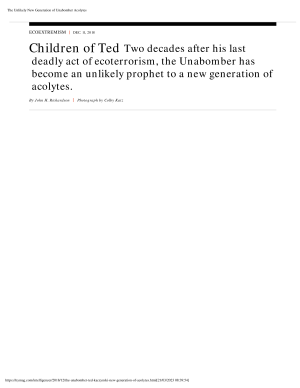
Two decades after his last deadly act of ecoterrorism, the Unabomber has become an unlikely prophet to a new generation of acolytes.
“It’s certainly an oversimplification to say that the struggle between left & right in America today is a struggle between the neurotics and the sociopaths (left = neurotics, right = sociopaths = criminal types),” he said, “but there is nevertheless a good deal of truth in that statement.”
“The current political turmoil provides an environment in which a revolutionary movement should be able to gain a foothold.” He returned to the point later with more enthusiasm: “Present situation looks a lot like situation (19th century) leading up to Russian Revolution, or (pre-1911) to Chinese Revolution. You have all these different factions, mostly goofy and unrealistic, and in disagreement if not in conflict with one another, but all agreeing that the situation is intolerable and that change of the most radical kind is necessary and inevitable. To this mix add one leader of genius.”
Kaczynski was Karl Marx in modern flesh, yearning for his Lenin. In my next letter, I asked if any candidates had approached him. His answer was an impatient no — obviously any revolutionary stupid enough to write to him would be too stupid to lead a revolution. “Wait, I just thought of an exception: John Jacobi. But he’s a screwball — bad judgment — unreliable — a problem rather than a help.”
“What is bad about an article like the one I expect you to write is that it may help make the anti-tech movement into another part of the spectacle (along with Trump, the ‘metoo movement,’ neo-Nazis, antifa, etc.) that keeps people entertained and therefore thoughtless.”
“A hypothesis: ITS is instigated by some country’s security services — probably Mexico. Their real task is to spread hopelessness, because where there is no hope there is no serious resistance.”
“If you’ve read my Anti-Tech Revolution, then you haven’t understood it,” he scolds. “All you have to do is disable some key components of the system so that the whole thing collapses.” I do remember the “small core of deeply committed people” and “Hit Where It Hurts,” but it’s still hard to fathom. “How long does it take to do that?” Kaczynski demands. “A year? A month? A week?”
And Fidel had only 19 in the jungles of Cuba, as Kaczynski likes to point out.
2019
Quoting John from a podcast on Last Born In The Wilderness:
PATRICK: ... I mean you, you communicated with Theodore Kaczynski from prison. I mean you corresponded with him a bit for this.
JOHN: Yeah, I’ve got a friend, stranger still, a number of letters, and exchanged a few since the end of this story. Although he’s got troubles communicating now because of the stamp issues, but he sent a few messages through an intermediary or something, [said] not to take it personally.
2020
Quoting John from a podcast on American Scandal
Lindsey: I suppose it was inevitable that the two of you spent some time discussing politics and the idea of political revolution. Certainly 2020 has been a year fraught with charged politics. Did Kaczynski have anything to say about the current moment?
John: Well, he’s not a big admirer of Trump, and he sort of spoke of this administration as grifters & thieves. Those are not his exact words. He once said that if he had been able to vote in 2016, he would have voted for Hillary, which I thought was kind of funny. I think that although he devotes a lot of time to hating liberals or leftists in his manifesto. But his sympathies are probably more in that direction than with conservatives. At least today’s version. He’s very interested in developments in technology and stuff like that. That’s one of the ways that I got his interest, I guess is I would write to him about developments in data mining and surveillance technology and things like that.
2025
Quoting John’s book Luigi: The Making and The Meaning:
In a short letter of introduction, I told Kaczynski I found most of his manifesto convincing. If I had a single criticism, it would be that his argument was too abstract, too mathematically perfect. “I’m still hoping fuzzy logic will save us, that maybe nuclear power can stave off global warming’s worst consequences and we can move to the stars and keep working this out,” I said. He told me to read his last two books, Technological Slavery and Anti-Tech Revolution: Why and How. “After you’ve read them, I invite you to write to me again.”
So I read the books and wrote back to him, this time five single-spaced letters of dogged, earnest persuasion. Yes, I admitted, his books anticipated most of the questions I asked in my first letter. He was a long-term thinker and probably not too interested in the day-to-day concerns of a news reporter. But I did find his analysis of the big picture persuasive. There seemed to be no way to stop technology or even to slow it down much, and something with the power to destroy the world could slip out of a lab at any time. I told him about the tech stories I’d been writing. I said I was worried about climate change and asked how he was doing and what he thought of Donald Trump. Maybe he thought Trump was good in a bad way, like some anarchists I heard about who voted for him because Hillary Clinton would have made a much better president. Trump was the candidate most likely to bring down technological society. But I told Ted that reading his writing actually made me look at right-wingers with a little more sympathy—they were trying to hold on to old ways of living, trying to keep their sense of independence and agency. Then Trump arrived as almost a trickster figure, both globalist and nationalist, old-world and hypermodern, authoritarian but also an outlaw. I mentioned a line from Kelefa Sanneh’s New Yorker story “Intellectuals for Trump”: “His reliance on his own intuition is part of what Trumpists love about him, because it frees him from the tyranny of technocracy.”
Kaczynski asked me not to write again for a year. With Trump in office, he didn’t want to draw attention to himself. They might cut off his mail. But he did want to clear up one misconception. He didn’t prefer the right to the left, he just figured leftists were more likely to latch on to the anti-tech idea, and he didn’t want any partisan group taking over the revolution. “Since an influx of rightists was unlikely anyway, it was mainly the left I had to drive away.”
Before signing off, he added another intriguing statement: “It’s certainly an oversimplification to say that the struggle between left & right in America today is a struggle between the neurotics and the sociopaths (left = neurotics, right = sociopaths = criminal types), but there is nevertheless a good deal of truth in that statement.” [...]
As instructed, I gave Kaczynski the year he asked for and tried again. I asked for his thoughts on eco-fascism and the Mexican eco-terrorist group with the name that translates as “Individuals Tending to the Wild.” I asked him about the youthful anti-civ movement and whether it was worthy of support even though it was leftist. Didn’t a revolution need a restless population ready for change?
Wrong! “Thank you for your undated letter postmarked 6/11/18, but you wrote the address so sloppily I’m surprised that it reached me,” he began. He wanted nothing to do with the anti-civ kids. They were feckless and unreliable. As to my tactical concerns:
If you’ve read my Anti-Tech Revolution then you haven’t understood it. You don’t have to hold power. You don’t have to destroy every single machine. All you have to do is disable some key components of the system so that the whole thing collapses. How long does it take to do that? A year? A month? A week?
He added a few more instructions. Contact his publisher for any background information I might need on his legal case, hire a big-name firm of high-powered lawyers to get into the prison for an interview—and don’t ever mention ITS again. That could get him in trouble. “Hypothesis: ITS is instigated by some country’s security services—probably Mexico,” he wrote. “Their real task is to spread hopelessness, because where there is no hope there is no serious resistance.” [...]
Then, as if he couldn’t resist, he responded to my earlier question about America’s partisan divides.
Present situation looks a lot like situation (19th century) leading up to the Russian Revolution, or (pre-1911) to Chinese Revolution. You have all these different factions, mostly goofy and unrealistic, and in disagreement if not in conflict with one another, but all agreeing that the situation is intolerable and that change of the most radical kind is necessary and inevitable. To this mix add one leader of genius. [...]
In my next letter, I asked if any candidates for that position had approached him. His answer was an impatient no—any revolutionary stupid enough to write to him would be too stupid to lead a revolution. Then he broke off mid-sentence. “Wait, I just thought of an exception: John Jacobi. But he’s a screwball—bad judgment—unreliable—a problem rather than a help.”
However, he wrote, if I came across any serious anti-tech people or groups, he’d appreciate a heads-up. He even gave me the name of someone to contact. “Failing that, will you send these individuals or groups the address of an anti-tech website that has been set up by a European friend of ours?”
And I could stop calling him “Dr. Kaczynski.” “Ted” would be fine. [...]
In my next letter, I told Ted how his comment about the necessity of hope affected me. “This may seem sentimental,” I wrote, “but it’s moving that someone who thought your thoughts and who’s been through what you’ve been through could retain even a shred of that old American positive thinking. It’s a good reminder not to wallow in the dark thoughts that come at 4:00 a.m.”
Ted wrote again, asking me to help out a friend who was looking for a job. He started to give me a hard time, apparently teasing me. “Thank you for your letter of 8/6/18, which I received on 8/16/19. It looks like a more elaborate and better developed, but otherwise typical, example of the type of brown-nosing that journalists send to a ‘mark’ to get him to cooperate.” He wrote something like that in almost every letter.
Whatever I ended up writing, he said, it would probably just reduce the anti-tech movement to another part of the spectacle “that keeps people entertained and therefore thoughtless.” [...]
Writing to him became a challenge of its own, like trying to solve a puzzle. Over and over, he returned to his obsession: Anti-tech people need to learn how to mobilize and organize resistance. “The current political turmoil provides an environment in which a revolutionary movement should be able to gain a foothold and make a name for itself—if it goes about it the right way.” S. M. Buehler’s Understanding Social Movements would be a useful resource. Because this seemed like an implicit rejection of his long, solitary bombing campaign, I wanted to ask him why he’d shifted tactics, but I was holding off for a better time. Even so, he must have worried he’d gone too far. He mentioned a guy who wrote to him and then tried to blow up a gas pipeline. He couldn’t correspond with people like that, he said. Same with Jacobi, who’d mentioned something in one of his letters about inciting people to acts of sabotage. “If you’ve been in contact with anyone who is or may become involved in illegal activities,” Ted told me, “I don’t want to hear about it.” [...]
After six years and dozens of letters, I told Ted I was planning to quit journalism, but if he didn’t mind, I’d keep on writing to him. I may have vented a little about robot dogs.
He wrote back right away, clearly enthused. I sounded like I might someday become active in the anti-tech movement, he said. “If you did, you could be extremely useful. Please comment on this.”
I told him not to get his hopes up. But after that, he started revealing more personal glimpses. When I asked about his musical life—he was a talented trombone player in his youth—he told me he’d just finished listening to a complete performance of Handel’s Messiah, “arguably the greatest piece of music ever written.” It played on the prison radio from 3 a.m. to 6 a.m., he said, so he’d been up all night. I pictured an old man in the dawn light of a bleak mountain prison with hallelujah, hallelujah, hallelujah bouncing off gray stone walls. He also wrote about his student days, when he learned about the perils of parallel fifths, and said his favorite composer was probably Antonio Vivaldi. Signing off, he wished me a happy New Year.
I tried to keep him talking with items from my “Dear Ted” file, which I started keeping because so many things in the news reminded me of his arguments. I saw them everywhere now, and he was about the only person I could talk to about them without coming off like a black storm cloud of gloom. The worst news just cheered Ted up. So I told him about a “bracelet of silence” that could block nearby microphones, about China linking up all the public cameras in five hundred cities with facial recognition systems controlled by law enforcement. I outlined a study put out by the Army War College, Implications of Climate Change for the U.S. Army. It didn’t get much press coverage, but wow, what a shocker. The military was worried about mass migrations, the spread of tropical diseases and changing weather patterns that would “compromise or eliminate fresh water supplies in many parts of the world.” It was especially worried about the power grid. A long-term outage caused by increased demand “would rapidly challenge the military’s ability to continue operations.” I mentioned James Woolsey, a CIA chief I interviewed a few years earlier. He told me he’d installed solar power and a well at his house in the country, just in case. I ended with a blast of emotion: “As you know, I have children. The failure of our ‘leaders’ to confront this disaster enrages me more than I can say. But functionally, I suppose I’m like a bird paralyzed by the sight of an approaching snake. If I could see a way to cut off its head, I would, I just can’t.”
In the next letter, I told him about a recent sailing trip and wondered how his life would have turned out if he’d chosen a sailboat instead of a cabin. If the neighbors got noisy, he could have just sailed off to some private cove. The world seems lightly settled when seen from the ocean.
“You ask whether I ever did any sailing? Shiver me timbers! Did I ever do any sailing? Avast! Belay that!”
He told me his father had a little boat called the Grace Note. They sailed around Burnham Harbor in Chicago, sometimes even venturing out into the open waters of Lake Michigan. They traded up to an eighteen-footer his father named the Wind Lass. “I’m proud to say the Wind Lass had no sort of auxiliary motor; if we got becalmed, we just got the paddles out.”
He went on about this for a full page in his typewriter-precise block print handwriting, rhapsodizing about pirates and the Jolly Roger and a plot to make a neighborhood kid named Chuckie walk the plank. After that, he finally answered some of my questions about life in prison. Don’t believe the media reports, he said. They did get to see the sky. A few prisoners had frosted windows, but everyone got outdoor recreation. In his unit, they took recreation in groups. They could have normal face-to-face conversations.
He signed off with an interesting request. “About the ‘Dear Ted’ file, would you please send me a copy of the article about the ‘bracelet of silence’?”
As 2020 came around, I sent him a fresh bunch of bullet points: a study using artificial intelligence to detect PTSD, a facial recognition program at the Mexican border, a report on a book called Bronze Age Mindset, a kind of prose poem celebrating wildness and freedom written by an online personality who goes by the name Bronze Age Pervert. A pirate “is the only free man,” he claims in one passage, “and it is this freedom, the primal freedom of the bronze age, that some need to recapture before anything else can be done.” Apparently this stuff is very popular in the manosphere and also the Trump administration, where odes to masculine power tend to find a receptive audience. On a related note, the American Political Science Association gave its award for the year’s best political psychology paper to a study about the urge to spur chaos for the sake of chaos, which was increasing throughout the Western world. Using a scale of one to seven, the subjects responded to questions like “I fantasize about a disaster wiping out most of humanity such that a small group of people can start all over…”
This time, Ted got downright excited. “This information is of considerable interest and I wish I could ask you to send it to some friends of mine…”
He vented about restrictions on his communications, which were getting worse. He couldn’t get homemade cards anymore, or the original envelopes the letters came in. This was important because you could see if they’d been opened by the guards in the mail room, he said. He couldn’t have friends on the outside relay messages either, or post things for him on the internet. The guards were making it hard for him to get books too. Letters went missing, got rejected. A story about a man who teaches survival skills for the end of industrial civilization gathered a full harvest of his contempt:
Lynx Vilden is stupid. If and when the system collapses, famishing millions from the cities will go swarming out over the countryside with their guns & bow-and-arrows or whatever, and the deer & other large game animals will soon become exceedingly rare. The edible wild plants will be gobbled up in short order. The survivors will be those who have their underground bunkers well stocked with ammunition for self-defense, plus a supply of food sufficient to last for quite a few years, until 99% of the city people were dead and populations of game & wild plants have had time to rebuild themselves.
He answered a question about Trump:
Quite a while ago I concluded that Trump himself was too incompetent and too deficient in self-control to be very dangerous. But I’m now beginning to suspect that some of the people who surround Trump and make use of him are a great deal more capable than he is himself; that they have an essentially criminal mentality; that they are after power for themselves; and that if they don’t get it they will seek revenge by doing as much damage to the democratic system as they can.
He went on about the criminal mentality of Trump’s people for most of a page, noticeably disgusted. Which could be seen as ironic, given his own crimes, but it’s clear the parallel never occurred to him. He was sure his own motives were pure. The Bronze Age stuff irritated him too. Throwing off morality and restraint led to freedom for only a tiny minority like “Mark Zuckerberg, Bill Gates, Jeff Bezos and some pirates in the White House,” he said. Don’t forget, the Nazis celebrated the Bronze Age too. It’s where they got the swastika. This surprised me because I thought the primal freedom angle would appeal to him, but such was the power of Trump—he could drive even the Unabomber to defend morality and restraint.
Ted ended that letter like a man hammering a nail. What we really needed was a “carefully calculated, rational, disciplined effort to precipitate the collapse of the technological system.” [...]
Ted sent me a final letter on February 24, 2021. He said he had been forbidden from talking to anyone on a certain political subject and forbidden from writing to anyone under the age of eighteen—so much for those teenage followers. He reminded me not to connect him with the anarchist or “anti-civ” types I’d mentioned. “They are childish fools. Worthless scum.” He finally agreed to an in-person interview, maybe, and suggested some people I might want to contact. If I didn’t annoy them, he’d suggest some more. [...]
Later that year, I got a note from one of his friends. He was going into the hospital and wouldn’t be able to correspond anymore. He had to focus on his writing in the little time he had left.